Read the full article to gain deeper insights and comprehensive information.

Aug 13, 2026
0
Confused between a Spice Grinder and Pulverizer Machine? Compare grinding quality, capacity, heat generation, price, maintenance and applications to choose the right machine for your masala business.
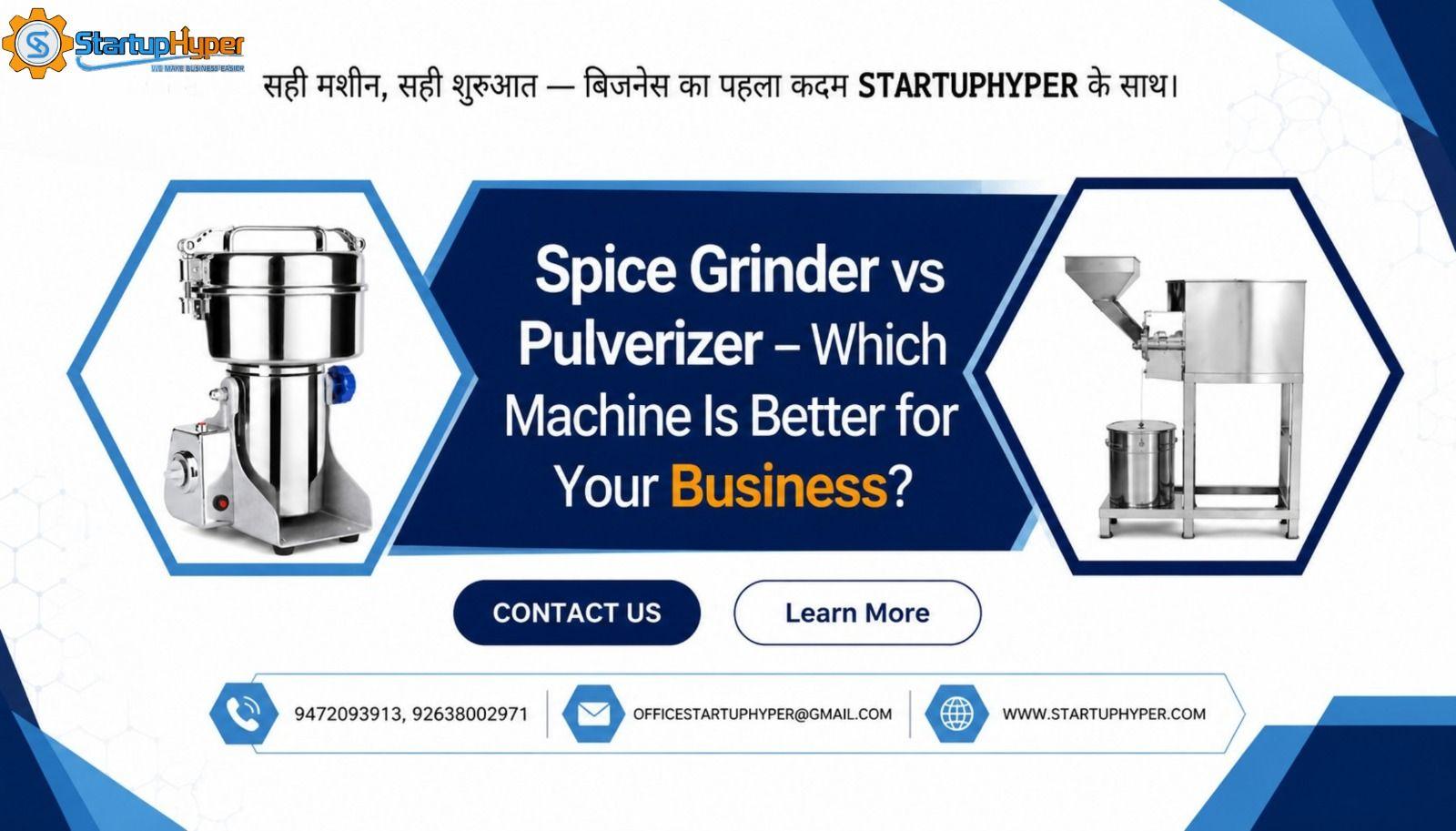
Spice Grinder vs Pulverizer – What’s the Difference?
What is a Spice Grinder?
What is a Pulverizer Machine?
Spice Grinder vs Pulverizer: Key Differences
Spice Grinder vs Pulverizer for Powder Fineness
Production Capacity Comparison
Heat Generation and Spice Quality
Maintenance and Operating Cost
Which Machine is Better for Different Spices?
Which Machine Should You Buy?
Spice Grinding Machine Price in India
How to Choose the Right Grinding Machine
Common Mistakes to Avoid
How StartupHyper Can Help
Frequently Asked Questions
Conclusion
Choosing the right grinding machine is an important decision when starting a masala or spice manufacturing business. Haldi, mirchi, dhaniya, jeera and other spices may require different grinding conditions depending on the desired powder fineness, production volume and product characteristics.
This is where the question of Spice Grinder vs Pulverizer comes in.
Although the terms are sometimes used interchangeably in the Indian machinery market, the machines can differ in their design, grinding mechanism, capacity and applications. A small business may need a compact grinder, while a commercial masala unit may require a higher-capacity pulverizer with better control over grinding and heat.
So, which machine is better?
There is no single answer for every business. The right choice depends on what you are grinding, how fine the powder needs to be, how much you need to produce and what your budget is.
A Spice Grinder Machine is designed to reduce whole or dried spices into smaller particles or powder. Depending on the machine design, grinding may be achieved through blades, discs, abrasive surfaces or other grinding mechanisms.
Small spice grinders are commonly used for:
• Small food businesses
• Restaurants
• Hotels
• Home-based businesses
• Trial production
• Small-scale spice processing
A commercial spice grinder can offer greater capacity than a household grinder, but its actual output and powder fineness depend on the machine specification and the product being processed.
In the Indian market, terms such as Masala Grinder, Spice Grinding Machine and Commercial Spice Grinder Machine are also commonly used.
A Pulverizer Machine is a grinding machine designed to reduce materials into fine powder.Depending on its design, it may use hammers, beaters, pins or other high-speed grinding mechanisms.
A Pulverizer Machine for Spices is commonly used for products such as:
• Turmeric
• Red chilli
• Coriander
• Cumin
• Black pepper
• Dry herbs
• Other dry spices
Commercial pulverizers are available in different capacities and configurations. Some models, particularly blower pulverizers, use air circulation to help manage heat during grinding.
This can be important for spices because excessive heat may affect product characteristics such as aroma, colour and volatile oils.
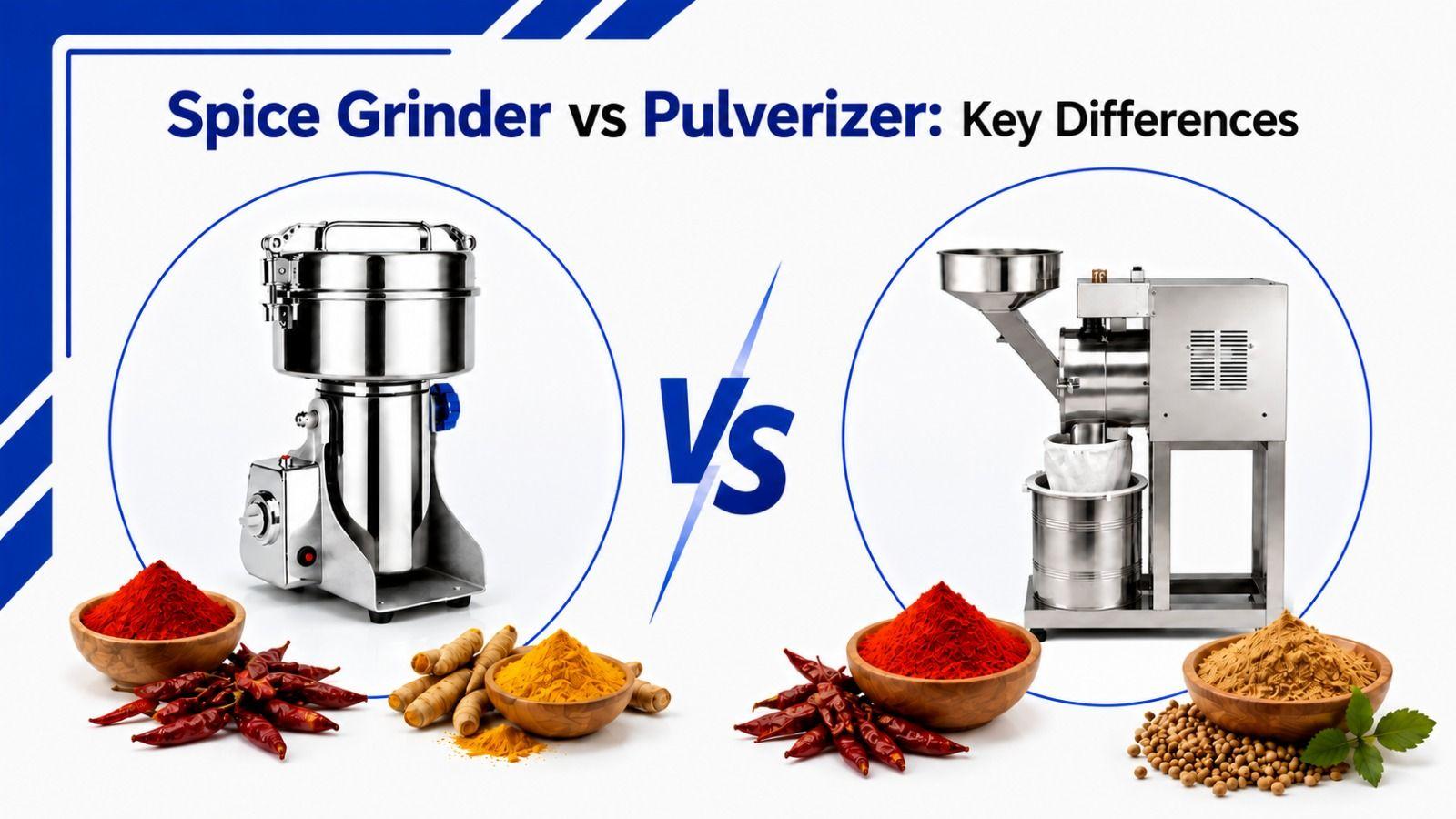
The main differences come down to grinding mechanism, powder fineness, production capacity, heat management and intended application.
| Feature | Spice Grinder | Pulverizer |
|---|---|---|
| Typical Use | Small to medium grinding | Commercial and industrial grinding |
| Powder Fineness | Depends on design | Generally suitable for finer grinding |
| Capacity | Low to medium | Medium to high |
| Heat Management | Depends on machine | Blower/cooling options available |
| Best Suited For | Small-scale applications | Commercial spice production |
| Investment | Generally lower for small models | Higher depending on capacity |
| Maintenance | Depends on design | Depends on machine and operating conditions |
The specifications can vary considerably between manufacturers, so these differences should be treated as general guidance rather than fixed rules.
For a masala business, powder fineness and consistency are important because customers generally expect the same texture from one batch to another.
A suitable pulverizer can produce fine and consistent powder when the correct grinding chamber, sieve and operating conditions are used.
However, the finest possible output is not determined by the machine name alone. It also depends on:
• Type of spice
• Moisture content
• Sieve size
• Grinding speed
• Feed rate
• Machine design
For example, turmeric and chilli may require different grinding conditions from coriander or cumin.
Which is better?
If your business requires fine, consistent commercial-grade spice powder, a suitable pulverizer is generally the more practical choice.
Production capacity is another important factor when selecting a Spice Grinding Machine for Small Business or a larger manufacturing unit.
A small grinder may be sufficient if you are producing limited quantities. However, when production increases, a higher-capacity machine can help reduce processing time and improve workflow.
Actual output should always be checked from the manufacturer's specifications and, preferably, through a product trial.
Capacity can be affected by:
• Type of spice
• Desired fineness
• Feed size
• Moisture level
• Sieve configuration
• Motor power
• Operator handling
Therefore, avoid selecting a machine based only on its advertised kg/hour figure.
Which is better?
For higher-volume commercial production, a properly sized pulverizer generally offers greater capacity and is easier to integrate into a larger spice-processing setup.
Heat is an important consideration when grinding spices.
High-speed grinding can generate heat, and excessive heat may affect the characteristics of certain spices. This is particularly relevant for products where aroma, colour and volatile oils are important.
Some Blower Pulverizer Machines use air circulation to help manage temperature during grinding.
Before buying a machine, ask the manufacturer about:
• Cooling arrangement
• Grinding chamber design
• Operating temperature
• Recommended feed rate
• Suitability for heat-sensitive spices
A machine with appropriate heat management can help maintain more consistent product quality.
Which is better?
A basic grinder may generate less heat depending on its design and operating speed. A properly designed blower pulverizer can also provide controlled grinding for commercial spice production.
So rather than choosing based only on the machine category, evaluate the actual cooling and grinding system.
Maintenance requirements depend on the machine design, operating hours and the material being processed.
Common maintenance requirements for grinding machines can include:
• Cleaning the grinding chamber
• Checking and replacing sieves
• Inspecting blades, hammers or other wear parts
• Checking bearings
• Inspecting belts and electrical components
• Cleaning dust from the machine
A simple machine may have fewer components, while a commercial pulverizer can have more wear parts that require periodic inspection or replacement.
However, maintenance should not be evaluated separately from production capacity.
A lower-cost machine may not necessarily be more economical if it cannot handle your required production volume.
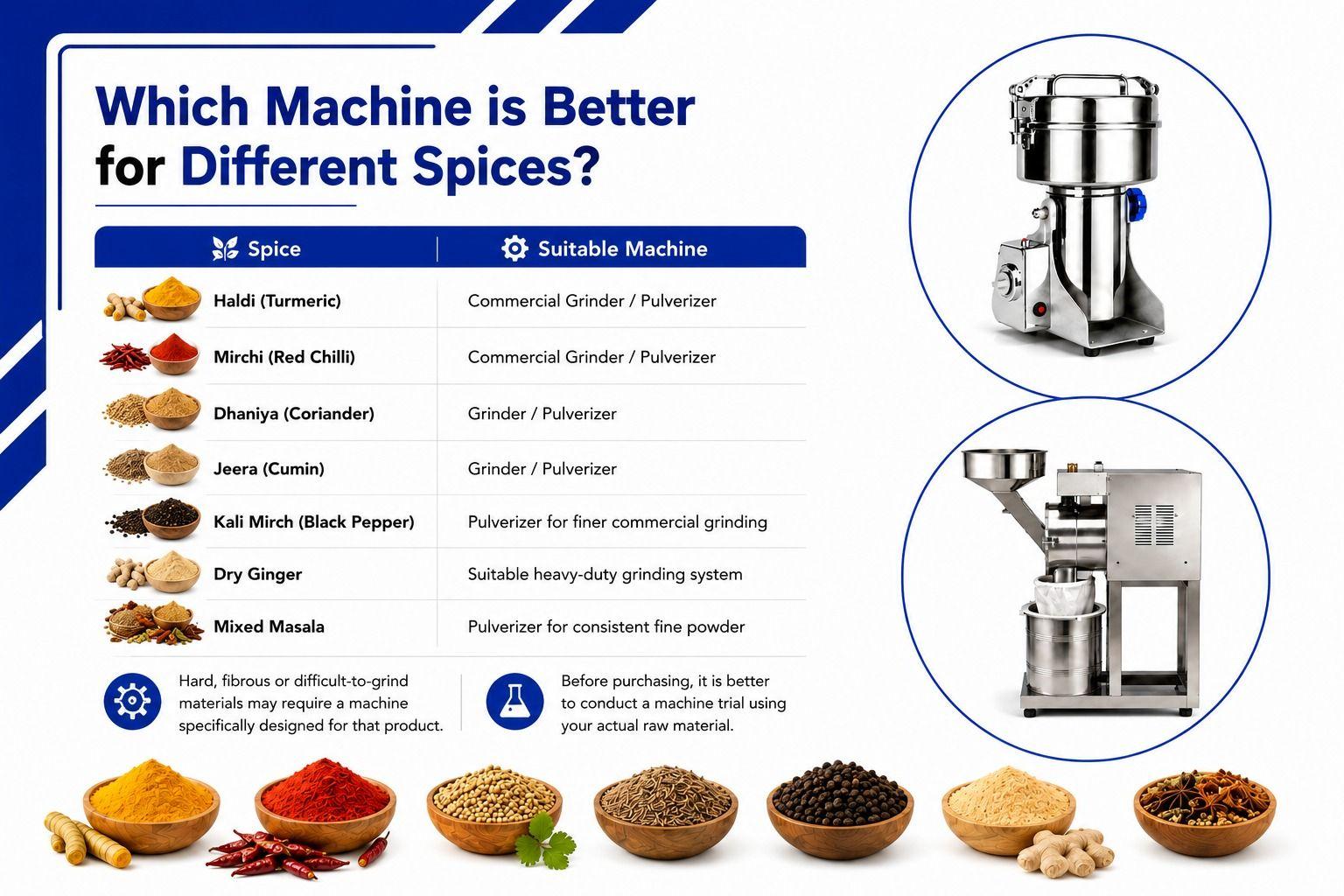
Both machines can be used for many dry spices, but the appropriate machine depends on the required powder quality and production scale.
| Spice | Suitable Machine |
|---|---|
| Haldi (Turmeric) | Commercial Grinder / Pulverizer |
| Mirchi (Red Chilli) | Commercial Grinder / Pulverizer |
| Dhaniya (Coriander) | Grinder / Pulverizer |
| Jeera (Cumin) | Grinder / Pulverizer |
| Kali Mirch (Black Pepper) | Pulverizer for finer commercial grinding |
| Dry Ginger | Suitable heavy-duty grinding system |
| Mixed Masala | Pulverizer for consistent fine powder |
| Hard, fibrous or difficult-to-grind materials may require a machine specifically designed for that product. |
Before purchasing, it is better to conduct a machine trial using your actual raw material.
• You have a small production requirement.
• You are testing the market.
• Your budget is limited.
• You need a machine for small-scale commercial use.
• Your required powder fineness can be achieved by the grinder.
• You are setting up a commercial spice-processing unit.
• You require finer and more consistent powder.
• Your production volume is increasing.
• You need a machine designed for continuous commercial operation.
• You plan to expand your masala product range.
A larger processing unit may use different grinding stages depending on the product and process. For example, a coarse reduction stage can be followed by finer grinding where required.
The decision should be based on your actual process rather than simply buying two machines.
The Spice Grinding Machine Price in India varies according to:
• Machine capacity
• Motor power
• Grinding mechanism
• Construction material
• Automation level
• Cooling arrangement
• Sieve system
• Brand
• Additional features
Small grinders may be available at relatively low prices, while commercial pulverizers can cost significantly more.
Instead of relying on a single market-wide price, compare machines based on their capacity, specifications, warranty, spare parts and after-sales support.
A machine with a higher purchase price may be more suitable if it provides the required production capacity and operating efficiency.
Before buying a Masala Pulverizer Machine or Spice Grinder, answer these questions:
Different spices have different hardness, moisture and grinding requirements.
Decide whether you need coarse, medium or fine powder.
Estimate your daily and monthly production requirements.
Consider not just the purchase price but also electricity, maintenance, wear parts and labour.
For commercial spice grinding, especially with heat-sensitive products, ask about the machine's heat-management system.
Check the availability and cost of sieves, hammers, bearings and other consumable parts.
Installation, machine trials, operator guidance and after-sales service can be important for a manufacturing business.
The cheapest machine may not be the right machine for your production requirement.
A machine that works well for one spice may not produce the same result with another. Always test your actual raw material when possible.
Advertised capacity can vary according to product type, moisture, fineness and operating conditions.
For spice processing, ask how the machine manages heat before making a purchase.
Wear parts are a normal part of grinding-machine operation. Make sure replacements are readily available.

Choosing between a Spice Grinder and Pulverizer becomes easier when the machine is selected according to your actual business requirements.
At StartupHyper, we help entrepreneurs understand their machinery requirements before investing in a spice-processing setup.
Our support includes:
• Understanding your production requirement
• Selecting a suitable Spice Grinding Machine
• Comparing grinder and pulverizer options
• Understanding machine specifications
• Connecting entrepreneurs with suitable machinery suppliers
• Business and manufacturing consultation
Whether you are starting a small spice-processing unit or planning a larger Masala Manufacturing Business, StartupHyper can help you evaluate the right machinery for your product and production target.
A Spice Grinder is a broad term for machines used to grind spices, while a Pulverizer is generally designed for finer and more intensive size reduction. The actual difference depends on the machine's grinding mechanism and specifications.
For a commercial masala business requiring fine and consistent powder, a suitably sized pulverizer is generally a practical option. For small-scale production, a commercial spice grinder may be sufficient.
Yes. Suitable pulverizer machines are commonly used for turmeric, chilli, coriander, cumin and other dry spices. The machine should be selected according to the required fineness and product characteristics.
A Blower Pulverizer Machine is a pulverizer equipped with an air-blower system. The airflow can assist material movement and help manage heat during grinding.
The price varies widely depending on capacity, motor power, design, construction and features. It is better to compare specific machine models rather than rely on a single price range.
A suitable small commercial Spice Grinder or Pulverizer can work for a small business. The choice should depend on your daily production, desired powder fineness and budget.
Use the appropriate machine, sieve size and operating conditions for each spice. Maintaining consistent raw-material quality and machine settings is also important.
Yes. If possible, conduct a trial using your actual spices. This allows you to check powder fineness, output, heat generation and overall product quality before investing.
The answer to “Spice Grinder vs Pulverizer – Which Machine Is Better?” depends on your business requirements.
A small commercial grinder can be suitable for limited production and basic grinding requirements. A properly selected pulverizer is generally more suitable when you need fine, consistent powder and higher commercial production capacity.
Instead of choosing a machine based only on price or motor power, consider your spice type, required fineness, production volume, heat management, maintenance requirements and after-sales support.
For the best decision, test your actual raw material and compare machine specifications before purchasing.
If you are planning to start a masala manufacturing business and need help choosing between a Spice Grinder and Pulverizer, StartupHyper can help you evaluate the options according to your production requirements and budget.
📞Call / WhatsApp: 9472093913
📧Email: info@startuphyper.com
🌐 Website: www.startuphyper.com | www.machinehai.com
🏢 Branches: Patna | Gaya | Katihar | Saharsa
Stay updated with the latest tips, trends, and best practices in factory setup and machinery procurement—subscribe to the StartupHyper newsletter!
No spam, we promise. Your inbox is safe with us—only valuable insights.