Read the full article to gain deeper insights and comprehensive information.

Aug 11, 2026
0
Learn about paper cutting machines, including their types, uses, price in India, features, capacity, and how to choose the right machine for printing, stationery and notebook businesses.
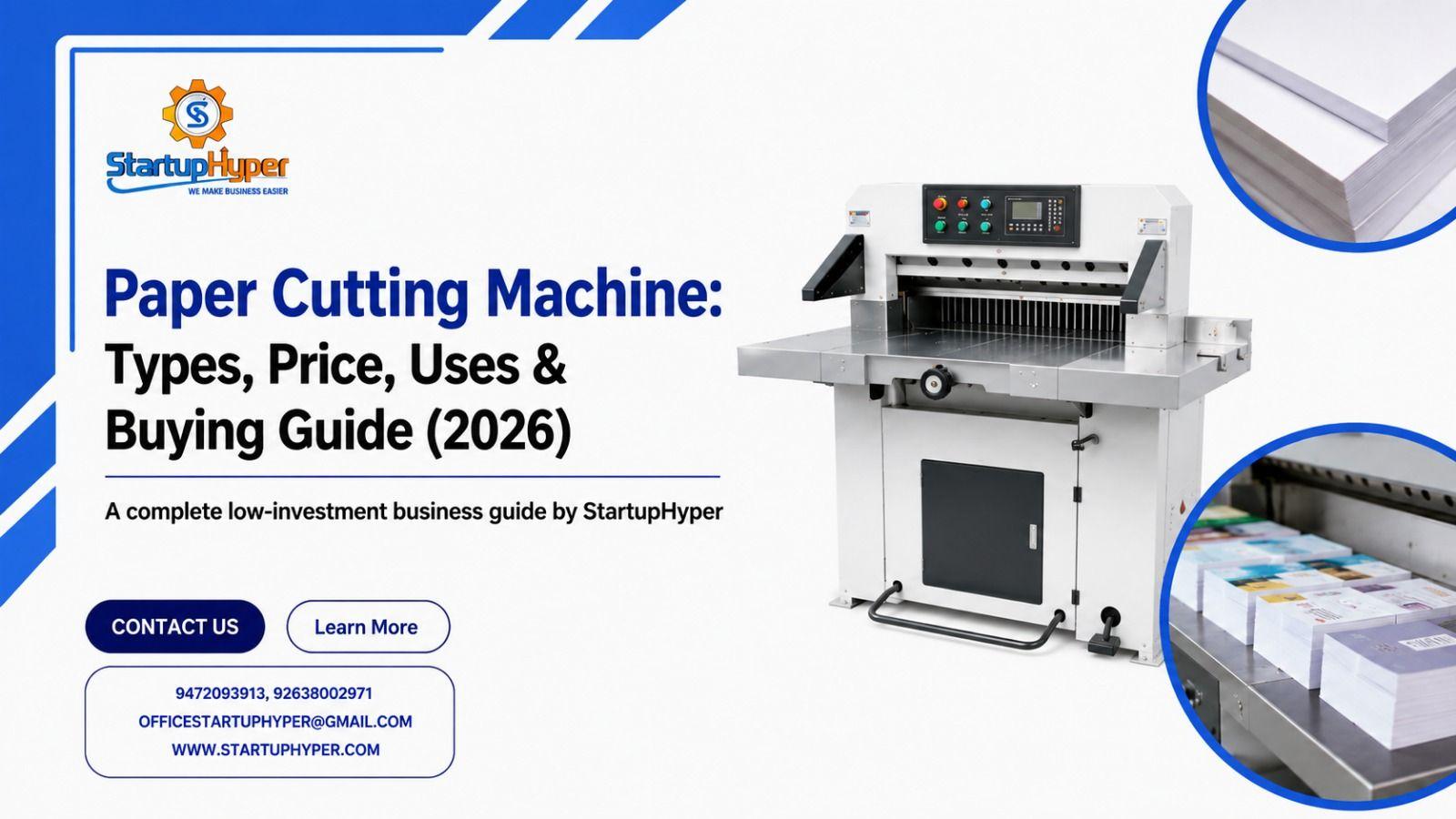
Paper cutting is an essential part of printing, publishing, stationery and notebook manufacturing. When production increases, cutting paper manually becomes slow, inconsistent and difficult to manage. A Paper Cutting Machine helps businesses cut paper sheets, paper stacks and other paper-based materials quickly and accurately.
From small printing shops to commercial printing presses and notebook manufacturing units, different types of paper cutting machines are available according to production volume, cutting size and automation requirements.
Modern machines can range from simple manual cutters for small businesses to hydraulic and programmable paper cutting machines designed for high-volume industrial operations. Current Indian market listings show models ranging from relatively low-cost manual and semi-automatic machines to hydraulic and programmable systems costing several lakhs of rupees.
If you're planning to purchase a paper cutting machine for a printing, stationery, notebook or paper-product business, understanding the machine type, capacity, price and features is important before investing.
A Paper Cutting Machine is a mechanical or electrically powered machine used to cut paper sheets or stacks into specific sizes and shapes.
Unlike scissors or basic paper trimmers, industrial paper cutting machines can handle multiple sheets in a single cutting cycle. Depending on the machine design, the cutting operation may be manual, semi-automatic or fully automatic.
Paper cutting machines are commonly used for:
• Notebook manufacturing
• Book printing
• Commercial printing
• Photocopy and printing shops
• Brochure and catalogue production
• Visiting card production
• Packaging applications
• Paper bag manufacturing
• Stationery manufacturing
The machine helps achieve uniform dimensions and cleaner edges while reducing the time required for manual cutting.
The basic working process is straightforward.
First, the required quantity of paper is arranged into a properly aligned stack. The stack is positioned against the machine's back gauge or measurement system according to the required cutting size.
The paper is then securely held in position using a clamp. The cutting blade moves through the paper stack and produces a clean, straight cut.
In advanced machines, the operator can set measurements using a digital or programmable control system. Some hydraulic models use hydraulic pressure for clamping and cutting, making them suitable for heavier production requirements.
Basic Working Process Paper Stack Preparation → Size Setting → Paper Alignment → Clamping → Blade Cutting → Finished Sheets
Different businesses require different cutting capacities. The major types include manual, semi-automatic and automatic or hydraulic paper cutting machines.
A manual paper cutter is operated by the user using a hand lever or mechanical cutting mechanism. These machines are generally suitable for small-scale applications where cutting volume is limited.
Suitable For
• Small printing shops
• Offices
• Schools
• Craft businesses
• Small stationery businesses
Advantages
• Lower initial investment
• Simple operation
• Easy maintenance
• No complex electrical system
For businesses with limited daily cutting requirements, a manual paper cutter can be a practical option.
A Semi Automatic Paper Cutting Machine combines manual operation with powered cutting or clamping functions. It offers greater productivity than a basic manual cutter while generally requiring less investment than a fully automatic industrial machine.
Suitable For
• Printing businesses
• Notebook manufacturing
• Book binding units
• Commercial stationery businesses
• Medium-scale production
Current Indian supplier listings include semi-automatic models with different cutting widths, capacities and drive systems, showing that specifications can vary considerably between machines.
A Hydraulic Paper Cutting Machine is designed for heavy-duty cutting operations. Hydraulic systems provide controlled force for clamping and cutting, making these machines suitable for large paper stacks and commercial production.
Suitable For
• Large printing presses
• Book manufacturing
• Notebook production
• Commercial printing
• High-volume paper processing
Depending on the model, hydraulic machines can offer computerized controls, programmable settings and high cutting capacity. Current Indian listings show hydraulic models with capacities such as several hundred sheets per cycle and programmable industrial systems.
A fully automatic paper cutting machine reduces manual intervention by automating functions such as measurement, positioning, clamping and cutting.
These machines are suitable for businesses handling large production volumes where speed and repeatable accuracy are important.
Key Advantages
• Higher productivity
• Consistent cutting
• Reduced manual effort
• Programmable cutting settings
• Suitable for continuous production
A Guillotine Paper Cutting Machine uses a large straight blade that moves downward through the paper stack. Guillotine-style cutters are widely associated with commercial printing and paper finishing because they can provide clean, straight cuts across large stacks.
Hydraulic guillotine machines are available for heavier industrial applications.
Paper cutting machines are used in many businesses where paper needs to be accurately cut into standard or customized sizes.
| Industry | Common Applications |
|---|---|
| Printing Press | Books, brochures, flyers, catalogues |
| Notebook Manufacturing | Notebook and register sheets |
| Stationery Industry | Paper sheets, cards, forms |
| Photocopy Shops | A4, A3 and custom-size sheets |
| Publishing | Books and printed materials |
| Packaging | Paper and board preparation |
| Paper Bag Manufacturing | Kraft paper and sheet preparation |
| Commercial Printing | Visiting cards, menus, brochures |
For example, paper cutting machines are commonly used to convert larger paper sheets or stacks into the dimensions required for notebooks, books, stationery and printed products.
A machine can cut multiple sheets simultaneously, significantly reducing the time required compared with cutting individual sheets manually.
A properly adjusted machine produces uniform dimensions across batches, which is especially important for notebooks, books and commercial printing.
Automation reduces the physical effort required from operators and can increase the number of jobs completed during a working day.
Straight and consistent edges give printed products a cleaner and more professional appearance. Suitable for Bulk Production
Industrial and hydraulic machines can handle large stacks and are designed for businesses with higher production requirements.
The Paper Cutting Machine Price varies significantly depending on machine type, cutting width, automation, blade system, hydraulic capacity and additional features.
Current Indian listings provide examples ranging from around ₹35,000 for some semi-automatic/tabletop models to several lakhs for hydraulic and programmable industrial machines. For example, TradeIndia currently lists semi-automatic/tabletop machines around ₹35,899, while hydraulic models in its listings range from approximately ₹1.75 lakh to ₹6.5 lakh and beyond depending on specifications.
| Machine Type | Indicative Price Range |
|---|---|
| Manual Paper Cutter | ₹10,000 – ₹40,000 |
| Semi-Automatic Paper Cutting Machine | ₹35,000 – ₹1.5 Lakh |
| Automatic Paper Cutting Machine | ₹1.5 – ₹4 Lakh |
| Hydraulic Paper Cutting Machine | ₹2 – ₹7 Lakh+ |
| Programmable Industrial Cutter | ₹5 Lakh+ |
Note: These are indicative market ranges, not fixed quotations. Actual prices depend on machine specifications, cutting width, capacity, automation, brand, taxes and supplier. Current supplier listings confirm substantial variation between models.
Before purchasing a paper cutting machine, pay attention to these specifications:
The maximum cutting width determines the size of paper sheets the machine can accommodate.
Check how many sheets the machine can cut in one cycle. Capacity depends on paper GSM, blade specifications and machine design.
For commercial printing and notebook manufacturing, consistent cutting dimensions are important.
Choose between manual, semi-automatic and fully automatic operation based on your production requirements.
A durable and properly maintained blade is essential for clean cutting and longer operating life.
Industrial paper cutters should have appropriate safety mechanisms and should only be operated by trained personnel.
The best machine isn't necessarily the most expensive one. Your choice should depend on your actual production requirements.
A manual or compact semi-automatic cutter may be sufficient for small printing shops, offices and low-volume stationery work.
A semi-automatic machine can provide a balance between investment, productivity and operator involvement.
High-volume printing presses and notebook manufacturers may benefit from hydraulic or programmable automatic machines that can handle larger paper stacks and repeated cutting jobs.
Before Buying, Check:
• Required cutting size
• Daily production volume
• Maximum paper stack height
• Paper GSM range
• Cutting accuracy
• Power requirement
• Automation level
• Spare parts availability
• Service and technical support
• Warranty
Regular maintenance is essential for maintaining cutting quality and machine life.
• Keep the cutting table clean.
• Remove paper dust regularly.
• Inspect the blade for wear.
• Sharpen or replace the blade when required.
• Check the alignment of the paper stack.
• Inspect hydraulic systems for leakage where applicable.
• Follow the manufacturer's lubrication schedule.
• Never operate the machine without its recommended safety systems.
• Ensure operators are properly trained.
A dull or poorly maintained blade can affect cutting quality and may increase the load on the machine.

Choosing the right machine can be difficult when different manufacturers offer different capacities, cutting widths and automation options.
StartupHyper helps entrepreneurs and manufacturing businesses identify machinery according to their production requirements, investment capacity and business goals.
Our support can include:
Whether you're planning a notebook manufacturing unit, printing business, stationery business or paper-product manufacturing setup, StartupHyper can help you identify the right machinery for your requirements.
A Paper Cutting Machine is used to cut paper sheets and stacks into specific sizes. It is commonly used in printing presses, notebook manufacturing, bookbinding, stationery and paper-product businesses.
Paper cutting machine prices vary widely. Small manual and semi-automatic models can cost tens of thousands of rupees, while hydraulic and programmable industrial machines can cost several lakhs. Current Indian listings show examples from roughly ₹35,000 to ₹6.5 lakh or more depending on the model and specifications.
For small production, a semi-automatic machine may be sufficient. For larger notebook manufacturing units, hydraulic or automatic machines can offer higher capacity and more consistent production.
A manual machine relies more heavily on operator input, while a hydraulic paper cutter uses hydraulic power for operations such as clamping and cutting. Hydraulic models are generally better suited to higher-volume industrial work.
Capacity varies by machine and paper GSM. Some commercial models are designed to cut hundreds of sheets per cycle, while larger hydraulic machines can handle substantially higher stacks. Always check the manufacturer's rated capacity for your specific paper type.
Yes. Small printing shops, stationery businesses and notebook startups can choose compact manual or semi-automatic models according to their production requirements.
📞Call / WhatsApp: 9472093913
📧Email: info@startuphyper.com
🌐 Website: www.startuphyper.com | www.machinehai.com
🏢 Branches: Patna | Gaya | Katihar | Saharsa
Stay updated with the latest tips, trends, and best practices in factory setup and machinery procurement—subscribe to the StartupHyper newsletter!
No spam, we promise. Your inbox is safe with us—only valuable insights.