Read the full article to gain deeper insights and comprehensive information.

Aug 06, 2026
0
Learn about the different types of fire extinguishers, their uses, fire classes, maintenance tips, and how to choose the right fire extinguisher for your home, office, factory, or commercial space.

To Read our full guide in Hindi: Click Here
A fire extinguisher is a portable fire safety device designed to control or extinguish small fires before they spread. It contains an extinguishing agent such as water, foam, dry chemical powder, carbon dioxide (CO₂), or other specialized chemicals that help suppress different types of fires.
Fire extinguishers are commonly installed in homes, offices, factories, schools, hospitals, hotels, warehouses, commercial buildings, and vehicles. Having the correct type of fire extinguisher can help minimize property damage and improve safety during emergencies.
However, not every fire extinguisher is suitable for every type of fire. Choosing the wrong extinguisher may fail to control the fire and, in some cases, make the situation more dangerous.
Different fires are caused by different materials such as wood, paper, flammable liquids, cooking oils, electrical equipment, or combustible metals. Since each fire behaves differently, a specific type of fire extinguisher is designed for each fire class.
Using the correct fire extinguisher helps:
Before purchasing or installing a fire extinguisher, it is important to understand the different types of fire extinguishers and their recommended applications.
Water Fire Extinguishers are designed for Class A fires, which involve ordinary combustible materials.
Suitable for:
Not suitable for:
Common Applications:
Foam Fire Extinguishers are suitable for both Class A and Class B fires.
The foam forms a protective layer over flammable liquids, helping prevent re-ignition.
Suitable for:
Common Applications:
The DCP Fire Extinguisher is one of the most commonly used fire extinguishers because it can handle multiple fire hazards.
Suitable for:
Common Applications:
Advantages:
Multi-purpose use Fast fire suppression Suitable for industrial environments
CO₂ Fire Extinguishers are primarily designed for electrical fires and flammable liquids.
Since carbon dioxide leaves no residue, it is ideal for protecting sensitive equipment.
Suitable for:
Common Applications:
Wet Chemical Fire Extinguishers are specially designed for fires involving cooking oils and fats.
Suitable for:
Common Applications:
Clean Agent Fire Extinguishers use non-conductive gases that leave no residue after discharge.
Suitable for:
Common Applications:
The ABC Fire Extinguisher is one of the most versatile and widely used fire extinguishers.
It can extinguish:
Common Applications:
Because of its versatility, the ABC Fire Extinguisher is often recommended for general-purpose fire protection.
An Automatic Modular Fire Extinguisher activates automatically when the surrounding temperature reaches a predetermined level.
Common Applications:
This extinguisher provides automatic fire protection without requiring manual operation.
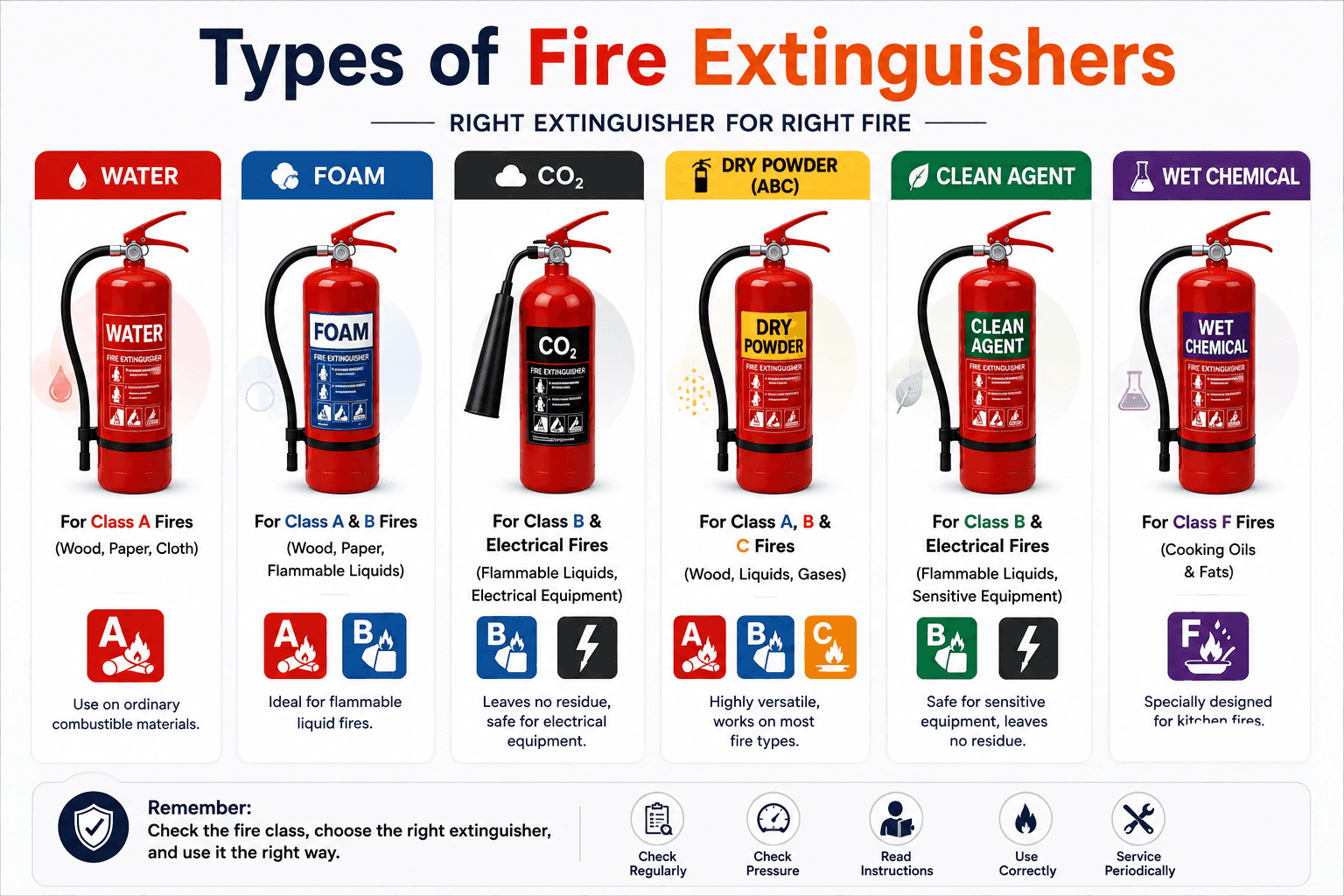
Understanding fire classes helps you choose the correct fire extinguisher.
| Fire Class | Examples | Recommended Fire Extinguisher |
|---|---|---|
| Class A | Wood, Paper, Cloth | Water, Foam, ABC |
| Class B | Petrol, Diesel, Paint | Foam, CO₂, DCP |
| Class C | LPG, CNG and other gases | DCP |
| Class D | Combustible Metals | Special Class D Extinguisher |
| Electrical Fire | Electrical Panels, Computers | CO₂, Clean Agent |
| Class K/F | Cooking Oil & Fats | Wet Chemical |
| Location | Recommended Fire Extinguisher |
|---|---|
| Home | ABC Fire Extinguisher |
| Office | ABC or CO₂ Fire Extinguisher |
| Factory | DCP or ABC Fire Extinguisher |
| Restaurant Kitchen | Wet Chemical Fire Extinguisher |
| Server Room | CO₂ or Clean Agent Fire Extinguisher |
| Petrol Pump | Foam Fire Extinguisher |
| Warehouse | DCP or Foam Fire Extinguisher |
The simplest way to remember how to use a fire extinguisher is the PASS Method.
Pull the safety pin to unlock the extinguisher.
Aim the nozzle at the base of the fire, not the flames.
Squeeze the handle slowly to release the extinguishing agent.
Move the nozzle from side to side until the fire is completely extinguished.
Regular maintenance ensures that your fire extinguisher is ready for use during an emergency.
Follow these basic maintenance practices:

Choosing the right fire extinguisher is just as important as having one. Different environments require different types of extinguishers, and using the wrong one may not provide effective fire protection during an emergency.
At StartupHyper, we help individuals, businesses, factories, institutions, and commercial establishments choose the right fire safety solutions based on their specific requirements.
Our services include:
➡️ Guidance in selecting the right Fire Extinguisher for your home, office, factory, warehouse, school, hospital, or commercial building.
➡️ A wide range of ABC, CO₂, DCP, Foam, Water, Wet Chemical, Clean Agent, and Automatic Modular Fire Extinguishers.
➡️ Fire extinguishers available in different capacities to suit residential, commercial, and industrial applications.
➡️ Assistance in choosing fire safety products based on the type of fire risk and workplace environment.
➡️ Competitive pricing with quality products that comply with applicable safety standards.
➡️ Expert support to help businesses improve fire safety preparedness.
Whether you need a single fire extinguisher for your home or multiple fire extinguishers for your office, factory, warehouse, school, hotel, hospital, or industrial facility, StartupHyper can help you find the right fire safety solution.
An ABC Fire Extinguisher is generally considered the best option for homes because it can handle multiple types of fires.
ABC extinguishers use a dry chemical powder that is suitable for Class A, B, and C fires. DCP extinguishers are also powder-based and are commonly used for industrial and commercial fire protection.
No. Water should never be used on electrical fires because it can conduct electricity and increase the risk of electric shock.
The service life depends on the type and manufacturer. Regular inspections and servicing are important to ensure it remains functional.
A fire extinguisher should be refilled immediately after use, even if only a small amount of the extinguishing agent has been discharged.
A Wet Chemical Fire Extinguisher is specifically designed for fires involving cooking oils and fats.
Regular maintenance ensures that the extinguisher works properly during an emergency and complies with workplace fire safety requirements.
Our team can help you choose the right fire extinguisher based on your application, fire risk, and safety requirements.
📞Call / WhatsApp: 9472093913
📧Email: info@startuphyper.com
🌐 Website: www.startuphyper.com | www.machinehai.com
🏢 Branches: Patna | Gaya | Katihar | Saharsa

Sep 21, 2026
Stay updated with the latest tips, trends, and best practices in factory setup and machinery procurement—subscribe to the StartupHyper newsletter!
No spam, we promise. Your inbox is safe with us—only valuable insights.