Read the full article to gain deeper insights and comprehensive information.

Sep 21, 2026
0
Start a makhana business in India with verified 2026 data — investment planning, FSSAI's new rules, machinery, processing steps, and real profit calculations.
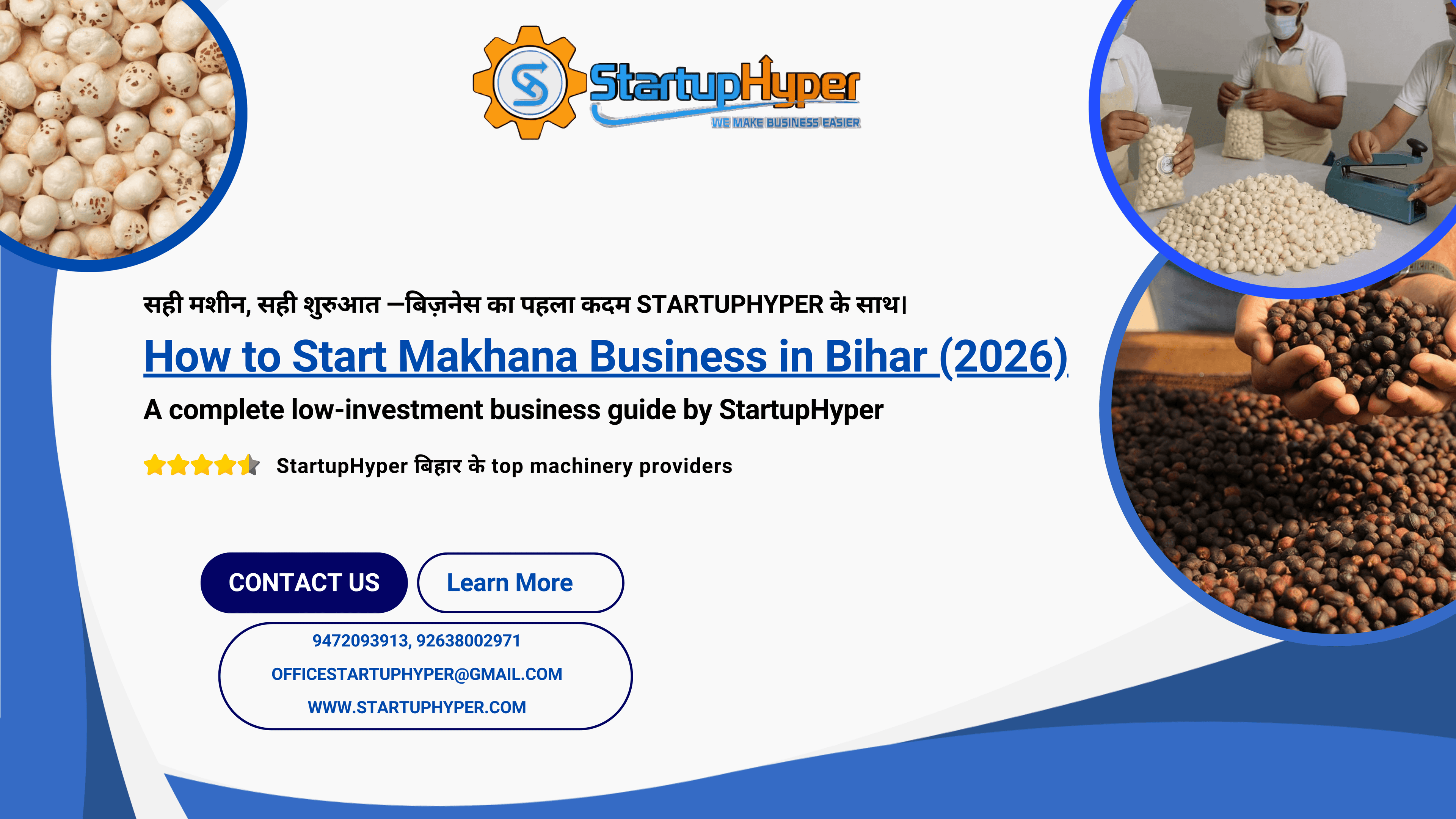
Makhana, also known as fox nuts or gorgon nuts, has become a popular snack in India's growing healthy-food market. Once mainly associated with fasting and traditional consumption, makhana is now widely available in roasted, flavoured, and packaged formats.
For entrepreneurs, this creates opportunities in makhana processing, roasting, flavouring, packaging, wholesale trading, and branded snack production. However, starting a makhana business requires more than purchasing a machine you need to understand raw material sourcing, production requirements, packaging, food safety regulations, investment planning, and customer demand.
This guide covers business models, machinery, processing steps, investment planning, licenses (including an FSSAI rule change from April 2026 that many other guides haven't caught up on), marketing strategies, and profit calculations.
What Is a Makhana Business?
Why Start a Makhana Business in India?
Makhana Business Models
Raw Materials Required for Makhana Business
Machines Required for Makhana Processing
Step-by-Step Makhana Processing Process
Makhana Business Investment and Setup Cost
Licenses and Registrations Required for Makhana Business
Makhana Packaging and Branding
How to Sell Makhana Products
Makhana Business Profit Calculation
Common Mistakes to Avoid for Makhana Business
Frequently Asked Questions
How StartupHyper Helps Entrepreneurs
Conclusion

A makhana business involves sourcing, processing, roasting, flavouring, packaging, distributing, or selling makhana-based products. Depending on your budget and experience, you can start a small-scale roasting and packaging unit or establish a larger processing facility.
Entrepreneurs can enter through roasted makhana manufacturing, flavoured makhana production, packaging-only operations, wholesale trading, private-label manufacturing, B2B supply to food businesses, or online/D2C sales. The right entry point depends on your available investment, production capacity, target customers, and access to raw materials — covered in detail in Section 3.
India is a major producer of makhana, and Bihar contributes a significant share of national production. The sector is also receiving increased government attention through initiatives focused on production, processing, value addition, and exports.
Verified Industry Data
Bihar contributes approximately three-fourths of India's makhana production and around 80–85% of global supply.
India's makhana production was 63,910 metric tonnes in 2024–25 and reached a second advance estimate of 80,590 metric tonnes for 2025–26.
Bihar contributed approximately 60,000 metric tonnes during 2025–26.
Domestic consumption of popped makhana is estimated at approximately 3,000–3,500 metric tonnes per month and may increase during festive periods.
Average makhana prices have increased considerably in recent years, making raw material sourcing and cost management important for new businesses.
The National Makhana Board was constituted in September 2025.
The Central Sector Scheme for the Development of Makhana has an approved outlay of ₹476.03 crore for 2025–26 to 2030–31.
Mithila Makhana received a Geographical Indication (GI) tag in 2022.
These developments support opportunities across the makhana value chain. However, industry growth does not automatically guarantee profits for every business. Your results will depend on raw material costs, product quality, pricing, operational efficiency, and sales execution.
Your choice of business model determines your machinery, working capital, production process, and marketing requirements. Bilkul bhai! Ab se tables isi Markdown format mein dunga, jaise tumne example mein diya hai.
| Business Model | What You Do | Main Requirements |
|---|---|---|
| Packaged Makhana Brand | Roast, flavour, package, and sell under your own brand. | Machinery, packaging, branding, marketing |
| Contract Manufacturing | Get products manufactured by a third-party unit. | Product development, packaging, marketing |
| Wholesale Trading | Purchase makhana in bulk and supply buyers. | Inventory, supplier network, logistics |
| B2B Foodservice Supply | Supply makhana to cafés, restaurants, hotels, and food businesses. | Processing, bulk packaging, distribution |
| Private-Label Manufacturing | Manufacture makhana products for another brand. | Manufacturing setup, quality control, consistency |
Quick guide to choosing: limited budget → contract manufacturing or small-scale flavouring and packaging; want to build your own brand → start with a focused packaged product line; have existing supplier connections → wholesale trading; have manufacturing experience → B2B or private-label. Start at a manageable scale and validate demand before committing to a larger investment.
Makhana itself: You may source raw, unpopped seed; already-popped makhana; graded makhana; or smaller/broken pieces suited to specific product formats. Before buying in bulk, check size and grade, moisture level, cleanliness, freshness, percentage of broken pieces, supplier reliability, and procurement cost.
Bihar is the key sourcing region, with production concentrated in districts including Darbhanga, Madhubani, Purnia, Katihar, Saharsa, Supaul, Araria, and Madhepura. Given how much prices have moved in recent years (roughly ₹500/kg to ~₹1,250/kg), building a reliable, ideally multi-season supplier relationship directly with farmer groups or FPOs where possible matters more now for cost stability than it did a few years ago.
Seasoning and flavouring ingredients: salt, black pepper, chaat masala, peri-peri seasoning, cheese and herb blends, other spices, edible oil, and any other food-grade flavouring ingredients relevant to your product line chosen for consistency across batches, not just cost.
Packaging materials: food-grade pouches, labels, sealing materials, outer cartons, bulk packaging bags, and rigid boxes for premium products selected for product protection, storage conditions, and applicable labelling requirements.
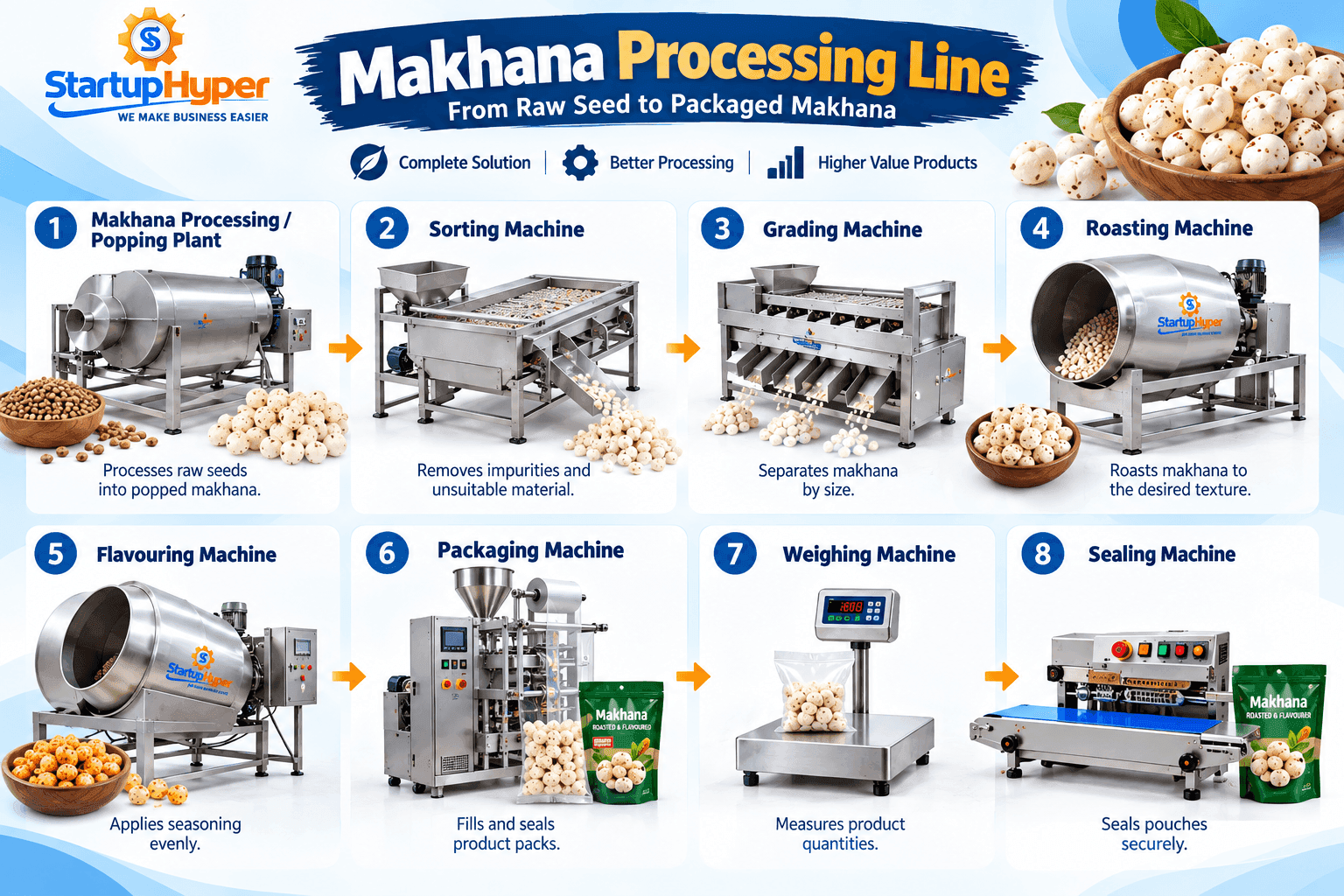
The machinery you need depends on your processing stage and production volume. A business buying already-popped makhana needs a very different setup than one processing raw seed.
| Machine | Purpose | Suitable For |
|---|---|---|
| Makhana Processing/Popping Plant | Processes raw seeds into popped makhana. | Full processing units |
| Sorting Machine | Removes impurities and unsuitable material. | Raw and semi-processed material handling |
| Grading Machine | Separates makhana by size. | Premium and bulk production |
| Roasting Machine | Roasts makhana to the desired texture. | Roasted makhana production |
| Flavouring Machine | Applies seasoning evenly. | Flavoured makhana production |
| Packaging Machine | Fills and seals product packs. | Medium- and large-scale production |
| Weighing Machine | Measures product quantities. | All packaging operations |
| Sealing Machine | Seals pouches securely. | Small and medium-scale units |
Before purchasing any machine, ask: What product am I manufacturing, and how many kilograms per day realistically? Batch-based or continuous production? What are the power and space requirements? Is the advertised capacity based on my actual product and conditions, or a best-case figure? Are spare parts and after-sales support genuinely available? How easy is it to clean and maintain? Can it support future expansion without replacement?
Don't buy machinery based on advertised capacity alone, and don't buy for your five-year target volume before demand is validated start with what your current process needs and scale as demand becomes consistent.
For roasted and flavoured makhana (starting from already-popped stock):
Processing raw, unpopped seed adds procurement, cleaning, drying, and popping stages before sorting and grading requiring meaningfully more equipment, space, and technical control than working with already-popped makhana.
Investment varies by business model, production capacity, machinery, and location a small flavouring-and-packaging setup has a very different cost structure from a full processing unit with popping, grading, and packaging equipment.
The ranges below are illustrative planning bands only, not verified market quotations. They're based on typical costs for small food-processing setups in India as of late 2026 and are meant to give you a rough sense of scale always confirm actual pricing directly with suppliers before budgeting.
| Investment Category | What It Covers | Illustrative Range |
|---|---|---|
| Machinery (Small-Scale Flavouring & Packing) | Roasting/flavouring unit, basic sorting equipment, hand or semi-automatic sealing | ₹1.5 lakh – ₹5 lakh |
| Machinery (Full Processing Line — Popping to Packaging) | Popping plant, sorting, grading, roasting/flavouring, automatic packaging | ₹15 lakh – ₹40 lakh+, depending heavily on automation and capacity |
| Raw Materials (Initial Stock) | First batch of makhana + seasoning, at current sourcing prices (~₹1,000–1,300/kg for good-grade makhana) | ₹50,000 – ₹2 lakh for a small first run |
| Packaging | Pouches, labels, cartons, sealing materials | ₹20,000 – ₹1 lakh (one-time design + first batch of consumables) |
| Facility | Rent, electrical work, basic infrastructure | ₹15,000 – ₹75,000/month depending on city and space |
| Labour | Operators and support staff | ₹15,000 – ₹25,000/month per worker, varies by state and skill level |
| Compliance | FSSAI registration/license fees, lab testing | ₹100 – ₹25,000/year depending on your FSSAI category (see Section 8), plus ₹10,000–₹30,000 for shelf-life/nutrition lab testing per product |
| Marketing | Branding, photography, initial ads, launch push | ₹50,000 – ₹3 lakh for a first-year D2C launch |
| Working Capital | 2–3 months of operating costs before revenue stabilises | Typically 20–30% of your total setup budget |
Two realistic starting-point scenarios, purely illustrative:
Small flavouring-and-packing brand (buying pre-popped makhana, not processing raw seed): total first-year investment roughly ₹3 lakh – ₹8 lakh, covering machinery, first raw material batch, packaging, compliance, and a modest marketing push.
Full processing unit (popping raw seed through to packaged product): total investment can run ₹25 lakh – ₹50 lakh+, driven almost entirely by machinery and facility costs.
FSSAI Registration or License thresholds revised effective 1 April 2026:
| Category | Annual Turnover |
|---|---|
| Basic Registration | Up to ₹1.5 crore |
| State License | Above ₹1.5 crore up to ₹50 crore |
| Central License | Above ₹50 crore |
Note: FSSAI eligibility thresholds may vary based on the applicable regulations and business category. Verify the latest official FSSAI requirements before publishing.
This is a major change from the earlier ₹12 lakh / ₹20 crore thresholds still cited in many older guides. Your applicable category can also depend on the specific food activity, business category, and location verify exact requirements through the official FoSCoS portal before applying.
Other registrations to check: GST registration (where applicable), Udyam/MSME registration, local trade license, business entity registration, and IEC/APEDA registration for eligible export activities.
Label requirements typically include the FSSAI number, product name, ingredient list, nutritional information, net quantity, batch details, manufacturing/packing details, best-before information, and allergen declarations where applicable. Always confirm current requirements for your specific product with FSSAI resources or a qualified compliance professional.
Common formats: stand-up pouches, laminated food-grade pouches, bulk packaging for B2B buyers, rigid boxes, and premium gift packs or tins.
Since makhana loses its desired texture with moisture exposure, focus on proper sealing, suitable packaging material, correct storage, transport safety, and accurate labelling. Nitrogen flushing can help, but it doesn't replace proper sealing, testing, and storage discipline.
Branding: regional sourcing, product quality, flavour variety, and transparent ingredients are all viable angles. Given the GI tag on Mithila Makhana and the ODOP recognition for Darbhanga and Muzaffarpur, an origin-based story is a genuine differentiator but only use it where your actual sourcing supports the claim.
Local retail stores — grocery stores, dry fruit shops, supermarkets, specialty stores; come prepared with samples, pricing, MOQs, and delivery terms.
Wholesale buyers — distributors, retailers, and processors who prioritise consistency, pricing, and reliable delivery.
B2B food businesses — cafés, restaurants, hotels, cloud kitchens, caterers, corporate snack suppliers; start with small arrangements before scaling.
Online marketplaces — your own website, e-commerce platforms, social media, WhatsApp orders, or subscriptions; requires investment in photography, shipping, and customer service.
Quick commerce (Blinkit, Zepto, etc.) — a relevant channel for this category, though listing eligibility and terms vary; treat it as a channel to pursue, not a guaranteed source of orders.
Social media — flavour comparisons, product demos, behind-the-scenes content, and customer reviews tend to work well; avoid unsupported health claims in promotions.
Rather than relying on a fixed industry margin, calculate your own unit economics using: revenue (total sales), direct cost (expenses tied directly to production), gross contribution (selling price minus direct cost), operating expenses (rent, labour, utilities, marketing, admin), and net profit (what remains after everything).
Illustrative example (method only — figures are hypothetical):
| Particular | Amount |
|---|---|
| Selling Price per 100g Pack | ₹100 |
| Direct Cost per Pack | ₹55 |
| Gross Contribution per Pack | ₹45 |
| This ₹45 is not net profit- labour, rent, electricity, transport, marketing, marketplace commissions, wastage, and admin costs still need to come out of it. Given that raw makhana prices have risen to around ₹1,250/kg, build your direct-cost figure from current sourcing prices, actual processing yield, and a realistic wastage allowance (at least 5–10% in early production runs) rather than assuming ideal conditions. |
Break-even quantity = Fixed Costs ÷ Contribution per Unit
a) Buying machinery before defining the product — decide what you'll manufacture first.
b) Ignoring raw material quality — affects taste, texture, and customer satisfaction directly.
c) Relying on someone else's profit claims — your margins depend on your own sourcing costs and channel mix.
d) Underestimating packaging — poor sealing is a leading cause of moisture-related quality problems.
e) Starting production without a sales plan — test with real buyers before scaling.
f) compliance as an afterthought — especially given the April 2026 FSSAI threshold change.
Overinvesting in machinery before demand is validated.
a) Is a makhana business profitable in India?
It can be, but results depend on your sourcing costs, selling price, product quality, and customer acquisition — not on the sector's overall growth. Build your own estimates before investing.
b) How much investment is required to start a makhana business?
It varies by business model and scale contract manufacturing and small-scale flavouring/packaging need considerably less capital than a full processing unit. Get current quotations before budgeting.
c) Which machine is used for makhana roasting?
A roasting machine handles the roasting stage; a flavouring machine applies seasoning evenly. Raw, unpopped seed requires additional processing equipment.
d) How do I source makhana in Bihar?
Through suppliers, traders, and farmer organisations in districts like Darbhanga, Madhubani, Purnia, Katihar, Saharsa, and Supaul check grade, quality, and procurement terms, and factor in that prices have risen substantially in recent years.
e) What licenses are required for a makhana business?
FSSAI registration or license based on turnover (under the revised April 2026 thresholds), plus GST, Udyam registration, local trade licensing, and IEC/APEDA for exports where applicable.
f) Is the FSSAI basic registration limit still ₹12 lakh?
No it's now up to ₹1.5 crore turnover as of 1 April 2026. Verify your exact category through FoSCoS.
g) Is a packaging machine necessary for a small makhana unit?
Not always manual or semi-automatic packaging can suit smaller volumes; base the decision on output, pack size, and quality requirements.
h) Is government support available for makhana businesses?
Yes the National Makhana Board and the Central Sector Scheme for the Development of Makhana (₹476.03 crore, 2025–26 to 2030–31) support production, processing, value addition, branding, and exports, largely channelled through FPOs. Verify current eligibility through your district agriculture office.
i) Does the Mithila Makhana GI tag matter for my business?
Only if your sourcing genuinely supports the claim. It's a legitimate branding differentiator for origin-based positioning, but GI status doesn't automatically transfer marketing rights to individual businesses verify current usage guidelines before referencing it commercially.

Starting a makhana business involves real decisions choosing the right business model, matching machinery to your actual production volume, and sequencing investment so you're not overcommitted before demand is proven.
StartupHyper helps entrepreneurs evaluate machinery solutions for food processing and manufacturing businesses, focusing on understanding your specific requirements rather than pushing a one-size-fits-all setup. Whether you're planning a small flavouring-and-packaging operation or a larger processing unit, getting the machinery decision right at the right stage helps manage both investment and operational risk.
Looking for a makhana roasting, flavouring, or processing machine? Connect with StartupHyper to discuss your requirements and explore suitable options.
Starting a makhana business in India offers real opportunities across roasting, flavouring, packaging, wholesale supply, and branded snack production backed by genuine government momentum through the National Makhana Board, GI recognition, and rising export activity. But building a sustainable business still requires reliable sourcing, the right machinery for your actual scale, consistent quality, proper packaging, regulatory compliance, and a practical sales strategy.
Start with a clearly defined business model, validate demand with real customers, calculate your actual costs, and expand production only as your business proves itself.
📞Call / WhatsApp: 9472093913
📧Email: info@startuphyper.com
🌐 Website: www.startuphyper.com | www.machinehai.com
🏢 Branches: Patna | Gaya | Katihar | Saharsa
Stay updated with the latest tips, trends, and best practices in factory setup and machinery procurement—subscribe to the StartupHyper newsletter!
No spam, we promise. Your inbox is safe with us—only valuable insights.