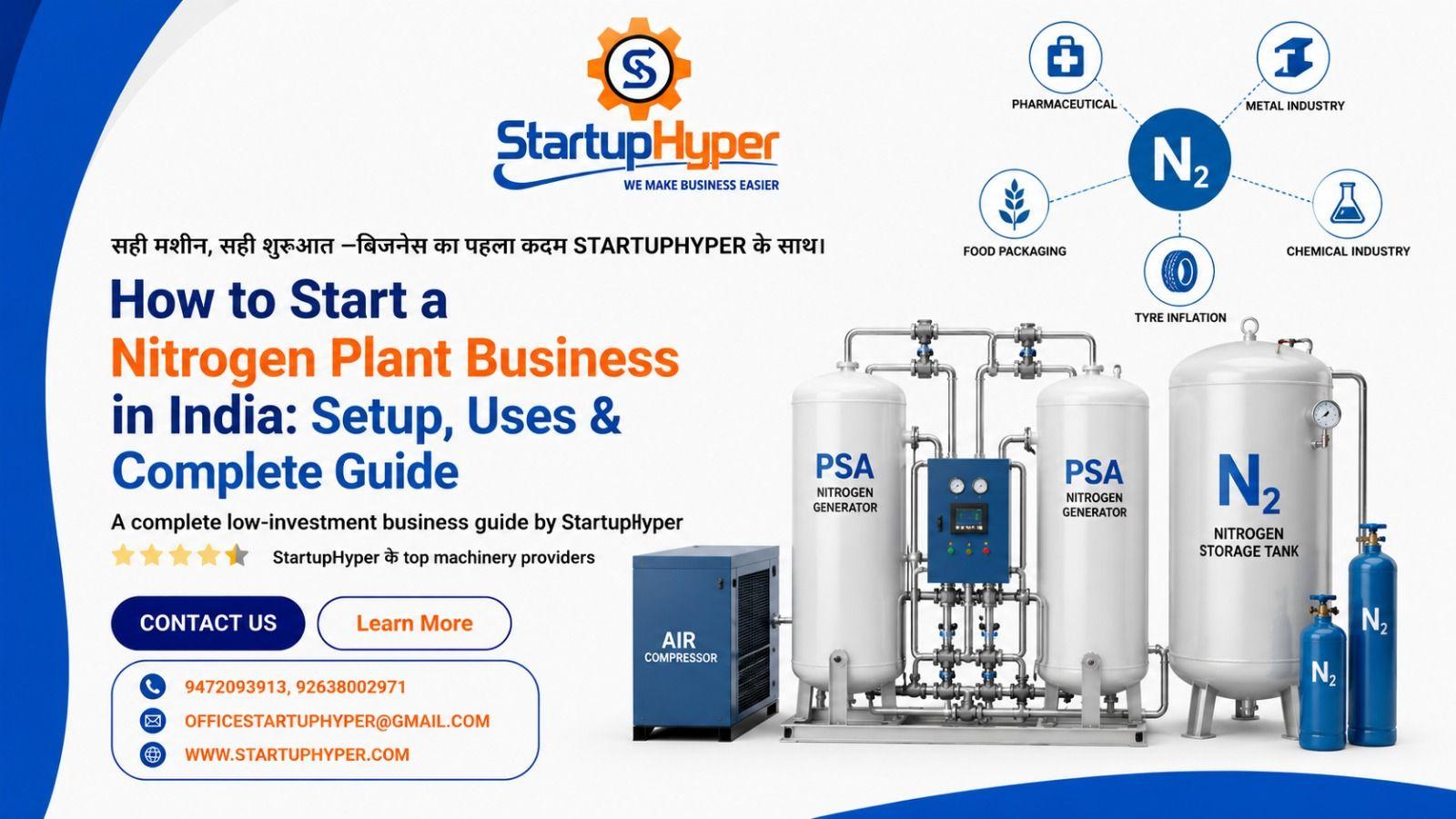
Read the full article to gain deeper insights and comprehensive information.

Jul 04, 2026
0
Learn about nitrogen plant business cost in India, PSA nitrogen plant setup, licences, PMEGP subsidy, profit factors, manpower, maintenance and supplier selection.
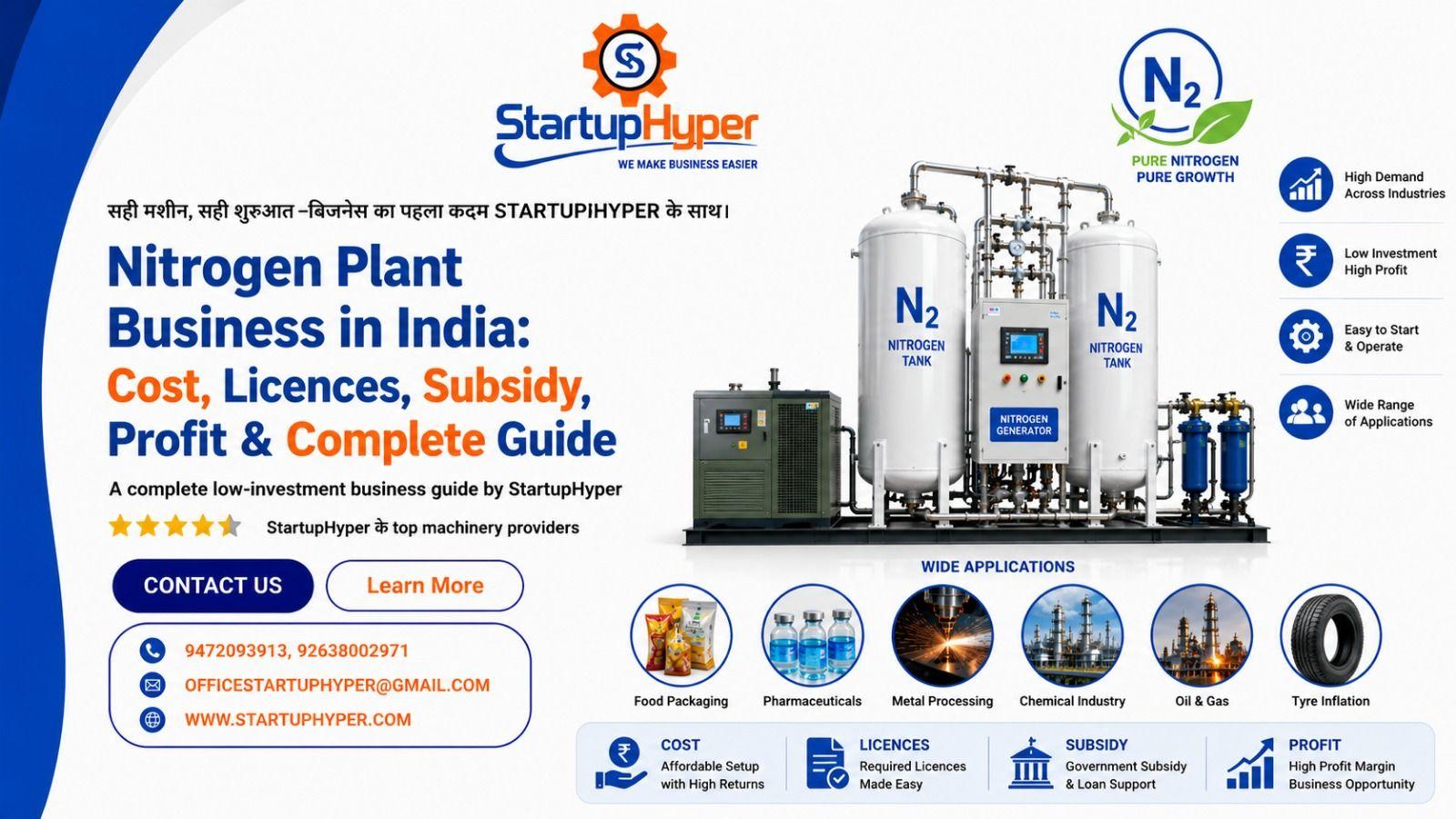
A nitrogen plant business can be a strong industrial opportunity because nitrogen gas is used across food packaging, pharmaceuticals, laser cutting, chemicals, electronics, oil and gas, metal processing and many other industries.
But this is not a business where you simply install a machine and wait for customers
A nitrogen plant needs industrial buyers, technical planning, reliable power supply, proper safety systems and the right business model. Your profitability will depend on plant utilisation, electricity cost, nitrogen purity, delivery method and whether you have committed customers before installation.
If you have already read our guide on How to Start a Nitrogen Plant Business in India, this article goes one step further. Here, we will cover the practical questions entrepreneurs usually ask before investing:
The first question most entrepreneurs ask is: “Nitrogen plant price kitna hai?” There is no single answer because nitrogen plant cost depends on capacity, purity, pressure, technology and whether the quotation includes supporting equipment.
A nitrogen generator alone may look affordable in an online listing, but a complete operating project also needs an air compressor, air dryer, filters, storage tank, electrical work, piping and installation.
| Setup Type | Approximate Cost Range |
|---|---|
| Small PSA Nitrogen Generator | ₹5 lakh – ₹15 lakh |
| Medium PSA Nitrogen Plant | ₹15 lakh – ₹40 lakh |
| Industrial PSA Plant with Complete Utility Setup | ₹25 lakh – ₹60 lakh+ |
| Membrane Nitrogen Generator Setup | ₹5 lakh – ₹25 lakh |
| Cryogenic / Liquid Nitrogen Plant | ₹1.5 crore and above |
These are broad planning ranges only. Final cost depends on actual nitrogen flow requirement, purity, pressure, compressor size, dryer type, automation level, storage arrangement and installation scope.
A realistic nitrogen plant project includes more than the PSA generator.
| Cost Head | Approximate Cost Range |
|---|---|
| PSA Nitrogen Generator | ₹5 lakh – ₹25 lakh |
| Air Compressor and Dryer | ₹2 lakh – ₹8 lakh |
| Air Receiver Tank | ₹50,000 – ₹2 lakh |
| Nitrogen Receiver Tank | ₹50,000 – ₹3 lakh |
| Filters and Pipeline Accessories | ₹1 lakh – ₹5 lakh |
| Booster Compressor (if required) | ₹2 lakh – ₹10 lakh |
| Electrical Installation | ₹1 lakh – ₹3 lakh |
| Civil Work / Shed / Foundation | ₹3 lakh – ₹10 lakh |
| Licences, NOCs, and Consultancy | ₹1 lakh – ₹3 lakh |
| Initial Working Capital | ₹3 lakh – ₹10 lakh |
For a small-to-medium industrial PSA nitrogen plant, the total project investment can commonly fall in the range of ₹15 lakh to ₹60 lakh, depending on the selected configuration.
Flow rate is usually measured in Nm³/hr or normal cubic metres per hour. A customer who needs 10 Nm³/hr will require a much smaller plant than a customer who needs 100 Nm³/hr or 500 Nm³/hr. Higher flow rate means:
Different industries need different purity levels.
| Application | Typical Nitrogen Requirement |
|---|---|
| Tyre inflation / General inerting | Lower purity nitrogen may be sufficient |
| Food packaging | Medium to high purity nitrogen |
| Chemical blanketing | Purity depends on the specific process |
| Laser cutting | High-pressure nitrogen with specific purity |
| Pharmaceutical / Electronics | High-purity nitrogen required |
Higher purity generally increases equipment cost and operating cost because the plant may produce less gas output at higher purity.
Some applications only need nitrogen at low pressure. Others, such as laser cutting, may require higher delivery pressure. A nitrogen booster compressor may be required for high-pressure applications, which increases the total project cost.
The nitrogen plant depends on clean compressed air. Poor-quality air with moisture, oil or dust can damage filters and reduce the life of Carbon Molecular Sieve inside the PSA system.
Never compare only the generator price. Compare the complete compressed-air system.
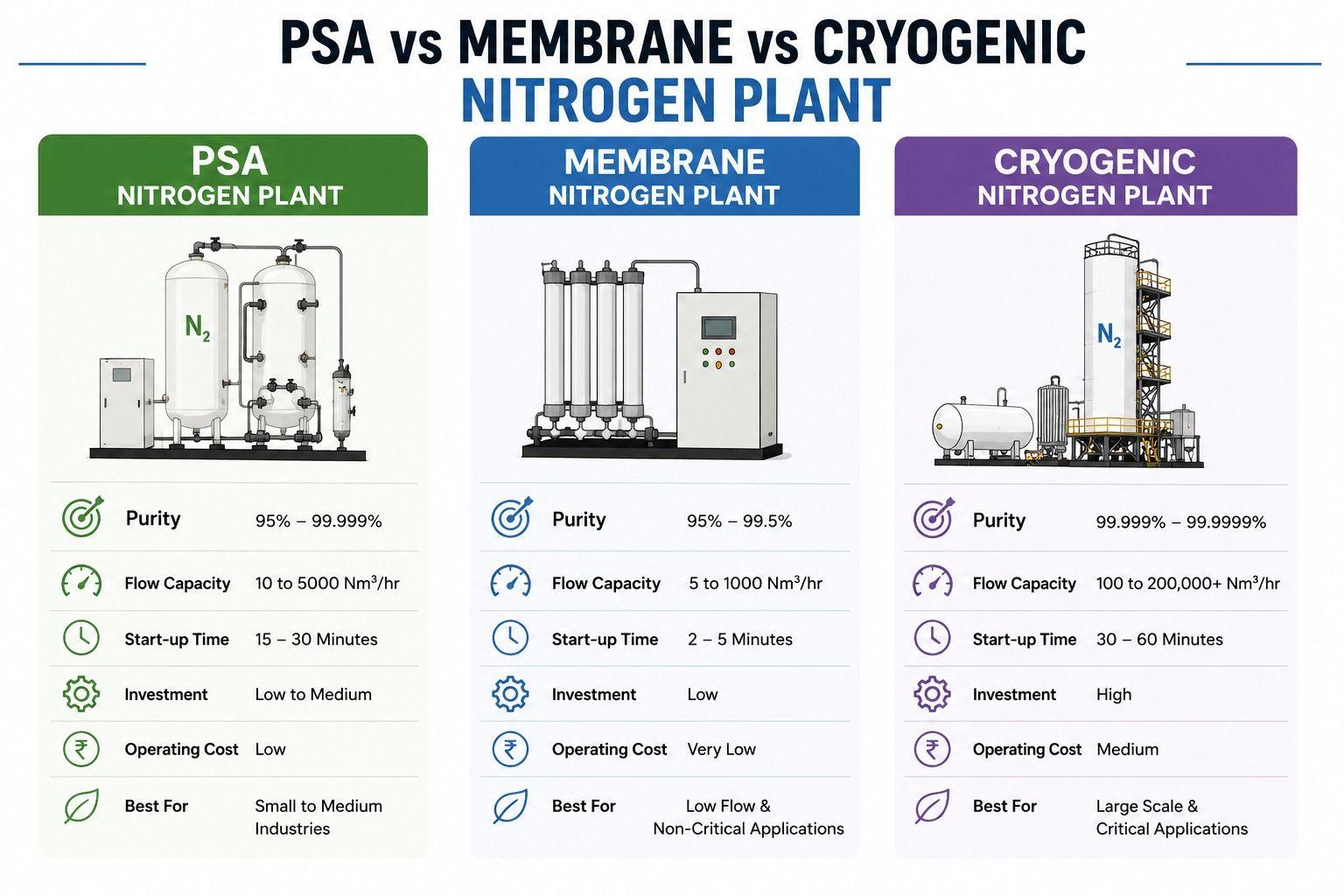
Before buying machinery, you need to understand which technology matches your target market.
| Technology | Purity Range | Investment Level | Best For |
|---|---|---|---|
| Membrane Nitrogen Generator | Lower to medium purity | Lower | Tyre inflation, inerting, and basic industrial applications |
| PSA Nitrogen Plant | Medium to very high purity | Medium | Food packaging, pharmaceuticals, laser cutting, electronics, and chemical industries |
| Cryogenic Nitrogen Plant | Very high purity / liquid nitrogen | Very high | Large-scale industrial gas supply and liquid nitrogen applications |
PSA stands for Pressure Swing Adsorption.
This is the most common technology for on-site industrial nitrogen generation.
A PSA nitrogen plant uses compressed air and Carbon Molecular Sieve to separate nitrogen from oxygen, moisture and other gases.
For most first-time entrepreneurs, PSA technology is usually the practical option because it can serve multiple industries and offers good purity levels without the huge investment required for cryogenic plants.
Membrane systems are generally simpler and can be suitable where ultra-high purity is not required.
Membrane systems may have lower initial cost, but they are not always suitable for high-purity pharma, electronics or food applications.
Cryogenic nitrogen plants separate gases by cooling air to extremely low temperatures.
These plants can produce liquid nitrogen, oxygen and other industrial gases at large scale.
However, they are expensive, technically complex and not usually suitable for a first-time small entrepreneur.
The exact licence requirement depends on your business model.
If your business includes cylinder filling, storage or transport, you may need additional approvals and safety compliance.
| Requirement | Why It May Be Needed |
|---|---|
| Business Registration | To establish the business as a proprietorship, partnership, LLP, or private limited company |
| Udyam Registration | To avail MSME benefits, loans, and government subsidy schemes |
| GST Registration | For B2B billing, tax compliance, and input tax credit |
| Factory Licence | Required depending on plant size and applicable local regulations |
| Local Trade Licence | Approval from the local municipal authority or governing body |
| Fire NOC | To ensure compliance with fire safety regulations |
| State Pollution Control Board Consent | Consent to Establish (CTE) and Consent to Operate (CTO), where applicable |
| Electrical Safety Approval | For industrial electrical installations and power safety compliance |
| PESO Approval / Licence | Required for filling, storing, or transporting compressed gas cylinders |
Important: Do not assume that a nitrogen generator automatically allows you to fill and sell cylinders. Cylinder filling and storage are separate activities that may require approvals under applicable gas-cylinder and safety rules.
If you plan to fill nitrogen into cylinders and sell or distribute them, PESO compliance becomes important.
PESO stands for Petroleum and Explosives Safety Organisation.
Do not construct a cylinder-filling facility before confirming the required layout approvals. It can lead to costly changes later.
For a simple on-site nitrogen generator supplying gas directly to a customer’s process through a pipeline, the compliance path may be different. Always verify your exact project requirement with a qualified consultant and relevant authority before investing.
Many entrepreneurs search: “Nitrogen plant subsidy available hai?”
A nitrogen plant is an industrial manufacturing or industrial-service project, so general MSME schemes may be relevant depending on the project model, applicant eligibility and bank assessment.
PMEGP stands for Prime Minister’s Employment Generation Programme
It is one of the most common schemes considered by first-time entrepreneurs for manufacturing projects.
PMEGP may support eligible manufacturing projects through margin-money subsidy, subject to current scheme rules, applicant category, location, bank approval and project viability.
Before preparing your project report, check the latest PMEGP guidelines because scheme limits, subsidy percentages and eligibility rules can change.
CGTMSE is useful for entrepreneurs who need bank finance but may not have large collateral.
It provides credit-guarantee support to eligible MSME loans through participating banks and lenders.
For a nitrogen plant project, CGTMSE can be useful because machinery, compressor, tanks and electrical installation require significant capital.
Udyam Registration is recommended for MSME businesses because it can help with:
A nitrogen plant business can be profitable, but only when the plant has regular industrial demand.
The raw material—air—is freely available. But that does not mean nitrogen is free to produce.
The biggest factor is plant utilisation.
A ₹30 lakh plant running at 30% capacity may struggle to recover costs. A ₹30 lakh plant running consistently with anchor customers can perform much better
| Revenue Model | Description / How You Earn |
|---|---|
| Equipment Sale | Earn profit from designing, supplying, installing, and commissioning nitrogen plants. |
| AMC / Service Contract | Generate recurring revenue through annual maintenance contracts, preventive maintenance, and repair services. |
| On-Site Gas Generation Contract | Charge customers a monthly fee or based on the volume of nitrogen generated and supplied at their facility. |
| Captive Use | Reduce operating costs by producing nitrogen in-house instead of purchasing cylinders or liquid nitrogen, improving overall profitability. |
| Cylinder Supply | Earn margins from filling, transporting, and delivering nitrogen cylinders to industrial customers. |
| Pipeline Supply | Generate long-term revenue by supplying nitrogen continuously through dedicated pipelines under industrial supply agreements. |
For new entrepreneurs, the safest approach is usually to identify one or two anchor industrial customers before commissioning the plant
Instead of promising a fixed profit number, prepare a project report based on your actual customer demand.
A small nitrogen plant does not need a large workforce, but it does need trained people.
| Role | Requirement |
|---|---|
| Plant Operator / Technician | 1 per shift |
| Supervisor | 1 (often owner-managed during the initial stage) |
| Helper | 1–2 for loading, material handling, and cleaning |
| Sales Executive | Required if supplying nitrogen to external customers |
| Electrician / Mechanical Technician | Can be outsourced or covered under an Annual Maintenance Contract (AMC) |
For a small single-shift unit, a team of 3–5 people may be sufficient depending on whether you are only generating gas on-site or also handling cylinders and deliveries.
This is the most important part of the business.
Your first target should be industrial clusters, not general retail markets. Industries to Target
Identify industrial estates and manufacturing clusters near your location. Visit factories and ask whether they use:
Industrial customers do not switch suppliers only because you offer nitrogen.
Prepare a simple comparison between their current gas expense and the estimated cost of on-site nitrogen generation.
This reduces the risk of low utilisation after commissioning.
Nitrogen plants require regular maintenance. Ignoring maintenance can reduce purity, increase power consumption and cause downtime.
| Frequency | Maintenance Work |
|---|---|
| Daily | Check nitrogen pressure, purity, system alarms, and compressor operation |
| Weekly | Drain moisture, inspect filters, and check for air or gas leaks |
| Monthly | Inspect filter condition and monitor pressure drop across the system |
| Quarterly | Service the compressor, inspect belts, cooling system, and check compressor oil |
| Annually | Calibrate the purity analyser, conduct a complete system inspection, and perform pressure testing |
Carbon Molecular Sieve, also called CMS, is one of the most important components of a PSA nitrogen plant.
If oil or moisture enters the PSA towers, the CMS performance can reduce and nitrogen purity may drop.
This is why air dryer and filters should never be treated as optional equipment.
For first-time operators, an AMC or Annual Maintenance Contract is usually a practical choice.
A plant shutdown can affect your industrial customer’s production. Reliable service support is often more valuable than choosing the lowest-cost supplier.
Your customer is not only buying gas quantity. They are buying nitrogen purity and reliability.
For process-critical customers such as pharma, food packaging and electronics,
A nitrogen purity analyser can help monitor oxygen content in the output gas.
If you are supplying high-value industrial customers, maintain shift-wise or daily logs. This improves customer confidence and helps during quality audits.
Do not choose a supplier only because they give the lowest quotation.
| Factor | What to Check |
|---|---|
| Plant Capacity | Ensure the plant matches your required nitrogen flow rate and production capacity. |
| Purity Guarantee | Verify the nitrogen purity level the plant can consistently deliver. |
| CMS Quality | Check the brand and quality of the Carbon Molecular Sieve (CMS) used. |
| Compressor Brand | Confirm the compressor is from a reliable brand with local service support. |
| Dryer and Filters | Ensure dryers and filters are included in the quotation and meet application requirements. |
| Service Support | Check whether the supplier provides local or regional installation and after-sales service. |
| Warranty | Understand what components are covered and the duration of the warranty. |
| Reference Clients | Ask for references or case studies of similar installations completed by the supplier. |
| Installation Scope | Confirm whether piping, receiver tanks, electrical work, and commissioning are included in the quotation. |
| AMC Cost | Evaluate the expected annual maintenance contract (AMC) cost after the warranty period. |
Always get quotations from at least three suppliers using the same technical requirement: flow rate, purity, pressure, operating hours and end-use application.
Do not install a large nitrogen plant just because the market looks promising.
First identify actual buyers and their gas requirement.
The compressor is one of the biggest power-consuming parts of the system.
Calculate electricity cost before finalising your selling price.
A high-purity plant may cost more and produce lower flow. A low-purity plant may not meet customer requirements.
Select purity based on the actual application.
Cylinder filling, storage and transport involve safety and compliance requirements.
Do not start this model without proper approvals and trained staff.
A nitrogen plant is a continuous industrial system. Filters, dryer, compressor and purity analyser need regular attention.

Starting a nitrogen plant is not only about purchasing a machine. The right setup depends on your target customer, required nitrogen purity, flow rate, delivery pressure, operating hours and business model.
Whether you want to set up a nitrogen plant for your own factory, sell industrial gas solutions or supply nitrogen to local industries, StartupHyper can help you plan a practical machine configuration based on your actual requirement.
A small PSA nitrogen plant project may require around ₹15 lakh to ₹25 lakh when you include the generator, compressor, dryer, tanks, electrical work, installation and working capital. Actual cost depends on capacity and application.
For many first-time industrial entrepreneurs, a PSA nitrogen plant is usually the practical option because it offers good purity and can serve food, pharma, laser cutting, electronics and chemical applications.
It can be profitable when you have regular industrial customers, stable plant utilisation and controlled electricity and maintenance costs.
If you are filling, storing or transporting nitrogen cylinders, additional PESO-related compliance may apply. For an on-site nitrogen generator supplying directly through a pipeline, requirements may differ. Always verify based on your project model.
PMEGP may be relevant for eligible manufacturing projects, subject to current scheme guidelines, bank approval and applicant eligibility. Check the latest rules before applying.
A small single-shift nitrogen plant may operate with around 3–5 people, including an operator, helper, supervisor and sales support.
PSA systems can generally provide higher purity and are used for more demanding applications. Membrane systems are simpler and may be suitable for lower-purity uses such as tyre inflation and inerting.
Yes, but it depends on plant capacity, storage, pipeline design, delivery method and compliance. Supplying multiple customers through cylinders or transport requires additional planning.
Electricity, especially for the air compressor, is usually one of the biggest operating costs.
Installation time depends on plant size, site readiness, electrical work, piping, tank installation and approval process. A ready site can be commissioned faster than a project requiring civil work and approvals.
Yes. Nitrogen is commonly used in food packaging to reduce oxygen exposure and help protect snack products. The required purity and packaging setup should be selected based on the product.
In many cases, capacity can be increased by adding another generator, compressor, receiver tank or pipeline section. Expansion should be considered during the initial layout planning.
If you are planning to start a nitrogen plant business in India, begin with customer demand not machinery.
Identify your target industries, understand their gas requirement, prepare a realistic project report and select the right plant configuration.
Stay updated with the latest tips, trends, and best practices in factory setup and machinery procurement—subscribe to the StartupHyper newsletter!
No spam, we promise. Your inbox is safe with us—only valuable insights.