Read the full article to gain deeper insights and comprehensive information.

Jul 03, 2026
0
Learn how to start a makhana processing business in India. Know required machines, processing steps, investment, packaging, licenses, profit margin and selling strategy.
Makhana is no longer sold only as a loose snack in local markets. Today, it is packed in branded pouches, sold in supermarkets, supplied to cafés, listed on e-commerce platforms and exported as a premium healthy snack.
For an entrepreneur, this creates an opportunity but there is one important point to understand first
You can process raw makhana, buy popped makhana and create a roasted/flavoured snack brand, or focus only on grading and packaging for wholesale buyers. Each model needs a different machine setup, investment level and sales strategy.
This guide explains how to choose the right model and start a practical makhana processing business in India.
Makhana, also called fox nut or lotus seed, has gained popularity because consumers see it as a lighter snack option compared with many fried snacks. The opportunity is especially strong in Bihar, where the makhana ecosystem from cultivation and traditional processing to trade and packaging is already well established.
India's makhana exports grew nearly fourfold, from 6,700 MT in 2020 to 25,130 MT in 2024, according to APEDA's makhana export dashboard. Bihar also remains central to India's makhana value chain, and GI-tagged Mithila Makhana has been actively promoted for export markets.
But demand alone does not guarantee profit. Your business will depend on sourcing quality raw material, controlling breakage, maintaining consistent roasting and seasoning, choosing the right packaging, and building repeat sales.
| Business model | What you sell | Main customers | Investment level |
|---|---|---|---|
| Raw makhana processing | Popped/processed makhana in bulk | Wholesalers, traders, processors | Medium to high |
| Grading and bulk packing | Size-graded makhana in bags or pouches | Retailers, distributors, private-label buyers | Medium |
| Roasted and flavoured makhana brand | Ready-to-eat flavoured snack packs | Retail customers, cafés, online buyers, supermarkets | Low to medium |
| Private-label manufacturing | Processed and packed makhana for another brand | D2C brands, retailers, distributors | Medium |
| Export-oriented packing | Quality-graded, export-compliant packaged makhana | Exporters and overseas buyers | Medium to high |
For most first-time entrepreneurs, roasting, flavouring and packaging popped makhana is often more practical than starting with raw seed popping. Raw processing needs stronger sourcing knowledge, skilled handling and a more specialised setup.
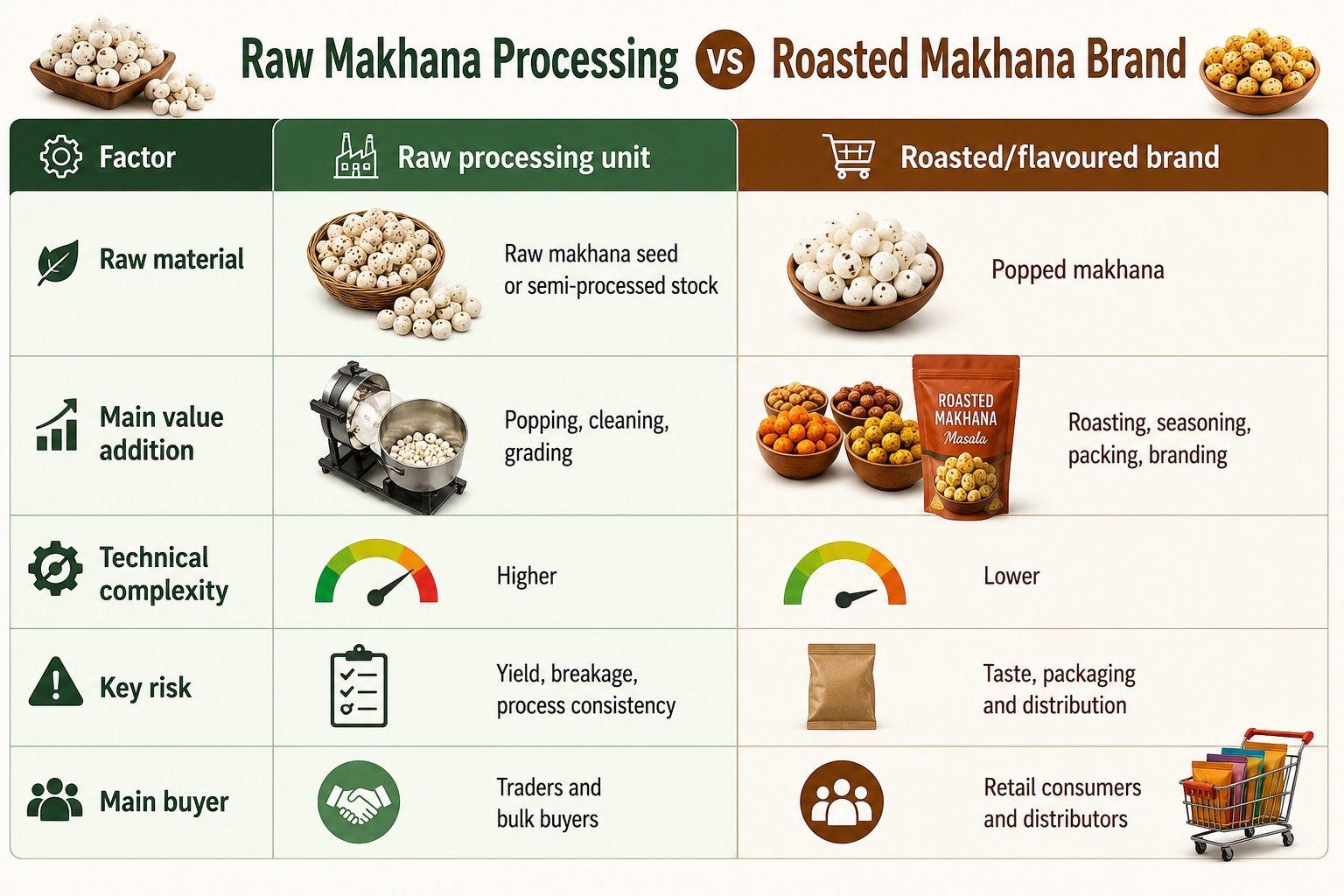
| Factor | Raw Processing Unit | Roasted/Flavoured Brand |
|---|---|---|
| Raw material | Raw makhana seed or semi-processed stock | Popped makhana |
| Main value addition | Popping, cleaning, and grading | Roasting, seasoning, packing, and branding |
| Technical complexity | Higher | Lower |
| Key risk | Yield, breakage, and process consistency | Taste, packaging, and distribution |
| Main buyer | Traders and bulk buyers | Retail consumers and distributors |
| Best for | Experienced processors or sourcing-led businesses | New FMCG entrepreneurs |
This distinction is missing from many generic makhana business guides. Do not buy a full processing plant if your real plan is to launch a snack brand; and do not launch a retail brand without planning flavour consistency, packaging shelf life and distribution.
Depending on your model, you may buy raw makhana seed, popped makhana, graded makhana or broken makhana.
For a branded snack business, a slightly lower raw-material price is not useful if the makhana has high breakage or poor roasting quality. Your finished product must look clean, uniform and premium inside the pouch.
The machinery depends on the business model you choose. For a full breakdown of how to evaluate suppliers and specifications before buying, see our Packaging Machine Buyer Guide.
| Machine | Use | Best Suited For |
|---|---|---|
| Makhana cleaning/sorting machine | Removes dust and unwanted material | Bulk processing |
| Makhana grading machine | Separates makhana by size | Wholesale, export, and premium packs |
| Makhana popping/puffing machine | Processes raw makhana into popped makhana | Raw processing unit |
| Makhana roasting machine | Roasts makhana evenly | Snack brand and processing unit |
| Seasoning/coating machine | Mixes flavours and seasoning uniformly | Flavoured makhana brand |
| Cooling tray or cooling conveyor | Brings product temperature down before packing | Better packaging quality |
| Weighing machine | Maintains pouch weight accuracy | All business models |
| Pouch packing machine | Packs product in branded pouches | Retail snack brand |
| Nitrogen flushing packing machine | Protects product quality in sealed packs | Premium retail packs |
| Band sealer or continuous sealer | Seals pouches | Small and medium units |
| Batch coding machine | Prints batch number, MRP, and manufacturing/expiry date | Retail-ready products |
See also: Pouch Packing Machine guide • Band Sealer Without Stand
For a simple roasted-makhana brand, the core line may be: Roaster → seasoning/coating → cooling → weighing → pouch sealing/packing.
For raw processing, the line becomes more specialised and must be planned around the quality and condition of the raw seed.
Popped makhana sourcing → cleaning/sorting → roasting → seasoning → cooling → weighing → pouch packing → batch coding → dispatch
Raw seed sourcing → traditional or mechanised processing/popping → cleaning → grading → roasting if required → packing
The exact raw-seed popping process can vary based on local processing practices and machine design. It should be demonstrated by the machinery supplier before you finalise the plant.
| Setup Type | Approximate Space Required |
|---|---|
| Small roasting and packing unit | 500–800 sq. ft. |
| Medium branded snack unit | 1,000–1,500 sq. ft. |
| Grading and bulk packing unit | 1,200–2,000 sq. ft. |
| Full raw processing plant | Depends on production capacity, storage requirements, and workflow layout |
Your unit should have separate areas for raw material, roasting/processing, seasoning, cooling, packing and finished-goods storage. Keep the packing area clean and dry, because moisture can affect crunch and shelf life
Investment depends heavily on whether you are processing raw makhana or launching a roasted snack brand
| Setup | Indicative Investment Range |
|---|---|
| Small roasted makhana packing setup | ₹3 lakh – ₹8 lakh |
| Semi-automatic roasting, flavouring, and packing unit | ₹8 lakh – ₹15 lakh |
| Grading and bulk packing setup | ₹8 lakh – ₹18 lakh |
| Full makhana processing plant | ₹15 lakh and above |
These are planning ranges, not fixed quotations. Machinery capacity, automation, packaging line, electrical work, raw-material stock, branding and working capital can change the final project cost significantly.
If you're weighing a makhana unit against other options, our Food Processing Business Ideas guide compares investment and margin ranges across categories. Many first-time entrepreneurs also reduce their upfront cost through the PMFME / MMUY subsidy schemes — worth checking eligibility before you finalise your budget
A food-processing unit generally needs to plan for:
FSSAI licence or registration, as applicable
Udyam registration for MSME benefits
For export, buyers may also expect stronger quality documentation, traceability and packaging standards. Verify the latest requirements with the relevant authorities or a qualified compliance professional before starting.
A good makhana product can still fail if the packaging is weak.
Your pouch should protect the product from moisture and breakage while clearly communicating the brand, flavour, net quantity, ingredients, nutrition information, batch details, MRP and required food-label information.
For premium snack packs, consider packaging that supports freshness and a professional shelf appearance. Before selecting a packing machine, decide:
Profit does not come only from buying makhana cheaply and selling it at a higher price. It comes from controlling wastage and adding value.
A branded 25 g or 50 g flavoured pack may have better value realisation than loose bulk makhana, but it also needs marketing, packaging investment and reliable distribution.
Do not depend on only one channel. Start with a mix of:
For Bihar-based businesses, local sourcing can be an advantage, but the final product must compete on taste, packaging and consistency not only on origin.
Begin with two or three flavours that you can produce consistently. Too many SKUs create inventory and quality-control problems.
Makhana is fragile. Rough handling, weak packaging and poor transport can reduce the saleable quantity.
A raw processing line, roaster and pouch-packing line solve different problems. Decide what you want to sell first.
Moisture and poor sealing can make makhana lose crunch. Packaging is part of product quality.
A great product sitting in a warehouse does not create profit. Build retailer and distributor relationships before scaling production.

Starting a makhana processing business is not only about buying one machine. The right setup depends on whether you want to process raw makhana, grade and pack bulk stock, or launch a roasted and flavoured snack brand. StartupHyper helps you with:
Whether you want to build a local makhana brand or set up a larger processing unit, StartupHyper can help you plan a machine configuration that matches your actual business goal.
It can be profitable when the business controls raw-material quality, breakage, packaging cost and distribution. Branded roasted makhana can offer more value addition than loose bulk sales, but it also needs marketing and consistent quality.
For many beginners, roasting, flavouring and packing popped makhana is more practical than raw seed processing because it needs less specialised processing knowledge.
A basic setup may include a roaster, seasoning or coating machine, cooling arrangement, weighing machine and pouch sealing or packing machine.
Yes. Bihar has a strong makhana ecosystem and sourcing advantage. However, the business should still be planned around quality, packaging and sales channels.
A small roasted-makhana packing setup may begin at a lower investment than a full raw-processing plant. Final cost depends on capacity, automation, raw-material stock and packaging setup.
Common retail sizes include 20 g, 25 g, 50 g and 100 g. Choose sizes based on your target price point and customer segment.
It can be useful for premium packaged snack products where freshness protection is important. The right packaging method depends on product, pouch material and shelf-life target.
Yes. Online selling can work well with strong packaging, product photos, clear flavour positioning and reliable fulfilment. Start with a focused product range rather than too many variants.
Grading separates makhana by size and quality. Processing can include cleaning, popping, roasting, flavouring, packing and other value-addition steps.
Yes. Plain makhana can target traditional and health-focused buyers, while flavoured variants can target snack consumers. Start with limited variants and expand based on sales.
Planning to start a makhana processing, roasting or packaging unit?
Contact StartupHyper to discuss your required capacity, product type and machinery setup
Stay updated with the latest tips, trends, and best practices in factory setup and machinery procurement—subscribe to the StartupHyper newsletter!
No spam, we promise. Your inbox is safe with us—only valuable insights.