Read the full article to gain deeper insights and comprehensive information.

Jul 03, 2026
0
Learn how to start a nitrogen plant business in India. Explore PSA nitrogen plant setup, uses, machinery, customer requirements, cost factors and safety planning.
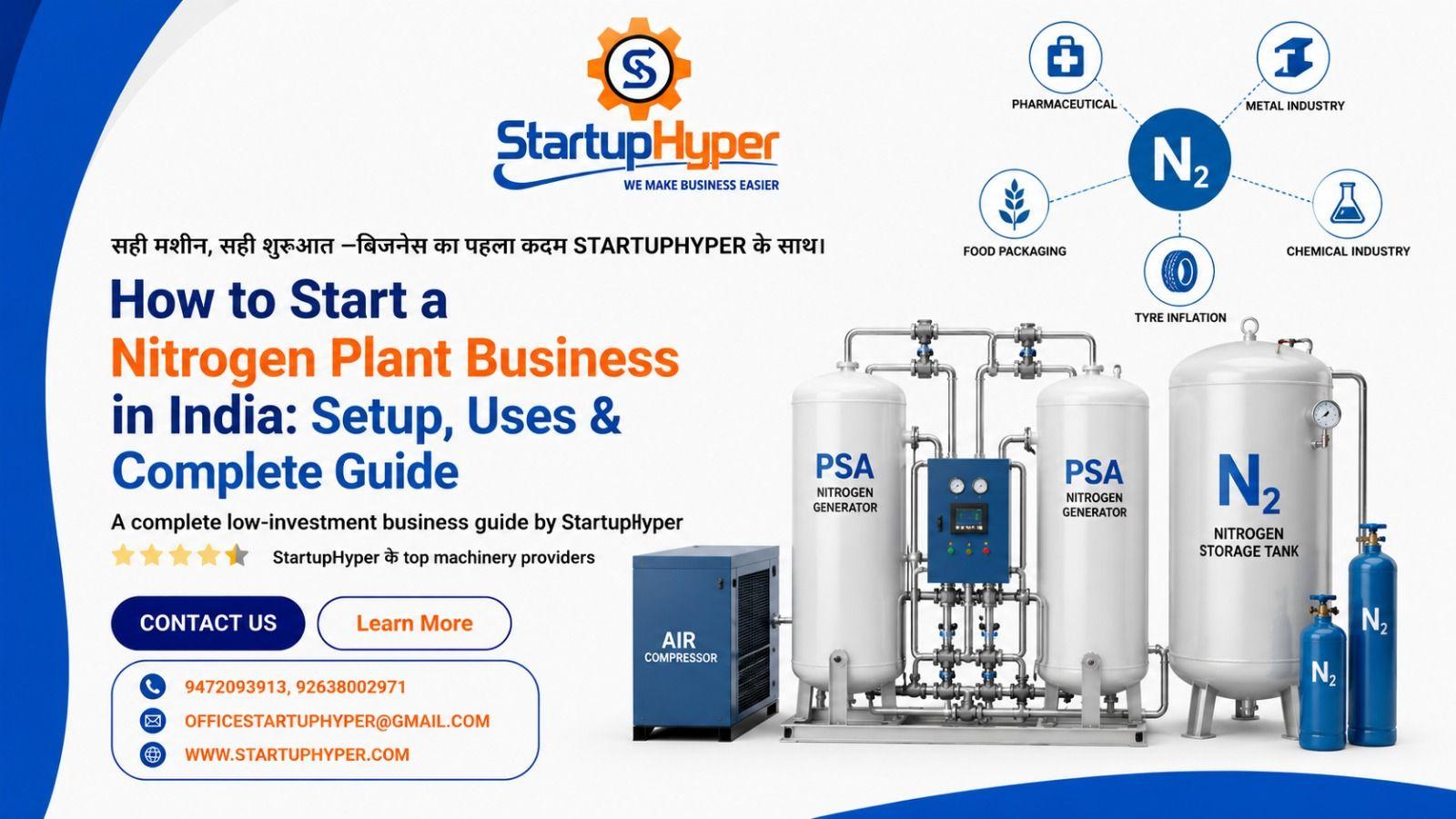
Starting a nitrogen plant business is different from starting a normal product-manufacturing unit. You are not making a packaged product and selling it through retailers. You are supplying an industrial utility: nitrogen gas.
The business works only when you first identify factories that need nitrogen regularly, understand their gas requirement, and then select the right plant configuration. For many industrial users, an on-site PSA nitrogen plant can reduce dependence on cylinder deliveries or bulk liquid nitrogen—but the economics depend on consumption, purity, pressure, operating hours and local logistics
A nitrogen plant, also called a nitrogen generator or nitrogen gas plant, separates nitrogen from atmospheric air. Air already contains roughly 78% nitrogen. The plant uses compressed air and gas-separation technology to remove oxygen, moisture, carbon dioxide and other unwanted components, leaving nitrogen for industrial use.
For most small and medium industrial applications, the relevant system is a PSA nitrogen plant. Large cryogenic air-separation plants are a different, far more capital-intensive category and should not be treated as a beginner-level setup. PSA and membrane generators separate nitrogen directly from compressed air, whereas cryogenic systems use very low temperatures and are generally used at much larger scale.
Nitrogen is valued because it is inert in many industrial processes. It can protect products from oxygen, help create controlled atmospheres, purge equipment and support specific manufacturing operations.
| Industry | Typical nitrogen use |
|---|---|
| Food packaging | Flushing snack and food packs to reduce oxidation |
| Pharmaceuticals | Packaging and controlled process environments |
| Laser cutting | Assist gas for selected metal-cutting applications |
| Chemicals | Tank blanketing, purging and process safety |
| Electronics | Controlled manufacturing and soldering-related applications |
| Oil, gas and cement | Purging, inerting and maintenance applications |
| Metal processing | Heat treatment and protective atmospheres |
PSA nitrogen systems are commonly positioned for food, pharmaceutical, electronics and chemical applications, but the required purity and pressure vary sharply by use case
Do not buy a nitrogen plant before deciding how you will earn from it. There are four different models:
| Model | How it works | Best for |
|---|---|---|
| Equipment sale | You sell and install a plant at the customer’s factory | Machinery suppliers and technical sales teams |
| On-site gas supply | You install a system at a customer site and charge under a supply/service arrangement | Entrepreneurs with long-term industrial contracts |
| Own-use generation | Your own factory uses nitrogen instead of purchasing cylinders | Food, pharma, laser-cutting and chemical manufacturers |
| Cylinder filling/distribution | Gas is filled, stored and supplied externally | Specialist gas businesses with compliance, safety and logistics capability |
For a new entrepreneur, equipment sale or an on-site generation contract is usually easier to evaluate than setting up cylinder filling and distribution from day one. Cylinder filling and possession are regulated activities: PESO states that a licence is required under Rule 43 of the Gas Cylinders Rules, 2016.
The most common mistake is selecting a plant based only on a supplier’s brochure. Start with a customer survey.
Target industrial areas with food-packaging units, pharmaceutical manufacturers, laser-cutting workshops, chemical units, electronics manufacturers and process industries. Ask each prospect:
These answers determine whether the opportunity is commercially viable and what exact system is needed
A PSA nitrogen plant generally follows this flow:
Atmospheric air → Air compressor → Air receiver → Dryer and filters → PSA nitrogen generator → Nitrogen receiver → Pipeline / end-use equipment
The compressed air must be cleaned before it reaches the PSA system. Moisture, oil and dust can affect the adsorbent and plant performance.
Inside the generator, two towers are typically filled with Carbon Molecular Sieve (CMS). In one tower, CMS preferentially adsorbs oxygen, carbon dioxide and water vapour while nitrogen passes through as product gas. The other tower regenerates by depressurising; then the system switches towers. This alternating process creates a continuous nitrogen supply.
Do not ask only, “What is the nitrogen plant price?” Ask for a configuration based on five parameters:
| Requirement | Why it matters |
|---|---|
| Flow rate | Determines how much nitrogen is required per hour |
| Purity | Different industries may need different nitrogen quality |
| Delivery pressure | A laser-cutting application may need a different setup from food packaging |
| Operating hours | Continuous operations require stable supply planning |
| End use | Determines filters, booster requirements and pipeline design |
A typical PSA nitrogen setup may include an air compressor, air receiver, dryer, pre-filters, PSA generator, nitrogen receiver, purity analyser, control panel and—where required—a booster compressor and delivery pipeline
A nitrogen plant is an industrial installation, not a plug-and-play machine. Before installation, plan for:
The exact footprint and electrical requirement should come from the final technical design, not a generic online estimate.
Compliance depends on the business model. An on-site generator feeding a customer’s own process may have a different compliance path from a facility that fills cylinders, stores large quantities of compressed gas or transports cylinders.
At the planning stage, assess:
Do not market a nitrogen plant as a “cylinder business” without obtaining project-specific professional compliance advice. PESO identifies filling and possession of gas cylinders as licensable activities.
A reliable nitrogen plant quotation cannot be based on one universal price. The final cost changes with:
That is why a good supplier first studies the customer’s application. A low-cost system that cannot deliver the required purity or pressure is not a cheaper solution—it is the wrong solution.
It can be profitable when the project is backed by real industrial demand and a clear commercial model. The strongest opportunity is usually not “install a plant and hope customers come.”

Setting up a nitrogen plant is not only about purchasing a machine. The right setup depends on your customer’s nitrogen requirement, required purity, pressure, production hours and end-use application.
StartupHyper helps entrepreneurs and industrial businesses understand the complete project requirement before selecting a plant.
Requirement Analysis We help you identify the required nitrogen flow rate, purity level, pressure and operating hours based on your industry or customer application.
Right Machine Configuration From air compressor, air dryer and filters to PSA Nitrogen Generator, receiver tank and booster compressor, we help you understand which equipment is required for your setup.
Application-Based Guidance Food packaging, laser cutting, pharmaceuticals, chemical processing and other industries can need different nitrogen specifications. We help you choose a setup according to the actual application.
Plant Capacity Planning We help you avoid both under-capacity and over-capacity investment by planning the system according to expected nitrogen demand and future expansion.
Installation and Setup Support We guide you on site space, electrical requirement, pipeline planning and basic workflow before installation.
Supplier and Project Guidance We help you understand what should be included in a quotation, such as compressor, dryer, filters, storage tanks, purity analyser, pipeline accessories, installation and service support.
After-Sales Support A nitrogen plant requires regular maintenance of filters, compressor, dryer and other components. StartupHyper helps you get the right technical support for smooth operation.
Whether you are planning a nitrogen plant for your own factory or want to offer nitrogen-generation solutions to industrial customers, StartupHyper can help you choose a practical setup based on your actual requirement
A PSA nitrogen plant uses compressed air and carbon molecular sieve to separate nitrogen from oxygen, moisture and other gases. Two adsorption towers alternate between production and regeneration to provide continuous nitrogen supply.
Food packaging, pharma, laser cutting, chemical processing, electronics, oil and gas, cement and metal processing are among the industries that use nitrogen for different applications.
For some users, yes. It depends on consumption, purity, pressure, operating hours and the cost of their current cylinder or liquid-nitrogen supply.
PESO’s official FAQ says a licence is required for filling and possession of gas cylinders under Rule 43 of the Gas Cylinders Rules, 2016. Project-specific compliance should be verified before starting operations.
Get actual customer data: required flow, purity, pressure, operating hours, current gas cost, electrical availability and installation space. Then request a technical configuration and commercial proposal.
The required nitrogen purity depends on the application. Food packaging, pharmaceutical manufacturing, laser cutting and chemical processing can have different purity requirements. Before selecting a plant, confirm the required purity with the customer’s process team or equipment supplier.
Electricity consumption mainly depends on the air compressor, dryer, nitrogen flow requirement, pressure and operating hours. The compressor is usually one of the major power-consuming components, so ask for a complete power-load calculation with the technical quotation.
Yes, if the plant capacity, nitrogen receiver size and pipeline design are planned according to the combined demand of all machines. However, simultaneous usage, pressure drop and future expansion should be considered before finalizing the system.
Not always. Some suppliers quote only the PSA nitrogen generator, while others provide a complete package with compressor, dryer, filters, tanks and pipeline accessories. Always ask clearly what is included in the quotation .
In many cases, both terms are used for the same on-site nitrogen-generation system. “Nitrogen plant” may refer to the complete setup, including compressor, dryer, filters, generator, tanks and pipeline, while “nitrogen generator” can refer specifically to the gas-separation unit.
Space depends on the plant capacity and included equipment. A complete system needs room for the compressor, air receiver, dryer, PSA generator, nitrogen receiver, control panel and service access. The final layout should be prepared after the technical configuration is selected.
Yes, PSA nitrogen plants are designed for continuous operation when correctly sized, installed and maintained. The actual output and stability depend on clean compressed air, proper filtration, regular servicing and the required purity level.
Regular maintenance may include checking filters, draining moisture, servicing the compressor and dryer, inspecting valves and sensors, monitoring purity, and replacing consumables when required. Follow the supplier’s maintenance schedule to avoid performance loss.
Installation time depends on the equipment size, site readiness, electrical work, piping requirement and commissioning process. A ready site with proper utilities can be completed faster than a project requiring civil work and pipeline installation.
Yes. Nitrogen can be stored in a nitrogen receiver tank for short-term buffer capacity before being supplied to the process. Storage requirements depend on pressure, consumption pattern and safety design.
Yes, nitrogen is commonly used in food packaging to reduce oxygen exposure and help protect products such as snacks and dry foods. The exact purity, hygiene requirements and packaging-machine compatibility should be checked before selecting the plant.
Yes, nitrogen is used as an assist gas in many laser-cutting applications. However, laser cutting can require high pressure and specific flow rates, so a booster compressor and suitable gas-delivery setup may be needed.
Neither is automatically better. An on-site PSA plant may be suitable for users with regular demand and high cylinder or liquid-nitrogen logistics costs. Liquid nitrogen can still be suitable for certain high-volume, high-purity or variable-demand applications. The right choice depends on the specific process and consumption pattern.
It is risky. This is a B2B industrial business, so you should identify target customers and validate demand before investing. Ideally, secure serious enquiries, a pilot customer or a supply agreement before finalizing the project.
Share the intended application, required nitrogen purity, flow rate, delivery pressure, operating hours, existing gas consumption, available electrical load, site space and whether the plant will be used for one machine or multiple users.
Generally, higher purity requirements can affect plant configuration, compressed-air demand, output capacity and overall cost. The supplier should calculate the system based on the exact purity needed rather than offering an unnecessarily high-purity plant.
In many cases, capacity can be expanded by adding another generator, receiver capacity, compressor capacity or related equipment. Expansion feasibility depends on the original system design and available space, power and pipeline capacity.
The biggest mistake is buying based only on price or advertised capacity. Always compare the required purity, flow rate, pressure, compressor quality, dryer and filtration system, service support, warranty and total installation scope
StartupHyper can help you understand the required machinery configuration, evaluate your customer’s gas requirement and plan the right setup for the intended application.
Stay updated with the latest tips, trends, and best practices in factory setup and machinery procurement—subscribe to the StartupHyper newsletter!
No spam, we promise. Your inbox is safe with us—only valuable insights.