Read the full article to gain deeper insights and comprehensive information.

Jul 04, 2026
0
Learn how to start a cake manufacturing business in India — machines, setup cost, licences, and production process.
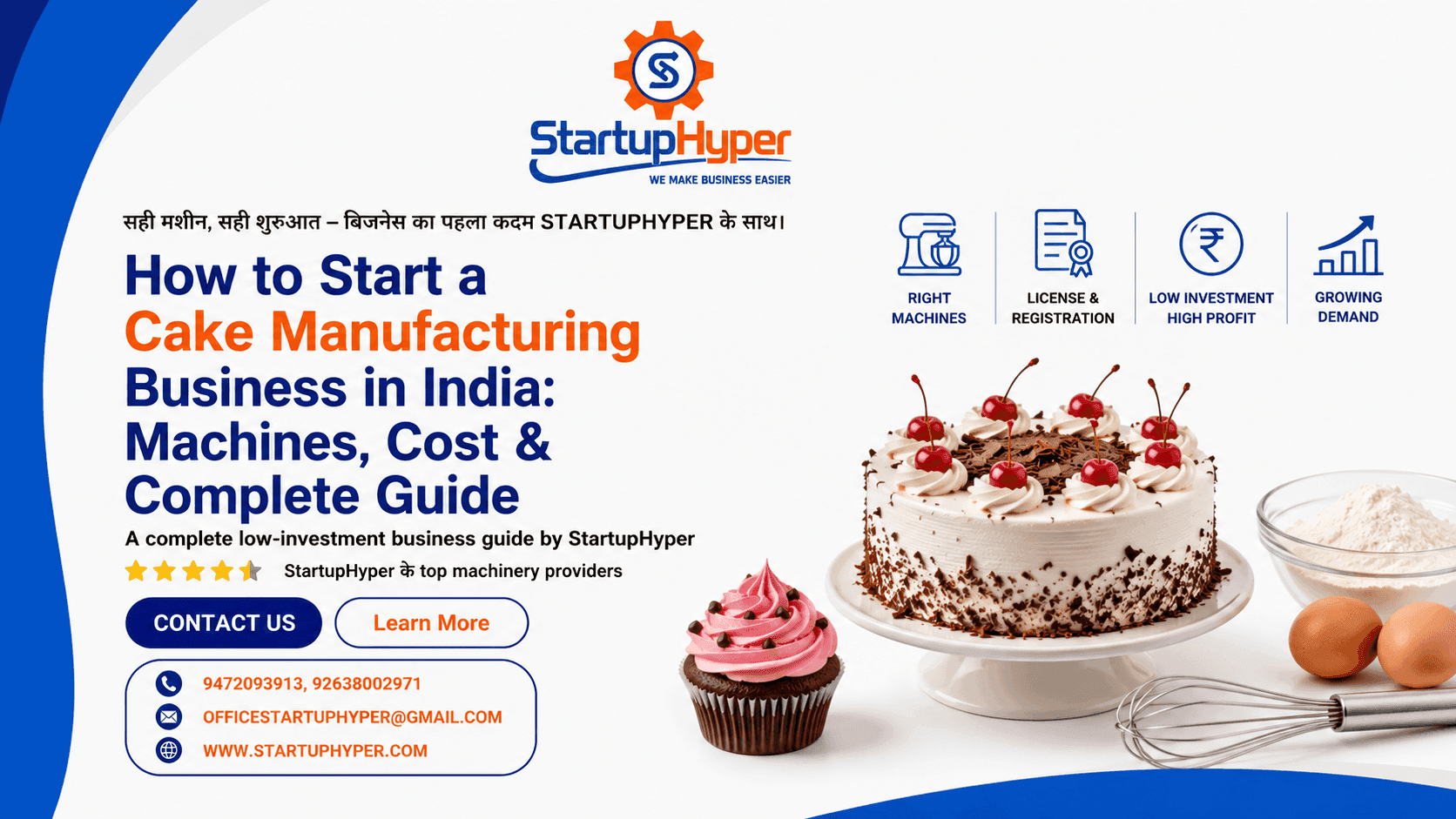
Cakes are no longer limited to birthdays and celebrations. Tea cakes, cupcakes, muffins, loaf cakes and packaged slices are sold through bakeries, cafés, grocery stores, supermarkets, school canteens, online platforms and local distributors every day.
That creates an opportunity for entrepreneurs who want to start a food-manufacturing business. But a cake manufacturing unit is different from a small home bakery. A commercial setup needs consistent recipes, reliable machinery, hygienic production, proper packaging, shelf-life planning and a clear sales channel.
This guide explains how to start a cake manufacturing business in India, including the right business model, machines, raw materials, investment, licences, production process and practical sales strategy.
“Cake business” can mean very different things. Before buying machines, decide what you want to manufacture and who you want to sell to.
| Business Model | Main Products | Main Customers | Complexity |
|---|---|---|---|
| Fresh Cake Bakery | Birthday cakes, pastries, custom cakes | Walk-in customers, events, online orders | Medium |
| Tea Cake Manufacturing | Loaf cakes, sponge cakes, muffins | Retailers, cafés, distributors | Medium |
| Packaged Cake Brand | Cupcakes, slices, mini cakes | General stores, supermarkets, distributors | Medium to High |
| Institutional Supply | Cakes, muffins, snacks | Schools, offices, caterers, canteens | Medium |
| Private-Label Manufacturing | Cakes made for another brand | Retail brands and distributors | High |
For a first-time manufacturing entrepreneur, tea cakes, muffins, cupcakes and packaged loaf cakes are often easier to standardise than customised celebration cakes.
Cake products have multiple sales opportunities:
The opportunity is not only in selling expensive designer cakes. A well-made, consistently packed ₹10, ₹20 or ₹50 cake product can create repeat sales if the taste, freshness and distribution are strong.
However, this business is competitive. Your product needs to compete on:
A cake unit does not need to start with ten products. Begin with a focused range.
| Product | Suitable For |
|---|---|
| Tea Cake | Local retail, cafés, general stores |
| Loaf Cake | Retail shelves, gifting, family packs |
| Cupcakes | Schools, cafés, events, delivery |
| Muffins | Cafés, supermarkets, snack counters |
| Cake Rusk | Retail and wholesale distribution |
| Swiss Roll | Premium bakery and snack market |
| Sliced Cake | Supermarkets and convenience stores |
| Eggless Cake | Specific customer segments and wider retail appeal |
Start with 3–5 products, test the market, and expand only after you can maintain consistent quality.
The raw-material list changes based on the recipe, but common ingredients include:
Raw-material quality directly affects taste, texture and shelf life. Do not compromise on eggs, flour, fat, flavouring or packaging only to reduce cost.
The machinery depends on your daily production capacity and product range.
| Machine / Equipment | Use |
|---|---|
| Planetary Mixer | Mixes cake batter evenly |
| Spiral Mixer | Useful for dough-based bakery products; not the main machine for all cake batters |
| Cake Depositor | Deposits equal quantity of batter into moulds or trays |
| Baking Oven | Bakes cakes, muffins, cupcakes and loaf cakes |
| Deck Oven | Suitable for smaller bakery setups |
| Convection Oven | Good for controlled small-batch baking |
| Rotary Rack Oven | Suitable for larger commercial production |
| Baking Trays and Moulds | Holds batter during baking |
| Cooling Rack / Cooling Conveyor | Cools products before packing |
| Slicing Machine | Cuts loaf cakes or cake bars uniformly |
| Cream Filling Machine | Used for filled cakes or speciality products |
| Weighing Scale | Controls batch and pack weight |
| Pouch Sealing Machine | Seals packaged cakes |
| Flow Wrap / Packaging Machine | Used for higher-volume retail packing |
| Batch Coding Machine | Prints batch number, date and MRP details |
Planetary Mixer → Cake Depositor → Oven → Cooling Rack → Packing and Sealing Machine
A planetary mixer can start from around ₹40,000 in some supplier listings, while commercial oven costs vary widely by type and capacity. Treat supplier prices only as a starting point; obtain capacity-matched quotations before finalising your project
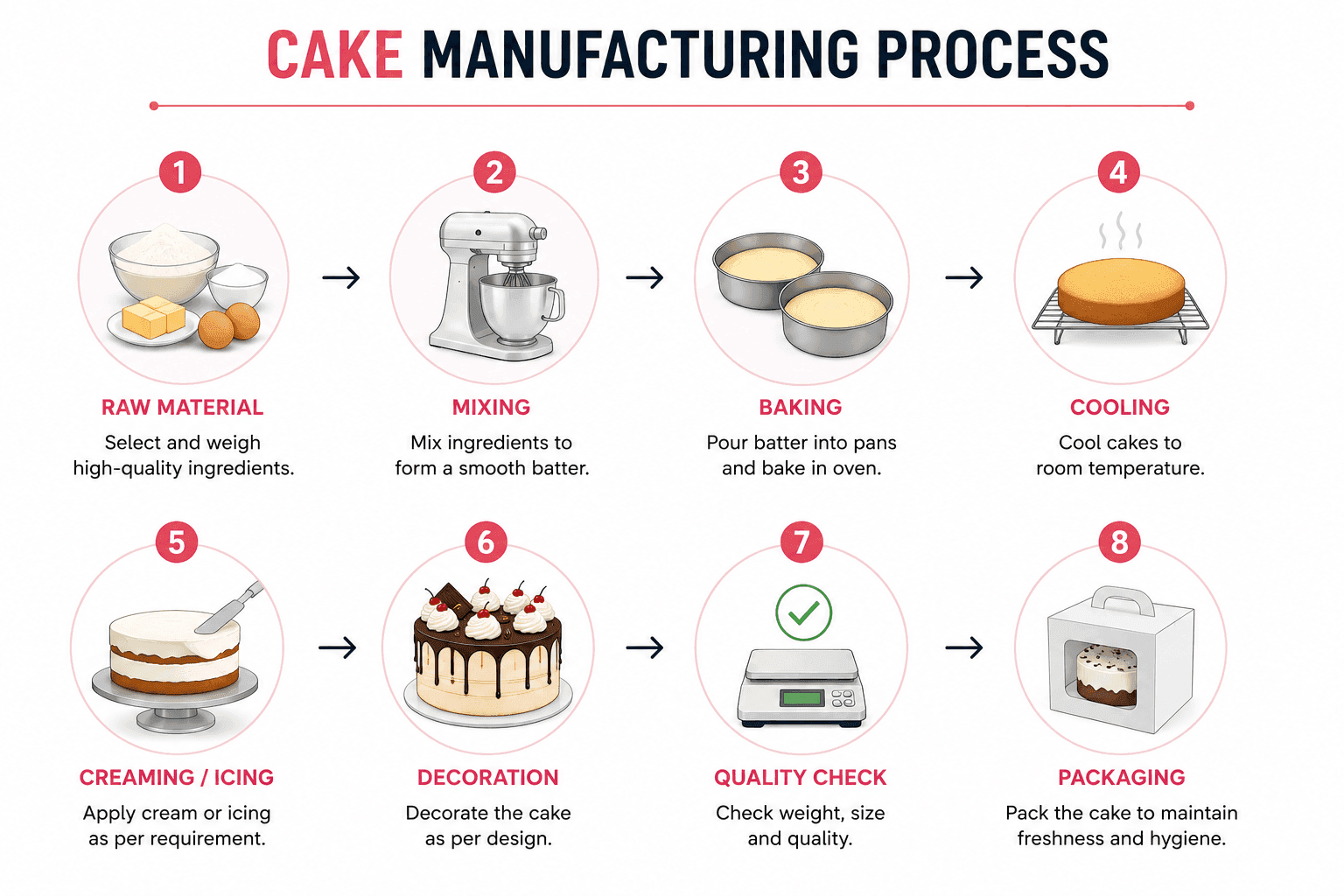
The basic production flow is:
Raw Material Receiving → Weighing → Batter Mixing → Depositing → Baking → Cooling → Slicing / Filling → Packing → Batch Coding → Dispatch
Raw Material Checking Check flour, sugar, eggs, fat, flavours and packaging material before production. Maintain clean, dry storage and follow FIFO — first in, first out — so older stock is used first.
Weighing and Batching Accurate weighing is essential. Small recipe variation can change cake texture, taste and baking quality.
Batter Mixing Ingredients are mixed in a planetary mixer according to the recipe and required consistency. Overmixing or undermixing can affect volume and texture.
Depositing The batter is placed into moulds, trays, cupcake cups or loaf tins. A depositor helps maintain uniform product weight and reduces manual variation.
Baking Products are baked in a deck oven, convection oven or rotary rack oven depending on batch size and production requirement.
Cooling Cakes must cool properly before packing. Packing hot cakes can create moisture inside the pouch and reduce product quality.
Slicing or Filling Loaf cakes may be sliced. Some products may receive cream filling, chocolate coating or toppings depending on your product range.
Packaging and Coding The final product is packed in food-grade packaging. Batch number, manufacturing date, best-before date, MRP, ingredients and FSSAI details should be printed as applicable.
| Setup Type | Approximate Space |
|---|---|
| Small Cake Production Unit | 500–800 sq. ft. |
| Medium Commercial Cake Unit | 1,000–1,500 sq. ft. |
| Larger Packaged-Cake Unit | 2,000 sq. ft. and above |
Your layout should keep these areas separate:
A clean workflow matters. Raw ingredients, baked products and packed finished goods should not be handled in the same cluttered space.
Investment depends on your product range, production capacity, automation level, location and whether you also operate a retail outlet.
| Expense Head | Approximate Range |
|---|---|
| Mixer, Oven and Basic Baking Equipment | ₹2 lakh – ₹8 lakh |
| Depositor, Moulds, Trays and Cooling Setup | ₹1 lakh – ₹4 lakh |
| Packing and Sealing Equipment | ₹50,000 – ₹5 lakh |
| Electrical, Exhaust and Installation | ₹1 lakh – ₹3 lakh |
| Interior, Flooring and Hygiene Setup | ₹1 lakh – ₹5 lakh |
| Raw Material and Packaging Stock | ₹1 lakh – ₹4 lakh |
| Branding, Labels and Initial Marketing | ₹50,000 – ₹3 lakh |
| Working Capital | ₹2 lakh – ₹8 lakh |
| Business Model | Approximate Investment |
|---|---|
| Small Tea-Cake / Cupcake Unit | ₹5 lakh – ₹10 lakh |
| Semi-Commercial Cake Manufacturing Unit | ₹10 lakh – ₹25 lakh |
| Packaged-Cake Manufacturing and Distribution Unit | ₹25 lakh and above |
A KVIC sample project profile for a cake-making unit lists machinery at about ₹12.27 lakh before GST and transport, showing why a proper capacity-based project report matters instead of relying on one generic "cake machine price."
These are indicative planning ranges. Your final investment can change based on local rent, oven type, production capacity, automation, packaging format and working-capital requirement.
A cake manufacturing unit is a food business. Compliance should be planned before launch, not after products reach the market.
Common requirements may include:
FSSAI registration or licence is required for food businesses. The official FoSCoS portal provides eligibility criteria, document requirements and the application process.
For packaged products, make sure your label follows applicable requirements for ingredients, nutrition information, allergen declaration, net quantity, batch details, dates, MRP and FSSAI details.
Do not use phrases such as "FSSAI Approved" as a marketing claim; an FSSAI licence number indicates regulatory compliance, not a blanket endorsement of product quality.
Your selling price should not be based only on what competitors charge.
For example, a cake sold to a retailer must leave enough margin for the retailer while still covering your production and distribution costs.
Do not enter the market only by offering the lowest price. A low-priced product with weak packaging, inconsistent taste or short shelf life will struggle to get repeat orders.
A manufacturing unit needs distribution.
Choose one area or one customer segment first. For example:
This is more practical than producing large quantities without a sales plan.
Shelf Life and Packaging: The Most Important Part of Packaged Cakes
Fresh cakes and packaged cakes are different businesses.
A fresh cake may sell the same day. A packaged cake needs shelf-life testing, suitable recipe formulation, hygienic production and packaging that protects it from moisture, damage and contamination.
Before launching packaged products, test:
Do not print a long "best before" date without proper product testing and compliance review.
Starting With Too Many Products: Do not launch 15 flavours on day one. Start with a limited range and build consistency first.
Buying the Wrong Oven: A small deck oven, convection oven and rotary rack oven serve different production needs. Choose based on batch size, product type, fuel availability and expected sales.
Ignoring Cooling Before Packing: Packing warm cake can create condensation and affect texture and shelf life. Weak Packaging Cake is fragile. Cheap or poorly sealed packaging can cause breakage, moisture damage and retailer complaints.
No Distribution Plan: A cake unit cannot survive only on occasional birthday orders if it is designed for daily production. Build regular retail or institutional demand.
Making Misleading Health Claims: Avoid unverified claims such as "100% healthy," "sugar-free," "preservative-free" or "high protein" unless your formulation, label and supporting evidence meet applicable standards. Recent FSSAI actions have highlighted the risk of misleading food claims.

Starting a cake manufacturing business is not only about buying an oven. The right setup depends on what you want to manufacture, your daily production target, packaging requirement and sales model.
StartupHyper can help you with:
📌 Selecting suitable cake-making machines such as planetary mixers, ovens, depositors and packing equipment
📌 Choosing a machine configuration based on tea cakes, cupcakes, muffins, loaf cakes or packaged products
📌 Understanding production capacity, power requirement and space planning
📌 Planning a clean workflow from mixing to baking, cooling and packing
📌 Guidance on packaging-machine selection and batch coding
📌 Comparing equipment quotations and avoiding unnecessary machinery
📌 Planning for future expansion as your distribution grows
Whether you want to start a small cake unit or build a packaged bakery brand, StartupHyper can help you select machinery that fits your actual production goal.
It can be profitable when product quality, distribution, pricing, packaging and wastage are controlled. Profitability depends more on repeat sales and capacity utilisation than on producing a large number of cakes.
A small tea-cake or cupcake manufacturing setup may begin around ₹5 lakh to ₹10 lakh, depending on machinery, location, packaging and working capital. A larger packaged-cake unit requires more investment.
A planetary mixer and a suitable baking oven are core machines. A depositor, cooling setup and packing machine become important as production volume increases.
Yes. Cupcakes, muffins, loaf cakes and tea cakes are practical products for a new unit because they can be standardised more easily than customised celebration cakes.
Yes. Cake manufacturing is a food business and needs FSSAI registration or licence as applicable. Use the official FoSCoS portal to check eligibility and documents.
Fresh cakes can work well for local bakery counters and online orders. Packaged cakes can reach more retailers but require stronger packaging, shelf-life planning and distribution.
Yes. Tea cakes, muffins, loaf cakes and packaged slices can be sold through grocery stores and supermarkets if the product is properly packed, labelled and regularly supplied.
A small unit may start with a baker, helper, packing staff and owner supervision. As production increases, you may add a production supervisor, delivery staff and sales support.
Yes. Eggless cakes have a strong market in many regions. However, recipe standardisation is important because eggless formulations can behave differently during mixing and baking.
Choose based on your product range, batch size, production volume, electricity or gas availability, space and budget. Ask suppliers for a live demonstration using your intended cake product before buying.
A successful cake manufacturing business starts with a focused product range, reliable recipes, hygienic production and a clear sales plan.
Start small, build consistent quality, test your market and expand your machinery only when demand grows.
Contact StartupHyper today to discuss your cake manufacturing machine requirement and plan the right bakery setup for your business.
📞Call / WhatsApp: 9472093913
📧Email: info@startuphyper.com
🌐 Website: www.startuphyper.com | www.machinehai.com
🏢 Branches: Patna | Gaya | Katihar | Saharsa
Stay updated with the latest tips, trends, and best practices in factory setup and machinery procurement—subscribe to the StartupHyper newsletter!
No spam, we promise. Your inbox is safe with us—only valuable insights.