Read the full article to gain deeper insights and comprehensive information.

Sep 12, 2026
0
Learn about waste paper recycling business, including cost, machinery, process, investment, and profit potential.
What Is a Waste Paper Recycling Business?
Why Start a Waste Paper Recycling Business?
Types of Waste Paper Recycling Products
Market Demand for Recycled Paper Products
Raw Materials Required
Waste Paper Recycling Process
Machinery Required for Waste Paper Recycling Business
Investment Required for Waste Paper Recycling Business
Cost of Waste Paper Recycling
Where to Sell Recycled Paper Products
Common Mistakes to Avoid
How StartupHyper Can Help
Frequently Asked Questions
Conclusion
A waste paper recycling business involves collecting used paper from homes, offices, schools, shops, printing presses, and other sources and converting it into reusable paper products. The collected waste paper is sorted, cleaned, processed, and converted into recycled paper, paper sheets, cardboard, packaging materials, and other useful products.
This business helps reduce the amount of paper waste sent to landfills and lowers the need for fresh raw materials. With proper machinery, waste paper collection, processing, and marketing, entrepreneurs can build a profitable business while supporting environmental sustainability and the circular economy.
Starting a waste paper recycling business can be a good opportunity for entrepreneurs because paper waste is generated regularly by households, offices, schools, shops, and industries. The business helps convert waste into useful products while creating opportunities for income and employment. With increasing awareness about waste management and sustainability, the demand for recycled paper products is also growing.
The demand for recycled paper and paper-based products is increasing as businesses and consumers look for more sustainable alternatives. Recycled paper is used for packaging, notebooks, cartons, tissue products, and other applications. This creates opportunities for entrepreneurs to supply recycled products to different customers and businesses.
Waste paper is easily available from offices, schools, printing presses, shops, households, and scrap dealers. This makes it possible to develop a regular supply network for the recycling business. Entrepreneurs can collect different types of paper waste and sort them according to their quality before processing.
A waste paper recycling business can create employment in areas such as waste collection, sorting, processing, packaging, and transportation. Workers may be required at different stages depending on the size of the unit. As the business grows, additional jobs can be created in production, sales, administration, and distribution.
Paper recycling helps reduce the amount of paper waste sent to landfills and promotes better use of available resources. It also encourages the reuse of materials that would otherwise be discarded. Therefore, the business can support both commercial activities and environmental sustainability.
With proper planning, suitable recycling machinery, and effective sales channels, a waste paper recycling business can be developed into a small or medium-sized enterprise. Entrepreneurs can start with a limited production capacity and expand operations as demand increases. The business can serve paper manufacturers, packaging companies, wholesalers, and other commercial buyers.
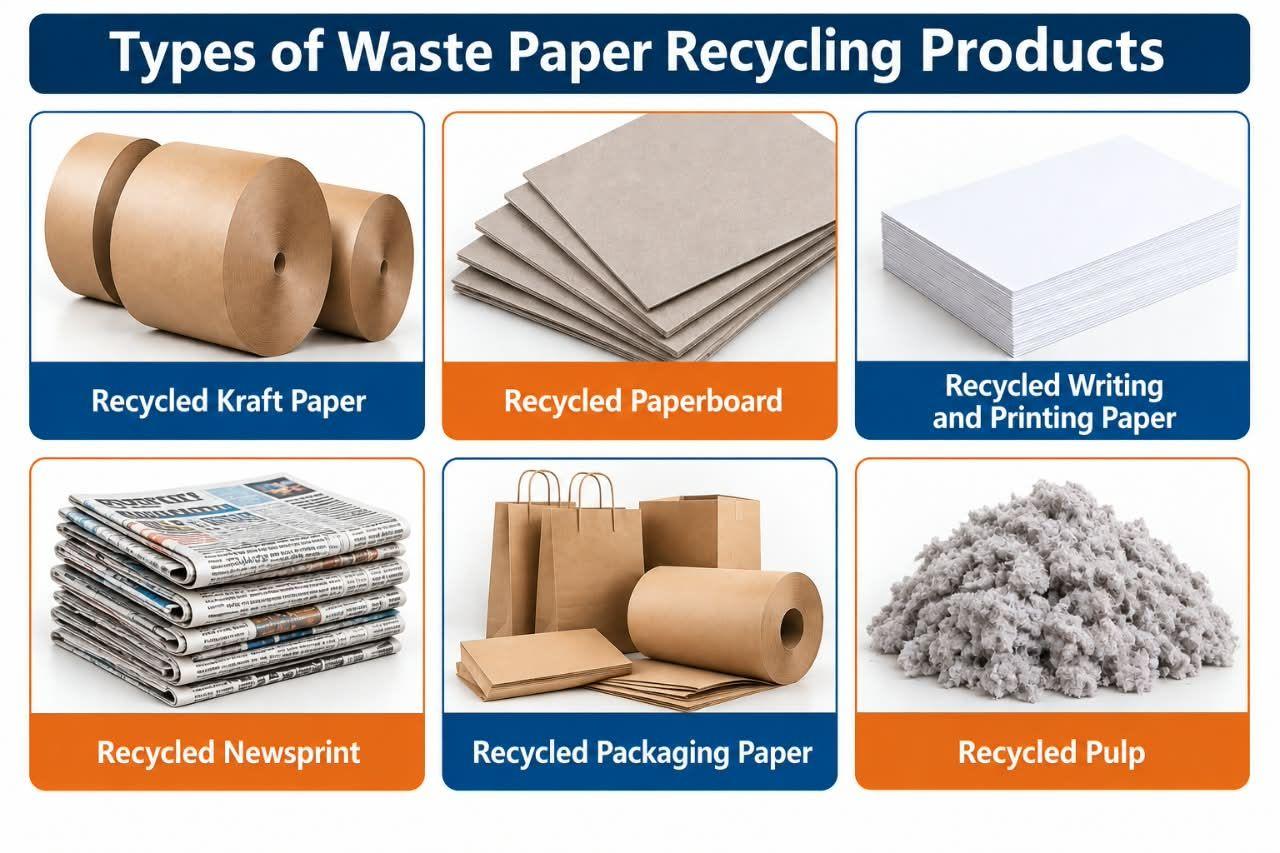
Waste paper can be recycled into different types of paper and pulp products based on the quality of waste paper, processing method, and machinery used. These recycled products are widely used in packaging, printing, newspapers, stationery, and industrial applications. The main types of waste paper recycled products include:
Used mainly for bags, wrapping, and industrial packaging.
Known for its strength and durability, making it suitable for heavy-duty applications.
Commonly supplied to packaging manufacturers and paper product businesses.
Used for making cartons, boxes, folders, and other packaging products.
It can be produced in different thicknesses and grades according to the required application.
It is widely used by packaging, food, retail, and consumer goods industries.
Used for notebooks, office papers, writing sheets, and printing applications.
It can be processed to achieve suitable smoothness, brightness, and paper quality.
Demand comes from schools, offices, stationery manufacturers, and printing businesses.
Used for producing newspapers, advertising inserts, and other printed materials.
It is generally made from suitable grades of recovered paper and processed into lightweight sheets.
Newspaper publishers and printing businesses are major users of newsprint.
Used for wrapping, paper bags, cartons, and various packaging applications.
It provides a useful alternative to some virgin paper packaging materials.
It is used by retailers, manufacturers, wholesalers, and packaging companies.
Recycled pulp is produced by processing waste paper into a fibrous pulp material.
It can be used as a raw material for manufacturing paper, paperboard, and moulded paper products.
Recycled pulp can be supplied to paper mills and other paper product manufacturers for further processing.
The demand for recycled paper products is increasing as businesses, industries, and consumers become more aware of environmental sustainability and waste management. Recycled paper is widely used in packaging, printing, stationery, newspapers, and various industrial applications. The growth of e-commerce, retail, food packaging, and other commercial activities is also creating opportunities for recycled paper manufacturers and suppliers.
The packaging industry is one of the major users of recycled paper and paperboard. E-commerce, food, retail, and manufacturing businesses require cartons, boxes, wrapping paper, and other packaging materials. This growing requirement creates opportunities for businesses producing recycled kraft paper, paperboard, and packaging paper.
Recycled writing and printing paper is used for notebooks, office stationery, school materials, printing, and other purposes. Schools, offices, publishers, and stationery manufacturers can create regular demand for these products. Different paper grades and sizes can be produced according to the requirements of customers.
Growing awareness about eco-friendly products and sustainable practices is encouraging businesses and consumers to choose recycled paper. Companies may use recycled paper for packaging, stationery, and promotional materials as part of their environmental initiatives. This changing preference can support the long-term market for recycled paper products.
Recycled pulp and processed waste paper are used as raw materials by paper and paperboard manufacturers. Recycling units can supply these materials to paper mills and other manufacturers that require a regular supply of suitable-quality recycled material. Maintaining consistent quality can help businesses develop long-term relationships with industrial buyers.
The growing market provides opportunities for small and medium-sized recycling businesses to serve local and industrial customers. Entrepreneurs can supply recycled products to wholesalers, packaging companies, printing businesses, stationery manufacturers, and other bulk buyers. Starting with selected products and gradually increasing production can help a business expand according to market demand.
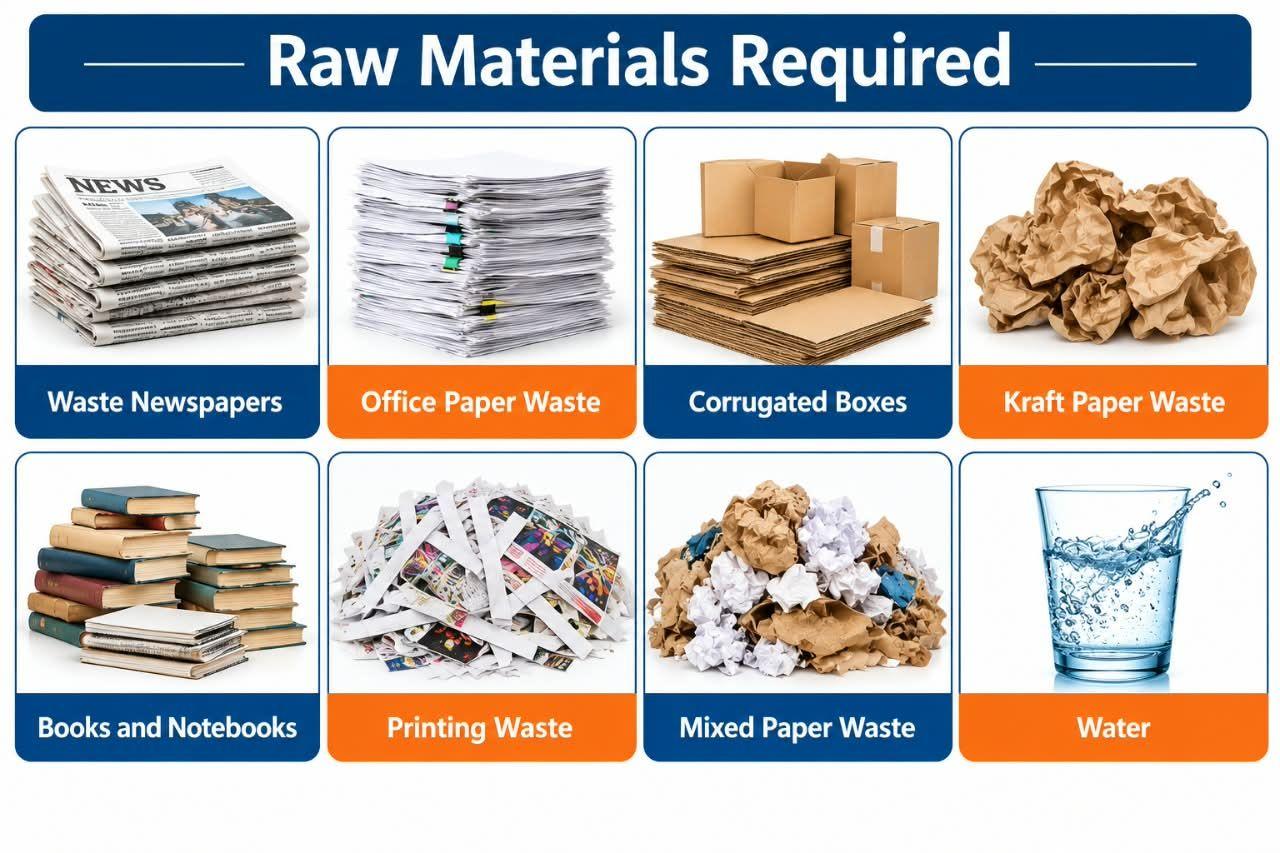
The main raw material for a waste paper recycling business is used paper collected from different sources. The type and quality of waste paper determine the quality of the recycled products. A recycling unit may collect and process different grades of paper waste depending on the products it plans to manufacture.
Waste newspapers are commonly collected from homes, offices, shops, and newspaper vendors. They can be processed to produce recycled newsprint, paper, and other paper products.
Office paper waste includes used printing paper, photocopy paper, and documents. This type of waste paper can be sorted and processed for producing recycled writing and printing paper.
Used corrugated boxes and cartons are an important source of recyclable paper. They can be processed into recycled paperboard, kraft paper, and other packaging materials.
Kraft paper waste is collected from packaging units, warehouses, shops, and industries. Due to its strength, it can be recycled into kraft paper and other packaging products.
Old books, notebooks, registers, and unused paper materials can be collected from schools, offices, households, and scrap dealers. They can be sorted and processed for making recycled paper and pulp.
Printing waste includes paper cuttings, rejected sheets, unused printed paper, and production waste from printing presses. It can be recycled after proper sorting and removal of unsuitable materials.
Mixed paper waste consists of different types of paper collected together from households, offices, commercial establishments, and scrap collection points. It requires proper sorting before being used in the recycling process.
Water is required during various stages such as pulping, cleaning, and processing of waste paper. An adequate and regular water supply is important for maintaining smooth recycling operations.
The waste paper recycling process involves converting used and discarded paper into reusable paper products through several stages. The collected paper is first sorted according to its type and quality, after which it is processed to remove unwanted materials and impurities. The paper is then converted into pulp, cleaned, and treated before being formed into new paper or paper-based products. Proper processing at each stage helps improve the quality, strength, and usability of the final recycled product.
Waste paper is collected from households, offices, schools, printing presses, shops, industries, and scrap dealers. The collected material is transported to the recycling unit for further processing. Regular collection helps maintain a continuous supply of raw material for production.
The collected paper is sorted according to its type, quality, colour, and condition. Materials such as plastic, metal, tape, staples, and other unwanted items are removed during this stage. Proper sorting helps maintain the quality of the recycled paper.
The sorted paper is cut or shredded into smaller pieces using suitable shredding equipment. Smaller pieces make it easier to mix the paper with water during the pulping stage. This also helps the paper fibres break down more efficiently.
The shredded paper is mixed with water and processed in a pulper to break it down into a soft fibre mixture called pulp. This stage separates the paper fibres and prepares them for further cleaning. The consistency of the pulp is maintained according to the required product.
The pulp is passed through screens and cleaning equipment to remove dirt, plastic pieces, staples, sand, and other unwanted materials. This helps improve the purity and quality of the recycled pulp. Proper screening also protects the machinery used in later stages.
When required, the pulp is treated to remove ink, printing colour, and other unwanted substances. De-inking is particularly important when producing lighter-coloured recycled paper. The process helps improve the appearance and quality of the finished paper.
Depending on the required product quality, the pulp may undergo bleaching and refining. Refining improves the properties of paper fibres, while bleaching can help achieve the required brightness. The treatment is selected according to the type of recycled paper being produced.
The processed pulp is spread over a paper-making screen or forming machine to create a wet paper sheet. Water is removed from the pulp during this stage, allowing the fibres to form an even layer. The thickness of the sheet depends on the product requirements.
The wet paper sheets are passed through pressing and drying equipment to remove excess water. Heat and mechanical pressure help produce stronger and properly dried paper sheets. Proper drying also helps prevent moisture-related problems during storage.
The dried paper is finished, trimmed, and cut into the required size, thickness, and shape. Depending on the product, it may be converted into sheets, rolls, paperboard, or other recycled paper products. Finishing gives the product its required final appearance.
The finished products are checked for thickness, strength, moisture, appearance, and overall quality. Products that meet the required standards are prepared for packaging and sale. Regular quality checks help maintain consistency between different production batches.
The final recycled paper products are properly packed and stored in a clean and dry area. Proper packaging protects the products from moisture, dust, and damage before transportation to customers. Finished products can then be supplied to wholesalers, manufacturers, retailers, and other buyers.
A waste paper recycling unit requires different types of machinery and equipment to convert collected paper waste into usable recycled paper products. The machinery required depends on the production capacity, type of waste paper, and final product. A small unit may use basic machines, while larger units require an integrated production line for efficient and continuous processing.
A waste paper shredder cuts collected paper into smaller pieces before pulping. It helps make the paper easier to process and improves the efficiency of the pulping stage.
A hydrapulper machine mixes shredded paper with water and breaks it down into paper fibres. It is one of the main machines used for converting waste paper into pulp.
A screening machine removes plastic, staples, tape, dirt, and other unwanted materials from the pulp. It helps improve the cleanliness and quality of recycled pulp.
A de-inking machine helps remove ink, printing colour, and other contaminants from waste paper pulp. It is mainly required when producing cleaner or lighter-coloured recycled paper.
The pulp cleaning machine separates heavy and light impurities from the paper pulp. It helps produce cleaner pulp suitable for further processing.
A bleaching machine is used when a higher level of paper brightness is required. The use of bleaching depends on the type and quality of the final recycled paper product.
A refining machine improves the strength and bonding properties of paper fibres. It prepares the pulp to produce paper with the required quality and characteristics.
The paper making machine converts processed pulp into continuous paper sheets or rolls. It controls important factors such as paper thickness, formation, and production speed.
A pressing machine removes excess water from newly formed paper sheets and helps compact the paper fibres. This stage improves the strength and reduces the moisture content of the paper.
The drying machine removes the remaining moisture from the paper using controlled heat and airflow. Proper drying is important for producing stable and usable recycled paper.
A cutting and rewinding machine converts large paper rolls into smaller rolls or sheets of the required size. It helps prepare the finished paper for different customers and applications.
A baling machine compresses waste paper into compact bales for easier handling, storage, and transportation. It can be particularly useful for recycling units that collect and process large quantities of waste paper.
The investment required for a waste paper recycling business depends on the production capacity, machinery, land or building requirements, labour, and working capital. A small-scale unit can be started with relatively lower investment, while a medium or large-scale plant requires more advanced machinery and infrastructure. The following table gives an approximate idea of the major investment requirements.
| Investment Component | Approximate Cost |
|---|---|
| Land/Workspace & Setup | ₹5–15 lakh |
| Waste Paper Recycling Machinery | ₹15–40 lakh |
| Electrical Installation | ₹2–5 lakh |
| Water & Processing Setup | ₹1–3 lakh |
| Labour & Staff Setup | ₹1–3 lakh |
| Packaging & Storage | ₹1–3 lakh |
| Licenses & Registration | ₹50,000–₹1.5 lakh |
| Transportation | ₹2–5 lakh |
| Working Capital | ₹5–15 lakh |
| Estimated Total Investment | ₹32.5–90.5 lakh |
These are indicative estimates. Actual investment may vary depending on machinery capacity, location, automation level, land ownership, and production requirements.
The cost of waste paper recycling includes expenses related to raw materials, electricity, labour, transportation, packaging, storage, and machinery maintenance. The exact cost depends on the scale of the unit, type of waste paper, machinery, production capacity, and local operating expenses. Proper management of these costs is important for maintaining efficient production and achieving good profit margins.
| Cost Component | What It Includes |
|---|---|
| Raw Material Cost | Purchase of waste newspaper, office paper, cardboard, kraft paper, books, notebooks, and mixed paper waste |
| Electricity Cost | Power required for shredders, pulpers, screens, pumps, paper-making machines, and dryers |
| Labour Cost | Wages for workers involved in collection, sorting, machine operation, processing, packaging, and loading |
| Transportation Cost | Cost of collecting waste paper and transporting raw materials and finished products |
| Packaging Cost | Paper, plastic wrapping, straps, labels, cartons, and other packaging materials |
| Maintenance Cost | Regular servicing, repairs, spare parts, and maintenance of recycling machinery |
| Storage Cost | Expenses related to storing waste paper, pulp, and finished recycled paper products |
| Other Operating Costs | Cleaning, administrative expenses, safety equipment, and other day-to-day business expenses |
_ The actual recycling cost may vary depending on the production capacity, machinery, type of waste paper, location, labour rates, and operating expenses_.
Recycled paper products can be sold through direct business sales, wholesalers, distributors, retailers, and online channels. Entrepreneurs can choose sales channels based on their product type, production capacity, and target customers. Building regular relationships with bulk buyers can help create stable demand and improve business growth.
Recycled paper, kraft paper, paperboard, and recycled pulp can be supplied directly to paper mills and packaging manufacturers. These businesses often require paper materials in bulk for further processing and manufacturing.
Recycled writing and printing paper can be sold to printing presses, publishers, stationery manufacturers, schools, and offices. Developing regular supply arrangements with these customers can provide consistent orders.
Wholesalers and distributors can purchase recycled paper products in bulk quantities and supply them to retailers and smaller businesses. This channel can help recycling units reach a wider market without managing every retail sale directly.
Products such as recycled paper, paper bags, notebooks, and packaging materials can be supplied to local shops, retailers, supermarkets, and other businesses. Direct local sales can be useful for small recycling units targeting nearby customers.
Using mixed or contaminated waste paper without proper sorting can affect the quality of recycled products. Entrepreneurs should develop reliable sources and ensure proper segregation before processing.
Starting production without understanding the market demand can lead to unsold inventory. It is important to identify potential customers and their product requirements before selecting the type of recycled paper to manufacture.
Selecting machinery without considering production capacity, paper type, and processing requirements can increase costs and reduce efficiency. Entrepreneurs should choose equipment according to their planned production scale and product range.
Failing to track expenses such as raw materials, electricity, labour, transportation, packaging, and maintenance can reduce profit margins. Maintaining proper cost records helps identify unnecessary expenses and control operating costs.
Inconsistent paper thickness, strength, moisture, and appearance can result in customer complaints and rejected products. Regular quality checking should be carried out throughout the production process.
Storing waste paper or finished products in a damp or unclean area can cause moisture damage and reduce product quality. Raw materials and finished goods should be stored in a clean, dry, and properly organized space.
Relying on only one customer can create problems if orders are reduced or stopped. Developing relationships with multiple buyers, wholesalers, manufacturers, and distributors can provide greater stability to the business.

StartupHyper can help entrepreneurs who want to start a waste paper recycling business by providing useful information and guidance about business planning, machinery, investment, raw materials, production process, and market opportunities. This can help entrepreneurs understand the basic requirements before setting up their recycling unit.
Entrepreneurs can also explore information related to business setup, cost management, marketing, selling channels, and growth opportunities. The available guidance can make the initial planning process easier and help entrepreneurs make informed decisions while developing their business.
• Get guidance on planning and setting up a waste paper recycling business.
• Understand the machinery and equipment required for the recycling unit.
• Estimate major investment and operating costs before starting the business.
• Learn about different types of waste paper and possible sourcing options.
• Understand market demand, potential customers, and selling opportunities.
• Learn about the basic recycling process and different production stages.
• Explore ways to reach potential buyers and develop effective sales channels.
• Identify opportunities for business expansion and long-term growth.
A waste paper recycling business involves collecting, sorting, and processing used paper to produce recycled paper, paperboard, kraft paper, recycled pulp, and other useful paper products.
Yes, a waste paper recycling business can be profitable when there is proper raw material sourcing, cost management, efficient production, good product quality, and steady market demand.
The investment depends on factors such as production capacity, machinery, workspace, labour, transportation, and working capital. A small or medium-sized unit may require comparatively lower investment than a large automated plant.
Common recyclable materials include waste newspapers, office paper, corrugated boxes, kraft paper, books, notebooks, printing waste, and mixed paper waste.
Common machinery includes a waste paper shredder, hydrapulper, screening machine, de-inking machine, pulp cleaning machine, paper-making machine, pressing machine, drying machine, and cutting machine.
Recycled paper can be used to produce kraft paper, paperboard, writing and printing paper, newsprint, packaging paper, and recycled pulp.
Recycled paper products can be sold to paper manufacturers, packaging companies, printing presses, stationery businesses, wholesalers, distributors, retailers, and other local businesses.
The main costs include waste paper purchase, electricity, labour, transportation, packaging, storage, machinery maintenance, and other operating expenses.
A waste paper recycling business can be a promising opportunity for entrepreneurs looking to enter the recycling and waste management sector. With proper sourcing of waste paper, suitable machinery, an efficient recycling process, and good quality control, the business can produce useful products such as recycled paper, paperboard, kraft paper, and recycled pulp.
Success in this business depends on effective cost management, consistent product quality, reliable buyers, and proper market planning. By focusing on sustainable production, efficient operations, and strong customer relationships, entrepreneurs can build a profitable and environmentally responsible waste paper recycling business.
📞Call / WhatsApp: 9472093913
📧Email: info@startuphyper.com
🌐 Website: www.startuphyper.com | www.machinehai.com
🏢 Branches: Patna | Gaya | Katihar | Saharsa
Stay updated with the latest tips, trends, and best practices in factory setup and machinery procurement—subscribe to the StartupHyper newsletter!
No spam, we promise. Your inbox is safe with us—only valuable insights.