Read the full article to gain deeper insights and comprehensive information.

Sep 10, 2026
0
Learn how to start a plastic item manufacturing business, including product types, raw materials, machinery, manufacturing process, marketing, and selling strategies.
What is Plastic Item Manufacturing Business?
Why Start a Plastic Item Manufacturing Business?
Types of Plastic Items You Can Manufacture
Market Demand for Plastic Products
Raw Materials Required
Plastic Manufacturing Process
Machinery Required for Plastic Item Manufacturing
Investment Required for Plastic Item Manufacturing Business
Cost of Manufacturing Plastic Items
How to Sell Plastic Products
Common Mistakes to Avoid
How StartupHyper Can Help
Frequently Asked Questions
Conclusion
A plastic item manufacturing business involves producing different types of plastic products by using plastic raw materials and specialized machinery. These products can include household items, storage containers, packaging products, industrial components, and other everyday plastic goods. The type of products manufactured can be selected according to market demand, available investment, production capacity, and target customers. Entrepreneurs can also focus on a specific product category instead of manufacturing multiple products.
The manufacturing process generally includes melting, moulding, cooling, trimming, and packaging the plastic products. Different machines and moulds are used depending on the size, shape, and design of the product. The finished products are then checked for quality, strength, appearance, and proper finishing before being packed and supplied to customers. Depending on the product and production capacity, entrepreneurs can start this business on a small, medium, or large scale.
Starting a plastic item manufacturing business can be a good opportunity for entrepreneurs because plastic products are used across households, retail, packaging, agriculture, construction, and various industries. With the right product selection, machinery, quality control, and marketing strategy, a business can develop a regular customer base and expand its production over time.
Plastic products are widely used in daily life and commercial activities, creating continuous demand for many permitted plastic items. Products such as containers, household goods, packaging materials, and industrial components are purchased by different types of customers.
Entrepreneurs can manufacture a variety of plastic items according to their investment and target market. Choosing the right product category allows the business to focus on specific customers and market requirements.
A plastic manufacturing business can be started on a small or medium scale and expanded as sales increase. Entrepreneurs can gradually add new moulds, machinery, product designs, and production capacity to grow the business.
Plastic products can be sold through wholesalers, retailers, distributors, businesses, and direct customers. Using multiple sales channels can help manufacturers reach a wider market and generate more regular orders.
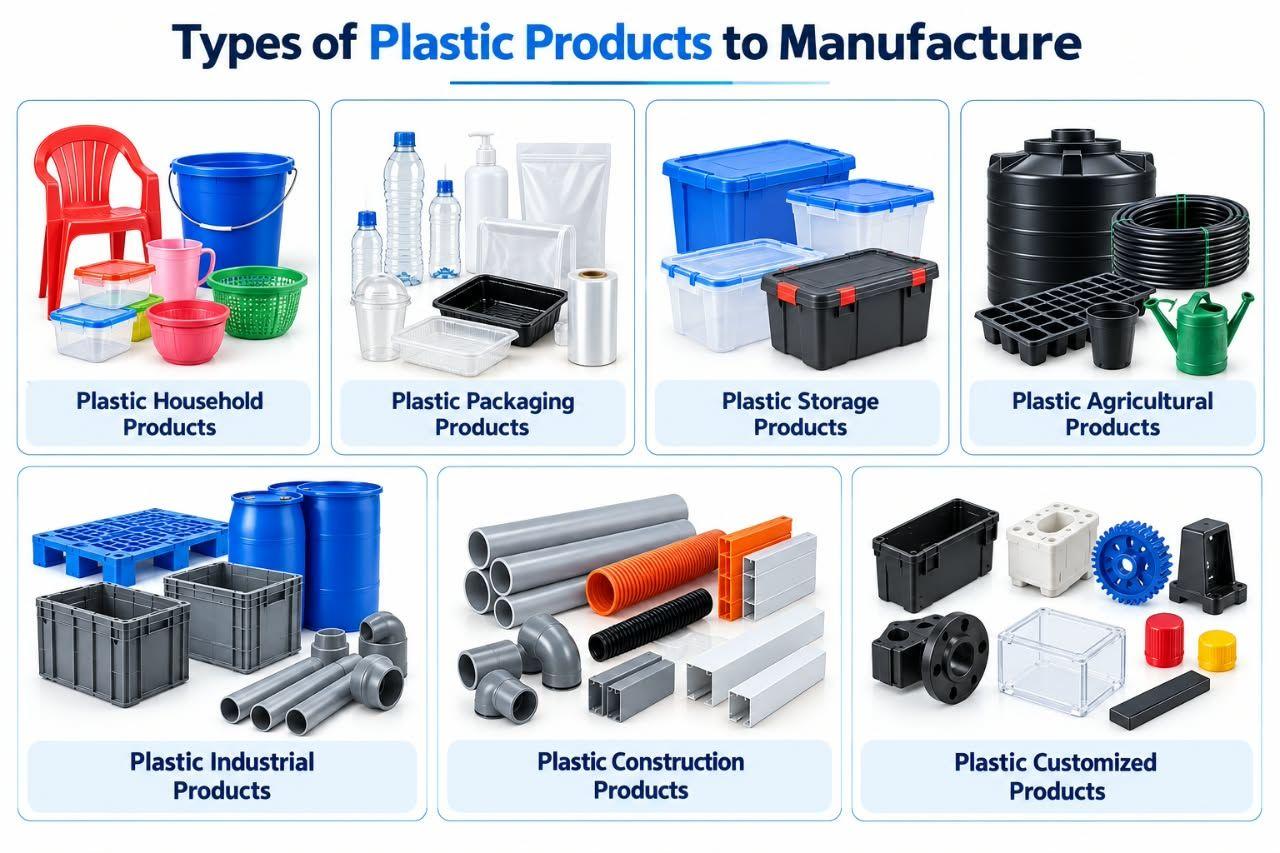
Plastic manufacturing offers a wide range of products for households, businesses, packaging, agriculture, construction, and industrial use. Entrepreneurs can choose products based on market demand, investment, machinery, mould requirements, and production capacity.
Plastic products have a wide market demand because they are used in households, retail businesses, packaging, agriculture, construction, and various industries. Their lightweight nature, durability, affordability, and availability in different designs make them useful for many applications. The demand for plastic products can vary according to the product category, customer requirements, local market, and applicable government regulations.
Plastic products are commonly used in homes, shops, offices, and commercial spaces for storage, cleaning, packaging, and other daily activities. This creates regular demand for many permitted plastic products.
Many businesses require plastic products for packaging, storage, transportation, and product components. Manufacturers can supply products in different sizes and designs according to the requirements of these businesses.
Plastic products can be sold to retailers, wholesalers, distributors, industries, institutions, and direct customers. Having multiple customer segments can help manufacturers develop a broader market for their products.
Manufacturers can produce different types of plastic products using different moulds, designs, sizes, and materials. This allows businesses to introduce new products based on changing market demand and customer preferences.
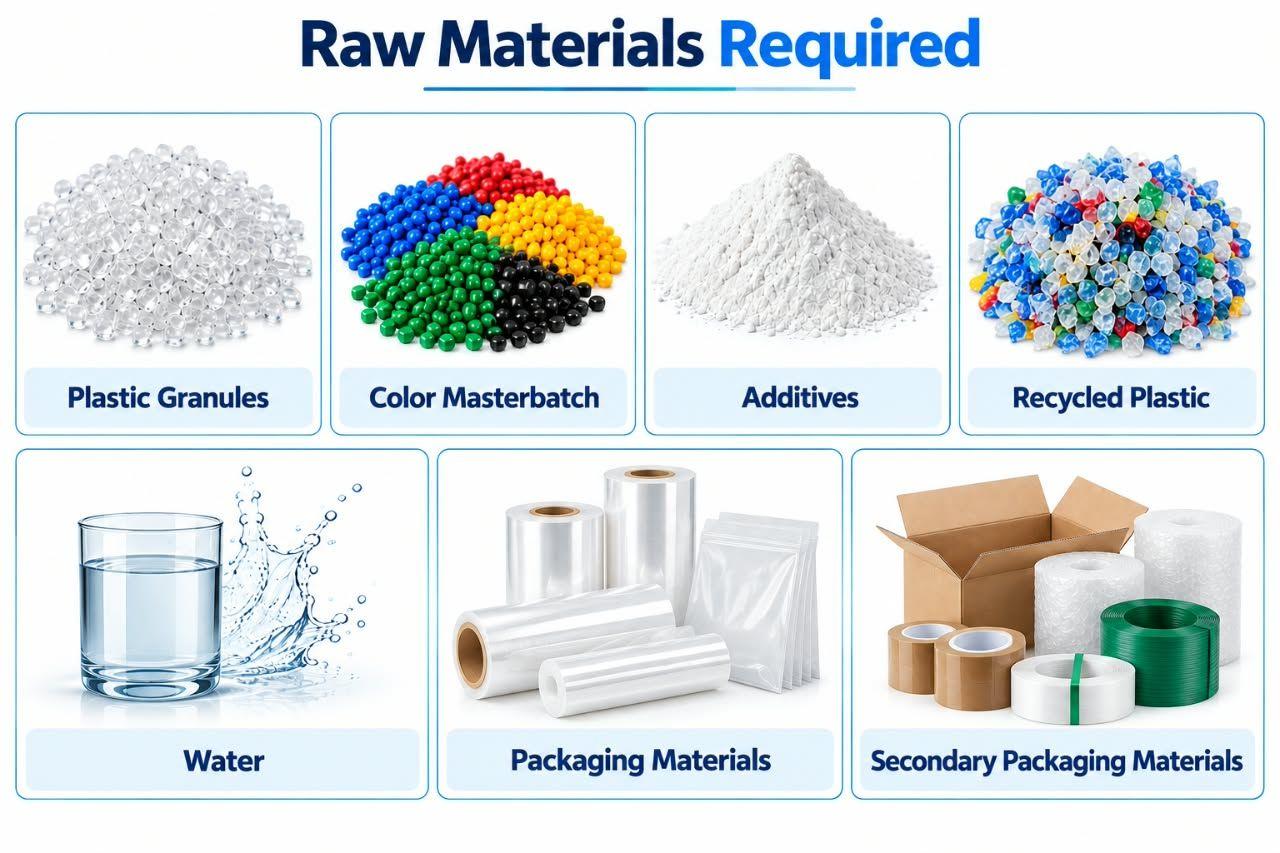
The raw materials required for a plastic manufacturing business depend on the type of product, manufacturing process, required strength, design, and quality. Choosing suitable materials is important for maintaining consistent product quality and controlling production costs. Proper storage of raw materials is also important to prevent moisture, contamination, and material wastage. Common raw materials include:
Plastic granules are the main raw material used for manufacturing many plastic products. Common options include PP (Polypropylene), HDPE (High-Density Polyethylene), LDPE (Low-Density Polyethylene), and ABS, depending on the product requirements. The grade of plastic should be selected according to the strength, flexibility, durability, and intended use of the final product.
Colour masterbatch is added to plastic material to give the finished product the desired colour and appearance. Different colours can be selected according to product design and customer requirements. The correct masterbatch helps maintain uniform colour throughout the manufactured products and improves the overall appearance of the finished item.
Different additives may be mixed with plastic materials to achieve specific properties, performance, appearance, or processing characteristics. The type and quantity depend on the product and manufacturing process. Additives should be used in the required proportion to maintain product quality and proper processing. Some additives may also help improve durability, flexibility, or resistance where required.
Recycled plastic material can be used for suitable products where the required quality and application standards allow it. It can help reduce raw material costs and support better utilization of plastic waste. The quality of recycled material should be checked before use to maintain consistent production and product quality. Its suitability depends on the type of product and required quality standards.
Water may be required for machine cooling, mould cooling, cleaning, and other manufacturing-related activities. The quantity of water required depends on the machinery, production capacity, and cooling system used in the manufacturing unit. Proper water management can help maintain efficient production and prevent unnecessary wastage.
Finished plastic products require suitable packaging for storage, transportation, and delivery. Common primary packaging materials can include plastic bags, pouches, wrapping films, labels, and other suitable packaging materials. Proper primary packaging helps protect the product from dust, moisture, scratches, and other forms of damage.
Secondary packaging materials are used to group, protect, store, and transport multiple finished products. Common materials include corrugated boxes, cartons, adhesive tape, strapping material, and protective wrapping materials. Good secondary packaging helps reduce product damage during handling, storage, and transportation.
The plastic manufacturing process involves several stages that convert plastic raw materials into finished products. The exact process may vary depending on the type of plastic, product design, machinery, mould, and required quality. In general, the process includes material preparation, mixing, heating, moulding, cooling, finishing, quality checking, and packaging.
The required plastic granules, colour masterbatch, additives, and recycled material, if suitable, are collected according to the product requirements. The materials are checked for quality, cleanliness, and suitability before production begins. Proper preparation helps maintain consistent production and reduces material-related defects.
Plastic granules are mixed with the required colour masterbatch, additives, and suitable recycled material, if applicable. The materials are mixed properly to achieve a uniform composition and colour throughout the batch. The correct proportion of each material is important for maintaining the required product properties.
The prepared plastic material is fed into the manufacturing machine, where it is heated and melted at a controlled temperature. The required temperature depends on the type and grade of plastic being processed. Proper temperature control helps achieve smooth processing and reduces the chances of defects.
The melted plastic is transferred into a mould that gives the material its required shape and design. Depending on the product, methods such as injection moulding, blow moulding, or other suitable moulding processes can be used. The mould must be properly designed and maintained to produce products with accurate dimensions.
After moulding, the plastic product is cooled inside or around the mould so that it becomes firm and retains its required shape. Cooling may be carried out using a suitable water-cooling or other cooling system. Proper cooling helps maintain the product's dimensions, strength, and surface finish.
Once the product has cooled sufficiently, it is carefully removed from the mould using the machine's ejection system or suitable handling method. The product is inspected during removal to ensure it has been properly formed. The mould is then prepared for the next production cycle.
Any extra plastic, edges, flash, or unwanted material is removed from the finished product. Additional finishing may include smoothing edges or carrying out minor corrections where required. This stage helps improve the appearance, usability, and overall finishing quality of the product.
The finished products are checked for size, shape, colour, strength, surface finish, and other required specifications. Manufacturers may also inspect products for cracks, deformation, uneven colour, or moulding defects. Products that do not meet the required quality standards are separated from approved products.
After quality checking, the approved plastic products are packed using suitable primary and secondary packaging materials. Packaging protects the products from dust, moisture, scratches, breakage, and handling damage. Products are then labelled or arranged according to customer and dispatch requirements.
The packaged products are stored in a clean, dry, and suitable storage area until they are ready for delivery. Products are organized according to product type, quantity, and customer orders. They are then dispatched to wholesalers, retailers, distributors, businesses, or other customers.
The machinery required for a plastic manufacturing business depends on the type of product, production capacity, plastic material, moulding method, and level of automation. Selecting suitable machinery helps maintain consistent product quality, production speed, and efficient use of raw materials. Common machinery and equipment used in plastic product manufacturing include:
An injection moulding machine is widely used to manufacture products by injecting melted plastic into a mould. It can be used for making products such as containers, household items, caps, fittings, and various moulded components.
A blow moulding machine is mainly used to manufacture hollow plastic products. It can be used for products such as bottles, containers, cans, and other hollow shapes.
An extrusion machine melts plastic material and pushes it through a specially designed die to create products with a continuous shape. It can be used for manufacturing plastic pipes, sheets, profiles, films, and similar products.
A plastic granule mixer is used to mix plastic granules with colour masterbatch, additives, and suitable recycled material. Proper mixing helps maintain uniform material composition and colour during production.
A plastic grinder or granulator is used to reduce suitable plastic waste, rejected products, or leftover material into smaller pieces or granules. This material may be reused in production where product requirements and quality standards permit.
Moulds and dies are essential for giving plastic material its required shape, size, and design. Different products require different moulds, and their quality can directly affect product accuracy, finishing, and production efficiency.
A cooling system is used to cool the mould and newly formed plastic products during manufacturing. Water chillers, cooling towers, or other suitable systems may be used depending on the machine and production requirements.
An air compressor supplies compressed air required by certain plastic manufacturing machines and related equipment. It is particularly important in processes such as blow moulding and for operating pneumatic components.
Trimming and finishing equipment is used to remove excess plastic, flash, rough edges, and unwanted material from finished products. It helps improve the product's appearance, usability, and final finishing.
Packaging machinery is used to pack, seal, label, or prepare finished products for storage and transportation. The type of packaging machine depends on the product size, packaging material, and required production volume.
Digital weighing machines and weighing scales are used to measure plastic raw materials, additives, masterbatch, and finished products accurately. Proper weighing helps maintain the correct material proportion, product weight, and consistency during production.
Quality testing equipment is used to check the strength, dimensions, weight, thickness, appearance, and other required properties of plastic products. Depending on the product, manufacturers may use measuring instruments, thickness gauges, weighing scales, and other testing equipment to maintain consistent quality.
The investment required for a plastic item manufacturing business depends on the type of products, production capacity, machinery, moulds, workspace, raw materials, and level of automation. A small-scale unit can be started with comparatively lower investment, while a medium or large manufacturing setup requires higher capital for advanced machinery and working capital. The estimated investment can be divided into the following major components:
| Investment Component | Estimated Cost |
|---|---|
| Plastic Manufacturing Machinery | ₹5 lakh – ₹20 lakh |
| Moulds and Dies | ₹1 lakh – ₹8 lakh |
| Raw Materials | ₹1 lakh – ₹5 lakh |
| Electrical Setup and Installation | ₹50,000 – ₹2 lakh |
| Cooling and Other Equipment | ₹50,000 – ₹3 lakh |
| Weighing & Quality Testing Equipment | ₹25,000 – ₹1.5 lakh |
| Packaging Setup and Materials | ₹30,000 – ₹1.5 lakh |
| Workspace Setup | ₹1 lakh – ₹5 lakh |
| Working Capital | ₹2 lakh – ₹8 lakh |
| Total Estimated Investment | ₹11.55 lakh – ₹54 lakh |
These are indicative estimates. Actual investment can vary significantly depending on the product category, machine capacity, mould specifications, location, and scale of operations.
The cost of manufacturing plastic items depends on factors such as the type of product, raw material price, electricity consumption, labour, packaging, machine maintenance, and production volume. Proper cost calculation helps manufacturers set competitive selling prices and estimate their profit margin. The major manufacturing costs generally include:
| Cost Component | What It Includes |
|---|---|
| Raw Material Cost | Plastic granules, recycled material, colour masterbatch, and additives |
| Electricity Cost | Power consumed by moulding, heating, cooling, mixing, and other machinery |
| Labour Cost | Wages or salaries of machine operators, helpers, quality staff, and packaging workers |
| Packaging Cost | Primary and secondary packaging materials used for finished products |
| Maintenance Cost | Regular maintenance, spare parts, mould maintenance, and machine servicing |
| Water & Cooling Cost | Water and related expenses for cooling systems, cleaning, and production |
| Transportation Cost | Movement of raw materials and finished products |
| Other Operating Costs | Rent, administrative expenses, wastage, and other day-to-day business expenses |
The per-unit manufacturing cost can be calculated by dividing the total production cost by the number of saleable products manufactured. Increasing production efficiency, reducing material wastage, and controlling operating expenses can help lower the overall cost per unit.
Plastic products can be sold through offline as well as online channels, depending on the product type, target customers, production capacity, and business scale. Manufacturers can focus on building relationships with retailers, wholesalers, distributors, industries, and direct customers to generate regular orders. Using multiple sales channels can help increase market reach and create a stable customer base.
Plastic products can be supplied to local grocery stores, household stores, hardware shops, and other relevant retailers. Regular supply and competitive pricing can help build long-term relationships with retailers.
Selling products to wholesalers can help manufacturers move larger quantities in fewer transactions. Wholesalers can further distribute the products to retailers and smaller businesses across different markets.
Manufacturers can appoint distributors to expand their reach into different cities, towns, or regions. A reliable distribution network can help increase sales without requiring the manufacturer to manage every retail customer directly.
Products can be sold directly to companies, factories, offices, institutions, and other commercial buyers that require plastic products in bulk. This can be particularly useful for manufacturers producing packaging or customized plastic products.
Plastic products can also be promoted and sold through business websites, B2B platforms, social media, and online marketplaces where permitted. Online channels can help manufacturers reach customers outside their local market and generate inquiries from different locations.
Manufacturers can target bulk buyers and customers requiring customized products based on specific sizes, shapes, colours, or designs. Such orders can provide larger sales volumes and opportunities to develop long-term business relationships.
Starting a plastic item manufacturing business requires proper planning, cost control, quality management, and market understanding. Avoiding common mistakes can help entrepreneurs reduce production losses, wastage, customer complaints, and unnecessary expenses while building a stable manufacturing business.
Starting production without properly studying market demand, customer requirements, and competition can result in slow sales and excess inventory. Entrepreneurs should select products with suitable demand and growth potential. It is also important to understand the target customers, competition, and expected selling price before investing in machinery and moulds.
Choosing machinery only on the basis of low price can lead to poor production efficiency and higher maintenance costs. Machines should be selected according to the required product, production capacity, mould specifications, and quality requirements. Entrepreneurs should also consider energy consumption, machine reliability, after-sales service, and spare-part availability before purchasing.
Using low-quality or unsuitable plastic granules, masterbatch, additives, or recycled material can affect the strength, appearance, and durability of finished products. Raw materials should be purchased from reliable suppliers and checked before production. Maintaining consistent material quality can help reduce production defects, rejection rates, and customer complaints.
Failing to conduct regular quality checks can result in defective products, customer complaints, and loss of business. Manufacturers should check important parameters such as size, weight, colour, strength, and finishing. Regular quality testing can help identify production problems at an early stage and maintain consistency across different batches.
Not calculating raw material, electricity, labour, packaging, maintenance, transportation, and other operating costs accurately can lead to incorrect pricing. Proper cost tracking is necessary to maintain healthy profit margins. Manufacturers should regularly review their expenses to identify areas where wastage can be reduced and production efficiency can be improved.
Producing large quantities without confirmed demand can create excess inventory and blocked working capital. Production should be planned according to market demand, customer orders, storage capacity, and sales performance. Maintaining balanced inventory can help reduce storage costs, unsold stock, and unnecessary pressure on working capital.
Manufacturers should understand and follow applicable plastic-related regulations, environmental requirements, waste-management rules, and business registrations. Ignoring these requirements can create legal and operational problems. Entrepreneurs should verify the latest applicable rules and permissions for their specific product category and location before starting production.
Producing good-quality products is not enough if there is no proper sales, marketing, and distribution strategy. Building relationships with retailers, wholesalers, distributors, and business buyers can help generate regular orders. A strong distribution network and consistent marketing can help manufacturers reach new markets, increase product visibility, and build long-term customer relationships.

StartupHyper can guide entrepreneurs who are planning to start a plastic item manufacturing business by helping them understand the major requirements of setting up and operating the business. This includes machinery, raw materials, investment, production process, workspace, and other basic requirements. Proper planning can help entrepreneurs make suitable decisions according to their budget and business goals.
Along with business setup, StartupHyper can assist entrepreneurs in understanding market opportunities, product selection, marketing, sales, and distribution. Entrepreneurs can use this guidance to organize their business plans, manage costs, reach suitable customers, and identify opportunities for future growth and expansion.
Understand the major requirements for setting up a plastic manufacturing business.
Choose suitable machinery and equipment according to production needs.
Plan the investment, working capital, and other business expenses.
Identify suitable products and potential market opportunities.
Develop suitable marketing, sales, and distribution strategies.
Explore opportunities for business growth and expansion.
Yes, plastic item manufacturing can be profitable when suitable products are selected, production costs are controlled, and there is consistent market demand.
The investment depends on the product type, machinery, moulds, production capacity, workspace, and working capital required for the business.
Common machinery includes injection moulding machines, blow moulding machines, extrusion machines, mixers, grinders, cooling systems, moulds, and quality testing equipment.
Common raw materials include plastic granules, colour masterbatch, additives, suitable recycled plastic material, and packaging materials.
Plastic products can be sold through retailers, wholesalers, distributors, direct business sales, online platforms, and bulk orders.
Yes, entrepreneurs can start with selected products, suitable machinery, and limited production capacity, and gradually expand the business as demand increases.
Raw material, electricity, labour, packaging, maintenance, transportation, wastage, and other operating expenses can affect the overall manufacturing cost.
Entrepreneurs should consider product demand, machinery, raw materials, investment, production capacity, quality requirements, customers, applicable regulations, and sales channels before starting the business.
Starting a plastic item manufacturing business can be a suitable opportunity for entrepreneurs who understand the market and choose the right products. With proper machinery, raw materials, investment planning, quality control, and production management, the business can be developed according to the available budget and production capacity.
A strong focus on product quality, cost control, marketing, sales, and customer demand can help build a stable customer base. With proper planning and gradual expansion, entrepreneurs can increase their production capacity, introduce new products, and explore wider market opportunities.
📞Call / WhatsApp: 9472093913
📧Email: info@startuphyper.com
🌐 Website: www.startuphyper.com | www.machinehai.com
🏢 Branches: Patna | Gaya | Katihar | Saharsa
Sep 07, 2026
Stay updated with the latest tips, trends, and best practices in factory setup and machinery procurement—subscribe to the StartupHyper newsletter!
No spam, we promise. Your inbox is safe with us—only valuable insights.