Read the full article to gain deeper insights and comprehensive information.

Sep 07, 2026
0
Learn how to start a broom making business with the right machinery, investment and production process.
What is a Broom Making Business?
Why Should You Start a Broom Making Business?
Types of Brooms
Raw Materials Required
Broom Making Machine Price
Broom Manufacturing Process
Investment Required for Broom Making Business
Market Demand and Business Opportunities
Broom Packaging and Branding
How to Sell Brooms
Common Challenges in Broom Making Business
Common Mistakes to Avoid
How StartupHyper Can Help
Frequently Asked Questions
Conclusion
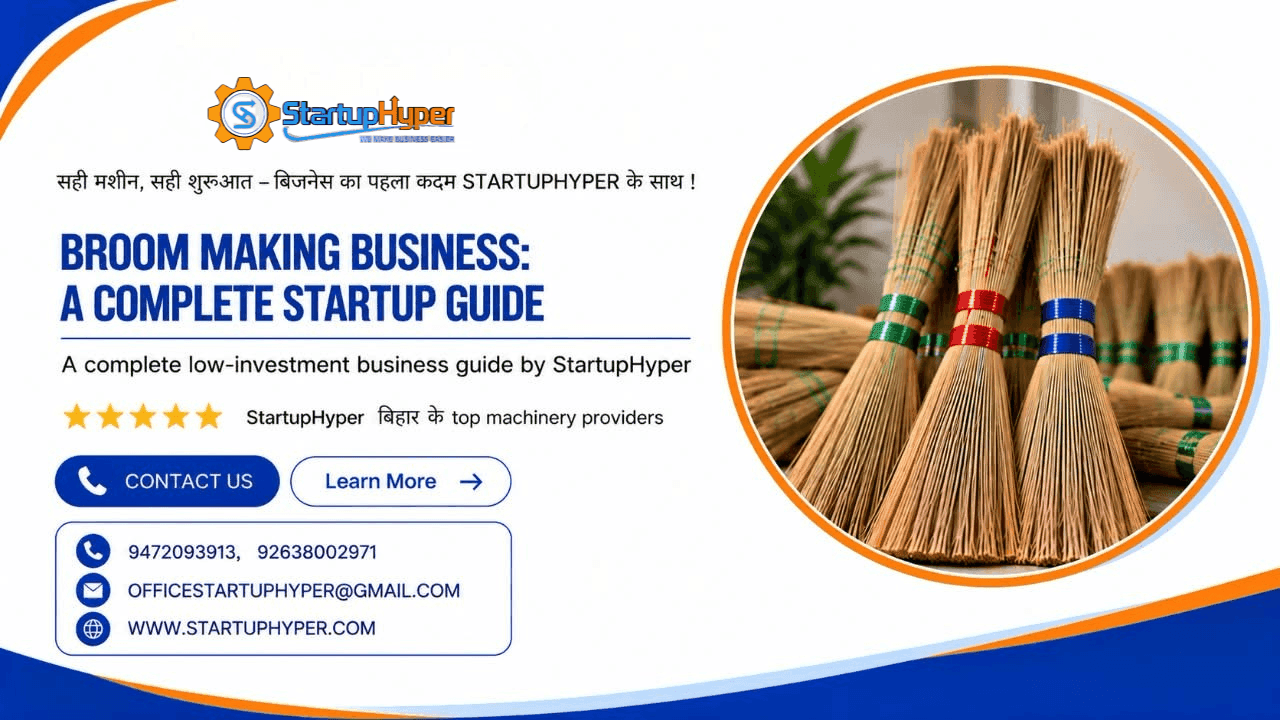
A broom making business involves the manufacturing of brooms used for cleaning homes, offices, shops, hotels, schools and other spaces. Brooms can be made from materials such as broom grass, coconut sticks, coir fibre and plastic bristles, depending on the type of product being manufactured.
The business can be started on a small or medium scale with basic equipment and gradually expanded by increasing production capacity, adding different broom varieties and developing a wider customer base. Proper sourcing of raw materials, machinery, quality control and packaging can help build a consistent and marketable product.
Starting a broom making business can be a suitable opportunity for entrepreneurs because brooms are essential cleaning products with regular demand in both household and commercial markets. The business can also be started on a small scale and expanded gradually with proper planning.
Brooms are everyday cleaning products used in homes, offices, shops, hotels, schools and other establishments, creating a consistent market for manufacturers.
The broom manufacturing process is relatively simple and can be carried out using basic equipment, making it suitable for entrepreneurs who are new to manufacturing.
The business can be started with limited production capacity and expanded gradually by increasing machinery, manpower and market reach as demand grows.
Entrepreneurs can manufacture grass brooms, coconut-stick brooms, plastic brooms and coir brooms to serve different customer requirements.
Brooms can be sold to retailers, wholesalers, distributors, households and institutional buyers, providing multiple opportunities to generate sales.
Developing attractive packaging and a distinct brand can help a business differentiate its products and build recognition in the market.
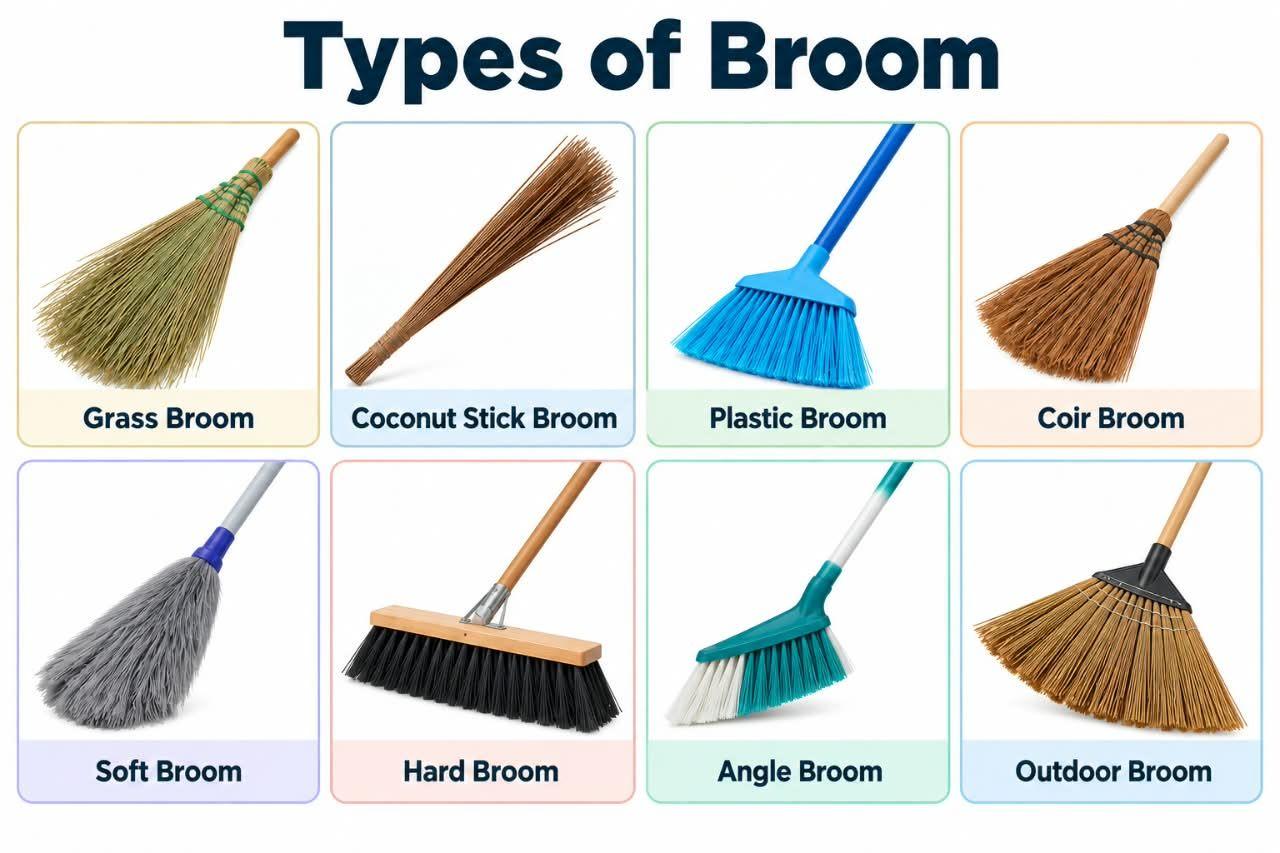
Brooms are available in different types based on their material, design, bristle type and cleaning purpose. Each type is suitable for different surfaces and customer requirements, so understanding these varieties can help entrepreneurs select the right products for their business.
Grass brooms are made from dried natural broom grass and are commonly used for household floor cleaning.
Made from natural broom grass.
Suitable for smooth indoor floors.
Commonly used for everyday household cleaning.
Coconut stick brooms are made from dried coconut leaf midribs and are mainly used for outdoor cleaning.
Made from mature coconut leaf sticks.
Suitable for courtyards and outdoor areas.
Strong and economical for regular cleaning.
Plastic brooms are made using synthetic plastic bristles and are widely used in households and commercial spaces.
Made from durable plastic bristles.
Available in different sizes and designs.
Easy to clean and maintain.
Coir brooms are manufactured using coconut coir fibre and are suitable for various cleaning applications.
Made from natural coconut fibre.
Suitable for rough and outdoor surfaces.
Provides a natural alternative to plastic brooms.
Soft brooms are designed with fine and flexible bristles for gentle cleaning of indoor surfaces.
Suitable for smooth floors.
Helps collect fine dust and dirt.
Commonly used for household cleaning.
Hard brooms use stiff and strong bristles for cleaning rough or heavily soiled surfaces.
Suitable for rough floors and outdoor areas.
Effective for removing stubborn dirt.
Commonly used in commercial and industrial spaces.
Angle brooms have bristles arranged at an angled position, making them useful for reaching corners and difficult areas.
Helps clean corners and edges.
Suitable for indoor floor cleaning.
Available with different handle options.
Outdoor brooms are designed with strong and durable bristles for cleaning open areas.
Suitable for gardens, courtyards and pathways.
Designed to handle rough surfaces.
Useful for removing leaves, dust and larger debris.
Broom manufacturing requires different raw materials and other supporting materials depending on the type of broom being produced. The right selection of materials helps ensure good cleaning performance, strength, durability, and overall product quality. Commonly required materials include:
Grass, coconut sticks, coir, plastic fibres, and synthetic fibres are commonly used for making broom bristles. The material is selected according to the type and quality of broom being manufactured.
Bamboo, wood, plastic, and metal can be used for making broom handles. A good handle should be strong, lightweight, and comfortable to hold during regular use.
Nylon thread, cotton thread, rope, and wire are used to bind the bristles firmly together. Proper binding provides strength, stability, and a better shape to the finished broom.
Glue or adhesive may be used to secure the bristles, handle, or other components. It helps create a firm connection and improves the overall durability of the broom.
Plastic covers, paper labels, cartons, and packaging tape are used for packing the finished brooms. Proper packaging helps protect the product during storage and transportation and also supports branding and presentation.
Broom making machines are available in manual, semi-automatic, and automatic models, and their prices vary according to capacity, automation level, and machine type. For a small-scale unit, basic machines can start from around ₹8,000–₹50,000, while advanced machines can cost significantly more.
| Machine Type | Approx. Price |
|---|---|
| Manual Broom/Jhadu Making Machine | ₹8,000–₹12,000 |
| Broom Stick Making Machine | ₹10,000–₹15,000 |
| Mechanical Broom Making Machine | ₹45,000–₹55,000 |
| Automatic Broom Making Machine | ₹50,000–₹3,00,000 |
| Bamboo Broom Stick Making Machine | ₹1,45,000–₹1,55,000 |
Prices are approximate and may vary depending on supplier, capacity, specifications, GST, and installation charges.
Broom manufacturing involves a series of steps, beginning with the selection and preparation of raw materials and ending with the packaging of the finished product. Proper handling at each stage helps ensure that the broom has good strength, durability, appearance, and sweeping performance.
The first step is to select good-quality broom grass, sticks or handles, binding thread or wire, and packaging materials. The raw materials should be clean, properly dried, and free from damaged or unsuitable pieces. Good-quality materials help in producing durable and attractive brooms.
The selected broom grass is cleaned carefully to remove dust, dirt, leaves, and other unwanted materials. After cleaning, the grass is spread out and dried properly to reduce moisture. Proper drying helps prevent fungal growth and improves the durability of the broom.
After drying, the broom grass is cut according to the required length and size. The grass is then sorted based on its quality, thickness, and length. This ensures that similar-quality material is used together and gives the finished broom a uniform appearance.
The prepared grass is arranged into suitable bundles according to the desired broom size. These bundles are tightly tied using binding thread, wire, or other suitable materials. Proper tying is important because it keeps the grass firmly together during regular use.
A suitable wooden, bamboo, plastic, or other handle is fixed to the prepared broom bundle. The handle is attached and secured firmly so that it remains stable while sweeping. The connection between the handle and broom head is checked to ensure proper strength.
The broom is given its final shape by trimming uneven or excess grass and adjusting the broom head. The edges are made as uniform as possible to improve sweeping performance. This step also gives the product a neat and professional appearance.
Each finished broom is inspected for proper tying, handle strength, size, shape, and overall finish. Loose grass, weak bindings, or damaged handles are corrected before the product is packed. Quality checking helps maintain consistency across the finished products.
After quality checking, the finished brooms are bundled or packed using suitable plastic, paper, or other packaging materials. Proper packaging protects the brooms from dust and damage during storage and transportation. The packaged products are then ready for distribution and sale.
Starting a broom making business requires investment in machinery, raw materials, workspace, packaging, labour, and working capital. The overall investment depends on the production capacity, machinery type, and scale of the business.
| Investment Area | Estimated Investment |
|---|---|
| Machinery and Equipment | ₹1.00–2.50 lakh |
| Raw Materials | ₹30,000–₹75,000 |
| Workspace and Setup | ₹40,000–₹1.00 lakh |
| Packaging Materials | ₹15,000–₹40,000 |
| Electricity and Installation | ₹15,000–₹35,000 |
| Labour and Initial Expenses | ₹20,000–₹50,000 |
| Working Capital | ₹30,000–₹75,000 |
| Total Estimated Investment | ₹2.50–₹6.25 lakh |
The above figures are approximate and may vary depending on location, machinery capacity, supplier prices, and production scale.
Brooms are regular-use cleaning products that are widely used in homes, offices, shops, hotels, schools, and other establishments. Their affordable price and frequent replacement create a steady market demand.
The business also provides opportunities to serve different customer segments through local and wider sales channels. Entrepreneurs can focus on retail sales, wholesale supply, institutional orders, and online selling to expand their market reach.
Brooms are regularly used in homes, offices, shops, schools, hotels, and other establishments.
The demand remains steady because brooms are affordable and frequently replaced.
Different types of brooms can be manufactured according to customer needs and cleaning requirements.
Local retailers and wholesalers can provide opportunities for bulk sales.
Products can be supplied to supermarkets, hotels, cleaning service providers, and institutions.
Online platforms can help businesses reach customers in different cities and regions.
Attractive packaging and branding can help a business stand out from competitors.
Packaging and branding play an important role in presenting broom products professionally and protecting them during storage and transportation. Good packaging can also make the product easier to display and handle in retail stores.
Plastic covers, paper wrappers, packaging bags, and other suitable materials can be used to protect finished brooms from dust, moisture, and physical damage.
A unique brand name and logo can be printed on the packaging to create product recognition and help customers identify the products easily.
The packaging can include important details such as product type, quantity, manufacturer details, contact information, and other required information.
A simple and attractive packaging design can improve the visual appeal of the product and help it stand out on retail shelves.
Brooms can be offered in different sizes, designs, and packaging quantities to meet the requirements of households, retailers, and bulk buyers.
Haan, har point mein 1–2 line aur detail add karke:
Brooms can be sold through both offline and online channels depending on the target customers and production capacity. A combination of local sales, wholesale distribution, and online selling can help entrepreneurs reach a wider market and increase sales.
Brooms can be supplied to local grocery stores, household stores, and cleaning-product shops. Building good relationships with retailers can help generate regular orders and create a stable local customer base.
Selling brooms to wholesalers and distributors is suitable for businesses producing larger quantities. Wholesale orders can help move products in bulk and allow the business to reach different markets through established distribution networks.
Brooms can be supplied to supermarkets, hotels, schools, offices, and cleaning service providers that require cleaning products regularly. Supplying these customers in bulk can create opportunities for repeat and long-term orders.
Businesses can list their broom products on online marketplaces and social media platforms to reach customers outside their local area. Clear product details, attractive packaging, and competitive pricing can help improve online sales.
Direct selling to households, shops, and other local customers can help businesses build direct customer relationships. It also allows manufacturers to receive customer feedback and understand changing market requirements.
Broom making is a relatively simple manufacturing business, but entrepreneurs may face several challenges related to raw materials, production, quality, labour, and market competition. Proper planning and quality control can help in managing these challenges effectively.
The prices of broom-making materials such as grass, plastic, bamboo, sticks, thread, and packaging materials may change depending on availability and seasonal demand. A sudden increase in raw material costs can affect the overall production cost and profit margin.
Maintaining consistent quality is important because customers expect brooms to be strong, durable, and effective for cleaning. Poor-quality materials, improper binding, or uneven finishing can reduce product quality and lead to customer dissatisfaction.
The availability of natural broom materials can vary according to season, location, and supply conditions. Maintaining sufficient stock and developing relationships with reliable suppliers can help prevent interruptions in production.
Although broom making does not always require highly skilled workers, workers need proper training to handle materials and maintain consistent quality. Finding reliable workers and managing labour costs can become challenging as production increases.
The broom market can have strong competition from local manufacturers, established brands, and low-priced products. New businesses may need to focus on quality, reasonable pricing, attractive packaging, and reliable supply to build a customer base.
Production costs include raw materials, labour, electricity, transportation, maintenance, and packaging. If these costs are not monitored properly, the business may experience lower profit margins. Regular cost tracking and efficient production planning can help control expenses.
Natural broom materials need to be stored in a clean, dry, and well-ventilated area. Excess moisture can affect the quality of materials and may lead to damage or fungal growth. Proper storage arrangements are therefore important for maintaining product quality.
Brooms need to be packed and handled carefully during transportation to prevent bending, breaking, or damage to the bristles. Proper packaging and efficient transportation arrangements can help reduce product damage and maintain the appearance of the finished products.
Starting a broom making business requires proper planning and attention to production, quality, pricing, and sales. Avoiding common mistakes can help maintain product quality, control costs, and build a reliable customer base.
Using low-quality grass, plastic, sticks, thread, or other materials can affect the strength and durability of the broom. Always select suitable and good-quality raw materials to maintain consistent product quality.
Producing brooms without proper checking can result in loose binding, uneven bristles, or weak handles. Each finished broom should be inspected before packaging and selling.
Keeping too little raw material can interrupt production, while excessive stock may increase storage costs and material wastage. Maintain stock according to production requirements and market demand.
Pricing the product without considering raw material, labour, packaging, transportation, and other costs can reduce profitability. Calculate the total production cost before deciding the selling price.
Poor packaging can cause brooms to become damaged, bent, or dirty during storage and transportation. Use suitable packaging to protect the finished products and maintain their appearance.

StartupHyper can help entrepreneurs planning to start a broom making business by providing guidance on important aspects such as machinery, raw materials, production setup, investment, and business planning. This can help beginners understand the basic requirements and plan their business more effectively.
With proper planning and guidance, entrepreneurs can make better decisions regarding their production capacity, infrastructure, costing, and market opportunities. The support can also help in preparing a structured business plan according to the requirements of the proposed business.
Assistance in selecting suitable machinery and equipment according to the required production capacity.
Guidance on estimating the investment required for machinery, infrastructure, raw materials, and working capital.
Support in planning the production unit, layout, and basic manufacturing requirements.
Help in understanding raw material requirements and estimating production costs.
Guidance on determining suitable production capacity based on the available investment and market demand.
Yes, broom making can be a profitable business when production costs are properly managed and the products are sold through suitable retail, wholesale, and institutional channels.
Common raw materials include grass, plastic, bamboo or sticks, thread, binding materials, and packaging materials. The exact materials depend on the type of broom being manufactured.
The machinery depends on the type and scale of production. Basic equipment may include broom-making machines, cutting machines, binding equipment, and other supporting tools.
The investment depends on factors such as production capacity, machinery, infrastructure, raw materials, labour, and working capital. A small unit generally requires less investment than a larger automated setup.
Brooms can be sold through local retailers, wholesalers, distributors, supermarkets, institutional buyers, and online platforms. Using multiple sales channels can help businesses reach more customers.
Quality can be maintained by using good-quality raw materials, proper binding methods, suitable machinery, and regular inspection of finished products before packaging.
Yes, broom making can be started on a small scale with limited machinery and production capacity. The business can gradually be expanded as demand and sales increase.
The major factors include raw material prices, labour costs, electricity, machinery maintenance, packaging, transportation, and production volume. Efficient cost management can help improve profitability.
Starting a broom making business can be a suitable opportunity for entrepreneurs looking for a business with regular market demand and manageable production requirements. With the right selection of raw materials, machinery, production capacity, and packaging, entrepreneurs can establish an efficient manufacturing setup.
Proper cost management, quality control, marketing, and distribution are important for building a sustainable business. By understanding market requirements and maintaining consistent product quality, a broom manufacturing unit can gradually expand its customer base and achieve long-term business growth and profitability.
📞Call / WhatsApp: 9472093913
📧Email: info@startuphyper.com
🌐 Website: www.startuphyper.com | www.machinehai.com
🏢 Branches: Patna | Gaya | Katihar | Saharsa
Stay updated with the latest tips, trends, and best practices in factory setup and machinery procurement—subscribe to the StartupHyper newsletter!
No spam, we promise. Your inbox is safe with us—only valuable insights.