Read the full article to gain deeper insights and comprehensive information.

Sep 09, 2026
0
Learn how to start a jaggery packaging business, including machinery, packaging process, investment, profit margin, and selling methods.
What is a Jaggery Packaging Business?
Why Start a Jaggery Packaging Business?
Types of Jaggery Products
Market Demand for Packaged Jaggery
Raw Materials Required
Jaggery Packaging Process
Machinery Required for Jaggery Packaging
Jaggery Packaging Business Investment
Cost of Jaggery Packaging
Quality Control in Jaggery Packaging
How to Sell Packaged Jaggery
Marketing Strategies for Jaggery Products
Wholesale vs Retail Selling
Common Mistakes to Avoid
How StartupHyper Can Help
Frequently Asked Questions
Conclusion
A jaggery packaging business involves purchasing jaggery in bulk, carrying out basic cleaning, sorting, cutting, or processing, and packing it into suitable consumer-sized packages. The packaged product can then be sold under a brand name through retail stores, wholesalers, supermarkets, and other sales channels.
Depending on the business model, entrepreneurs can offer different products such as jaggery blocks, jaggery powder, jaggery cubes, and jaggery pieces. Proper packaging helps maintain product quality, improve convenience, and create a professional presentation for customers.
This business can be started on a small or medium scale depending on the available investment, production capacity, machinery, and target market. With good-quality jaggery, attractive packaging, consistent quality, and effective marketing, entrepreneurs can build a branded jaggery product business.
Starting a jaggery packaging business can be a promising opportunity for entrepreneurs looking to enter the food and FMCG sector. Jaggery is a commonly used traditional food product, and packaging it into convenient consumer-sized packs can create additional value and improve its market appeal.
Some key reasons to start this business include:
Consumers are increasingly looking for hygienically packed and properly labelled food products. Packaged jaggery offers convenience and can be easily stored, transported, and purchased from retail outlets.
Buying jaggery in bulk and converting it into consumer-ready packs adds value to the product. Proper sizing, packaging, labelling, and branding can make the product more attractive to customers.
Entrepreneurs can offer different forms such as jaggery blocks, jaggery powder, cubes, and pieces. Providing multiple options allows the business to target customers with different preferences and usage requirements.
A jaggery packaging business can be started on a small or medium scale depending on the available investment and expected market demand. Entrepreneurs can begin with basic machinery and gradually increase their production capacity.
Packaged jaggery can be sold through local retailers, supermarkets, wholesalers, restaurants, sweet shops, and online platforms. Using multiple sales channels can help businesses reach a wider customer base.
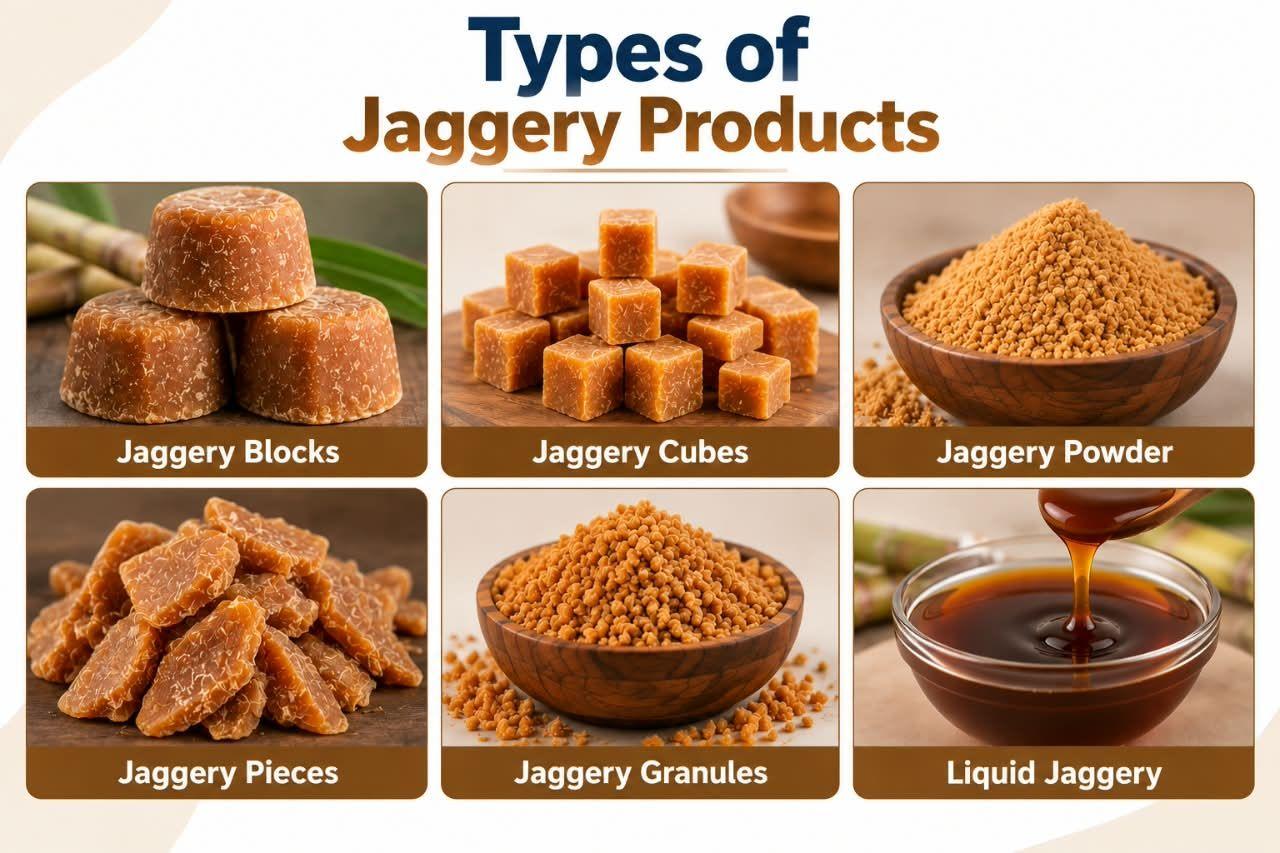
Jaggery is available in different forms, shapes, and textures depending on its processing and packaging method. A jaggery packaging business can offer different products to meet the needs of households, retailers, food businesses, and other customers.
Jaggery blocks are one of the most commonly available forms of jaggery and are sold in different sizes and weights.
Made by setting processed jaggery into solid blocks or moulded shapes.
Available in different weights and pack sizes according to customer requirements.
Commonly used for household consumption, cooking, sweets, and beverages.
Jaggery cubes are small, uniformly shaped pieces that are convenient to use and easy to portion.
Produced in small and consistent cube-shaped pieces.
Suitable for tea, milk, snacks, and traditional beverages.
Can be packed in small retail pouches or premium packaging.
Jaggery powder is made by processing solid jaggery into a fine or coarse powdered form.
Easy to measure, mix, and dissolve compared with solid jaggery.
Commonly used in tea, beverages, desserts, sweets, and cooking.
Can be packed in small consumer pouches or larger bulk packs.
Jaggery pieces are smaller cut or broken portions of solid jaggery that can be packed according to the required weight.
Available in different shapes and sizes depending on the cutting process.
Suitable for direct consumption and household cooking.
Can be packed in pouches, containers, or other food-grade packaging.
Jaggery granules are small, coarse particles of jaggery that offer an alternative to blocks and fine powder.
Have a small, grain-like texture and are easy to portion.
Can be used in beverages, desserts, cooking, and food preparations.
Suitable for retail packs as well as larger food-service packs.
Liquid jaggery is a semi-liquid form of jaggery that can be used as a sweetening ingredient.
Provides a ready-to-use sweetening option for consumers.
Can be used in beverages, desserts, sweets, and traditional food preparations.
Requires suitable leak-proof and food-grade packaging to prevent leakage and maintain product quality.
The demand for packaged jaggery is growing due to changing consumer preferences, better food hygiene awareness, and the increasing availability of branded food products.
Some of the key reasons behind the demand for packaged jaggery are:
Consumers are increasingly looking for natural and traditional sweetening options instead of highly processed alternatives. This has created greater interest in jaggery-based products.
Properly packed jaggery provides better hygiene, protection, and convenience compared with loosely sold products. Attractive and sealed packaging can also increase customer confidence.
Packaged jaggery is available in different sizes and forms, making it easier to store, handle, measure, and use according to household or commercial requirements.
Packaged jaggery is increasingly being sold through grocery stores, supermarkets, departmental stores, and other retail outlets, making it easily accessible to consumers.
Sweet shops, restaurants, bakeries, cafes, and food manufacturers can use jaggery for preparing sweets, beverages, desserts, and other food products, creating demand for both retail and bulk packs.
The availability of jaggery blocks, cubes, powder, pieces, granules, and liquid jaggery allows businesses to serve different customer preferences and usage requirements.
Businesses can create demand through attractive packaging, strong branding, clear labelling, and consistent quality. A well-presented product can compete with loose and unbranded jaggery in the market.
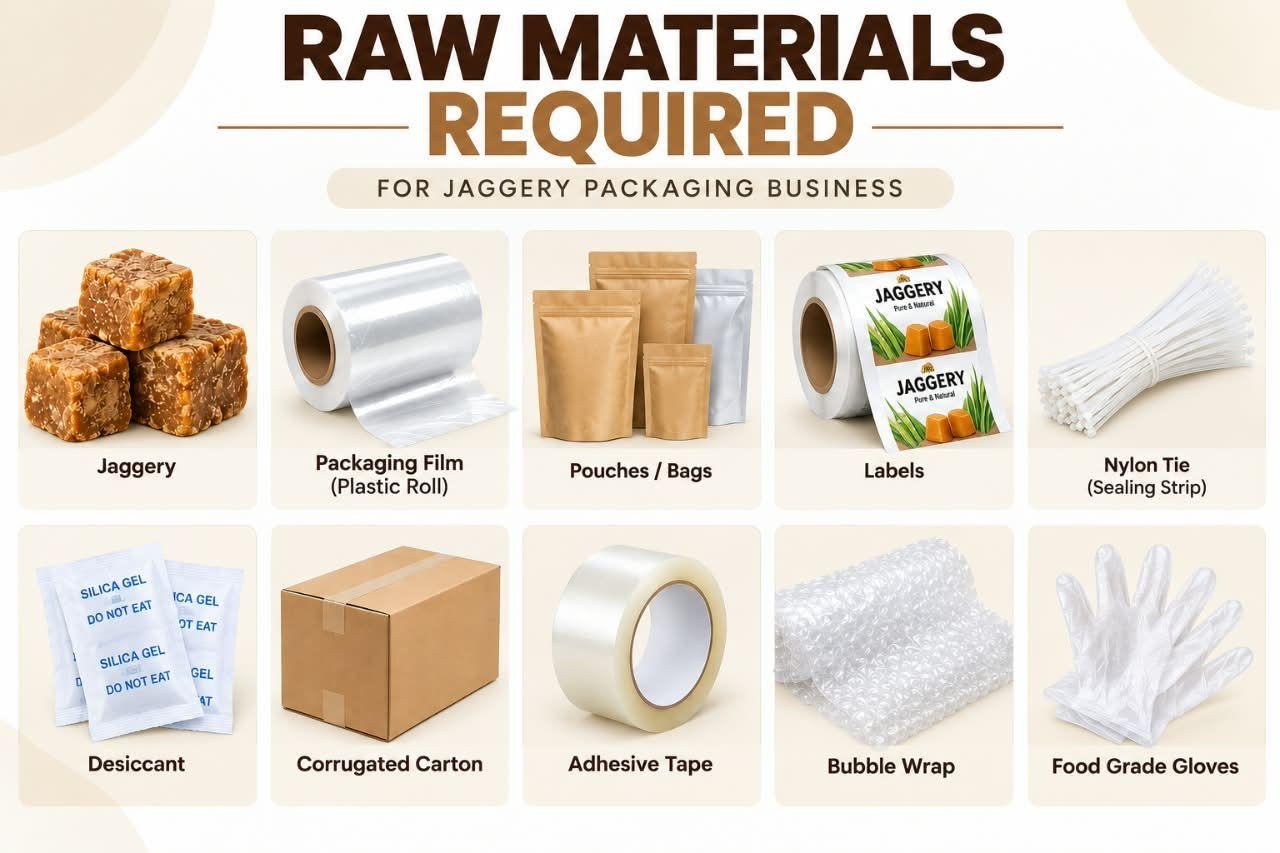
A jaggery packaging business requires jaggery, packaging materials, and supporting supplies to safely pack and prepare the product for sale. Proper selection of these materials helps maintain product quality, hygiene, protection, and packaging durability.
Jaggery
Packaging Film
Pouches/Bags
Labels
Nylon Tie
Desiccant
Corrugated Carton
Adhesive Tape
Bubble Wrap
Food-Grade Gloves
The jaggery packaging process involves several steps to convert bulk jaggery into a clean, properly weighed, sealed, and market-ready product. The process may vary depending on whether the jaggery is packed as blocks, cubes, powder, pieces, granules, or liquid jaggery. Proper handling and packaging help protect the product from moisture, dust, contamination, and damage. A systematic process also helps maintain consistent quality and presentation.
The bulk jaggery is first inspected to check its quality, appearance, colour, texture, and cleanliness. Any damaged, contaminated, or unsuitable jaggery is separated before further processing. This step helps ensure that only good-quality jaggery is used for packaging.
The selected jaggery is cleaned and sorted to remove dust, unwanted particles, and visible impurities. The product is also separated according to its size, shape, quality, or required product type. Proper sorting helps maintain uniformity and product quality in the final packs.
Depending on the product type, jaggery may be cut, powdered, shaped, or processed into cubes, pieces, or granules. The processing method is selected according to the desired product form and packaging requirements. Liquid jaggery may follow a different handling process before being filled into suitable containers.
The processed jaggery is weighed according to the selected pack size, such as 250 g, 500 g, or 1 kg. Accurate weighing ensures that every package contains the specified quantity. Suitable weighing equipment can improve accuracy and consistency during the packaging process.
The measured jaggery is filled into suitable food-grade pouches, bags, containers, or other packaging materials. The filling process should be carried out in a clean and hygienic environment. Careful filling helps prevent product loss and maintains the appearance of the packaged product.
After filling, the packages are properly sealed using suitable sealing equipment or packaging methods. A secure seal helps protect the jaggery from moisture, dust, air, and external contamination. Proper sealing also helps maintain the integrity and quality of the packaged product.
The sealed packages are labelled with important product and business information. The label may include the product name, net quantity, batch details, manufacturing information, MRP, and other applicable details. Clear labelling helps customers identify the product and provides essential product information.
The sealed retail packs are placed inside corrugated cartons for additional protection during handling and transportation. Materials such as bubble wrap may be used where additional protection is required. Proper secondary packaging helps reduce the risk of damage or deformation during transportation.
The finished packages are stored in a clean, dry, and suitable storage area before dispatch. The products should be protected from excess moisture, direct sunlight, pests, and contamination. After proper storage, the packaged jaggery can be dispatched to retailers, wholesalers, food businesses, or customers.
The machinery required for a jaggery packaging business depends on the type of jaggery product, packaging method, production capacity, and level of automation. Selecting suitable equipment can help improve packaging speed, accuracy, hygiene, and consistency. A small business may start with basic equipment, while larger units can use automated packaging systems.
A jaggery cutting machine is used to cut solid jaggery blocks into smaller and uniform pieces or cubes. It helps maintain consistent product size and can reduce manual cutting work.
A jaggery pulverizer is used to convert solid jaggery into fine or coarse jaggery powder. It is useful for businesses producing powdered jaggery in larger quantities.
A weighing machine is required to measure the exact quantity of jaggery before filling it into packages. Accurate weighing helps maintain the required net weight and consistency across different packs.
A filling machine is used to fill measured jaggery into pouches, bags, or containers. Depending on the product form, different filling systems may be used for powder, granules, pieces, or other forms.
A pouch packing machine is used for forming, filling, and packing jaggery into pouches. Depending on the machine model, it may perform several packaging operations automatically.
A band sealing machine is used to seal filled pouches or bags securely. It provides a consistent seal and helps protect the packaged jaggery from moisture, dust, and contamination.
A batch coding machine is used to print information such as batch number, manufacturing date, expiry or best-before details, and other applicable information on the packaging.
A labeling machine is used to apply product labels accurately and consistently on pouches, bottles, jars, or other containers. It is particularly useful for businesses handling larger packaging volumes.
A liquid jaggery filling machine is used for accurate filling of liquid jaggery into bottles, jars, or suitable containers. It helps control the filling quantity and reduce product spillage.
An air compressor may be required when the packaging setup includes pneumatic machinery or automated equipment. It supplies compressed air to operate compatible machine components.
A conveyor system can be used to move packages between different stages such as filling, sealing, coding, labelling, and packing. It can improve workflow and reduce manual handling in larger units.
The investment required for a jaggery packaging business depends on the scale of operations, machinery, packaging requirements, workspace, and production capacity. A small-scale unit can start with a lower investment, while a larger setup requires higher capital for machinery, infrastructure, raw materials, and working capital.
| Investment Component | Estimated Cost |
|---|---|
| Machinery & Equipment | ₹1.5 lakh – ₹4 lakh |
| Packaging Materials | ₹30,000 – ₹1 lakh |
| Initial Jaggery Stock | ₹1 lakh – ₹3 lakh |
| Workspace Setup | ₹50,000 – ₹1.5 lakh |
| Branding & Labelling | ₹20,000 – ₹75,000 |
| Working Capital | ₹1 lakh – ₹3 lakh |
| Miscellaneous Expenses | ₹25,000 – ₹75,000 |
| Total Estimated Investment | ₹4.75 lakh – ₹13 lakh+ |
The actual investment may vary depending on business scale, machinery selection, production capacity, and local operating costs.
The cost of jaggery packaging depends on the type of jaggery, packaging material, pack size, packaging method, and production volume. The overall cost includes the jaggery itself as well as packaging and supporting materials used to prepare the final product for sale.
| Cost Component | Estimated Cost |
|---|---|
| Jaggery | ₹40 – ₹70 per kg |
| Packaging Film | ₹2 – ₹8 per pack |
| Pouches/Bags | ₹2 – ₹10 per pack |
| Labels | ₹0.50 – ₹3 per pack |
| Nylon Tie | ₹0.20 – ₹1 per pack |
| Desiccant | ₹0.50 – ₹2 per pack |
| Corrugated Carton | ₹15 – ₹40 per carton |
| Adhesive Tape | ₹2 – ₹5 per carton |
| Bubble Wrap | ₹5 – ₹15 per pack/carton |
| Food-Grade Gloves | ₹1 – ₹3 per pack equivalent |
The actual cost may vary depending on jaggery quality, packaging material, pack size, purchase quantity, supplier, and market conditions.
Quality control is important to maintain the quality, hygiene, safety, and consistency of packaged jaggery. Proper quality checks should be carried out at different stages of packaging.
The jaggery should be checked for colour, texture, cleanliness, moisture, and visible impurities before packaging. Only suitable-quality jaggery should be selected for the final product.
Jaggery should be properly cleaned and sorted before packaging to remove unwanted particles, damaged pieces, and other impurities. This helps maintain a consistent product quality.
Each pack should be checked for correct net weight according to the selected pack size. Accurate weighing helps maintain consistency and prevents quantity-related issues.
The packaging material should be food-grade, clean, strong, and suitable for the jaggery product. Packages should be checked for proper sealing and any visible damage.
Jaggery should be protected from excess moisture during packaging and storage. Proper sealing and suitable packaging help reduce moisture-related quality problems.
Labels should be checked to ensure that the required product information, quantity, batch details, and other applicable information are accurate and clearly printed.
The final packages should be inspected for proper sealing, appearance, weight, labelling, and overall condition before they are stored or dispatched to customers.
Packaged jaggery can be sold through offline and online sales channels depending on the target market, production capacity, and business scale. Using multiple channels can help reach more customers and build a wider distribution network.
Packaged jaggery can be supplied to grocery stores, departmental stores, supermarkets, and local food shops. Regular supply and consistent product quality can help develop long-term relationships with retailers.
Selling through wholesalers and distributors can help businesses move larger quantities of packaged jaggery. This channel is suitable for expanding into different localities and markets.
Sweet shops, restaurants, cafes, bakeries, and food businesses can be targeted as regular buyers of jaggery. Businesses can offer suitable pack sizes and bulk quantities according to their requirements.
Jaggery can be sold directly to customers through a local shop, packaging unit, exhibitions, fairs, or direct orders. Direct selling allows businesses to interact with customers and build brand awareness.
Packaged jaggery can be listed on online marketplaces and e-commerce platforms to reach customers beyond the local market. Attractive product images, clear descriptions, and proper packaging can support online sales.
Businesses can promote their products through social media platforms and accept customer enquiries or orders through available communication channels. Regular product posts and promotional offers can help increase visibility.
Effective marketing can help increase brand awareness, customer reach, and sales of packaged jaggery. Businesses can use a combination of offline and digital strategies to promote their products.
Use attractive packaging, clear labels, and consistent branding to make jaggery products stand out on retail shelves. A professional package can help create a strong brand identity and attract customers.
Promote jaggery products through Instagram, Facebook, YouTube, and other social media platforms. Product images, short videos, recipes, and promotional offers can help attract potential customers.
Offer introductory discounts, retailer margins, and promotional schemes to encourage local retailers to stock the product. Good retailer relationships can support regular sales and wider distribution.
Provide product samples at local stores, exhibitions, fairs, or promotional events. Sampling allows potential customers to experience the product and can encourage them to make future purchases.
Create an online presence through a business website, e-commerce listings, and digital advertisements. Online marketing can help the business reach customers beyond its local market.
Packaged jaggery can be sold through both wholesale and retail channels, depending on the business scale and target customers. Each selling method has different requirements in terms of quantity, pricing, margins, and customer reach.
| Basis | Wholesale Selling | Retail Selling |
|---|---|---|
| Customer | Wholesalers, distributors, and bulk buyers | Individual customers and households |
| Order Quantity | Large quantities | Small quantities |
| Selling Price | Generally lower per unit | Generally higher per unit |
| Profit Margin | Lower margin with higher volume | Higher margin with lower volume |
| Customer Reach | Wider through distributors | Direct customer interaction |
| Packaging | Usually larger or bulk packs | Smaller consumer-friendly packs |
| Payment | Often credit or bulk payment terms | Usually immediate payment |
| Marketing | Focus on distributors and business relationships | Focus on branding, promotions, and customer engagement |
For a growing jaggery business, using a combination of wholesale and retail selling can help balance sales volume, profit margins, and market reach.
A jaggery packaging business requires proper attention to product quality, packaging, pricing, and sales. Avoiding common mistakes can help maintain consistency, reduce losses, and build customer trust.
Using low-quality or contaminated jaggery can affect the taste, appearance, and overall quality of the final product. Always select good-quality jaggery from reliable suppliers.
Using weak or unsuitable packaging can expose jaggery to moisture, dust, and contamination. Food-grade and suitable packaging materials should be selected according to the product type.
Incorrect weighing can lead to quantity-related complaints and affect customer trust. Use accurate weighing equipment and regularly check the weight of packaged products.
Improper sealing can allow air and moisture to enter the package, which may affect product quality. Ensure that every package is properly and securely sealed.
Missing or incorrect product information, net quantity, batch details, MRP, or other applicable details can create compliance and customer-related issues. Labels should be checked carefully before dispatch.
Handling jaggery without proper hygiene can increase the risk of contamination. Maintain a clean packaging area and use appropriate protective equipment during product handling.
Purchasing excessive quantities without considering market demand, storage conditions, and sales volume can increase the risk of quality deterioration and working capital blockage.
Setting prices too low just to attract customers can reduce profit margins and make it difficult to cover operating costs. Pricing should consider product cost, packaging expenses, distribution costs, and market conditions.

StartupHyper can help entrepreneurs planning to start a jaggery packaging business with support in areas such as business planning, machinery selection, investment estimation, and production setup. This can help entrepreneurs understand their requirements and plan the business according to their budget, production capacity, and target market.
From the initial planning stage to setting up the packaging unit, StartupHyper can provide guidance on important business requirements. This can help entrepreneurs make informed decisions about machinery, infrastructure, raw materials, packaging, and working capital before starting operations.
Help in selecting suitable jaggery packaging machinery based on production capacity and business requirements.
Assistance in preparing a business plan covering machinery, raw materials, investment, production, and sales.
Support in estimating machinery cost, raw material expenses, packaging costs, and working capital.
Guidance in planning the production and packaging unit, including basic infrastructure and machinery placement.
Assistance in selecting suitable pack sizes, packaging methods, and product options according to the target market.
Support in understanding the required machinery, equipment, and setup requirements for the business.
Guidance on the key requirements involved in starting and managing a jaggery packaging business.
Yes, a jaggery packaging business can be profitable with good product quality, proper cost control, and effective sales channels.
The investment depends on machinery, production capacity, packaging method, workspace, and working capital. A small-scale unit can be started with a comparatively lower investment.
Common machinery includes a weighing machine, cutting machine, pulverizer, filling machine, pouch packing machine, sealing machine, batch coding machine, and labelling machine.
Businesses can package jaggery blocks, cubes, powder, pieces, granules, and liquid jaggery according to customer requirements and market demand.
Common packaging materials include packaging film, pouches, bags, labels, corrugated cartons, adhesive tape, and other suitable food-grade materials.
Packaged jaggery can be sold through retailers, wholesalers, supermarkets, sweet shops, restaurants, institutional buyers, online marketplaces, and social media channels.
The main factors include machinery, jaggery price, packaging materials, production capacity, labour, transportation, and working capital requirements.
Quality can be maintained by using good-quality jaggery, proper cleaning and sorting, accurate weighing, suitable food-grade packaging, proper sealing, and hygienic storage.
Yes, the business can be started on a small scale with basic machinery, limited production capacity, and a smaller product range. The setup can be expanded as sales and customer demand increase.
The jaggery packaging business can be a suitable opportunity in the food and FMCG sector. With good-quality jaggery, suitable machinery, proper packaging, and effective planning, entrepreneurs can create branded and consumer-friendly products. Different forms such as blocks, cubes, powder, and pieces can help serve the needs of various customers.
For successful growth, businesses should focus on product quality, hygiene, accurate weighing, attractive packaging, competitive pricing, and effective marketing. By developing strong sales channels and gradually expanding the product range and market reach, entrepreneurs can build a stable and profitable jaggery packaging business.
📞Call / WhatsApp: 9472093913
📧Email: info@startuphyper.com
🌐 Website: www.startuphyper.com | www.machinehai.com
🏢 Branches: Patna | Gaya | Katihar | Saharsa
Sep 07, 2026
Stay updated with the latest tips, trends, and best practices in factory setup and machinery procurement—subscribe to the StartupHyper newsletter!
No spam, we promise. Your inbox is safe with us—only valuable insights.