Read the full article to gain deeper insights and comprehensive information.

Sep 28, 2026
0
Learn how to start a pickle manufacturing business with details on raw materials, process, investment, market demand, selling options, and business opportunities.
What is a Pickle Manufacturing Business?
Why Start a Pickle Manufacturing Business?
Types of Pickles You Can Manufacture
Raw Materials Required
Market Demand for Pickles
Pickle Manufacturing Process
Investment Required for Pickle Manufacturing Business
Where to Sell Pickles
Common Mistakes to Avoid
How StartupHyper Can Help
Frequently Asked Questions
Conclusion
A Pickle Manufacturing Business involves producing different varieties of pickles using fresh fruits, vegetables, spices, oil, salt, and other ingredients. Popular products include mango, lemon, chilli, garlic, and mixed vegetable pickles. The Pickle Manufacturing Process generally includes cleaning, cutting, mixing, curing, and packaging the prepared product for sale.
A Pickle Making Business can be started on a small scale and gradually expanded according to production capacity and market demand. With proper food processing, hygienic production, attractive packaging, and effective branding, entrepreneurs can supply pickles to local retailers, supermarkets, restaurants, wholesalers, and online customers.
The Pickle Manufacturing Business can be started on a small or medium scale with different product varieties and sales channels. Growing interest in packaged traditional foods, along with opportunities in local retail and online selling, makes the Achar Making Business a potential option within the food processing business sector.
Pickles are commonly consumed with meals in Indian households, restaurants, and food-service businesses. This creates regular demand for products such as mango, lemon, chilli, and mixed vegetable pickles.
A Pickle Manufacturing Business can offer several varieties based on regional tastes and customer preferences. Manufacturers can develop different flavours, spice levels, and packaging sizes to serve different market segments.
The Pickle Making Business can begin with a small production setup and gradually expand as sales increase. Entrepreneurs can initially focus on local customers and retailers before entering supermarkets, online marketplaces, and wider distribution channels.
A Pickle Manufacturing Business offers good scope for creating a unique food brand through attractive packaging, consistent taste, and different product combinations. A strong Pickle Brand can help businesses build customer recognition and encourage repeat purchases.
The Achar Making Business can use different sales channels, including local grocery stores, supermarkets, restaurants, wholesalers, exhibitions, and online platforms. Selling through multiple channels can help manufacturers reach more customers and expand their Pickle Business.
The Pickle Manufacturing Business can offer different varieties based on customer preferences, regional tastes, and availability of ingredients. Among the commonly produced varieties, mango, lemon, and mixed vegetable pickles have a wide range of uses and can be packed in different sizes for retail and household consumption.
Mango Pickle is a popular traditional product made from raw mangoes, spices, salt, and edible oil.
Popular traditional pickle variety.
Made with raw mangoes and spices.
Suitable for different pack sizes.
Lemon Pickle is prepared using fresh lemons, salt, spices, and other ingredients to create a tangy and spicy product. It can be included in a Pickle Making Business as a separate product option for customers who prefer citrus-based flavours.
Known for its tangy flavour.
Requires fresh lemons and spices.
Can be sold throughout the year.
Mixed Vegetable Pickle combines selected vegetables with spices, salt, and oil to create a distinctive product. It gives manufacturers an opportunity to expand their Pickle Products and offer customers a combination of different vegetable flavours in one package.
Made using multiple vegetables.
Offers a combination of flavours.
Suitable for retail and online sales.
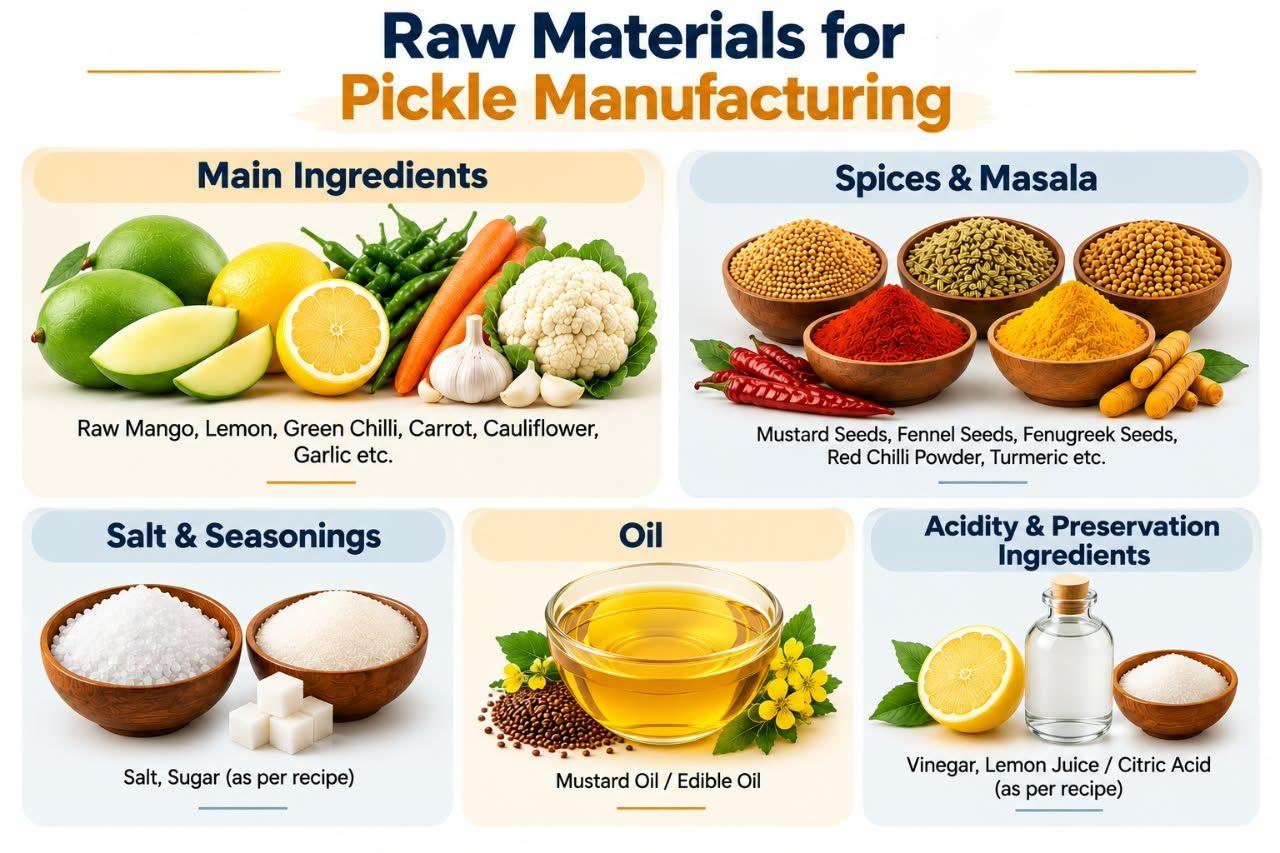
The Pickle Manufacturing Business requires a combination of fresh fruits or vegetables, spices, salt, oil, and other food-grade ingredients. The selection and quality of Pickle Manufacturing Raw Materials directly affect the taste, texture, colour, and shelf life of the final product. Different pickle varieties may require different ingredients and quantities.
The main ingredients form the base of the pickle and depend on the variety being manufactured. Fresh and good-quality ingredients help maintain consistent taste and product quality. Common choices include raw mangoes, lemons, carrots, cauliflower, and other suitable vegetables.
Raw mangoes
Fresh lemons
Carrot, cauliflower, and other vegetables
Spices and masala give the pickle its distinctive flavour, aroma, and colour. The combination and quantity of spices can be adjusted according to the recipe and customer preferences, making them an important part of Achar Making.
Red chilli powder
Turmeric powder
Mustard seeds
Fenugreek seeds
Salt and seasoning are important ingredients in the Pickle Manufacturing Process because they contribute to the characteristic taste of the product. Their quantity should be properly measured to maintain consistency across different batches.
Common salt
Black salt
Other recipe-based seasonings
Oil is used to coat the ingredients and blend the spices throughout the pickle. It also contributes to the flavour and helps create the desired texture of different Pickle Products.
Mustard oil
Edible vegetable oil
Acidity and permitted preservation ingredients can be used to support the quality and shelf stability of packaged pickles. Their selection and quantity should follow the applicable food safety and regulatory requirements.
Vinegar
Citric acid
Permitted food preservatives
The Pickle Manufacturing Business has a broad market because pickles are commonly consumed with meals across different parts of India. Demand comes from households as well as restaurants, hotels, food outlets, grocery stores, and other retail businesses. Packaged Pickle Products also provide opportunities for small manufacturers to build their own brands.
Pickles are regularly used as a side dish with everyday meals, creating continuous demand among household consumers. Different regional tastes also create opportunities for Mango Pickle, Lemon Pickle, and Mixed Vegetable Pickle.
Local grocery stores, supermarkets, and food retailers provide important selling opportunities for Pickle Manufacturing businesses. Different jar sizes and attractive packaging can help manufacturers serve both regular and occasional customers.
Online selling allows Pickle Brands to reach customers beyond their local market. Manufacturers can use e-commerce websites, social media, and their own online stores to promote and sell different Pickle Products.
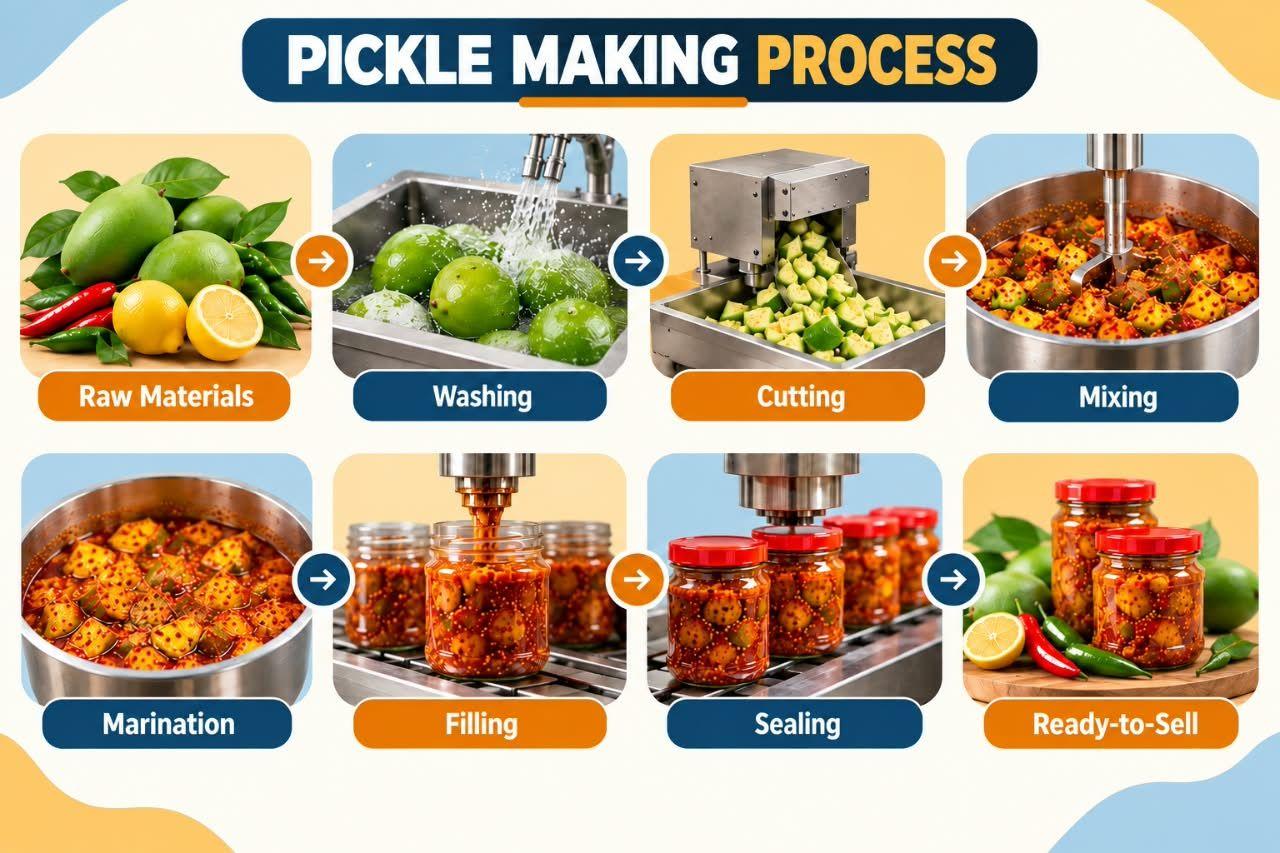
The Pickle Manufacturing Process involves several carefully managed stages, starting with the selection of quality ingredients and ending with the packaging of the finished product. Proper cleaning, cutting, mixing, marination, and packaging are important for maintaining the taste, quality, hygiene, and shelf life of the Pickle Products.
Select fresh and good-quality fruits or vegetables according to the type of pickle being produced. The Raw Materials for Pickle Making should be clean, fresh, and suitable for food processing.
Wash the selected fruits and vegetables properly with clean water to remove dust, dirt, and other unwanted particles. Proper washing is an important part of hygienic Pickle Manufacturing.
Cut the cleaned fruits or vegetables into the required size and shape according to the pickle variety. Uniform cutting helps the ingredients mix properly during the Pickle Manufacturing Process.
Mix the cut ingredients with the required spices, salt, seasoning, and oil. Proper mixing ensures that the ingredients and Pickle Masala are distributed evenly throughout the batch.
Allow the prepared mixture to marinate for the required period so that the ingredients can absorb the spices and develop the desired flavour. The Pickle Marination Process also helps achieve the required texture and taste.
After marination, fill the prepared Pickle Products into clean and food-grade jars or containers. The quantity should be measured properly to maintain consistency across different packages.
Seal the filled containers properly to protect the pickle from contamination, moisture, and leakage. Good-quality Pickle Packaging helps maintain product quality during storage and transportation.
After proper inspection, labeling, and packaging, the finished pickle is ready for sale. The Ready-to-Sell Pickle can be supplied to grocery stores, supermarkets, restaurants, distributors, and online customers.
Starting a Pickle Manufacturing Business requires investment across several areas, including machinery, production space, raw materials, packaging, labour, licenses, utilities, and working capital. The overall Pickle Business Investment depends on the production capacity, equipment selected, size of the manufacturing unit, and the variety of pickles being produced.
| Investment Component | Estimated Investment |
|---|---|
| Machinery & Equipment | ₹60,000 – ₹2 Lakh |
| Workspace & Setup | ₹50,000 – ₹1.5 Lakh |
| Raw Materials | ₹40,000 – ₹1 Lakh |
| Packaging Materials | ₹20,000 – ₹60,000 |
| Licenses & Registration | ₹10,000 – ₹25,000 |
| Labour & Utilities | ₹30,000 – ₹70,000 |
| Working Capital | ₹50,000 – ₹1.5 Lakh |
| Total Estimated Investment | ₹2.6 Lakh – ₹7.05 Lakh |
The estimated Pickle Business Investment can vary depending on production capacity, machinery selection, location, and the scale of the manufacturing setup.
The Pickle Manufacturing Business can use multiple sales channels to reach household customers, retailers, restaurants, and bulk buyers. Choosing the right selling channels can help manufacturers increase product visibility, attract regular customers, and expand their Pickle Business beyond the local market.
Local grocery stores are a useful starting point for selling Pickle Products within nearby markets. Manufacturers can supply different flavours and packaging sizes according to local customer demand.
Supermarkets provide an opportunity to display packaged pickles alongside other food products. Attractive packaging, clear labeling, and consistent product quality can help improve the presentation of the Pickle Brand.
Restaurants and hotels can purchase pickles for serving with meals or for regular kitchen use. Manufacturers can offer suitable pack sizes and supply quantities based on the requirements of these businesses.
Wholesalers and distributors can help expand the Pickle Manufacturing Business into different markets. This selling channel can be useful when production increases and the business starts receiving regular bulk orders.
Online marketplaces, social media, and an independent website can help Pickle Brands reach customers beyond their local area. Online selling also provides an opportunity to promote different Pickle Products, flavours, pack sizes, and offers.
Using low-quality or damaged fruits and vegetables can affect the taste, texture, and overall quality of the pickle. Fresh and good-quality Pickle Manufacturing Raw Materials should always be selected to maintain consistent product quality.
Poor hygiene during preparation, processing, filling, and packaging can affect the quality and safety of the product. The production area, equipment, containers, and workers should be kept clean throughout the Pickle Manufacturing Process.
Using different quantities of spices, salt, oil, and other ingredients can make the taste vary between batches. Following a standard recipe and measuring ingredients properly helps maintain consistent Pickle Products.
Using unsuitable or weak packaging can lead to leakage, contamination, and product damage during storage and transportation. Food-grade containers with proper sealing should be used to protect the quality of the Pickle Products.
Limited branding and marketing can make it difficult for a new Pickle Brand to attract customers in a competitive market. Attractive packaging, clear labeling, suitable pricing, and proper promotion can help improve product visibility.

StartupHyper helps entrepreneurs understand the important requirements of starting a Pickle Manufacturing Business. It provides useful information about Pickle Manufacturing Machinery, raw materials, investment, production processes, packaging, and market opportunities. This makes it easier to understand the basic requirements before setting up a Pickle Making Business.
Entrepreneurs can also explore different Food Processing Business ideas and compare their basic setup requirements through StartupHyper. Information about Pickle Business Investment, production planning, selling channels, and business operations can help entrepreneurs prepare a practical plan and understand the different stages involved in building a Pickle Business.
Explore Pickle Manufacturing Machinery and equipment requirements for different production setups.
Understand Pickle Business Investment and the major expenses involved in starting the business.
Learn about Pickle Manufacturing Raw Materials and their role in maintaining product quality.
Understand the Pickle Manufacturing Process from raw material selection to final packaging.
Explore suitable selling channels and market opportunities for Pickle Products.
Research other Food Processing Business opportunities for future business expansion.
A Pickle Manufacturing Business involves producing different varieties of pickles using fruits, vegetables, spices, salt, oil, and other food-grade ingredients. The business includes preparation, processing, marination, filling, sealing, and packaging of pickle products for sale.
A pickle manufacturing business can generate revenue through different product varieties and selling channels. Actual profitability depends on production cost, selling price, sales volume, packaging expenses, and distribution costs.
Common raw materials include fresh fruits or vegetables, spices, salt, oil, vinegar, citric acid, and permitted food preservatives. The exact ingredients depend on the type of pickle being manufactured.
Manufacturers can produce varieties such as mango pickle, lemon pickle, and mixed vegetable pickle. The selection can be based on customer preferences, regional tastes, and market demand.
A small pickle manufacturing setup may require an estimated investment of around ₹2.6 lakh to ₹7.05 lakh. The actual investment can vary depending on machinery, production capacity, workspace, packaging, and working capital.
Pickles can be sold through local grocery stores, supermarkets, restaurants, hotels, wholesalers, distributors, online marketplaces, social media, and direct customer sales.
The process generally includes selecting raw materials, washing, cutting, mixing, marination, filling, sealing, and preparing the final product for sale. Proper hygiene and quality control should be maintained at each stage.
Yes, a pickle manufacturing business can be started on a small scale with limited production capacity. Entrepreneurs can begin with selected products and gradually expand production and sales as market demand increases.
Starting a Pickle Manufacturing Business can be an opportunity for entrepreneurs looking to enter the Food Processing Business sector. With proper Pickle Manufacturing Raw Materials, hygienic production, consistent taste, suitable packaging, and effective branding, entrepreneurs can develop different Pickle Products for household and commercial customers.
A well-planned Pickle Making Business can begin with a small setup and gradually expand through local retailers, supermarkets, restaurants, distributors, and online platforms. By managing Pickle Business Investment, production costs, product quality, and marketing properly, entrepreneurs can build a strong Achar Making Business and expand their presence in the market.
📞Call / WhatsApp: 9472093913
📧Email: info@startuphyper.com
🌐 Website: www.startuphyper.com | www.machinehai.com
🏢 Branches: Patna | Gaya | Katihar | Saharsa
Stay updated with the latest tips, trends, and best practices in factory setup and machinery procurement—subscribe to the StartupHyper newsletter!
No spam, we promise. Your inbox is safe with us—only valuable insights.