Read the full article to gain deeper insights and comprehensive information.

Sep 26, 2026
0
Learn about bamboo products manufacturing business, including bamboo products, market demand, raw materials, manufacturing process, investment, cost, and selling opportunities.
What is Bamboo Products Manufacturing Business?
Why Start a Bamboo Products Manufacturing Business?
Types of Bamboo Products
Market Demand for Bamboo Products
Raw Materials Required
Bamboo Products Manufacturing Process
Investment Required for Bamboo Products Manufacturing Business
Where to Sell Bamboo Products
Common Mistakes to Avoid
How StartupHyper Can Help
Frequently Asked Questions
Conclusion
Bamboo products manufacturing business involves processing raw bamboo and converting it into useful and decorative products such as furniture, baskets, trays, lamps, handicrafts, storage items, and home décor products. The business includes activities such as bamboo cutting, splitting, shaping, drying, polishing, assembling, and finishing.
A bamboo products manufacturing business can be started on a small or medium scale depending on the product range, production capacity, available space, and investment. With proper bamboo manufacturing process, quality raw materials, suitable equipment, and effective marketing, manufacturers can supply products to local markets, retailers, wholesalers, hotels, restaurants, and online customers.
The bamboo products manufacturing business offers an opportunity to produce a variety of products for home, commercial, and lifestyle markets. With increasing interest in natural and eco-friendly products, entrepreneurs can explore different bamboo product categories according to market demand and production capacity.
Bamboo products are used for furniture, home décor, handicrafts, kitchen items, and utility products. Their natural appearance and practical use create demand across different customer segments.
Bamboo can be converted into baskets, trays, lamps, furniture, storage products, and decorative items. This allows manufacturers to select products based on their skills, machinery, and target market.
A bamboo manufacturing business can be started with a suitable production setup and gradually expanded as orders increase. Entrepreneurs can begin with selected products and increase their product range over time.
Bamboo is a natural material widely used for eco-friendly and sustainable products. This creates opportunities for businesses offering bamboo alternatives for home, lifestyle, and commercial use
Bamboo products can be manufactured in different sizes, shapes, designs, and finishes. Customized products can be developed according to specific customer requirements and market preferences.
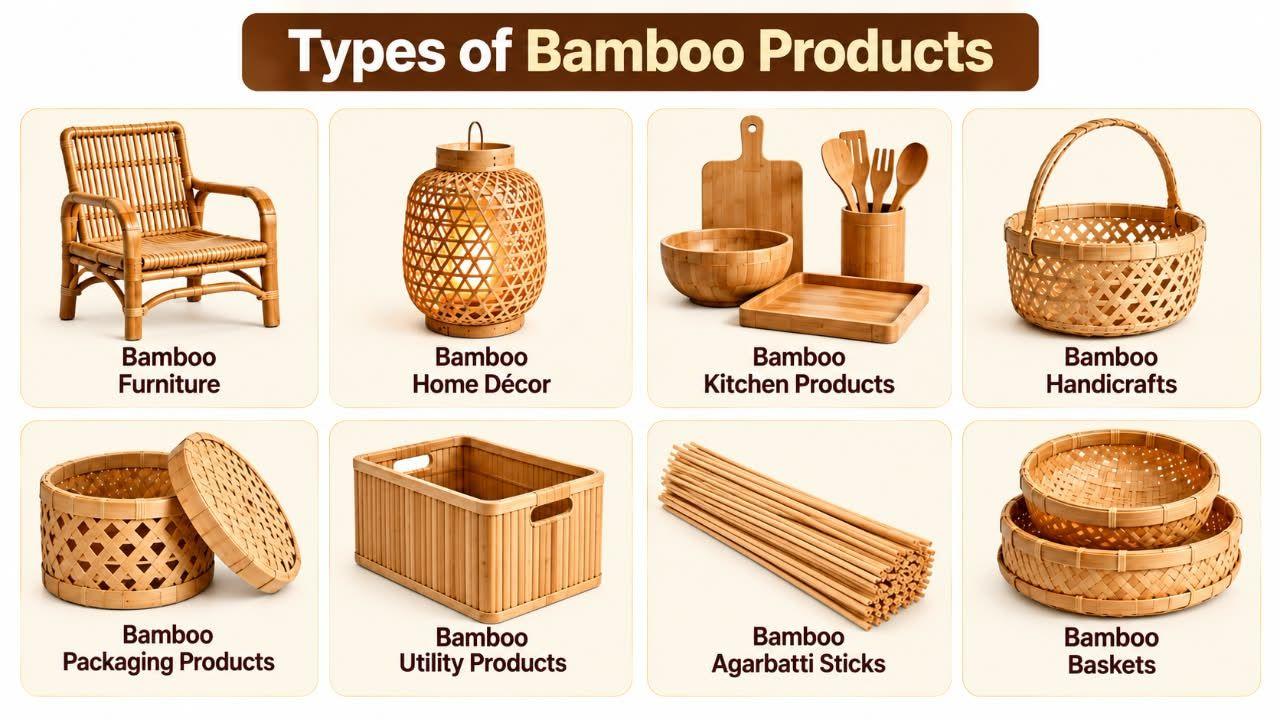
Bamboo can be converted into a wide range of products for home, commercial, lifestyle, packaging, and decorative applications. The product range depends on the type and quality of bamboo, manufacturing skills, design requirements, and market demand. Manufacturers can select different products according to their production capacity and target customers. Some commonly manufactured bamboo products include:
a. Bamboo Furniture
b. Bamboo Home Décor
c. Bamboo Kitchen Products
d. Bamboo Handicrafts
e. Bamboo Packaging Products
f. Bamboo Utility Products
g. Bamboo Agarbatti Sticks
h. Bamboo Baskets
The bamboo products market has demand across home décor, furniture, handicrafts, kitchen products, packaging, and utility segments. The growing use of eco-friendly products has created opportunities for manufacturers to develop bamboo-based products for different customer requirements. Demand can vary by product category, location, design, quality, and selling channel.
The use of bamboo products is increasing in lifestyle, home, and commercial markets where customers look for natural and eco-friendly options. This creates opportunities for businesses involved in bamboo product manufacturing.
Bamboo furniture, home décor, kitchen products, and utility products are used in homes, hotels, restaurants, cafés, offices, and resorts. Manufacturers can target these markets with different designs, sizes, and product ranges.
Bamboo packaging products and bamboo handicrafts can serve gifting, retail, decorative, and packaging requirements. Attractive designs, proper finishing, and suitable packaging can help manufacturers reach different customer segments.
There is also scope for customized bamboo products made according to specific sizes, designs, patterns, and branding requirements. Manufacturers can serve individual customers as well as businesses looking for unique bamboo handicrafts, packaging products, and utility items.
Bamboo products can be sold through online marketplaces, social commerce platforms, websites, and other digital channels. Online selling allows manufacturers to reach customers outside their local market and showcase products such as bamboo handicrafts, décor items, baskets, and utility products.
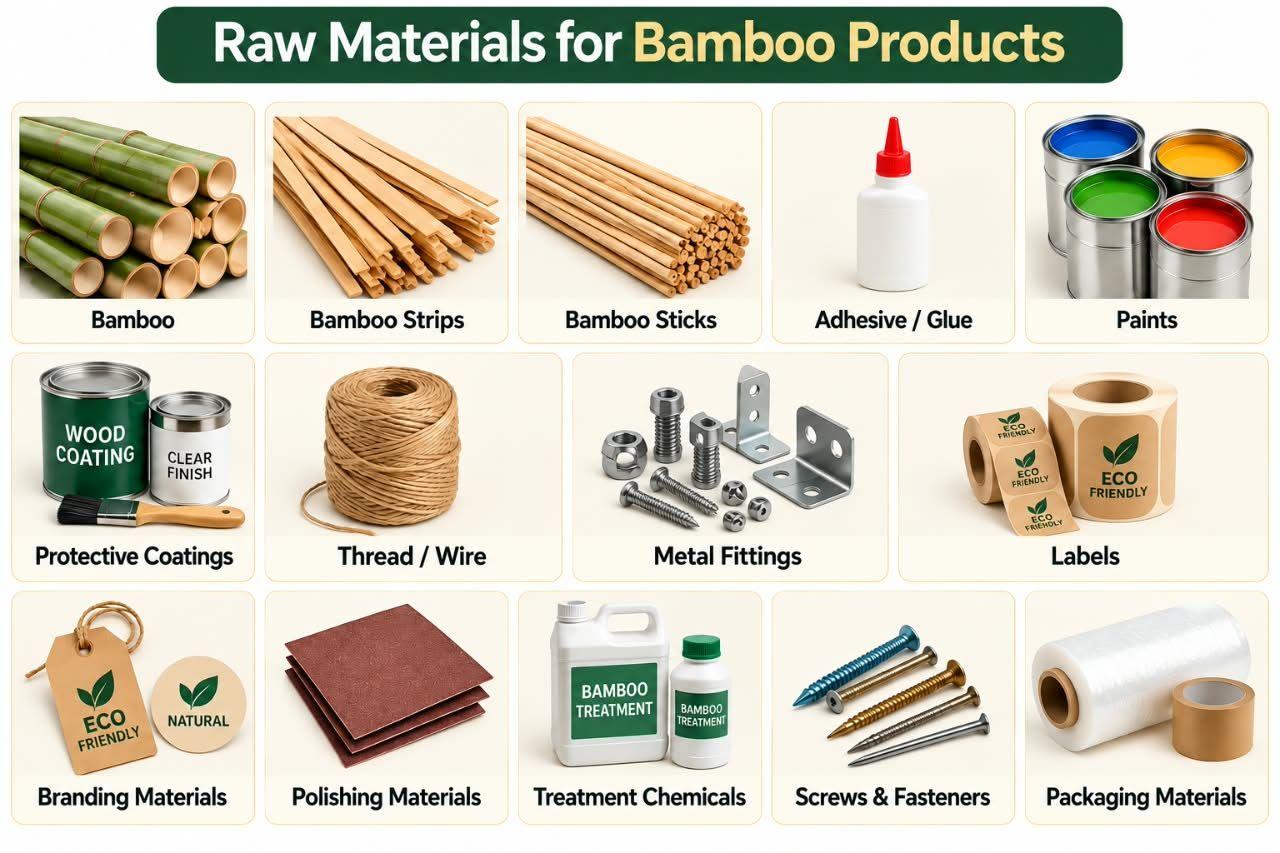
The raw materials required for a bamboo products manufacturing business depend on the type of products, production process, design, and finishing requirements. Along with bamboo, manufacturers may require materials for treatment, polishing, joining, finishing, branding, and packaging of the final products.
a. Bamboo
b. Bamboo Strips
c. Bamboo Sticks
d. Paints
e. Protective Coating
f. Thread/Wire
g. Metal Fittings
h. Labels
i. Branding Materials
j. Polishing Materials
k. Treatment Chemicals
l. Screws & Fasteners
m. Packaging Materials
The bamboo products manufacturing process involves several stages, from selecting quality bamboo to preparing and finishing the final product. Proper bamboo processing, treatment, drying, shaping, polishing, and finishing help manufacturers produce durable and attractive products according to market requirements.
Good-quality bamboo is selected according to its size, maturity, thickness, strength, and intended product. Proper raw material selection helps improve the quality and durability of bamboo products.
The selected bamboo is cut into the required length and size according to the product design. Accurate sizing helps maintain consistency throughout the bamboo manufacturing process.
Bamboo poles are split into required sections or strips. The prepared bamboo strips can be used for furniture, baskets, handicrafts, packaging products, and other bamboo-based products.
The processed bamboo is treated to improve its durability and provide protection against insects, moisture, and fungal damage. The treatment method depends on the type of product and manufacturing requirements.
Treated bamboo is properly dried to reduce excess moisture before further processing. Proper drying helps improve the stability, strength, and finishing quality of the material.
The dried bamboo is shaped, bent, drilled, or joined according to the required product design. Metal fittings, screws, fasteners, thread, or wire can be used for assembling different components.
Bamboo surfaces are sanded and polished using suitable polishing materials to remove rough portions and create a smooth surface. This step also prepares the product for final finishing.
Paints, colours, and protective coatings are applied according to the desired design and finish. Proper finishing improves the appearance and provides additional protection to the bamboo product.
The finished products are inspected for strength, dimensions, joints, surface quality, finishing, and overall appearance. Products are corrected or rejected if they do not meet the required quality standards.
The final bamboo products are packed using suitable packaging materials to protect them from damage during storage, transportation, and delivery. Labels and branding materials can also be added before dispatch.
The investment required for a bamboo products manufacturing business depends on the production scale, product range, machinery and equipment, workspace, raw materials, labour, and finishing requirements. A small manufacturing unit generally requires less investment, while a larger setup with higher production capacity requires more funds for machinery, infrastructure, and working capital.
| Investment Component | Estimated Investment |
|---|---|
| Machinery & Equipment | ₹2–6 Lakh |
| Workspace Setup | ₹1–3 Lakh |
| Raw Materials | ₹50,000–₹1.5 Lakh |
| Electrical & Installation | ₹50,000–₹1 Lakh |
| Labour & Initial Expenses | ₹50,000–₹1 Lakh |
| Packaging & Branding | ₹25,000–₹75,000 |
| Working Capital | ₹1–3 Lakh |
| Total Estimated Investment | ₹5.75–16.25 Lakh |
The actual investment may vary depending on the product category, production capacity, location, equipment selected, and business requirements.
Bamboo products can be sold through both offline and online channels depending on the product category, target customers, order volume, and business scale. Manufacturers can combine local sales with digital platforms to reach retailers, businesses, and individual customers across different markets.
Bamboo products can be supplied to local handicraft stores, furniture shops, home décor stores, gift shops, and retail outlets. This channel can be useful for building regular local customers and receiving direct product feedback.
Manufacturers can sell bamboo furniture, baskets, handicrafts, packaging products, and utility items in bulk to wholesalers and distributors. Bulk orders can help manufacturers move larger quantities of products.
Hotels, resorts, restaurants, and cafés can be potential buyers of bamboo furniture, lamps, trays, baskets, and décor products. Manufacturers can approach businesses directly and offer products based on their design and quantity requirements.
Bamboo products can be listed on online marketplaces and e-commerce platforms to reach customers beyond the local market. Products with attractive designs and proper product photographs can be promoted through digital channels.
Manufacturers can showcase their bamboo products through social media platforms and an own business website. This allows them to display product collections, receive enquiries, and build direct relationships with customers.
Handicraft exhibitions, trade fairs, and local business events can provide opportunities to display bamboo products directly to buyers, retailers, distributors, and other businesses.
Using low-quality or immature bamboo can affect the strength, durability, and appearance of the final products. Manufacturers should select suitable bamboo according to the product requirements.
Without proper bamboo treatment, products may become more vulnerable to insects, moisture, and fungal damage. Proper treatment helps improve the durability and usability of bamboo products.
Poor finishing, weak joints, uneven sizes, and rough surfaces can reduce customer satisfaction. Regular quality checking is important to maintain consistent product standards.
Manufacturing too many products without understanding market demand can increase inventory and production difficulties. Businesses should select products according to customer requirements and available production capacity.
Not calculating raw materials, labour, electricity, packaging, transportation, and other expenses properly can affect business profitability. A clear cost calculation helps in better production and pricing decisions.

StartupHyper helps entrepreneurs understand the requirements of starting a bamboo products manufacturing business. It provides useful information about bamboo products, raw materials, manufacturing processes, investment, production requirements, and market opportunities.
Entrepreneurs can use StartupHyper to explore suitable bamboo manufacturing business options and understand the requirements before planning their production setup. The available information can help in comparing products, understanding machinery and raw material needs, and planning the business according to the selected product range.
Understand the requirements for starting a bamboo products manufacturing business.
Explore different bamboo products and their manufacturing requirements.
Compare raw materials and production requirements for different products.
Understand the bamboo products manufacturing process from raw material preparation to finishing.
Explore investment and operating requirements for setting up a manufacturing unit.
Identify suitable selling channels for reaching retailers, wholesalers, businesses, and customers.
A bamboo products manufacturing business involves converting raw bamboo into products such as furniture, baskets, handicrafts, kitchen items, décor products, and utility items.
The main raw material is bamboo. Other materials may include bamboo strips, bamboo sticks, paints, protective coatings, thread, wire, metal fittings, screws, polishing materials, treatment chemicals, and packaging materials.
Manufacturers can produce bamboo furniture, home décor items, kitchen products, handicrafts, packaging products, utility items, agarbatti sticks, and baskets.
The process generally includes bamboo selection, cutting, splitting, treatment, drying, shaping, assembly, sanding, polishing, finishing, quality checking, and packaging.
Yes, the business can be started on a small scale by focusing on selected products and gradually increasing production capacity and product variety according to market demand.
Bamboo products can be sold through local markets, retail stores, wholesalers, distributors, hotels, restaurants, cafés, online marketplaces, social media, websites, exhibitions, and trade fairs.
Starting a bamboo products manufacturing business can provide opportunities to manufacture a wide range of useful, decorative, and eco-friendly products. With suitable raw materials, proper manufacturing process, quality finishing, and effective production planning, entrepreneurs can develop products according to different customer requirements.
A clear understanding of market demand, investment requirements, manufacturing cost, product quality, and selling channels is important for building a sustainable business. By selecting the right product range and maintaining consistent quality, manufacturers can expand their bamboo products business and reach different markets.
📞Call / WhatsApp: 9472093913
📧Email: info@startuphyper.com
🌐 Website: www.startuphyper.com | www.machinehai.com
🏢 Branches: Patna | Gaya | Katihar | Saharsa
Stay updated with the latest tips, trends, and best practices in factory setup and machinery procurement—subscribe to the StartupHyper newsletter!
No spam, we promise. Your inbox is safe with us—only valuable insights.