Read the full article to gain deeper insights and comprehensive information.

Sep 29, 2026
0
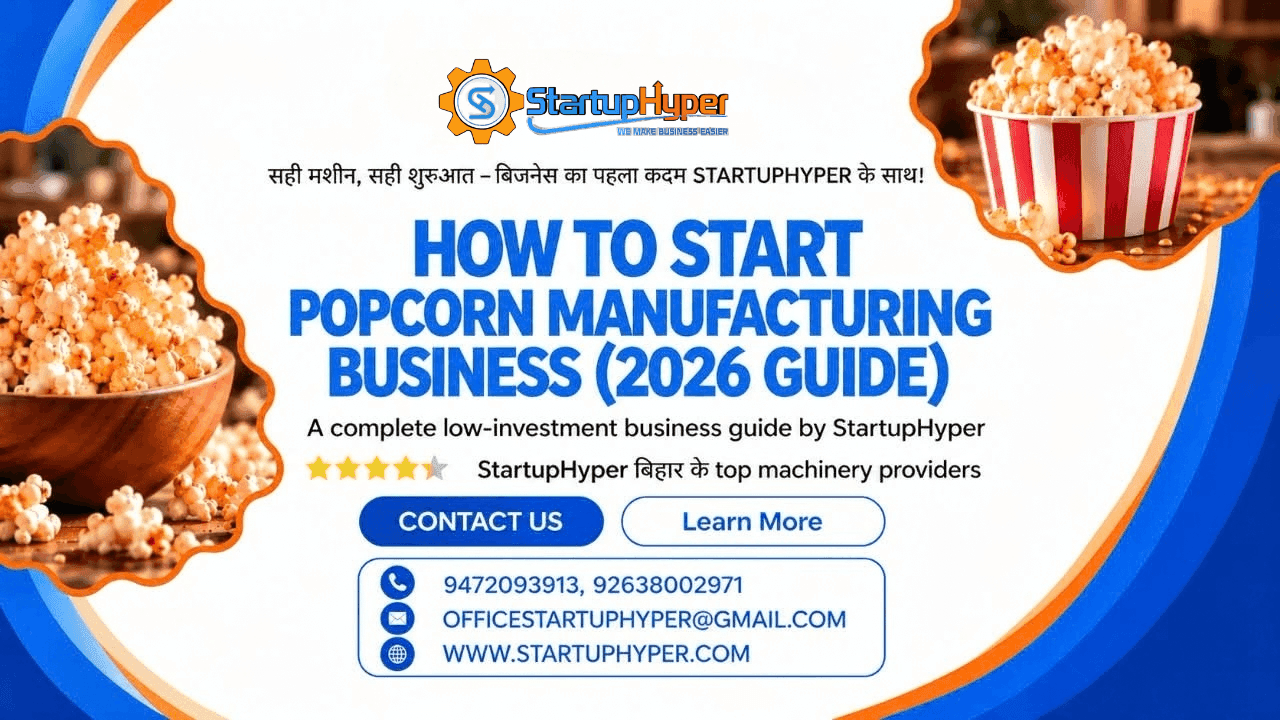
Learn how to start a Popcorn Manufacturing Business in 2026 with details on popcorn manufacturing process, raw materials, investment, types, market demand, selling opportunities, and business setup.
What Is a Popcorn Manufacturing Business?
Why Start a Popcorn Manufacturing Business?
Types of Popcorn
Market Demand for Popcorn
Raw Materials Required
Popcorn Manufacturing Process
Investment Required for Popcorn Manufacturing Business
Where to Sell Popcorn
Common Mistakes to Avoid
How StartupHyper Can Help
Frequently Asked Questions
Conclusion
A Popcorn Manufacturing Business involves producing popcorn using special maize kernels, edible oil, salt, butter, and different flavouring ingredients. The Popcorn Manufacturing Process includes kernel heating, popping, flavour mixing, cooling, and packaging. Popular varieties include salted popcorn, butter popcorn, caramel popcorn, and cheese popcorn.
A Popcorn Making Business can be started on a small or medium scale depending on production capacity and market demand. With proper Popcorn Manufacturing, quality ingredients, attractive packaging, and effective branding, entrepreneurs can supply popcorn to grocery stores, supermarkets, cinemas, food outlets, and online customers.
Popcorn is a convenient snack that can be prepared, flavoured, and packed in different formats for various customer groups. A Popcorn Manufacturing Business can serve demand from cinemas, food counters, retail shops, events, and direct consumers, giving entrepreneurs several ways to build their business.
The demand for ready-to-eat snacks creates opportunities for Popcorn Products in both local and commercial markets. Popcorn can be consumed during movies, parties, events, travel, and leisure activities.
Manufacturers can create different popcorn flavours according to customer preferences and market trends. Options such as cheese, caramel, butter, salted, and other flavoured popcorn can make the product range more attractive.
A Popcorn Making Business can be planned according to the required production volume and available investment. Entrepreneurs can start with a basic setup and add production capacity as the customer base and order volume increase.
Popcorn has good potential for creative packaging because it can be offered in cups, pouches, boxes, and other formats. Well-designed Popcorn Packaging can make the product suitable for retail shelves, events, and entertainment venues.
Popcorn can be supplied in larger quantities for cinemas, birthday parties, exhibitions, fairs, corporate events, and other gatherings. These bulk-order opportunities can provide an additional revenue channel for a Popcorn Manufacturing Business.
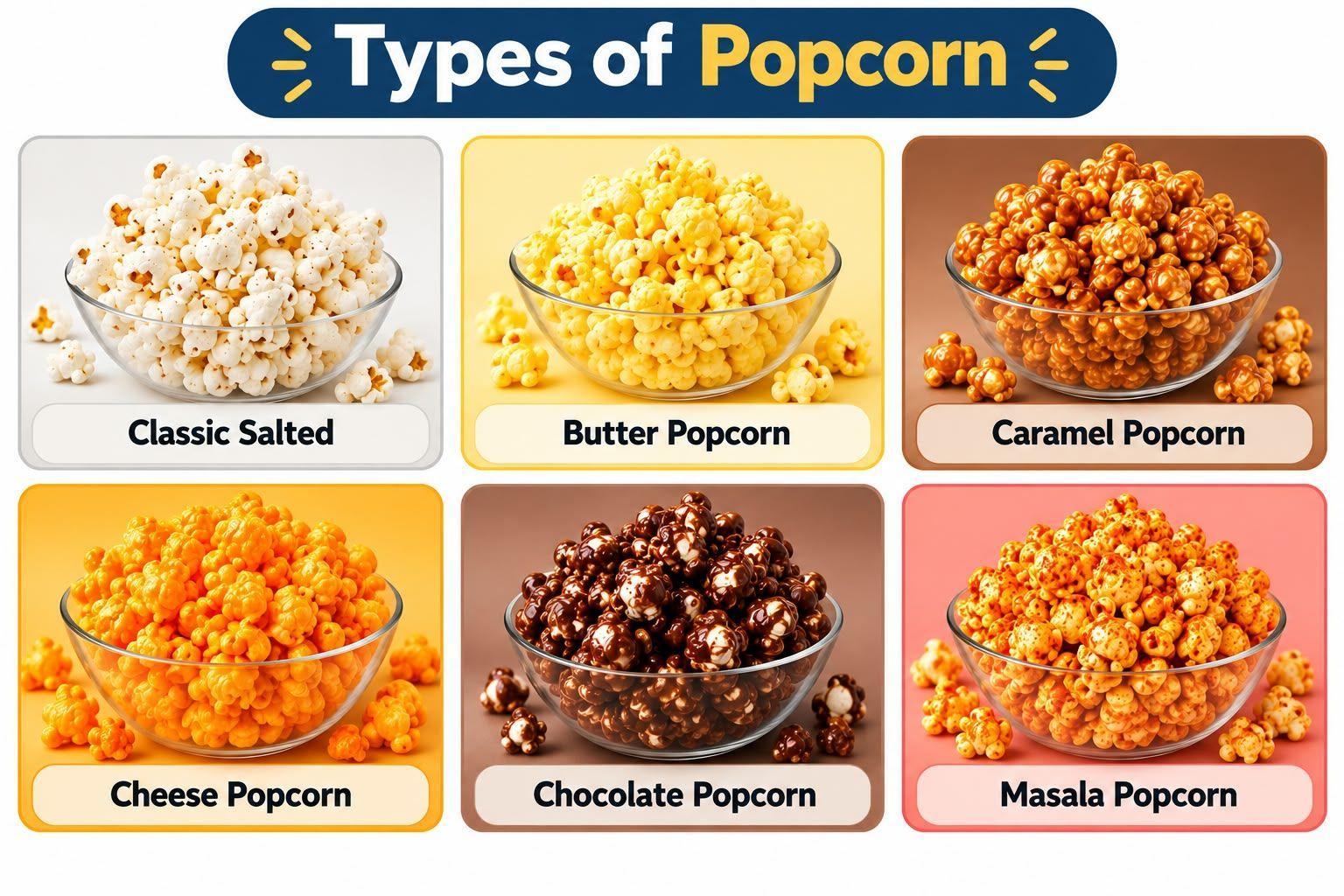
A Popcorn Manufacturing Business can offer a wide range of flavours to meet different customer preferences and market requirements. From traditional salted varieties to sweet and spicy options, manufacturers can develop different Popcorn Products for cinemas, retail stores, food outlets, events, and online sales.
Classic Salted Popcorn is a traditional snack prepared using popped corn kernels, oil, and salt. Its simple taste and easy preparation make it a common choice for Popcorn Manufacturing and everyday snack sales.
Traditional and familiar popcorn flavour.
Made with basic ingredients.
Suitable for retail and cinema sales.
Butter Popcorn is prepared by combining freshly popped corn with butter or suitable butter-flavoured ingredients. Its rich taste makes it a popular option for Popcorn Making Business operators targeting cinemas, food counters, and snack retailers.
Rich and buttery flavour.
Suitable for cinema-style popcorn.
Can be sold in different pack sizes.
Caramel Popcorn is made by coating popped corn with a sweet caramel preparation, giving it a crunchy texture and sweet taste. It can be included in a premium range of Popcorn Products for retail and special occasions.
Sweet caramel-coated popcorn.
Crunchy and attractive snack option.
Suitable for premium packaging.
Cheese Popcorn combines freshly popped corn with cheese seasoning to create a savoury snack with a distinctive flavour. It provides an additional product option for a Popcorn Manufacturing Business targeting customers who prefer savoury flavours.
Strong cheese flavour.
Popular savoury snack option.
Suitable for pouches and containers.
Chocolate Popcorn is prepared by adding a chocolate-based coating or flavouring to popped corn. Its sweet taste makes it suitable for speciality snack ranges and attractive Popcorn Packaging designed for younger consumers and chocolate lovers.
Sweet chocolate flavour.
Suitable for speciality popcorn ranges.
Can be offered in attractive packaging.
Masala Popcorn is prepared using spices and seasoning to give the product a spicy and savoury taste. Manufacturers can adjust the Popcorn Masala according to regional preferences and create different levels of spice for their target customers.
Spicy and savoury popcorn flavour.
Prepared with a customised masala blend.
Suitable for Indian snack markets.
The Popcorn Market has demand across entertainment, retail, food-service, and event-based businesses. Its convenient serving format and variety of flavours make Popcorn Products suitable for different customer groups. This creates opportunities for manufacturers to supply both individual consumers and bulk buyers.
Cinemas, theatres, amusement centres, and entertainment venues are important markets for Popcorn Manufacturing businesses. Different serving sizes and flavours can be offered according to the requirements of these venues.
Grocery stores, supermarkets, snack shops, and convenience stores can provide regular retail opportunities for packaged popcorn. Attractive Popcorn Packaging and different pack sizes can help manufacturers reach more retail customers.
Parties, fairs, exhibitions, festivals, and other events can create opportunities for fresh and packaged popcorn sales. Manufacturers can supply ready-to-eat popcorn or handle bulk orders based on the requirements of event organisers.
Online platforms provide another channel for selling packaged Popcorn Products beyond the local market. Manufacturers can promote different flavours, pack sizes, and special popcorn varieties through e-commerce websites and social media.
A Popcorn Manufacturing Business requires a combination of food-grade ingredients and packaging materials to produce consistent-quality popcorn. The main raw materials include popcorn kernels, cooking oil, salt, butter or flavouring agents, sugar, spices, and other ingredients depending on the variety being manufactured.
Popcorn kernels are the primary raw material used in Popcorn Manufacturing. Good-quality kernels should have suitable moisture content and popping characteristics to produce properly expanded popcorn with good texture.
Cooking oil is used for heating and popping the kernels. Manufacturers can select suitable edible oil according to the production method, flavour requirements, and product quality.
Salt and seasoning ingredients are used to develop the taste of different Popcorn Products. The quantity and seasoning blend can be adjusted according to the flavour being produced and customer preferences.
Different flavouring ingredients are required for products such as butter, cheese, caramel, chocolate, and masala popcorn. These ingredients help manufacturers create a wider range of Flavoured Popcorn.
Sugar and other ingredients used for caramel preparation are required for making sweet popcorn varieties. Proper coating helps provide the desired sweetness, texture, and appearance.
Food-grade pouches, cups, containers, boxes, labels, and sealing materials are required for Popcorn Packaging. The packaging should protect the product from moisture and maintain its freshness during storage and transportation.
The Popcorn Manufacturing Process includes cleaning the kernels, popping them with controlled heat, adding flavours or seasonings, cooling, and packaging the finished product. A properly managed Popcorn Production Process helps maintain consistent taste, texture, hygiene, and product quality.
Good-quality popcorn kernels are selected according to the required production capacity and product type. Proper kernel selection is important for achieving good popping results and maintaining the quality of Popcorn Products.
The selected kernels are cleaned to remove dust, stones, and other unwanted particles. Clean kernels help maintain food hygiene and ensure better quality during the Popcorn Making Process.
The cleaned kernels are placed in a suitable popcorn-making machine and heated with edible oil. When the required temperature is reached, the kernels expand and pop, producing fresh popcorn.
The required flavouring or seasoning is prepared according to the type of popcorn being produced. Salt, butter, cheese, caramel, chocolate, and masala can be used to manufacture different Flavoured Popcorn varieties.
Freshly popped corn is mixed with the selected flavour, seasoning, or coating. Proper mixing ensures that the ingredients are distributed evenly and that every portion of the Popcorn Product has a consistent taste.
After flavouring, the popcorn is allowed to cool before packaging. Proper cooling helps remove excess heat and reduces the possibility of moisture affecting the texture and shelf life of the product.
The cooled popcorn is packed into food-grade pouches, cups, boxes, or containers according to the target market. Good Popcorn Packaging helps protect the product from moisture, contamination, and damage during transportation.
The final product is checked for taste, texture, appearance, quantity, sealing, and packaging quality. After the quality check, the finished Popcorn Products are ready for storage, distribution, and sale.
The Popcorn Manufacturing Business offers flexibility in investment because the setup can be designed according to the quantity and variety of popcorn to be produced. A business focusing on fresh popcorn may need a different setup from one producing sealed retail packs with multiple flavours. The choice of production equipment, seasoning arrangements, packaging format, storage capacity, and daily output will determine the overall Popcorn Business Investment.
| Investment Component | Estimated Investment |
|---|---|
| Popcorn Production Equipment | ₹40,000 – ₹1.50 Lakh |
| Flavouring & Seasoning Setup | ₹15,000 – ₹50,000 |
| Packaging Equipment & Materials | ₹20,000 – ₹80,000 |
| Initial Raw Material Stock | ₹20,000 – ₹60,000 |
| Workspace Setup | ₹30,000 – ₹1 Lakh |
| Storage & Handling Equipment | ₹10,000 – ₹35,000 |
| Branding & Marketing | ₹15,000 – ₹50,000 |
| Working Capital | ₹30,000 – ₹1 Lakh |
| Total Estimated Investment | ₹1.80 Lakh – ₹6.25 Lakh |
The estimated Popcorn Manufacturing Business Investment can differ based on production volume, product range, packaging style, equipment selection, and the scale of the business.
A Popcorn Manufacturing Business can target both direct consumers and bulk buyers through different sales channels. Since popcorn is consumed at cinemas, events, retail stores, food outlets, and during leisure activities, manufacturers can choose selling channels according to their product type and production capacity. Fresh popcorn can be supplied locally, while properly packed Popcorn Products can be distributed through retail and online markets.
Cinemas and multiplexes can provide regular demand for salted, butter, cheese, and other popular Popcorn Products. Manufacturers can supply bulk quantities or ready-to-serve packs based on the requirements of the venue.
Packaged popcorn can be placed in grocery stores, supermarkets, convenience stores, and snack shops. Different flavours and pack sizes can help manufacturers target a wider range of retail customers.
Cafes, food courts, snack counters, and quick-service outlets can sell fresh or flavoured popcorn to their customers. Manufacturers can develop supply arrangements with these outlets for regular product orders.
Birthday parties, fairs, exhibitions, festivals, amusement parks, and other gatherings can create opportunities for popcorn sales. Businesses can accept bulk orders or prepare customised popcorn packs for different events.
Packaged Flavoured Popcorn can be marketed through e-commerce platforms, social media, and the business's own online channels. Online selling can help manufacturers reach customers beyond their local area and expand their market presence.
Poor-quality kernels can result in uneven popping, small popcorn size, and inconsistent texture. Using suitable kernels is important for maintaining the quality of Popcorn Products and reducing production wastage.
Excessive seasoning or flavouring can affect the taste and texture of popcorn. Maintaining the right quantity of salt, butter, cheese, caramel, or masala helps create a consistent Flavoured Popcorn product.
Popcorn can lose its crisp texture when exposed to moisture. Proper cooling, storage, and suitable Popcorn Packaging are important to maintain freshness and product quality.
Weak or unsuitable packaging can allow moisture and air to enter the product and may also affect its appearance during transportation. Food-grade and properly sealed packaging should be selected for packaged popcorn.
Manufacturing too many flavours or pack sizes without understanding customer preferences can increase inventory and wastage. A Popcorn Manufacturing Business should identify its target customers and plan production accordingly.

Starting a Popcorn Manufacturing Business requires clear information about production setup, raw materials, investment planning, packaging, market opportunities, and selling channels. StartupHyper provides practical business information that helps entrepreneurs understand the requirements of setting up a Popcorn Manufacturing Unit according to their production capacity and target market.
StartupHyper also covers important areas of the Popcorn Business, including the manufacturing process, flavour options, packaging requirements, investment planning, and sales opportunities. This information helps new entrepreneurs understand the business requirements and plan their Popcorn Manufacturing venture with greater clarity.
Helps entrepreneurs understand the key requirements for starting a Popcorn Manufacturing Business.
Provides information about the Popcorn Manufacturing Process and production requirements.
Helps in planning Popcorn Business Investment according to the desired business scale.
Provides useful details about Popcorn Raw Materials and flavouring requirements.
Helps explore different Flavoured Popcorn options for the target market.
Provides information about Popcorn Packaging and suitable selling formats.
Helps identify Popcorn Market opportunities across retail, events, cinemas, and online channels.
Bilkul, FAQ section mein kuch bhi highlight/bold nahi hoga. Questions aur answers normal text mein rahenge.
To start a Popcorn Manufacturing Business, entrepreneurs need to plan the production setup, select suitable raw materials and equipment, decide the popcorn varieties, arrange packaging, and identify suitable sales channels.
Popular popcorn products include Classic Salted Popcorn, Butter Popcorn, Caramel Popcorn, Cheese Popcorn, Chocolate Popcorn, and Masala Popcorn.
The basic popcorn manufacturing setup may require popcorn-making equipment, heating arrangements, flavour mixing equipment, weighing tools, sealing equipment, and other production accessories.
Flavoured popcorn can be prepared using ingredients such as butter, cheese seasoning, caramel, chocolate coating, salt, spices, and other flavouring agents depending on the product variety.
Popcorn should be packed in suitable food-grade pouches, cups, boxes, or containers that protect the product from moisture and contamination. Proper popcorn packaging also helps improve product presentation.
Salted, butter, caramel, cheese, chocolate, and masala are common flavoured popcorn options. Manufacturers can select flavours according to local demand and customer preferences.
The main customers for popcorn products can include cinemas, retail stores, food outlets, event organisers, supermarkets, cafes, entertainment venues, and individual consumers.
Yes, a small-scale popcorn manufacturing business can begin with limited production capacity and a smaller product range. The setup can be expanded later according to sales, customer demand, and available investment.
Conclusion ko 2 fresh paragraphs mein rakh raha hoon, with natural top-level SEO keywords highlighted.
Starting a Popcorn Manufacturing Business can provide an opportunity to enter the growing ready-to-eat snack market with different product varieties and selling formats. By choosing suitable Popcorn Raw Materials, maintaining an efficient Popcorn Manufacturing Process, and offering attractive flavours and packaging, entrepreneurs can develop products for cinemas, retail stores, events, food outlets, and online customers.
A successful Popcorn Business requires proper Popcorn Business Investment, consistent product quality, effective packaging, and a clear sales strategy. Entrepreneurs can begin with a manageable production setup and gradually expand their Popcorn Manufacturing Unit by introducing new flavours, increasing production capacity, and reaching wider markets.
📞Call / WhatsApp: 9472093913
📧Email: info@startuphyper.com
🌐 Website: www.startuphyper.com | www.machinehai.com
🏢 Branches: Patna | Gaya | Katihar | Saharsa
Stay updated with the latest tips, trends, and best practices in factory setup and machinery procurement—subscribe to the StartupHyper newsletter!
No spam, we promise. Your inbox is safe with us—only valuable insights.