Read the full article to gain deeper insights and comprehensive information.

Jul 06, 2026
0
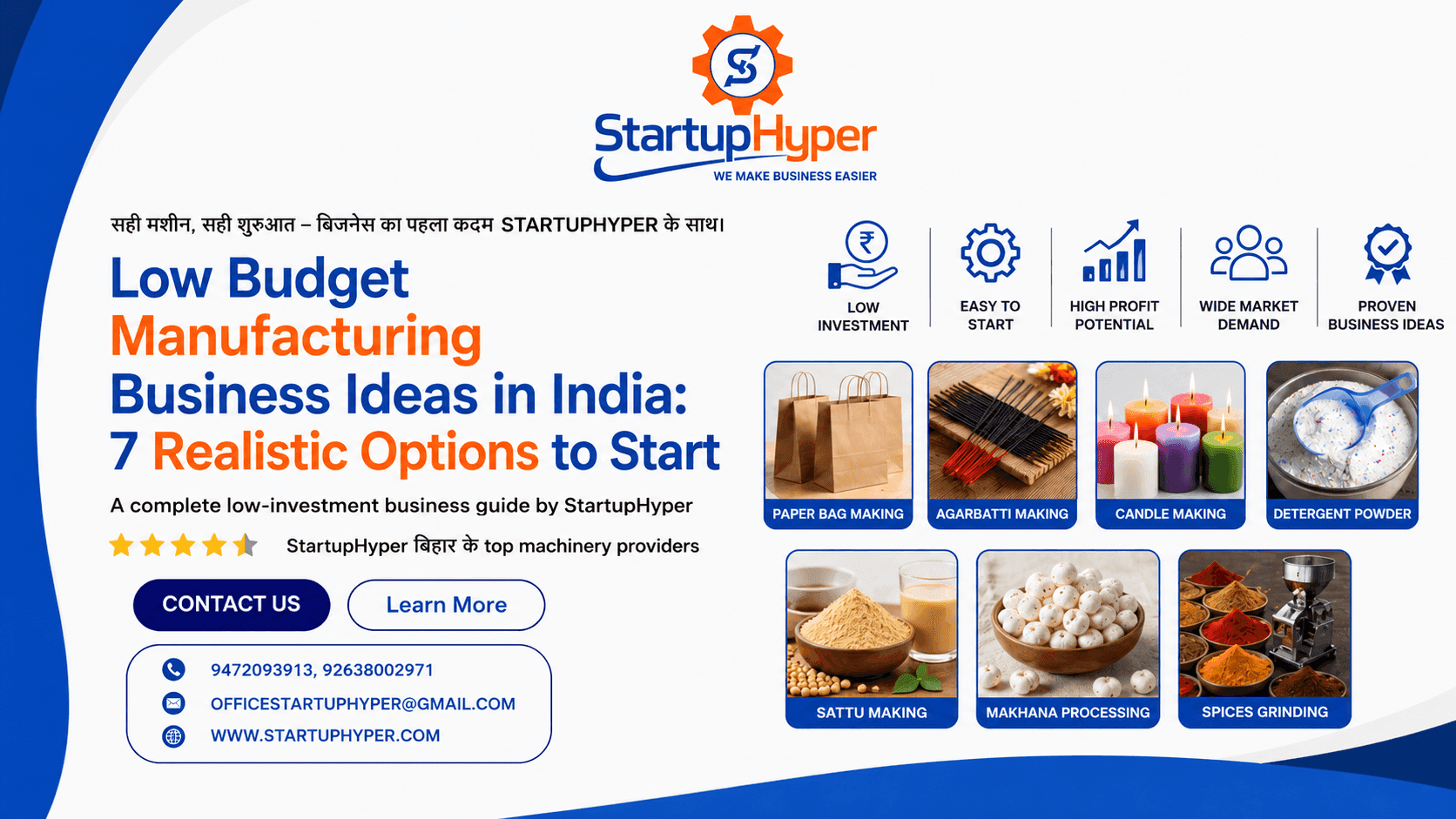
low budget manufacturing business ideas in India under ₹10 lakh — compare machines, investment, raw materials and customers for each
Starting a manufacturing business does not always mean setting up a huge factory or investing crores of rupees.
Many practical manufacturing businesses can begin with a focused product, basic machinery, a small workshop and a clear local sales plan. The important part is choosing a product that people buy repeatedly, can be produced consistently and has a realistic route to market.
For this guide, "low budget" means a small manufacturing setup that can generally be planned under ₹10 lakh, depending on machinery capacity, rent, raw material, packaging and working capital.
Do not choose a business only because someone claims it gives "high profit." A business becomes sustainable when you can source raw material properly, maintain product quality, sell regularly and manage cash flow.
This article covers seven realistic manufacturing opportunities that fit StartupHyper's machinery-focused audience, all achievable within a ₹10 lakh budget
Before selecting any business idea, answer these questions:
| Question | Why It Matters |
|---|---|
| Who will buy the product? | Production without buyers creates unsold stock. |
| Is the product used repeatedly? | Repeat-demand products can create regular sales. |
| Can raw material be sourced easily? | Better sourcing helps control cost and quality. |
| Can you sell locally first? | Local sales reduce transport and distribution risk. |
| Does the machine capacity match your sales plan? | A large machine with no orders can create unnecessary EMI pressure. |
| How much working capital will you need? | Machinery alone does not run the business. |
A good beginner manufacturing business usually has three things: repeat demand, manageable machinery and a clear customer segment.
Indicative investment: ₹3 lakh–₹8 lakh
Main products: Turmeric powder, chilli powder, coriander powder, cumin powder, garam masala and blended spices
Target customers: Grocery stores, wholesalers, restaurants, caterers, hotels and online buyers
Spices are everyday products. People buy them regularly, and local markets often have space for brands that offer clean grinding, good aroma, consistent quality and proper packaging.
A small spice unit does not need to launch twenty products. Start with two or three products that have regular demand in your area. For example, turmeric powder, chilli powder and coriander powder can be a practical starting range
| Machine | Use |
|---|---|
| Pulverizer or Spice Grinder | Grinds whole spices into powder |
| Ribbon Blender | Mixes blended masalas evenly |
| Vibro Sifter | Helps achieve uniform powder size |
| Weighing Scale | Maintains accurate pouch weight |
| Pouch Sealing or Packing Machine | Packs spices in retail pouches |
| Batch Coding Machine | Prints batch number, MRP and date details |
The key is not only grinding spices. You need to control raw-spice quality, aroma and colour, powder fineness, hygiene, moisture, packaging quality and retailer margin. A poor-quality spice packet may get one sale. A consistent product gets repeat orders. → Read our full guide: How to Start a Spice Manufacturing Business in India (coming soon)
Indicative investment: ₹3 lakh–₹8 lakh
Main products: Detergent powder, dishwash powder, liquid handwash, dishwash liquid and floor cleaner
Target customers: Grocery stores, wholesalers, hostels, hotels, offices, institutions and local distributors
Cleaning products are used regularly in homes and commercial spaces. This makes detergent and liquid-cleaner manufacturing a repeat-demand category.
A beginner can start with one detergent powder and one liquid product instead of trying to launch a full personal-care range.
| Machine | Use |
|---|---|
| Ribbon Blender or Detergent Mixer | Mixes detergent ingredients |
| Pulverizer, where required | Processes certain dry materials |
| Liquid Mixing Tank | Mixes liquid cleaners |
| Liquid Filling Machine | Fills bottles or pouches |
| Cap Sealing Machine | Seals bottles |
| Weighing and Packing Machine | Packs detergent powder |
Your product must perform well at the price point. Customers and retailers will compare cleaning performance, fragrance, foam level, packaging, price, quantity and retailer margin.
Do not compete only by making the cheapest detergent. Focus on a reliable product and a distribution plan.
Indicative investment: ₹3 lakh–₹8 lakh
Main products: Plain agarbatti, scented agarbatti, dhoop sticks, dhoop cones and incense cups
Target customers: Grocery stores, puja stores, wholesalers, temples, local distributors and online buyers
Agarbatti has year-round demand and stronger sales during festivals, religious events and wedding seasons. It can be produced at a small scale and expanded gradually with fragrance, premium packaging and different product formats.
| Machine | Use |
|---|---|
| Agarbatti Making Machine | Produces incense sticks |
| Powder Mixer | Mixes charcoal powder, wood powder and binding material |
| Dryer | Dries agarbatti before perfume application |
| Perfume Application Setup | Adds fragrance |
| Packing Machine | Packs incense sticks and dhoop products |
The product needs proper burning time, consistent fragrance, strong packaging, good stick quality and reliable distribution.
You can start with basic fragrance variants and later add premium packs, cones and dhoop cups
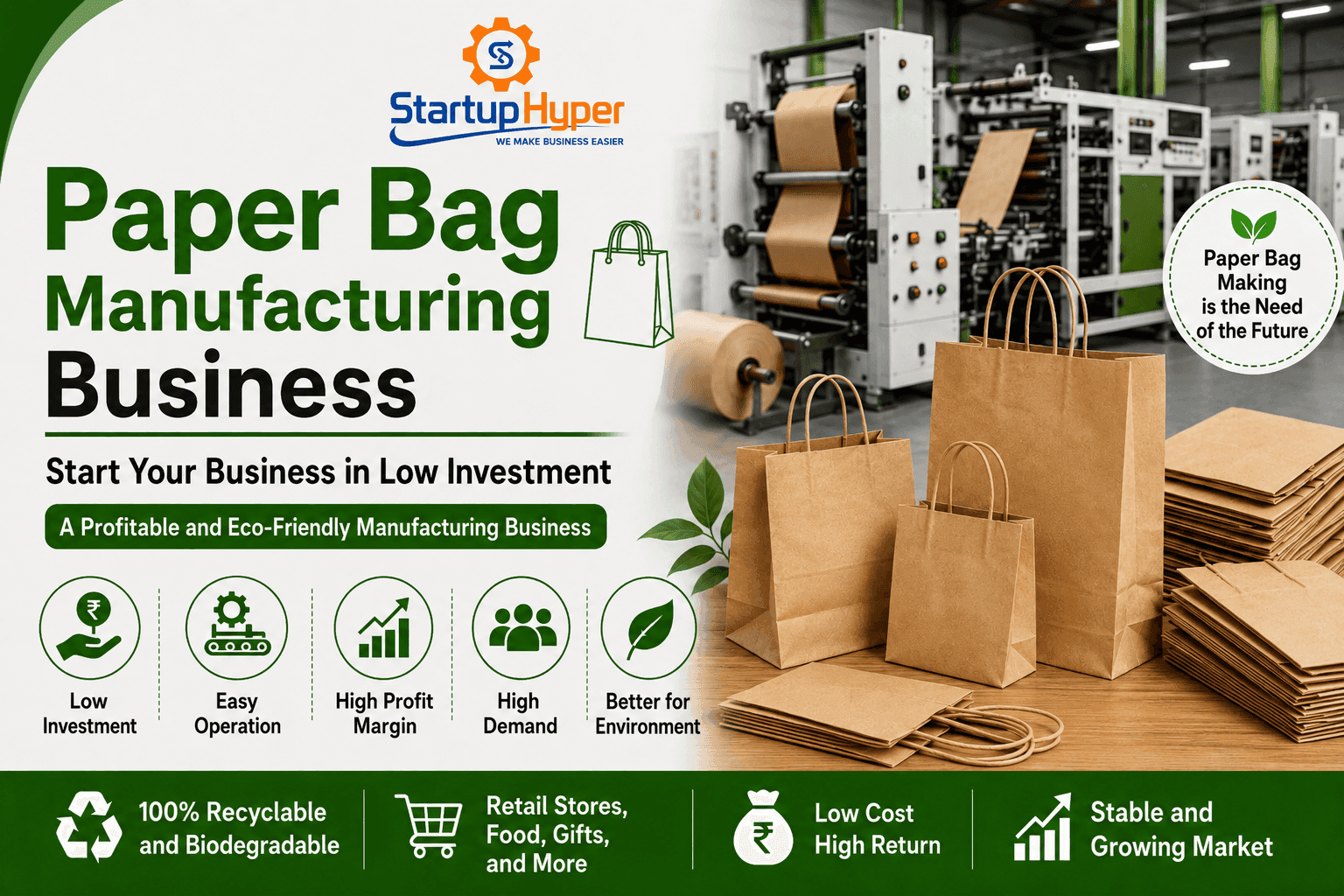
Indicative investment: ₹3 lakh–₹9 lakh
Main products: Grocery bags, bakery bags, pharmacy bags, boutique bags, food-delivery bags and printed paper bags
Target customers: Bakeries, pharmacies, clothing shops, sweet shops, restaurants, cafés and retail stores
Paper bag manufacturing is mainly a B2B business. Instead of waiting for retail buyers, approach businesses that already need bags every week.
The opportunity is strongest when you offer the right bag size, paper GSM, handle type and printing option for each customer category.
| Machine | Use |
|---|---|
| Paper Bag Making Machine | Forms paper bags |
| Paper Cutting Machine | Cuts paper to the required size |
| Pasting Machine or Setup | Applies adhesive |
| Handle-Pasting Machine | Adds handles to carry bags |
| Printing Machine, if required | Prints logos and branding |
| Packing Setup | Bundles finished bags |
Visit local markets and ask businesses what bag sizes they use, how many bags they need monthly, whether they need plain or printed bags, and what price they currently pay.
This information is more useful than buying a machine first and searching for customers later.
Indicative investment: ₹3 lakh–₹10 lakh
Main products: Chana sattu, barley sattu, mixed-grain sattu, roasted gram flour and flavoured sattu drink mixes
Target customers: Grocery stores, wholesalers, local retailers, health-food stores, cafés, distributors and online buyers
Sattu is a repeat-use food product with strong demand in Bihar, eastern India and among customers looking for traditional, easy-to-prepare food options. It can be sold as plain sattu for drinks and cooking, or as flavoured ready-to-mix drink packs.
A new unit does not need to launch multiple flavours or premium variants from day one. Start with plain chana sattu in two common pack sizes, build local distribution, and then expand into barley sattu, mixed-grain variants or flavoured drink mixes.
Machines Required
| Machine | Use |
|---|---|
| Roaster | Roasts chana, barley or other grains evenly before grinding |
| Pulverizer | Grinds roasted material into fine sattu powder |
| Vibro Sifter | Removes coarse particles and makes the powder more uniform |
| Ribbon Blender | Mixes ingredients for flavoured or mixed-grain variants |
| Weighing Machine | Ensures accurate pouch weight |
| Pouch Packing or Sealing Machine | Packs sattu in retail pouches |
| Batch Coding Machine | Prints batch number, packing date, MRP and best-before details |
Focus on proper roasting, fine grinding, low moisture, clean processing and moisture-proof packaging. Sattu should have a fresh aroma, smooth texture and consistent taste in every pack.
Local grocery stores, distributors and summer drink demand can create regular sales. Bulk supply to hostels, canteens, retailers and regional-food outlets can also help create predictable production runs once you build the right local relationships.
Indicative investment: ₹3 lakh–₹12 lakh
Main products: Plain makhana, roasted makhana, flavoured makhana, makhana snack mixes and premium gift packs
Target customers: Grocery stores, supermarkets, cafés, health-food stores, distributors, corporate buyers and online customers
Makhana has moved beyond being only a traditional dry-fruit product. Today, plain and flavoured makhana is sold as a healthy snack through local stores, supermarkets, cafés and online platforms. For a new entrepreneur, buying popped makhana and focusing on roasting, flavouring and packing is usually more practical than setting up a raw-makhana processing unit.
A new unit does not need to start with many flavours. Begin with plain makhana and two popular variants such as salted and peri-peri, then expand into cheese, pudina or other flavours after getting regular customer feedback.
| Machine | Use |
|---|---|
| Makhana Roaster | Roasts makhana evenly and improves crunch |
| Seasoning Drum / Coating Machine | Mixes flavour, seasoning and oil evenly on roasted makhana |
| Cooling Tray or Cooling Setup | Cools makhana before packing to avoid moisture inside the pouch |
| Weighing Machine | Ensures accurate pouch weight |
| Pouch Packing or Sealing Machine | Packs makhana in retail pouches |
| Nitrogen Flushing Packing Machine | Helps protect freshness and crunch in premium snack packs |
| Batch Coding Machine | Prints batch number, packing date, MRP and best-before details |
Focus on good-quality popped makhana, low breakage, even roasting, limited but consistent flavours and strong moisture-proof packaging. Makhana is fragile, so rough handling and weak packing can quickly reduce product quality.
Regular sales can come from local grocery stores, supermarkets, cafés, healthy-snack counters and online orders. If you are sourcing from Bihar, it can give you a raw-material advantage, but the final product still needs to win on taste, freshness, packaging and reliable supply.
Indicative investment: ₹2 lakh–₹6 lakh
Main products: Plain candles, pillar candles, tealight candles, decorative candles and scented candles
Target customers: Gift shops, home-decor stores, online buyers, event and wedding planners, and general retail during festive seasons
Candles have steady year-round household demand plus strong seasonal spikes around festivals, weddings and gifting occasions, making it one of the lowest-entry manufacturing businesses on this list.
A new unit can start with plain and tealight candles before expanding into scented or decorative designs, which typically sell at a higher margin.
| Machine | Use |
|---|---|
| Wax Melting Unit | Melts paraffin or other candle wax |
| Candle Moulding Machine | Shapes candles using moulds |
| Wick Inserting Setup | Positions wicks accurately during moulding |
| Cooling Trays or Racks | Cools and sets candles before removal |
| Cutting and Trimming Tools | Finishes candle edges and wick length |
| Packing Setup | Packs candles for retail or gifting |
Focus on consistent burn time, clean finish, fragrance quality (for scented variants) and attractive packaging, since candles are often bought as gifting or décor items rather than pure necessity.
Start with a narrow, well-finished range rather than many designs with inconsistent quality.
| If You Have… | Better Manufacturing Option |
|---|---|
| Grocery-store and food-distributor connections | Spices, detergent or soybean products |
| Local commercial-market contacts | Paper bags or notebooks |
| Religious-product retail network | Agarbatti and dhoop products |
| School, college or stationery-wholesaler contacts | Notebook making |
| Gift shop, décor or event-planning network | Candle making |
| B2B selling ability | Paper bags, detergent products or notebooks |
The exact requirements depend on your product, location and business size. However, common registrations may include:
The exact requirements depend on your product, location and business size. However, common registrations may include
For food businesses such as spices and soyabean products, FSSAI registration or licensing should be planned before commercial sales.
For food businesses such as spices and soyabean products, FSSAI registration or licensing should be planned before commercial sales.
Do not spend your complete budget on machinery. Keep at least two to three months of operating buffer for raw material, packaging material, labour, electricity, transport, retailer credit, product returns, and small repairs and maintenance.
A business can have good machinery and still struggle if it runs out of working capital before sales become regular.
Buying a Machine Before Validating Demand Talk to retailers, wholesalers, distributors or institutional buyers before buying machinery. Find out what products, pack sizes and price points they already buy.
Starting Too Many Products Start with one main product and a few variants. Too many SKUs create inventory, quality-control and working-capital problems.
Ignoring Packaging Packaging protects the product, helps maintain quality and affects how retailers and customers see your brand.
Competing Only on Price Low price without quality, retailer margin and reliable supply is difficult to sustain.
No Distribution Plan Manufacturing is only half the business. Your product must reach customers regularly through retailers, wholesalers, distributors or direct sales.
StartupHyper helps entrepreneurs move from an idea to a practical manufacturing setup.
Depending on location and machine capacity, agarbatti, candle making, basic spice grinding, detergent powder and small notebook or paper-bag setups can be explored under ₹5 lakh. However, keep working capital separate from machinery cost.
Spices, detergents, agarbatti, notebooks, soyabean products, candles and paper bags can have repeat demand because they are used regularly by households, institutions or businesses.
Food products can have regular demand but need stronger hygiene, shelf-life and food-compliance planning. Non-food products may have simpler production but can depend more on B2B distribution. The better option depends on your local market and ability to sell.
Some small-scale activities may begin from a home-based or small-workshop setup, subject to local rules, electricity load, hygiene requirements and product-specific compliance. Food manufacturing needs especially careful cleanliness and licensing planning.
Start with semi-automatic machinery when demand is still being tested. Move to higher automation once orders become regular enough to use the additional capacity.
Prepare a project report with machinery quotations, estimated sales, raw-material cost, working-capital requirement and repayment plan. MSME registration and bank finance options may help, but approval depends on eligibility and lender assessment
The best low-budget manufacturing business is not the one with the biggest profit claim. It is the one you can source, produce, sell and repeat consistently. Start with a focused product, validate local demand, keep working capital aside and select machinery that matches your real sales target.
Contact StartupHyper today to discuss the right manufacturing business and machinery setup for your budget
📞Call / WhatsApp: 9472093913
📧Email: info@startuphyper.com
🌐 Website: www.startuphyper.com | www.machinehai.com
🏢 Branches: Patna | Gaya | Katihar | Saharsa
Stay updated with the latest tips, trends, and best practices in factory setup and machinery procurement—subscribe to the StartupHyper newsletter!
No spam, we promise. Your inbox is safe with us—only valuable insights.