Read the full article to gain deeper insights and comprehensive information.

Jul 13, 2026
0
Learn how to start a spice processing business in India. Explore spice processing machines, investment, manufacturing process, raw materials, FSSAI licence, packaging, branding and profit guide.
India is known as the "Land of Spices." From turmeric and chilli to coriander, cumin, black pepper and garam masala, spices are an essential part of every Indian kitchen.
Whether it is a household, restaurant, hotel, food manufacturer or export company, spices are used every single day. This consistent demand makes the spice processing business in India one of the most attractive food manufacturing opportunities for entrepreneurs.
Unlike seasonal agricultural products, spices have a long shelf life when processed and packed properly. They can be sold in retail packs, bulk packaging, institutional packs or exported to international markets.
However, starting a spice business is not just about buying a pulverizer machine and filling packets.
• Quality raw materials
• Proper cleaning
• Controlled grinding
• Uniform particle size
• Hygienic processing
• Moisture control
• Attractive packaging
• Food safety compliance
• Strong branding
• Distribution network
This guide explains everything you need to know about starting a spice processing business, from selecting raw materials and machinery to obtaining licences, packaging your products and building a successful spice brand
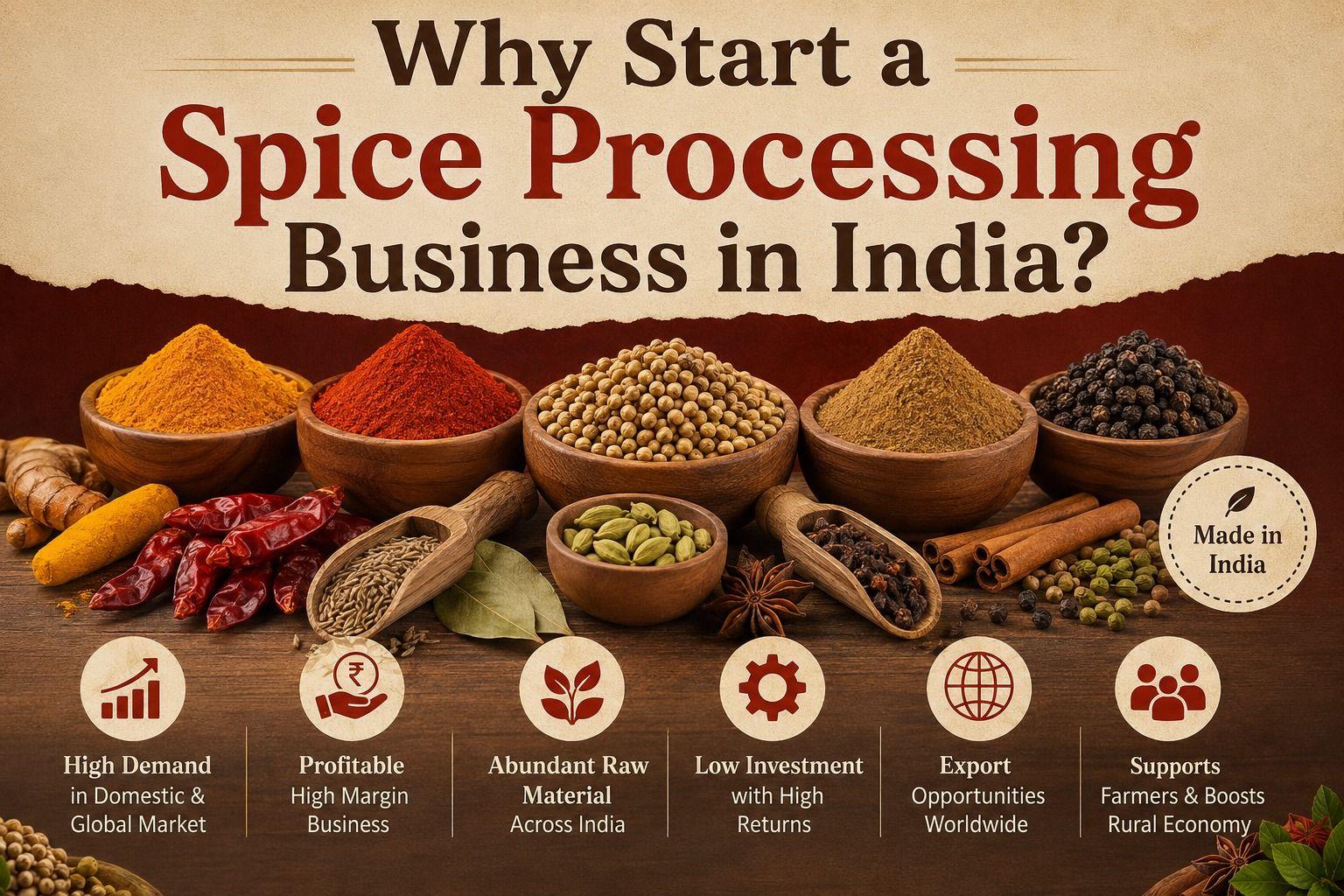
India is one of the world's largest producers, consumers and exporters of spices.
The demand for packaged spices continues to grow because of:
• Increasing urban population
• Busy lifestyles
• Rising preference for branded food products
• Expansion of supermarkets
• Growth of online grocery platforms
• Increasing exports
• Expansion of food processing industries
Consumers today prefer buying ready-to-use spice powders instead of grinding spices at home.
This creates an excellent opportunity for entrepreneurs to manufacture and sell:
• Single spices
• Blended spices
• Premium spices
• Organic spices
• Export-quality spices
• Institutional packs
Unlike many food businesses, spices generally require relatively lower refrigeration costs and have better storage life when handled correctly.
A spice processing business involves converting whole spices into cleaned, graded, ground and packaged products for commercial sale.
The business may include:
• Cleaning
• Drying
• Grinding
• Pulverizing
• Blending
• Sieving
• Packaging
• Labelling
• Distribution
The finished products are sold under your own brand or supplied to wholesalers, retailers, hotels, restaurants and food manufacturers.
Every entrepreneur does not need a large factory.
There are multiple business models available.
You manufacture individual spice powders.
Examples include:
• Turmeric Powder
• Chilli Powder
• Coriander Powder
• Cumin Powder
• Black Pepper Powder
Advantages
• Simple production
• Easy inventory management
• Lower product complexity
Instead of individual spices, you manufacture spice mixes.
Examples:
• Garam Masala
• Kitchen King Masala
• Chaat Masala
• Pav Bhaji Masala
• Sambhar Masala
• Chicken Masala
• Meat Masala
• Biryani Masala
Blended spices usually provide higher value addition because customers are paying for a ready-made recipe rather than a single ingredient.
Many supermarket chains and online brands outsource manufacturing.
You manufacture and pack spices using the customer's branding.
Advantages
• No retail marketing cost
• Bulk production
• Stable orders
Instead of retail packs, spices can be supplied in bulk to:
• Hotels
• Restaurants
• Food manufacturers
• Pickle manufacturers
• Snack companies
• Namkeen manufacturers
• Exporters
The Indian spice industry serves multiple customer segments.
These include:
Retail spice packs are purchased daily for home cooking.
Hotels and restaurants require bulk quantities of spices every month.
Online food delivery businesses consume significant quantities of spice blends.
Manufacturers of:
• Snacks
• Ready-to-eat food
• Instant noodles
• Frozen food
• Sauces
• Pickles
require spices as ingredients
Hotels often purchase spices in larger institutional packs.
Indian spices are exported worldwide. Many exporters purchase processed spices from domestic manufacturers for further distribution
One of the biggest advantages of a spice processing business is product diversity.
You can manufacture:
One of India's highest-selling spice products.
Available in different varieties depending on colour, pungency and regional preference.
Used across households and food industries.
Popular in spice blends and daily cooking.
Premium spice with relatively higher value.
Used in sweets, beverages and bakery products.
Used in spice blends and pharmaceutical products.
Popular in bakery and beverage industries.
Used in food processing and traditional formulations.
Used in spice mixes and food manufacturing.
One of the highest-value blended spices.
Widely used in Indian cooking.
Large retail demand across India.
Popular among restaurants and households.
Growing demand due to increasing consumption of ready-made spice mixes.
Do not launch 30 different products immediately.
Start with:
• Turmeric Powder
• Chilli Powder
• Coriander Powder
These three products usually account for a significant share of everyday household spice consumption.
Once your distribution improves, expand into blended spices
The quality of your finished spice depends entirely on the raw material.
Common raw materials include:
| Product | Raw Material |
|---|---|
| Turmeric Powder | Dry Turmeric Fingers |
| Chilli Powder | Whole Dry Chillies |
| Coriander Powder | Coriander Seeds |
| Cumin Powder | Cumin Seeds |
| Pepper Powder | Black Pepper |
| Cardamom Powder | Cardamom Pods |
| Cinnamon Powder | Cinnamon Bark |
| Fennel Powder | Fennel Seeds |
| Clove Powder | Cloves |
| Dry Ginger Powder | Dry Ginger |
• Food-grade packaging material
• Labels
• Corrugated boxes
• Pouches
• PET jars
• Batch coding ink
• Cartons
Never compromise on raw material quality.
You can source spices from:
• Agricultural Mandis
• Farmer Producer Organizations (FPOs)
• Spice Traders
• Wholesalers
• Direct Farmers
• Agricultural Cooperatives
• Processing Clusters
• Moisture level
• Colour
• Aroma
• Foreign matter
• Stones
• Dust
• Insect infestation
• Fungal contamination
• Broken pieces
• Harvest season
• Better colour
• Better aroma
• Better shelf life
• Better grinding efficiency
• Better customer satisfaction
The manufacturing process may vary slightly depending on the product, but the general workflow remains similar.
Raw Material Procurement → Cleaning → Drying (if required) → Grinding → Pulverizing → Sieving → Blending → Quality Inspection → Packaging → Storage → Dispatch
Let's understand each step.
Every batch received should be inspected before production.
Check:
• Moisture
• Colour
• Aroma
• Foreign matter
• Insects
• Dust
• Stones
Poor-quality raw materials can damage machinery and affect the final product.
Raw spices are passed through cleaning equipment.
This removes:
• Dust
• Stones
• Metal particles
• Leaves
• Sand
• Other impurities
Cleaning improves both machine performance and product quality.
Some spices may require controlled drying before grinding.
Excess moisture can:
• Reduce shelf life
• Cause microbial growth
• Create lumps
• Affect grinding performance
Whole spices are ground using a spice grinding machine or pulverizer.
Grinding capacity depends on:
• Machine size
• Motor power
• Type of spice
• Required fineness
Different spices behave differently during grinding. For example, turmeric, chilli and black pepper may require different processing considerations because of their hardness, oil content or heat sensitivity.
For finer powders, spices pass through a pulverizer.
The objective is to achieve:
• Uniform particle size
• Smooth texture
• Better mixing
• Consistent appearance
Uniform grinding is important because customers expect the same texture in every pack.
Ground spices are passed through a vibrating sieve.
Sieving removes:
• Larger particles
• Unwanted fibres
• Uneven granules
This improves product consistency.
If you manufacture blended spices, measured quantities of different spices are mixed in a blender according to your recipe.
Consistency is critical. Even small variations can affect taste, aroma and customer acceptance
The machinery required for a spice processing plant depends on your production capacity, level of automation and product range. A small business can start with semi-automatic equipment, while medium and large units generally invest in automated processing lines to improve productivity and consistency.
Below is a complete list of machines commonly used in a spice processing plant.
| Machine | Purpose |
|---|---|
| Raw Material Cleaning Machine | Removes dust, stones, stems, and other foreign particles |
| Destoner Machine | Removes stones and heavy impurities |
| Vibro Separator | Separates impurities based on size |
| Dryer (If Required) | Reduces moisture before grinding |
| Spice Grinding Machine / Pulverizer | Grinds whole spices into fine powder |
| Hammer Mill | Performs coarse grinding of spices |
| Pin Mill | Produces ultra-fine spice powders |
| Vibro Sifter | Ensures uniform particle size |
| Ribbon Blender | Mixes multiple spices uniformly |
| Screw Conveyor | Transfers material between machines |
| Dust Collection System | Reduces airborne spice dust |
| Storage Hopper | Stores processed material before packaging |
| Stainless Steel Storage Bin | Hygienic storage of finished spices |
| Pouch Filling Machine | Fills pouches accurately |
| Weighing Machine | Ensures accurate product weight |
| Band Sealing Machine | Seals pouches securely |
| Nitrogen Flushing Machine (Optional) | Extends shelf life for premium packaging |
| Batch Coding Machine | Prints batch number, MRP, and manufacturing/expiry date |
| Labeling Machine | Applies labels to jars and containers |
| Shrink Wrapping Machine | Provides secondary packaging |
| Carton Sealing Machine | Seals cartons for dispatch |
Many entrepreneurs make the mistake of purchasing machinery based only on price.
Instead, compare machines based on:
• Production capacity
• Motor power
• Grinding efficiency
• Particle size consistency
• Ease of cleaning
• Stainless steel food-contact parts
• Electricity consumption
• Dust control system
• Spare parts availability
• After-sales service
• Warranty
• Future expansion capability
A slightly higher investment in a reliable machine can significantly reduce maintenance costs and production downtime.
The cost of a spice processing plant depends on:
• Daily production capacity
• Number of products
• Automation level
• Packaging line
• Factory size
• Storage capacity
| Plant Type | Approximate Investment |
|---|---|
| Small Semi-Automatic Unit | ₹5–10 Lakhs |
| Medium Processing Plant | ₹10–30 Lakhs |
| Fully Automatic Plant | ₹30 Lakhs–₹1 Crore+ |
These are indicative ranges. Actual investment varies depending on machine specifications, supplier, capacity, civil work and packaging setup.
Here's a cleaner and more professional version of your table:
| Expense | Importance |
|---|---|
| Processing Machinery | Highest Capital Investment |
| Packaging Line | Major Equipment Cost |
| Raw Material Inventory | Largest Working Capital Requirement |
| Packaging Materials | Continuous Operating Expense |
| Factory Rent / Building | Fixed Infrastructure Cost |
| Labour | Monthly Operating Cost |
| Electricity | Production & Utility Cost |
| Marketing & Branding | Business Growth & Customer Acquisition |
| Working Capital | Essential for Smooth Daily Operations |
The required space depends on production capacity
| Plant Size | Approximate Area Required |
|---|---|
| Small Unit | 800–1,500 sq. ft. |
| Medium Unit | 2,000–4,000 sq. ft. |
| Large Plant | 5,000 sq. ft. and above |
The factory should have separate areas for:
• Raw material storage
• Cleaning section
• Grinding section
• Blending section
• Packaging section
• Finished goods warehouse
• Quality control
• Dispatch area
Proper workflow improves hygiene and production efficiency
Power consumption depends on:
• Grinding machine capacity
• Pulverizer size
• Blender
• Packaging machine
• Dust collection system
Before finalising your factory, obtain the exact electrical load from the machinery supplier. Industrial power with stable voltage is recommended for continuous production.
Since spices are food products, regulatory compliance is essential.
Common registrations and licences include:
• FSSAI Licence
• GST Registration
• Udyam Registration
• Trade Licence
• Shop & Establishment Registration
• Factory Licence (where applicable)
• Pollution Control Board approval (where applicable)
• Fire Safety NOC (where applicable)
• Trademark Registration (recommended)
• Legal Metrology compliance for packaged commodities
If you plan to export spices, you may also require:
• Import Export Code (IEC)
• Registration with the Spices Board of India, depending on your export activities
Always verify the latest regulatory requirements before commercial production.
Quality is one of the biggest differentiators in the spice industry.
A good quality control system should include:
Check:
• Moisture
• Colour
• Aroma
• Foreign matter
• Insects
• Fungal contamination
Maintain:
• Clean equipment
• Sanitized production area
• Food-grade contact surfaces
• Pest control
• Personal hygiene
Depending on your product and market, quality checks may include:
• Moisture content
• Particle size
• Colour consistency
• Aroma
• Bulk density
• Microbiological parameters
• Foreign matter
Regular testing improves consistency and customer confidence.
Packaging directly influences customer perception.
Popular options include:
Ideal for:
• Retail packs
• Cost-effective packaging
• High-volume sales
Suitable for:
• Premium brands
• Better shelf presentation
Used for:
• Premium spice powders
• Garam Masala
• Black Pepper
Ideal for:
• Export products
• Premium positioning
Suitable for:
• Hotels
• Restaurants
• Food manufacturers
Your label should generally include:
• Product Name
• Net Quantity
• Ingredient List
• Nutritional Information
• Batch Number
• Manufacturing Date
• Best Before
• MRP
• FSSAI Licence Number
• Manufacturer Details
• Customer Care Details
• Storage Instructions
• Veg Symbol
Ensure labels comply with applicable food-labelling regulations.
Thousands of spice brands already exist.
You cannot compete only on price.
Instead, build your brand around:
• Premium quality
• Fresh grinding
• Hygienic processing
• Authentic taste
• Consistent flavour
• Attractive packaging
• Transparent sourcing
Develop a strong visual identity with:
• Professional logo
• Consistent packaging design
• Easy-to-read labels
• Clear product information
A successful spice business should diversify its sales.
Potential channels include:
• Kirana Stores
• Supermarkets
• Wholesale Markets
• Organic Stores
• Department Stores
• Hotels
• Restaurants
• Caterers
• Own Website
• Amazon
• Flipkart
• JioMart
• BigBasket (where applicable)
• WhatsApp Business
• Instagram Shop
• Facebook Marketplace
Supply spices to:
• Hotels
• Cloud Kitchens
• Food Processing Companies
• Snack Manufacturers
• Pickle Manufacturers
• Catering Companies
Institutional buyers often place repeat bulk orders, providing stable revenue
The profitability of a spice processing business depends on:
• Raw material purchase price
• Grinding efficiency
• Packaging cost
• Labour cost
• Electricity consumption
• Product mix
• Distribution expenses
• Marketing cost
• Brand positioning
• Repeat customers
Premium brands generally focus on quality, consistency and customer trust rather than competing only on low prices
Low-quality spices result in poor colour, weak aroma and customer dissatisfaction.
Low-cost machines may lead to inconsistent grinding, higher maintenance and frequent downtime.
Start with a few high-demand products before expanding your portfolio.
Packaging is often the first thing customers notice on the shelf.
Inconsistent quality can quickly damage your brand reputation.
Instead of becoming the cheapest brand, focus on delivering consistent quality and value.
Buying excessive raw material without proper storage can lead to quality deterioration

Starting a spice processing business involves selecting the right machinery, planning production capacity and building an efficient processing line.
StartupHyper can help you understand:
• Spice processing machine selection
• Pulverizer and grinding system planning
• Blending and packaging setup
• Capacity planning
• Factory layout
• Production workflow
• Machinery comparison
• Supplier quotation evaluation
• Expansion planning from a small unit to a commercial processing plant
Yes, it can be profitable because spices have consistent year-round demand. Profitability depends on product quality, branding, operational efficiency and market reach.
A small semi-automatic unit can generally be started with an investment of around ₹5–10 lakh, while larger automated plants require higher capital.
Turmeric powder, chilli powder, coriander powder, cumin powder and blended spices such as garam masala are among the most popular products.
Many spice grinding machines can process multiple spices, but machine suitability depends on the hardness, oil content and processing characteristics of the spice. Proper cleaning between batches is essential to avoid cross-contamination.
Yes. Spice processing is a food manufacturing activity, and the applicable FSSAI registration or licence is generally required.
Yes. Exporters typically require an Import Export Code (IEC) and may need registration with the Spices Board of India, depending on the nature of their export business.
Shelf life varies depending on the spice, moisture content, packaging material and storage conditions. Always establish shelf life through appropriate testing and follow applicable food regulations.
The spice processing business in India offers a strong opportunity for entrepreneurs because spices are an everyday necessity with steady demand across households, restaurants, food manufacturers and export markets.
Success depends on more than just buying a grinding machine. High-quality raw materials, hygienic processing, efficient machinery, attractive packaging, regulatory compliance and consistent branding are the key factors that help build a trusted spice brand.
Start with a focused product range, establish reliable supply chains and invest in quality rather than competing solely on price. As your customer base grows, you can gradually expand into blended spices, premium packaging and institutional or export markets
If you're planning to set up a spice processing plant, StartupHyper can help you understand the machinery, production setup and business planning needed to build a scalable spice manufacturing business
📞Call / WhatsApp: 9472093913
📧Email: info@startuphyper.com
🌐 Website: www.startuphyper.com | www.machinehai.com
🏢 Branches: Patna | Gaya | Katihar | Saharsa
Stay updated with the latest tips, trends, and best practices in factory setup and machinery procurement—subscribe to the StartupHyper newsletter!
No spam, we promise. Your inbox is safe with us—only valuable insights.