Read the full article to gain deeper insights and comprehensive information.

Jul 10, 2026
0
Learn how to start a honey processing business in India. Explore raw honey sourcing, processing machines, FSSAI licence, packaging, investment, branding and profit factors.
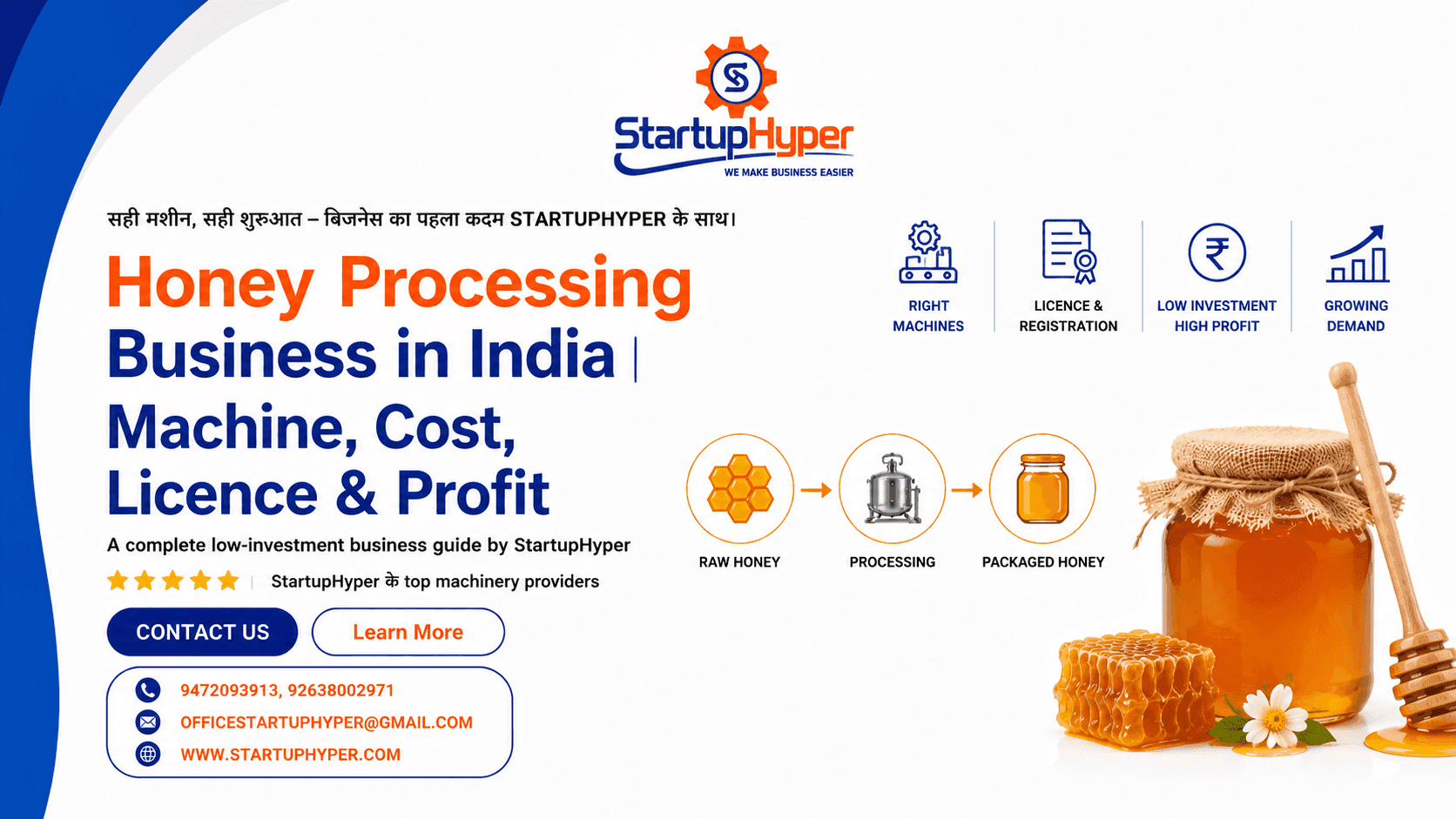
The honey processing business in India is not only about buying raw honey, filling it into jars and selling it online.
A successful honey brand needs reliable raw honey sourcing, batch-wise quality testing, controlled filtration, proper moisture management, food-grade packaging, FSSAI compliance, honest labelling and a clear sales strategy.
The opportunity is attractive because honey can be sold in multiple formats:
But honey is also a high-trust product. Consumers are highly concerned about adulteration, purity and origin. That means a new business cannot win only through attractive packaging. It must build trust through testing, traceability and consistent quality.
FSSAI’s honey standard requires honey to be free from visible mould, insects, insect debris, fragments of bees and other objectionable matter. (FSSAI)
This guide explains how to start a honey processing business in India, including raw material, machines, investment, licence, processing steps, packaging, branding, customers and profit factors.
A honey processing business buys raw honey from beekeepers, farmer groups, aggregators or suppliers, then processes it for safe and consistent retail sale.
The final product is usually packed honey for retail, wholesale, online sale or institutional supply.
| Business Type | Main Activity | Suitable For |
|---|---|---|
| Beekeeping Business | Managing bee colonies and harvesting honey | Farmers, rural entrepreneurs and apiary operators |
| Honey Trading Business | Buying honey from beekeepers and reselling it | Low-investment sellers and local distributors |
| Honey Processing Business | Testing, filtering, bottling and branding raw honey | Food entrepreneurs and honey brand builders |
| Integrated Honey Business | Beekeeping, processing and branding under one business model | Entrepreneurs looking for long-term supply control and brand growth |
For StartupHyper readers, the most practical model is often:
Raw Honey Sourcing + Processing + Packaging + Own Brand
You do not need to own thousands of bee boxes to start. However, you do need reliable suppliers and a serious quality-control process
Honey has several business advantages:
It has a longer shelf life than many fresh food products.
It is sold year-round.
It can be packed in multiple sizes.
It can be positioned for household, gifting, café, bakery and online markets.
It can support premium variants based on floral source or region.
It is relatively easy to transport compared with many liquid foods.
The National Beekeeping and Honey Mission includes support provisions related to honey processing units and in-house testing facilities, highlighting the importance of processing and quality infrastructure in the honey value chain. (National Biodiversity Authority)
However, this is not an easy “high-margin” business by default. Your margins can disappear if raw honey quality is inconsistent, packaging is weak, returns are high or you spend heavily on online advertising without repeat customers.
You buy raw honey, process it and sell it in bulk to:
This model needs fewer retail marketing expenses but usually offers lower margins per kilogram.
You process and pack honey under your own brand.
Common pack sizes include:
This model can create better margins, but requires packaging, branding, distribution and customer trust.
You sell specific varieties such as:
This can support premium positioning, but only if sourcing, testing and traceability are strong.
You process and pack honey for another brand, retailer, distributor or corporate client.
This can create stable production volumes once you secure recurring orders.
Your machine can filter honey, but it cannot turn poor-quality raw material into premium honey.
Before buying raw honey, check:
The National Bee Board provides beekeeper registration guidance as part of its efforts to support scientific beekeeping and the honey ecosystem. (Madhukranti)
Honey adulteration is one of the biggest trust issues in the market. Recent enforcement reporting has highlighted suspected adulterated honey seizures, reinforcing why a honey brand needs credible testing and supplier verification. (The Times of India)
Do not rely only on colour, thickness or taste to judge purity. These are not reliable authenticity tests
A typical honey processing flow is:
Raw Honey Receiving → Batch Sampling → Quality Testing → Straining / Filtration → Controlled Warming if Needed → Settling → Fine Filtration → Bottling → Labelling → Packing
Raw honey is received in food-grade drums or containers.
Each incoming batch should be assigned a batch code so you can trace it later.
Take a sample before processing.
Depending on your business scale, testing may include:
FSSAI has a dedicated manual for honey and other bee-hive products, including sample handling guidance such as storing samples in airtight jars and keeping them moisture-free. (FSSAI)
The honey is passed through a coarse filter to remove wax particles, bee fragments and visible impurities.
Honey may crystallise during storage. Controlled warming can help improve flow and filtration. Do not overheat honey. Excessive heat can affect quality and can increase HMF, a quality parameter monitored in honey. FSSAI issued an advisory in 2025 on considering HMF as a quality parameter in honey. (FSSAI)
Fine filtration removes smaller particles and helps create a clean, uniform retail product. Do not treat “ultra-clear” appearance as the only quality goal. Over-processing can affect the natural character of honey, and your processing approach should remain aligned with food standards and product claims.
Filtered honey is held in a settling tank so air bubbles and remaining fine particles can rise or settle before filling.
Honey is filled into food-grade jars, bottles, squeeze packs or pouches. The filled packs are then capped, sealed, labelled, batch-coded and packed in cartons.
| Machine / Equipment | Use |
|---|---|
| Raw Honey Storage Tank | Stores incoming raw honey before processing. |
| Honey Warming Tank / Jacketed Tank | Gently warms honey to improve flow before filtration. |
| Honey Filter Unit | Removes wax particles and visible impurities. |
| Fine Filter / Filter Press | Improves clarity by removing fine particles. |
| Settling Tank | Allows air bubbles and remaining particles to settle. |
| Honey Transfer Pump | Moves honey between tanks and the filling line. |
| Honey Filling Machine | Fills jars, bottles or pouches accurately. |
| Bottle Capping Machine | Seals jars and bottles properly. |
| Induction Sealing Machine | Provides a tamper-evident inner seal where required. |
| Labelling Machine | Applies labels on jars, bottles or pouches. |
| Batch Coding Machine | Prints batch number, MRP, packing date and best-before details. |
| Weighing Scale | Checks the net quantity of each pack. |
| Shrink Wrapping / Carton Packing Setup | Supports final secondary packaging and dispatch. |
| Basic Quality Testing Tools | Helps check moisture level and basic batch quality. |
The investment depends on capacity, automation, packaging format, lab setup and working capital.
| Setup Type | Indicative Investment |
|---|---|
| Small Honey Filtering and Packing Unit | ₹3 lakh–₹8 lakh |
| Semi-Automatic Honey Processing and Bottling Unit | ₹8 lakh–₹20 lakh |
| Medium Honey Processing Plant with Better Automation | ₹20 lakh–₹50 lakh |
| Larger Plant with In-House Testing and Multiple Packaging Lines | ₹50 lakh and above |
These ranges are for planning only. Your final honey processing plant cost can change based on:
| Cost Head | Why It Matters |
|---|---|
| Raw Honey Purchase | Usually the biggest recurring cost in the business. |
| Processing Machinery | Includes filtration, warming, storage tanks and filling equipment. |
| Packaging | Covers jars, bottles, caps, labels, cartons and seals. |
| Testing | Helps verify quality, moisture level and product authenticity. |
| Licence and Compliance | Required for food business registration, labelling and quality compliance. |
| Labour | Needed for processing, filling, packing, storage and dispatch. |
| Marketing | Important for retail distribution, product sampling and online promotion. |
| Working Capital | Raw honey and packaging materials must often be purchased before sales payments are received. |
Honey processing is a food business, so FSSAI registration or licence is essential according to the scale and nature of your operation. Applications and licence-related services are handled through the official FoSCoS platform. FoSCoS FSSAI licensing portal
Depending on your setup, you may also need:
Your label should generally include applicable information such as:
Confirm the exact requirements with a food-compliance professional before printing packaging in bulk.
Honey is not just a sweet liquid. It is a regulated food product with defined standards. FSSAI’s honey standard states that honey should be free from organic and inorganic matter, including visible mould, insects, insect debris, bee fragments and brood pieces. (FSSAI)
Your quality-control plan should include:
Do not print claims such as:
unless you can support them and they comply with applicable food-labelling and advertising rules.
FSSAI has recently acted against misleading food claims and inaccurate labels across food categories, so conservative, evidence-based marketing is safer for a new brand. (The Times of India)
| Packaging Type | Best For |
|---|---|
| Glass Jar | Premium retail, gifting and natural product positioning |
| PET Jar | Value retail packs with lower breakage risk |
| Squeeze Bottle | Easy and convenient household use |
| Pouch | Low-cost packs and institutional supply |
| Sachet | Product sampling, travel packs and food-service use |
| Gift Box | Festive gifting and premium sales |
Choose packaging based on:
For a new brand, 250 g and 500 g packs are often practical starting sizes. Add 1 kg packs for families and bulk users only after you understand demand.
A honey business becomes profitable when customers trust the product enough to buy again.
Do not launch ten variants immediately.
Choose one of these directions:
Show customers:
Avoid exaggerated health claims.
Honey is a repeat-use product. Your brand should focus on:
Possible sales channels include:
Useful content ideas include:
Do not use content to make medical claims unless legally supported
Honey processing business profit depends on:
Potential buyers include:
For bulk supply, buyers may ask for specifications, test reports, sample approval and regular supply capability.
Selling Price – Raw Honey Cost – Packaging – Processing – Testing – Distribution – Marketing – Overheads = Actual Profit
A premium-looking jar does not guarantee profit. If you sell online with high ad cost and low repeat orders, your margin can become very small.
Potential buyers include:
For bulk supply, buyers may ask for specifications, test reports, sample approval and regular supply capability.
Do not rely only on supplier claims. Check quality, moisture and authenticity before purchasing in bulk.
Excessive heat can affect honey quality and increase HMF levels. Use controlled warming during processing.
Start with one or two fast-moving packs. Too many SKUs can block money in packaging and inventory.
Avoid claims that cannot be properly supported. They can create compliance issues and reduce customer trust.
Leaking caps, poor seals, broken jars and unclear labels can lead to returns and negative reviews.
Honey can crystallise naturally over time. Educate customers so they do not assume the product is defective.
First build product quality, customer trust and repeat orders before investing heavily in paid advertising.
Keep records of raw honey suppliers and packing batches so customer complaints can be handled quickly.

StartupHyper can help entrepreneurs understand the machinery side of honey processing and packaging, including:
For food safety, FSSAI compliance, laboratory testing and label approval, work with qualified food technologists, laboratories and compliance professionals.
It can be profitable if you source quality raw honey at the right price, control packaging and marketing cost, maintain trust and build repeat sales. It is not automatically high-margin; quality testing and distribution are critical.
A small honey filtering and packing setup may start around ₹3 lakh–₹8 lakh. A semi-automatic processing and bottling unit may need around ₹8 lakh–₹20 lakh, excluding major marketing and inventory expansion.
Common machines include storage tanks, warming tank, honey filter, fine filter, transfer pump, filling machine, capping machine, induction sealer, labelling machine and batch coding machine.
Yes. Honey processing and packaging are food-business activities and require the applicable FSSAI registration or licence. Use the official FoSCoS platform to apply or manage licensing.
Yes. You can source raw honey from verified beekeepers, cooperatives or aggregators and focus on testing, processing, packaging and branding.
Raw honey generally refers to honey that has undergone minimal processing. Processed retail honey may be filtered, settled and packed for consistency. Any product claim should be accurate and supported.
Crystallisation is a natural process influenced by honey composition and storage conditions. It does not automatically mean the honey is adulterated or spoiled.
Yes, provided your food licence, label, packaging, shipping and customer-service systems are in place. Glass packaging needs extra care during shipping.
For many new brands, 250 g and 500 g packs are practical. You can add 1 kg packs or sachets after understanding your customer demand.
A honey processing business in India can become a strong consumer-food brand when it is built on quality, not shortcuts.
Start with verified raw honey, test every batch, use controlled processing, choose reliable packaging and make honest product claims. Build a small but consistent product range, then expand after you develop repeat buyers.
The most important investment is not only the honey processing machine. It is your quality-control system and the trust customers place in your brand.
Contact StartupHyper to discuss honey processing machines, filtration systems, honey filling machines and a practical packaging setup for your honey brand.
📞Call / WhatsApp: 9472093913
📧Email: info@startuphyper.com
🌐 Website: www.startuphyper.com | www.machinehai.com
🏢 Branches: Patna | Gaya | Katihar | Saharsa
Stay updated with the latest tips, trends, and best practices in factory setup and machinery procurement—subscribe to the StartupHyper newsletter!
No spam, we promise. Your inbox is safe with us—only valuable insights.