Read the full article to gain deeper insights and comprehensive information.

Jul 08, 2026
0
Learn how to start an oxygen plant business in India. Explore PSA oxygen plant machines, setup cost, licence requirements, capacity, customers and business planning.
Starting an oxygen plant business in India can be a serious industrial opportunity, but it is not a simple “buy a machine and sell cylinders” business.
An oxygen plant needs the right technology, reliable power, compressed-air quality, storage, safety systems, trained operators, maintenance planning and clear customer demand. The business model also changes depending on whether you want to supply medical oxygen, industrial oxygen, an on-site hospital pipeline, or cylinder-filling customers.
For many new entrepreneurs, the most practical route is a PSA oxygen plant. PSA stands for Pressure Swing Adsorption. It produces oxygen from ambient air by separating nitrogen through molecular-sieve technology. For medical applications, WHO guidance describes PSA oxygen as typically 93% ±3% oxygen, while medical-grade requirements and local compliance must be confirmed for the intended use. (World Health Organization)
This guide explains oxygen plant setup in India, including machines, investment, licences, customers, capacity planning and common mistakes.
An oxygen plant business produces oxygen gas and supplies it to hospitals, healthcare facilities, cylinder distributors, fabrication units, welding shops, steel units and other industrial customers.
There are three broad business models:
| Business Model | Main Customers | Main Output |
|---|---|---|
| Medical Oxygen Plant | Hospitals, nursing homes, clinics and healthcare facilities | Medical-grade oxygen for pipeline supply or cylinder filling |
| Industrial Oxygen Plant | Fabrication units, welding shops, metal cutting units, steel plants and other industries | Industrial-grade oxygen for welding, cutting and industrial applications |
| On-Site Oxygen Generator Setup | Hospitals, factories and industrial customers with regular oxygen demand | Oxygen generated and consumed directly at the customer’s location |
The best model depends on your location, capital, customer network and compliance capability.
Oxygen has regular demand in healthcare and industry, but the business has high responsibility.
For medical use, oxygen is an essential medicine used in respiratory illness, surgery, trauma and other clinical care. WHO also notes that medical oxygen systems need appropriate quality, safety, storage and distribution controls. (World Health Organization)
A PSA oxygen plant uses compressed air and molecular sieves to separate nitrogen from air and concentrate oxygen.
WHO technical guidance describes oxygen generator plants using PSA, VSA and VPSA technologies. For health-facility applications, a single medical oxygen generator unit commonly falls in the range of about 10–60 Nm³/hr, although final sizing must be based on actual demand and redundancy requirements. (World Health Organization)
A cryogenic plant separates air at very low temperatures and is used for larger-scale oxygen production. It can produce high-purity oxygen and may also be connected to liquid oxygen systems.
This model requires much higher investment, specialised engineering and a larger market. It is generally not the first choice for a small entrepreneur.
A cylinder-filling setup compresses oxygen into approved cylinders for transport and supply. It can be linked to a PSA oxygen generator or another approved oxygen source.
Cylinder filling adds business potential, but it also adds major safety, testing, storage and regulatory responsibilities.
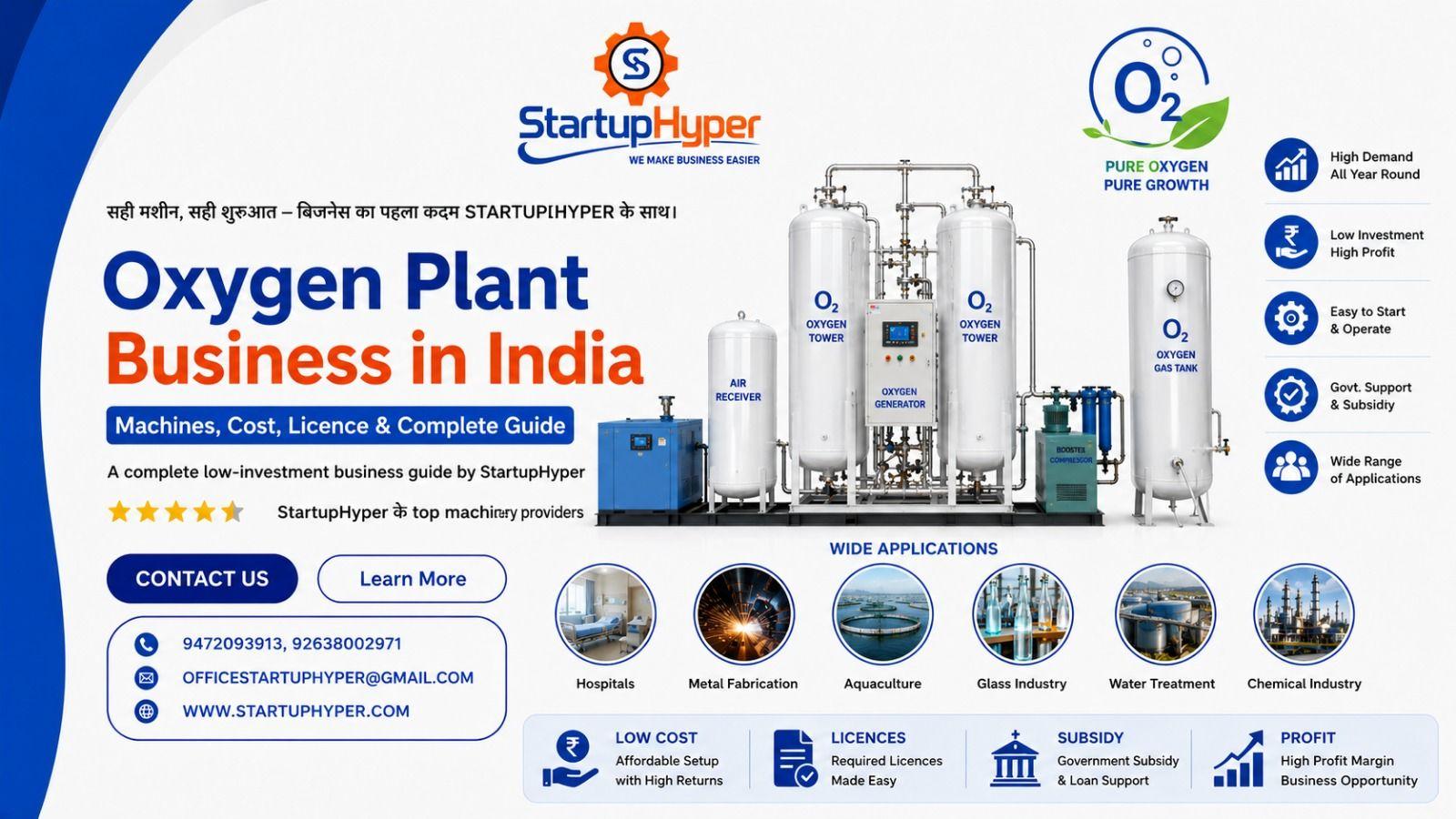
A PSA oxygen generator plant generally works in this sequence:
Ambient Air → Air Compressor → Air Dryer and Filters → Air Receiver Tank → PSA Oxygen Generator → Oxygen Storage Tank → Pipeline or Cylinder Filling System
An air compressor pulls in ambient air and compresses it.
Filters and dryers remove moisture, oil and contaminants. Clean, dry compressed air is essential because moisture and oil can damage the molecular sieves.
The air passes through molecular-sieve beds. These beds adsorb nitrogen more strongly than oxygen, allowing oxygen-rich gas to pass through.
The produced oxygen is stored in an oxygen receiver tank and supplied to a hospital pipeline, industrial customer or cylinder-filling system.
PSA systems rely on molecular-sieve technology, commonly zeolites, to selectively remove nitrogen from pressurised air and concentrate oxygen. (World Health Organization)
| Machine / Equipment | Main Use |
|---|---|
| Air Compressor | PSA system ke liye ambient air ko compress karta hai |
| Air Dryer | Compressed air se moisture remove karta hai |
| Air Filters | Oil, dust aur other contaminants ko filter karta hai |
| Air Receiver Tank | Processing se pehle compressed air ko store karta hai |
| PSA Oxygen Generator | Air se oxygen separate karta hai |
| Molecular Sieve Beds | PSA process mein nitrogen ko adsorb karta hai |
| Oxygen Receiver Tank | Produced oxygen ko store karta hai |
| Oxygen Booster Compressor | Cylinder filling ke liye oxygen pressure badhata hai |
| Cylinder Filling Manifold | Multiple oxygen cylinders ko safely fill karta hai |
| Oxygen Purity Analyzer | Oxygen concentration/purity check karta hai |
| Flow Meter & Pressure Gauges | Oxygen flow aur pressure monitor karte hain |
| Oxygen Pipeline System | Hospitals ya industrial points tak direct oxygen supply karta hai |
| Electrical Control Panel | System ko control aur protect karta hai |
| Backup System | Maintenance ya failure ke time continuous supply support karta hai |
A hospital oxygen system can include the oxygen source, storage and distribution network. WHO’s technical specifications separately identify oxygen generator plants, cylinder-filling stations, high-pressure cylinders and medical gas pipeline components as parts of a medical oxygen system. (World Health Organization)
Oxygen plant capacity is usually measured in Nm³/hr—normal cubic metres per hour.
| Capacity Range | Typical Use |
|---|---|
| 5–10 Nm³/hr | Small hospital, nursing home, clinic ya limited industrial use ke liye suitable |
| 10–20 Nm³/hr | Small-to-medium hospital ya local industrial oxygen demand ke liye |
| 20–50 Nm³/hr | Medium hospital, multiple users aur cylinder-filling support ke liye |
| 50–100 Nm³/hr | Larger hospital, industrial supply ya wider local distribution ke liye |
| Above 100 Nm³/hr | Large industrial units ya high-volume oxygen supply operation ke liye |
Do not choose capacity only because a supplier says a bigger plant is “more profitable.”
For medical use, sizing must include demand assessment, system design, installation, testing and commissioning by qualified personnel. (World Health Organization)
The cost of an oxygen plant in India depends on capacity, technology, automation, medical or industrial use, cylinder-filling requirement and installation conditions
| Setup Type | Indicative Investment Range |
|---|---|
| Small PSA Oxygen Generator Setup | ₹15 lakh–₹35 lakh |
| 10–20 Nm³/hr PSA Oxygen Plant | ₹25 lakh–₹60 lakh |
| 20–50 Nm³/hr Oxygen Plant | ₹50 lakh–₹1.2 crore |
| PSA Plant with Cylinder Filling Setup | ₹75 lakh–₹2 crore+ |
| Large Industrial or Cryogenic Oxygen Plant | Several crore rupees and above |
These ranges are only for initial planning. Your final project cost can change significantly based on:
Note: Never finalise an oxygen plant only on “machine price.” Ask for a complete project quotation with capacity, purity, pressure, power load, included equipment, installation scope, warranty, spares and after-sales service.
| Setup Type | Approximate Space Requirement |
|---|---|
| Small PSA Oxygen Generator | 500–1,000 sq. ft. |
| PSA Plant with Storage and Filling Area | 1,500–3,000 sq. ft. |
| Medium Oxygen Plant with Cylinder Handling | 3,000–8,000 sq. ft. |
| Large Industrial Oxygen Plant | Depends on production capacity, cylinder storage, safety clearance, and logistics plan |
Power requirement depends on compressor and plant capacity. Obtain the exact connected load, running load and backup-power requirement from the supplier before selecting the site.
The approvals depend on whether you produce medical oxygen, industrial oxygen, store compressed gas, fill cylinders or operate an on-site generator.
Medical oxygen production and distribution must meet applicable quality and regulatory requirements. WHO’s 2025 regulatory discussion notes that medical oxygen manufacturing requires quality assurance and quality-control verification, including specialised testing and validated filling processes where cylinders are involved. (World Health Organization)
Do not rely on a generic online licence checklist before investing.
| Factor | Medical Oxygen Plant | Industrial Oxygen Plant |
|---|---|---|
| Main Customers | Hospitals, clinics, nursing homes and healthcare facilities | Fabrication units, welding shops, steel plants and manufacturing industries |
| Quality Control | Strict medical-grade purity and healthcare-use requirements | Quality standards depend on the industrial application and customer requirement |
| Distribution | Hospital pipeline systems, cylinders and central oxygen supply systems | Cylinders, bulk supply tanks and direct supply to industrial points |
| Compliance | Higher and more specialised compliance, documentation and safety standards | Safety-critical and regulated, with requirements based on storage, transport and usage |
| Buyer Expectation | High purity, reliable supply and uninterrupted oxygen availability | Competitive pricing, required pressure, timely delivery and consistent supply |
If you want to supply hospitals, do not treat it like a standard industrial-gas business. Medical oxygen needs stronger quality, safety and continuity planning.
Decide whether your first target is hospitals, industrial users or both. A mixed model can work, but it increases planning complexity.
Talk to hospitals, cylinder distributors, fabrication units and industrial buyers. Estimate realistic monthly demand before choosing capacity.
For small and medium on-site oxygen generation, PSA is often the practical technology. For large-scale liquid oxygen production, cryogenic technology is more complex and capital-intensive.
Choose plant capacity based on peak demand, not only average demand. Plan backup cylinders, storage or redundancy—especially for medical supply.
Check industrial power, access road, ventilation, safety distance, water requirement, cylinder movement and local approvals before taking the site.
Start the approval process early. Medical oxygen, compressed gas and cylinder filling can require different compliance steps.
Use qualified engineers for installation, testing, safety checks, purity testing and commissioning.
Oxygen customers value reliability. Plan delivery, emergency response, preventive maintenance, spare parts and customer communication.
The plant may look profitable on paper but perform poorly if it runs at low utilisation. A 50 Nm³/hr plant without regular customers can create more financial pressure than a smaller plant with stable contracts.
Do not install a high-capacity oxygen plant only because it seems scalable. First confirm regular demand from hospitals, factories or industrial customers so the plant capacity matches actual consumption.
Oxygen plants depend on continuous electricity for compressors, dryers and PSA systems. Plan for stable power supply, proper electrical load and backup arrangements to avoid production stoppage.
Medical oxygen and industrial oxygen serve different markets and follow different quality, safety and compliance requirements. Medical supply needs stricter purity monitoring and documentation.
Purity analyzers, pressure gauges and routine testing are important to ensure the oxygen produced meets the required standard. This is especially critical for medical oxygen supply.
Cylinder filling is only one part of the business. Storage, loading, transport, testing, delivery, empty-cylinder returns and inventory tracking also need proper planning.
A cheaper plant can become costly if it has poor-quality components, limited spare parts or weak service support. Compare installation, warranty, maintenance and after-sales support before buying.
Compressors, dryers, filters and PSA systems require regular servicing. A preventive maintenance schedule helps reduce breakdowns, avoid downtime and maintain customer trust.

An oxygen plant is a complete system—not only an oxygen generator.
For medical oxygen applications, work with qualified technical, regulatory and healthcare professionals for final design, validation and compliance.
It can be profitable when you have regular customers, suitable capacity, controlled electricity and logistics costs, reliable machinery and strong maintenance. Profit depends on utilisation and contracts, not only oxygen selling price.
A small PSA oxygen generator setup may begin around ₹15 lakh–₹35 lakh, while a commercial plant with cylinder filling can require much more. Final cost depends on capacity, pressure, storage, filling equipment and approvals.
For a small or medium setup, a PSA oxygen plant is generally more practical than a cryogenic plant. The final choice should depend on your customers and required output.
A PSA oxygen plant uses compressed air and molecular sieves to remove nitrogen and produce oxygen-rich gas. PSA technology is commonly used for on-site medical and industrial oxygen generation. (World Health Organization)
For medical PSA plants, WHO guidance specifies oxygen at 93% ±3% from ambient air. Your final specification must match the intended application and applicable Indian requirements. (World Health Organization)
Yes, approvals may be required depending on whether you produce medical or industrial oxygen, store compressed gas or fill cylinders. Check applicable requirements with PESO, state authorities, fire authorities and medical/drug regulators where relevant.
A small PSA setup may need around 500–1,000 sq. ft. A plant with storage and cylinder filling may need 1,500–3,000 sq. ft. or more.
A PSA plant can be connected to a booster compressor and cylinder-filling system where properly designed, installed and approved. Cylinder filling must follow applicable safety and regulatory requirements.
Hospitals, nursing homes, medical distributors, welding shops, fabrication units, steel units and industrial manufacturers can be potential customers.
The oxygen plant business in India can be a scalable opportunity when it is built around real demand, proper technology and strong safety planning.
Start by identifying customers, deciding whether you will supply medical or industrial oxygen, selecting the right PSA plant capacity and confirming all applicable approvals. Do not choose a plant only on price—reliability, service support, purity monitoring and maintenance are equally important.
Contact StartupHyper to discuss oxygen plant machinery, PSA oxygen generator capacity and a practical setup plan for your target market.
📞Call / WhatsApp: 9472093913
📧Email: info@startuphyper.com
🌐 Website: www.startuphyper.com | www.machinehai.com
🏢 Branches: Patna | Gaya | Katihar | Saharsa
Stay updated with the latest tips, trends, and best practices in factory setup and machinery procurement—subscribe to the StartupHyper newsletter!
No spam, we promise. Your inbox is safe with us—only valuable insights.