Read the full article to gain deeper insights and comprehensive information.

Jul 11, 2026
0
Learn how to start a cold pressed oil business in India. Explore machines, investment, raw materials, licences, manufacturing process, packaging, branding, marketing and profit factors.
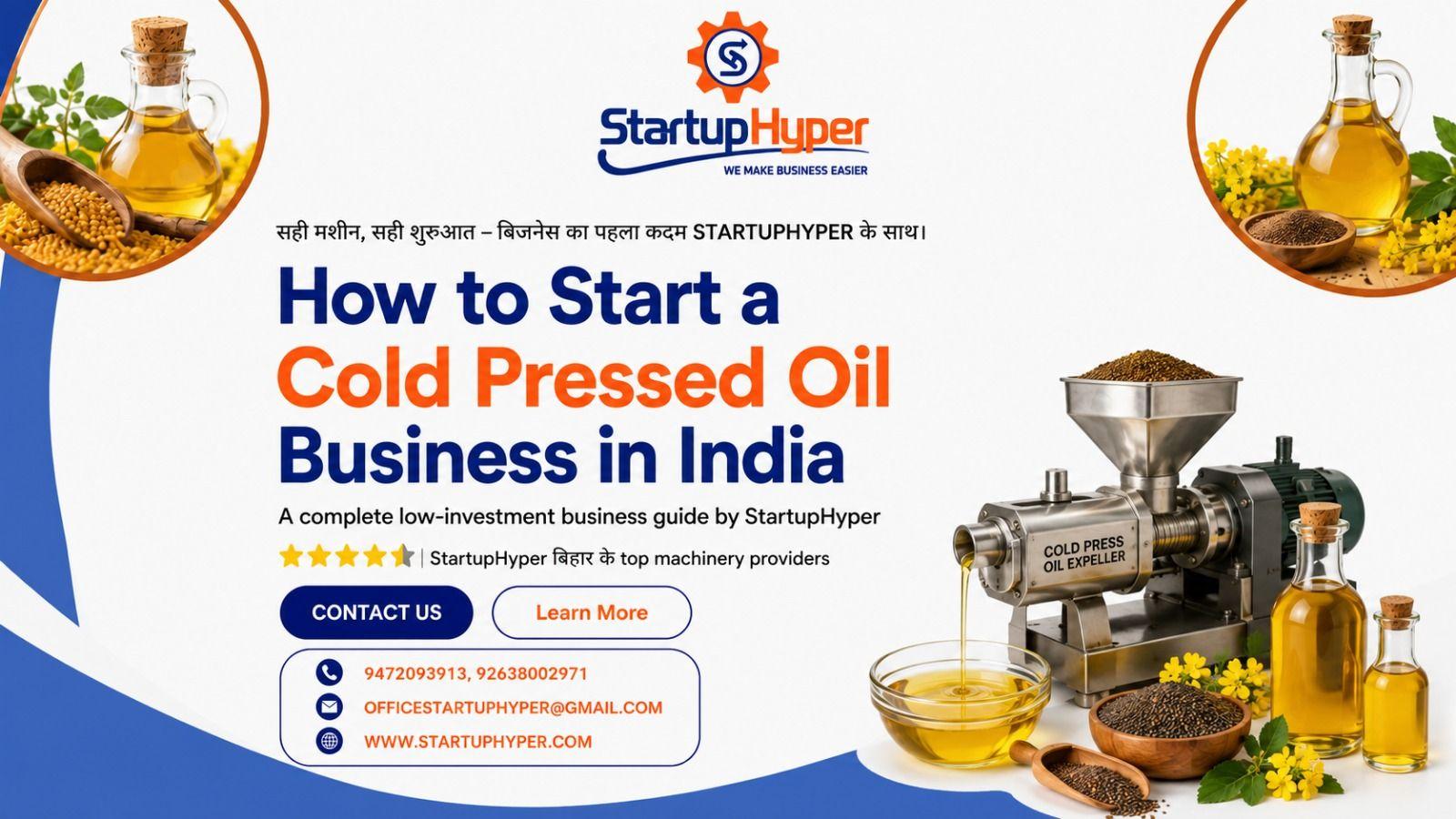
The edible oil industry in India is changing rapidly. Consumers today are becoming more conscious about what they eat and how their food is produced. Instead of buying highly refined cooking oils, many families are shifting towards cold pressed oils, also known as wood pressed oils or kachi ghani oils, because they are perceived as less processed and closer to traditional extraction methods.
This shift has created a significant opportunity for entrepreneurs who want to start a cold pressed oil business in India.
However, many people believe this business is simply about buying a cold press oil machine and filling bottles. In reality, a successful cold pressed oil brand requires much more than machinery. You need reliable raw material suppliers, proper oil extraction, filtration, food-grade storage, packaging, branding, FSSAI compliance and a strong distribution network.
Whether you want to manufacture mustard oil, groundnut oil, sesame oil, coconut oil, sunflower oil or flaxseed oil, the fundamentals remain the same—quality raw material, efficient processing and customer trust.
In this complete guide, you'll learn everything about starting a cold pressed oil manufacturing business, including machinery, investment, licences, manufacturing process, packaging, branding and profit factors.
A cold pressed oil business involves extracting edible oil from oilseeds using a low-speed mechanical oil extraction process without the use of chemical solvents.
Unlike solvent extraction or highly refined oil production, cold pressing relies on mechanical pressure to extract oil while limiting excessive heat generation during processing.
The extracted oil is then filtered, stored, packed and sold under your own brand or supplied in bulk to wholesalers, retailers and food businesses.
Unlike a traditional oil mill that focuses mainly on high-volume production, a cold pressed oil business usually focuses on:
• Premium quality
• Natural processing
• Better flavour and aroma
• Small batch production
• Retail branding
• Higher selling price
• Direct-to-consumer sales
Over the last few years, consumers have started paying more attention to food quality, ingredient transparency and minimally processed products.
Several factors have contributed to the increasing demand for cold pressed oils:
Consumers are increasingly reading product labels before purchasing edible oils. Many buyers prefer products that undergo minimal processing.
This has increased the popularity of:
• Mustard oil
• Groundnut oil
• Coconut oil
• Sesame oil
• Flaxseed oil
produced through cold pressing.
Modern grocery stores and online marketplaces now dedicate shelf space to premium edible oils.
Consumers are willing to pay higher prices for products that offer:
• Better packaging
• Transparent sourcing
• Premium branding
• Small-batch manufacturing
• Traceability
This allows new brands to compete even against established companies.
Earlier, local edible oil brands had limited reach.
Today, businesses can sell through:
• Their own website
• Online marketplaces
• Social commerce
• WhatsApp Business
• Modern retail stores
This has made it easier for regional brands to reach customers across India.
Unlike refined oils, cold pressed oils generally command higher retail prices because of their positioning and lower extraction yield.
This allows businesses to focus on quality rather than competing only on volume.
One of the biggest questions customers ask is:
What is the difference between cold pressed oil and refined oil?
| Cold Pressed Oil | Refined Oil |
|---|---|
| Extracted using mechanical pressure | Undergoes multiple refining processes |
| Generally processed at lower temperatures | Processed through stages such as degumming, neutralization, bleaching, and deodorization |
| Usually retains its natural aroma | Neutral flavour and smell |
| Limited processing | Highly processed |
| Often positioned as a premium product | Commonly sold as a mass-market product |
| Typically produced in smaller batches | Usually produced on a large industrial scale |
For your business, this difference becomes your biggest marketing advantage.
However, avoid making unverified health claims. Instead, focus your branding on:
• Traditional extraction
• Minimal processing
• Natural aroma
• Quality raw materials
• Fresh production
• Traceable sourcing
Not every entrepreneur needs to start with a large manufacturing plant.
There are four popular business models.
This is the most profitable long-term model.
You purchase oilseeds, extract oil, package it and sell it under your own brand.
Advantages:
• Higher profit margins
• Brand value
• Customer loyalty
• Long-term scalability
Challenges:
• Marketing
• Distribution
• Packaging
• Inventory management
Instead of selling directly to consumers, you manufacture oil and supply it to:
• Wholesalers
• Restaurants
• Hotels
• Food manufacturers
• Retail chains
Advantages:
• Lower marketing expenses
• Higher production volume
• Stable orders
Challenges:
• Lower margins
• Dependence on fewer buyers
Many supermarkets and online brands don't own manufacturing plants. Instead, they outsource production.
In this model you:
• Extract oil
• Package oil
• Print their brand name
• Supply finished products
Advantages:
• Consistent orders
• No retail marketing
Some farmers or businesses already own oilseeds.
They simply hire you to process them.
You charge processing fees instead of selling oil.
This reduces inventory investment.
One of the biggest advantages of this business is that a single cold press oil machine can process multiple seeds (depending on machine specifications and proper cleaning between batches).
Popular products include:
One of the highest-demand edible oils in North and East India.
Customers:
• Households
• Restaurants
• Grocery stores
Very popular in Gujarat, Maharashtra and South India.
Target market:
• Premium cooking oil customers
• Restaurants
• Retail stores
Often used in:
• Cooking
• Ayurveda
• Traditional food
• Religious purposes
Premium pricing makes it attractive.
Can be sold for:
• Cooking
• Hair care
• Personal care
• Ayurvedic applications
Suitable for customers looking for lighter cooking oils.
A niche premium product with growing demand among health-conscious consumers.
A specialty oil sold in smaller quantities.
Requires different branding strategy.
Industrial and pharmaceutical applications may require additional specifications and regulations depending on the end use.
Don't manufacture every oil from Day One.
Instead choose:
• One flagship product
• One secondary product
• Mustard Oil
• Groundnut Oil
Once your distribution becomes stable, expand into:
• Sesame Oil
• Coconut Oil
• Flaxseed Oil
Too many SKUs increase inventory and working capital.
Your biggest recurring cost will always be raw materials.
Depending on your product, you'll need:
| Product | Raw Material |
|---|---|
| Mustard Oil | Mustard Seeds |
| Groundnut Oil | Groundnuts |
| Sesame Oil | Sesame Seeds |
| Coconut Oil | Copra |
| Sunflower Oil | Sunflower Seeds |
| Flaxseed Oil | Flax Seeds |
| Black Seed Oil | Nigella (Black) Seeds |
Apart from seeds, you'll also require:
• Food-grade containers
• Packaging bottles
• Caps
• Labels
• Cartons
• Batch coding materials
Your final oil quality depends almost entirely on the seeds you buy.
Good machinery cannot compensate for poor-quality raw material.
You can source seeds from:
• Farmers
• Farmer Producer Organizations (FPOs)
• Agricultural mandis
• Oilseed traders
• Cooperatives
• Contract farming arrangements
• Wholesale agricultural markets
Before purchasing, inspect:
• Moisture level
• Dirt and stones
• Fungus or mold
• Broken seeds
• Insect infestation
• Harvest season
• Storage conditions
Maintaining consistent seed quality helps ensure better oil yield, flavour and shelf stability
Many first-time entrepreneurs assume that all seeds produce the same amount of oil.
That is incorrect.
Oil recovery depends on:
• Seed variety
• Moisture content
• Machine efficiency
• Seed quality
• Processing method
For example:
• Mustard seeds generally provide a different oil recovery than groundnuts or sesame seeds.
• Better-quality seeds usually improve extraction efficiency.
Rather than promising a fixed recovery percentage, calculate your production based on actual trial runs with your chosen raw material.
One of the biggest mistakes beginners make is buying a machine solely based on price.
Instead, evaluate:
• Production capacity (kg/hour)
• Motor power
• Power consumption
• Build quality
• Material of contact parts
• Ease of cleaning
• Spare parts availability
• After-sales service
• Warranty
• Technical support
• Ability to process multiple seeds
A reliable machine supplier can save significant maintenance costs over the life of the business
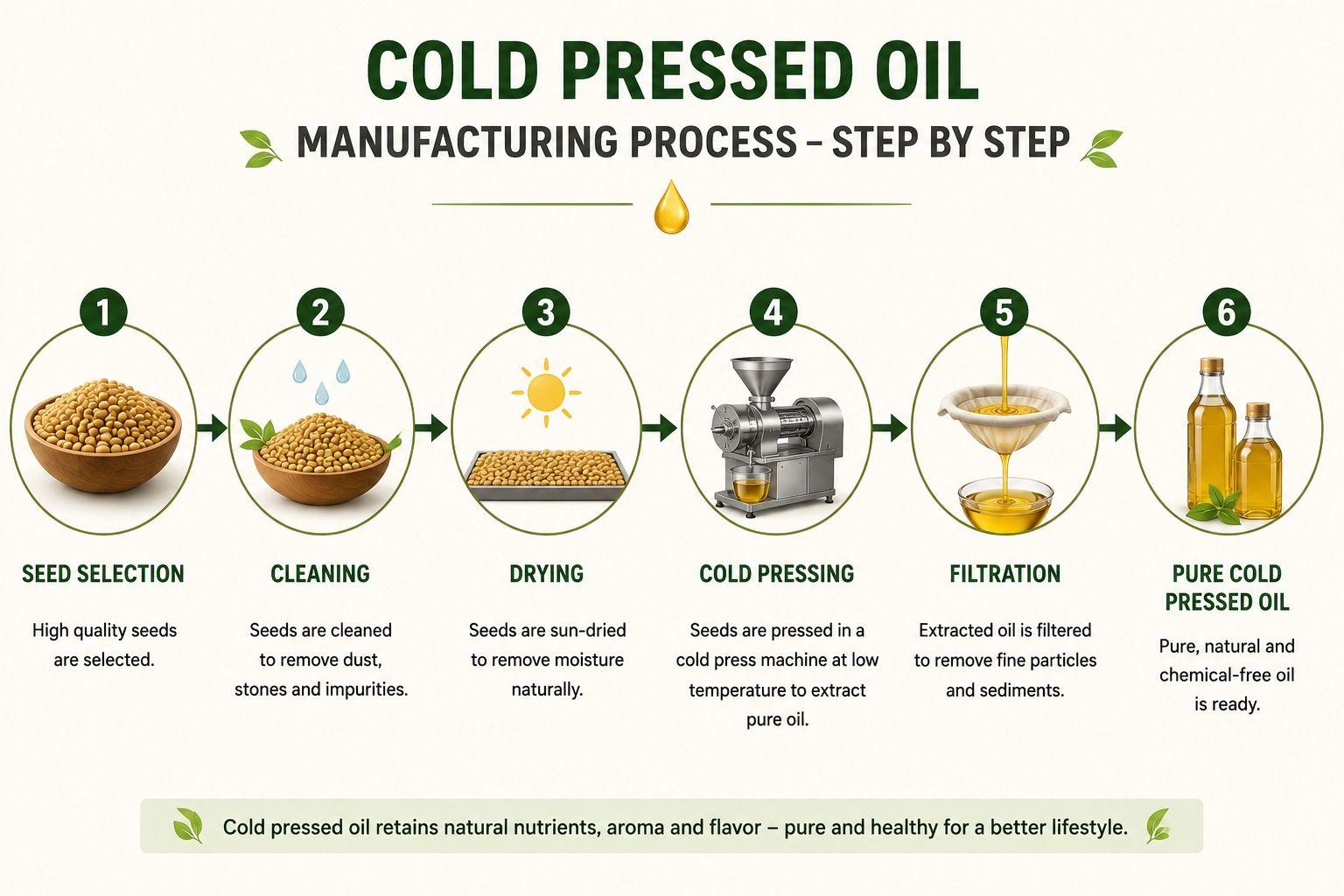
The manufacturing process of cold pressed oil is much simpler than a large edible oil refinery, but maintaining hygiene, proper temperature control and seed quality is essential.
A typical process flow looks like this:
Raw Material Procurement → Cleaning → Drying (if required) → Cold Press Oil Extraction → Filtration → Storage → Quality Testing → Filling → Labelling → Packing
The process starts with receiving oilseeds from suppliers.
Every batch should be inspected before production.
Check for:
• Moisture
• Broken seeds
• Dust
• Stones
• Fungus
• Insects
• Foreign particles
Good raw material directly affects:
• Oil recovery
• Oil colour
• Aroma
• Shelf life
• Customer satisfaction
Oilseeds pass through a cleaning machine.
This removes:
• Dust
• Stones
• Metal particles
• Leaves
• Sand
• Small impurities
Skipping this step can damage the oil expeller and reduce oil quality.
Some seeds may contain higher moisture.
If moisture is excessive, oil recovery can decrease and storage stability may be affected.
Controlled drying helps maintain consistent extraction performance.
This is the most important step.
The cleaned seeds are fed into the Cold Press Oil Machine (Oil Expeller).
The machine uses mechanical pressure to extract oil without using chemical solvents.
The extracted oil flows into a collection tank while the remaining solid material comes out as oil cake.
Oil cake is not waste.
Depending on the seed, it can often be sold for:
• Cattle feed
• Organic fertilizer
• Industrial use
• Further oil extraction (depending on the business model)
This creates an additional revenue stream.
Freshly extracted oil contains:
• Fine seed particles
• Natural sediments
• Wax
• Other suspended impurities
The oil passes through a filtration system to improve clarity while retaining its natural characteristics.
Depending on production capacity, filtration may be:
• Filter press
• Pressure filter
• Plate filter
Filtered oil is stored in food-grade stainless steel storage tanks.
Storage conditions should be:
• Clean
• Dry
• Away from direct sunlight
• Properly covered
• Food-grade
Poor storage can reduce product quality and shelf life.
Before packaging, every production batch should be checked.
Quality parameters may include:
• Colour
• Aroma
• Moisture
• Acid Value
• Peroxide Value
• Free Fatty Acid (FFA)
• Density
• Foreign matter
Regular quality testing helps maintain consistency and customer trust.
The processed oil is transferred to filling machines.
Common bottle sizes include:
• 250 ml
• 500 ml
• 1 Litre
• 2 Litre
• 5 Litre
Bulk buyers may require:
• 15 Litre
• 15 kg tins
• 20 Litre jars
• 50 Litre drums
Each bottle should be:
• Properly capped
• Induction sealed
• Labelled
• Batch coded
Your label should contain:
• Product name
• Net quantity
• FSSAI Licence Number
• Batch Number
• Manufacturing Date
• Best Before
• MRP
• Nutritional Information
• Customer Care Details
• Storage Instructions
Finished bottles are packed into cartons before dispatch.
Proper packaging reduces:
• Leakage
• Breakage
• Transit damage
A complete cold pressed oil plant consists of multiple machines.
| Machine | Purpose |
|---|---|
| Seed Cleaner | Removes dust, stones, and other impurities |
| Seed Grader | Separates seeds based on size |
| Seed Dryer (If Required) | Reduces seed moisture before processing |
| Cold Press Oil Expeller | Extracts oil using mechanical pressure |
| Oil Filter Press | Removes suspended particles from the oil |
| Oil Transfer Pump | Transfers oil between processing and storage tanks |
| Stainless Steel Storage Tank | Stores filtered oil hygienically |
| Bottle Filling Machine | Fills bottles with accurate quantities |
| Bottle Capping Machine | Seals bottles with caps |
| Induction Sealing Machine | Provides tamper-evident bottle sealing |
| Labelling Machine | Applies product labels to bottles |
| Batch Coding Machine | Prints batch number, MRP, and manufacturing date |
| Weighing Scale | Ensures accurate weight and quality checks |
| Shrink Wrapping Machine | Packs finished products for secondary packaging |
Machine capacity depends on your target production.
| Business Size | Suggested Production Capacity |
|---|---|
| Small Unit | 30–80 kg/hour |
| Medium Unit | 80–150 kg/hour |
| Large Unit | 150 kg/hour and above |
Do not purchase the largest machine immediately.
Buy according to actual demand.
Expanding later is easier than recovering from over investment
A small cold pressed oil manufacturing unit generally requires around 800–1,500 sq. ft.
A medium unit may require:
2,000–4,000 sq. ft.
Separate areas should be planned for:
• Raw material storage
• Cleaning
• Production
• Filtration
• Oil storage
• Packaging
• Finished goods
• Dispatch
A proper workflow reduces contamination and improves efficiency.
Power consumption depends on:
• Machine capacity
• Motor size
• Number of machines
• Automation level
Always obtain the exact electrical load from your machinery supplier before finalising your factory.
Investment depends on:
• Capacity
• Automation
• Number of products
• Packaging line
• Storage capacity
Indicative investment:
| Setup | Approximate Investment |
|---|---|
| Small Semi-Automatic Unit | ₹5–10 Lakhs |
| Medium Unit | ₹10–25 Lakhs |
| Fully Automatic Plant | ₹25 Lakhs–₹75 Lakhs+ |
This generally includes machinery only.
Additional investment is required for:
• Building
• Electrical installation
• Working capital
• Packaging inventory
• Raw materials
• Marketing
• Licences
| Expense | Importance |
|---|---|
| Machinery | Highest initial investment |
| Raw Material | Continuous operating expense |
| Packaging | Major recurring cost |
| Factory Rent | Fixed monthly cost |
| Labour | Monthly operating cost |
| Electricity | Essential operational expense |
| Marketing | Supports brand building and sales |
| Working Capital | Ensures smooth business continuity |
A cold pressed oil business is a food manufacturing business.
Common registrations may include:
• FSSAI Licence
• GST Registration
• Udyam Registration
• Trade Licence
• Shop & Establishment Registration
• Factory Licence (where applicable)
• Pollution approvals (if applicable)
• Trademark Registration (recommended)
• Legal Metrology compliance for packaged products
Before commercial production, ensure your labels and packaging comply with applicable food-labelling regulations
Packaging is one of the biggest factors influencing purchase decisions.
Popular options include:
• Affordable
• Lightweight
• Easy transportation
• Premium appearance
• Better brand positioning
Ideal for:
• Hotels
• Restaurants
• Bulk buyers
Suitable for:
• Budget customers
• Wholesale
Instead of competing only on price, build a premium brand.
Highlight:
• Cold Pressed
• Traditional Extraction
• Freshly Processed
• Small Batch Production
• Traceable Sourcing
• No Chemical Solvent Extraction
Avoid unsupported health or disease-related claims on packaging and marketing.
Potential sales channels include:
• Kirana Stores
• Supermarkets
• Organic Stores
• Medical Stores (where appropriate)
• Hotels
• Restaurants
• Cafés
• Online Marketplace
• Own Website
• WhatsApp Business
• Instagram Shop
• Distributors
A combination of offline and online sales generally provides better long-term stability than relying on a single channel.
Your profitability depends on:
• Raw material purchase price
• Oil recovery
• Packaging cost
• Labour cost
• Electricity cost
• Distribution margin
• Brand positioning
• Customer repeat rate
Higher selling prices alone do not guarantee better profit. Consistent quality, efficient operations and repeat customers are often more important.
• Buying low-quality oilseeds
• Purchasing machinery without market research
• Selling too many product variants from day one
• Ignoring packaging quality
• Weak branding
• Poor storage practices
• No quality testing
• Depending only on online marketplaces
• Underestimating working capital
• Competing only on price

Starting a cold pressed oil business involves more than buying an oil expeller.
StartupHyper can help you understand:
• Cold press oil machine selection
• Plant capacity planning
• Production workflow
• Machinery comparison
• Factory layout planning
• Packaging line setup
• Supplier quotation comparison
• Expansion planning from a small unit to a commercial plant
It can be profitable when you maintain consistent product quality, source good raw materials, build a trusted brand and develop repeat customers.
A small semi-automatic setup may begin around ₹5–10 lakh, while larger automated plants require significantly higher investment.
Mustard oil, groundnut oil, sesame oil and coconut oil are among the most commonly sold cold pressed oils in India.
Many cold press oil machines can process different oilseeds, provided they are suitable for the machine and proper cleaning is carried out between batches.
Yes. Since this is a food manufacturing business, the applicable FSSAI registration or licence is generally required.
Shelf life depends on the type of oil, storage conditions, packaging and applicable food standards. Always determine and declare it based on proper testing and regulatory requirements.
Oil cake is the solid material left after oil extraction. Depending on the seed type, it may be sold for animal feed, organic fertilizer or industrial applications.
The cold pressed oil business is one of the strongest value-added food manufacturing opportunities in India. Consumers are increasingly looking for quality, transparency and trusted brands, creating space for new entrepreneurs who focus on consistent products rather than competing only on price.
Success depends on sourcing quality oilseeds, selecting the right machinery, maintaining food safety, investing in attractive packaging and building a reliable distribution network. If you begin with a focused product range, maintain strict quality standards and expand gradually, a cold pressed oil business can grow into a sustainable long-term brand
If you're planning to set up a cold pressed oil manufacturing unit, StartupHyper can help you understand the machinery, production setup and business planning needed to get started.
📞Call / WhatsApp: 9472093913
📧Email: info@startuphyper.com
🌐 Website: www.startuphyper.com | www.machinehai.com
🏢 Branches: Patna | Gaya | Katihar | Saharsa
Stay updated with the latest tips, trends, and best practices in factory setup and machinery procurement—subscribe to the StartupHyper newsletter!
No spam, we promise. Your inbox is safe with us—only valuable insights.