Read the full article to gain deeper insights and comprehensive information.

Aug 22, 2026
0
Learn how to start a dry fruits packaging business with low investment, the right machinery, packaging process, and profit potential.

What Is a Dry Fruits Packaging Business?
Why Start a Dry Fruits Packaging Business?
Dry Fruits Packaging Machine: What Equipment Is Required?
Raw Materials & Packaging Materials
Dry Fruits Packaging Process
Dry Fruits Packaging Business Setup
Investment Required
How to Calculate Profit?
Packaging & Branding Ideas
How to Sell Dry Fruits
Common Mistakes to Avoid
How StartupHyper Can Help
Frequently Asked Questions
Conclusion
A dry fruits packaging business involves buying dry fruits in bulk, sorting and cleaning them, packing them into attractive and hygienic packages, and selling them under a brand name or to retailers. Common products include almonds, cashews, raisins, pistachios, walnuts, dates, and mixed dry fruits.
The business can operate on a small, medium, or large scale, depending on the investment and packaging machinery used. Products can be packed in pouches, jars, boxes, or gift packs in different sizes according to customer requirements.
The main focus of this business is quality, hygiene, attractive packaging, proper labelling, and efficient sealing. With increasing demand for healthy snacks and premium food products, packaged dry fruits can be sold through retail stores, supermarkets, online platforms, wholesalers, and direct customers.
Dry fruits are purchased throughout the year, with demand often increasing during festivals, weddings, gifting seasons and special occasions.
Bulk dry fruits can be converted into retail-ready products through sorting, grading, weighing, packaging and branding.
A well-designed package can help an entrepreneur build a recognizable local or regional brand.
Products can be sold in small trial packs, regular family packs, premium packs and gift boxes.
Products can be supplied to retailers, supermarkets, wholesalers, offices, gift businesses and online customers
The machinery required depends on whether the business only weighs and seals products or also performs cleaning, grading, sorting and automated filling.
| Machine/Equipment | Purpose |
|---|---|
| Dry Fruit Cleaning Equipment | Helps remove dust and unwanted particles where required. |
| Grading/Sorting Equipment | Separates products according to size or quality. |
| Weighing Machine | Measures the required quantity for each pack. |
| Automatic/Automatic-Like Filling Machine | Helps fill a consistent quantity into suitable pouches. |
| Pouch Packing Machine | Forms, fills, and seals pouches depending on the selected configuration. |
| Vacuum Packing Machine | Can be used for suitable products and packaging formats where vacuum packaging is appropriate. |
| Sealing Machine | Seals pouches securely. |
| Date/Batch Coding Machine | Prints applicable batch and date information. |
| Labeling Equipment | Applies labels where required. |
Not every business needs every machine. Machinery should be selected according to product type, pack size, daily production target, available space, power supply and budget.
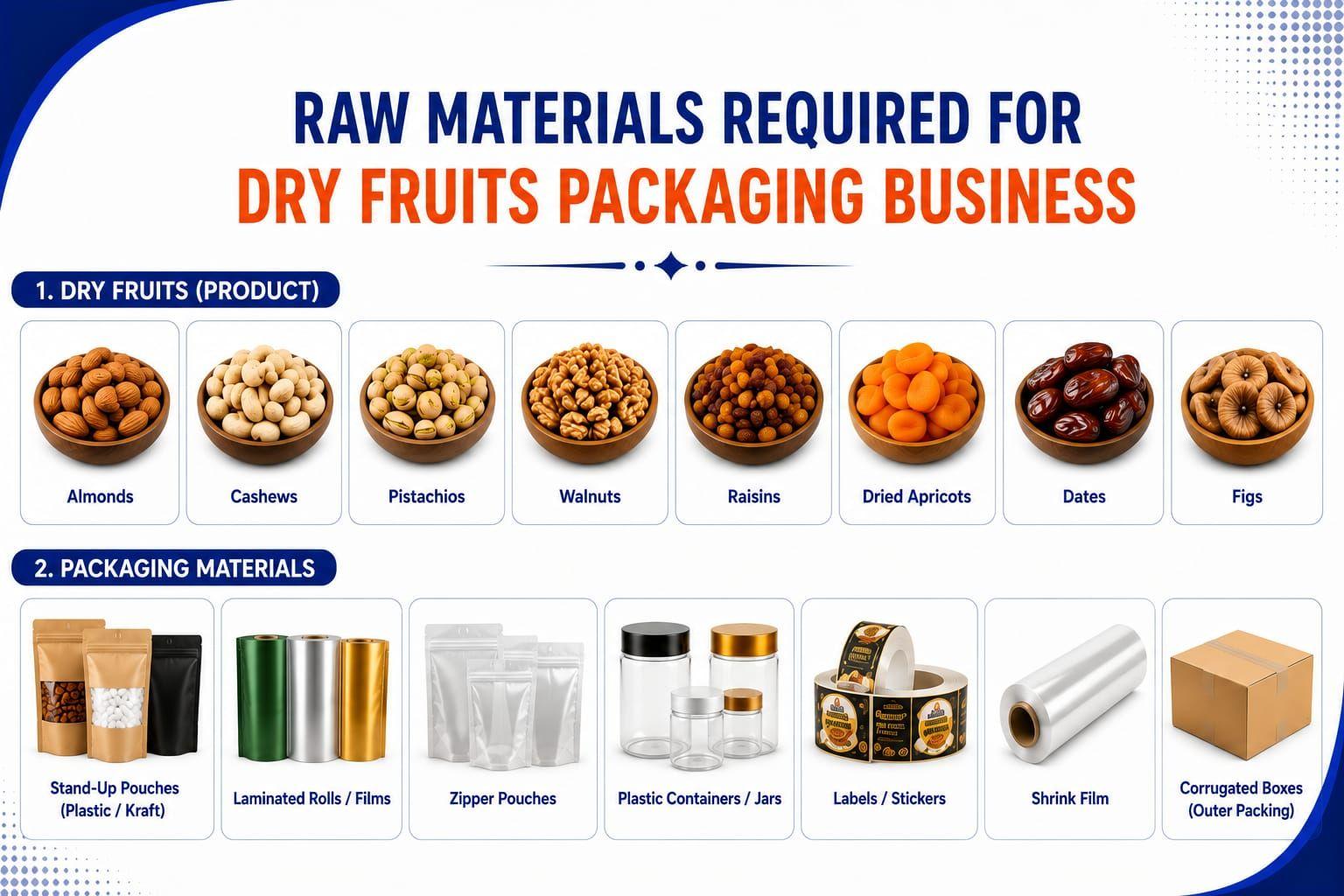
The main products are dry fruits themselves, while the packaging system requires additional materials
• Almonds
• Cashews
• Raisins
• Pistachios
• Walnuts
• Dates and figs
• Mixed dry-fruit combinations
• Food-grade pouches
• Laminated or suitable barrier packaging
• Rigid boxes for premium products
• Labels
• Outer cartons
• Sealing materials
• Stickers or printed packaging
Packaging material should be selected according to the product, shelf-life requirements, storage conditions, branding needs and applicable food-packaging requirements.
Bulk Procurement ® Quality Check ® Cleaning/Sorting ® Grading ® Weighing ® Filling ® Sealing ® Coding/Labeling ® Quality Check ® Cartoning ® Dispatch
Purchase suitable-quality dry fruits from reliable suppliers and verify the quality before accepting the stock.
Check appearance, size, smell, cleanliness and other relevant quality characteristics.
Where required, remove unwanted material and separate unsuitable pieces.
Separate products according to size or quality for consistent retail presentation.
Measure the required quantity for each consumer pack.
Transfer the measured dry fruit into the selected pouch, box or container.
Seal the package using the appropriate sealing method.
Apply required batch/date/label information according to the applicable requirements.
Inspect package weight, seal integrity, appearance and labeling.
Arrange finished packs in outer cartons and prepare them for distribution.
Provide a clean and organized area for sorting, weighing and packing.
Keep packaging operations separate and organised to reduce contamination and handling errors.
Store bulk dry fruits under suitable conditions to protect quality.
Keep pouches, boxes and labels clean, dry and organised.
Store packed products appropriately before dispatch.
Power requirements depend on the selected packaging and processing equipment.
Manpower depends on automation level and daily packing volume.
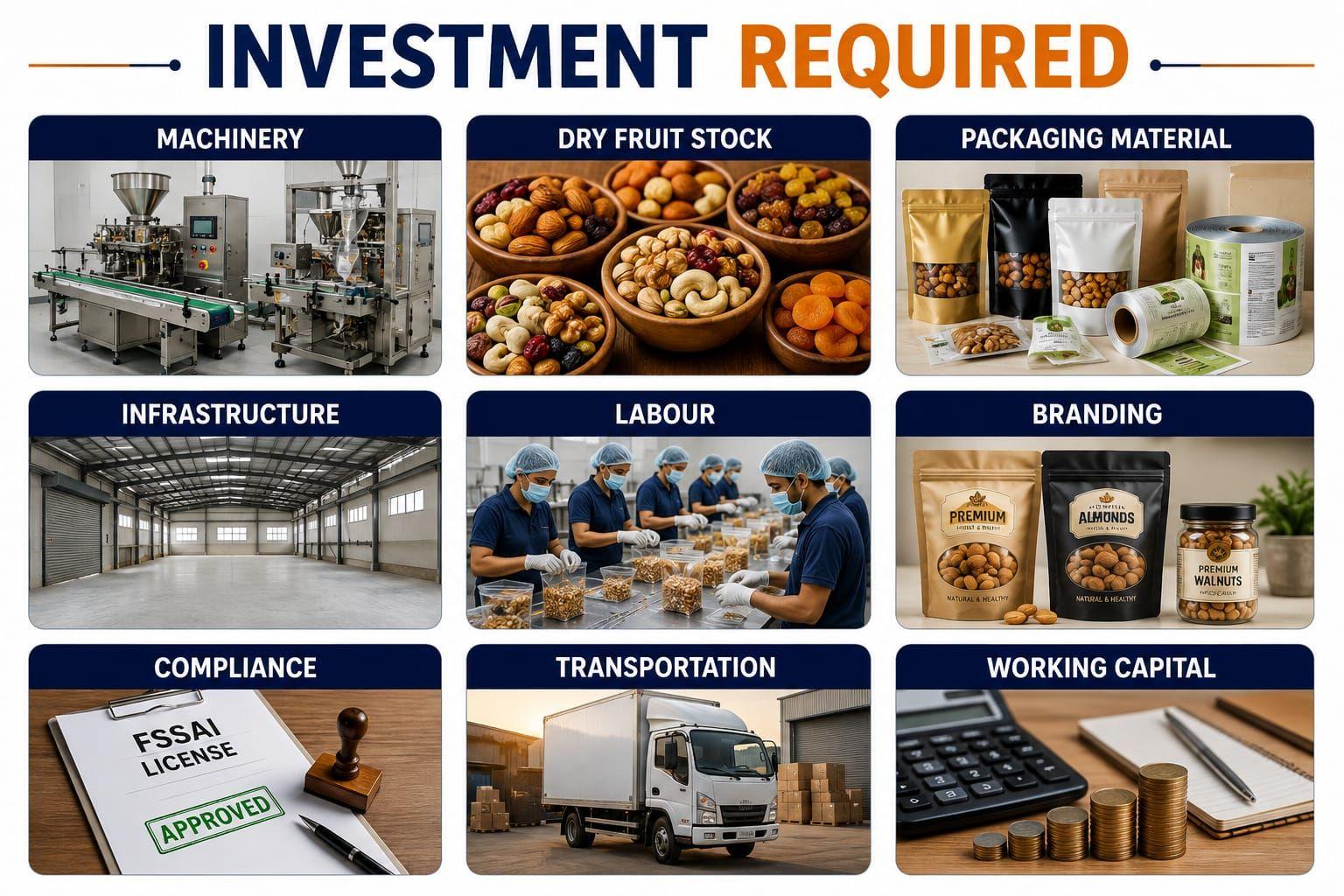
The investment can vary significantly depending on the business model. A basic manual/semi-automatic packaging unit can have a very different cost from a fully automated line.
| Expense | What It Covers |
|---|---|
| Machinery | Weighing, filling, packing, sealing, coding, and optional sorting equipment |
| Dry Fruit Stock | Initial inventory and working capital |
| Packaging Material | Pouches, boxes, labels, and cartons |
| Infrastructure | Rent, electrical setup, tables, storage, and basic facility preparation |
| Labour | Packing and handling staff |
| Branding | Packaging design, labels, logo, and promotional material |
| Compliance | Applicable registrations, licences, and professional costs |
| Transportation | Procurement and distribution costs |
| Working Capital | Regular operating expenses and inventory replenishment |
The most important point is to calculate the complete project requirement rather than looking only at the packaging machine price.
Profit in dry-fruit packaging depends heavily on procurement price, packaging cost, selling price, wastage, distribution margin and sales volume.
Gross Contribution = Sales Revenue – Product & Packaging Cost
Operating Profit = Total Sales – Total Operating Expenses
Your calculation should consider:
• Bulk dry-fruit purchase price
• Sorting/grading losses
• Packaging material
• Labour
• Electricity
• Rent
• Transportation
• Distributor/retailer margin
• Marketing expenses
• Taxes and other applicable costs
• Wastage and damaged stock
Because dry-fruit prices can fluctuate, profitability should be calculated using current supplier rates and realistic selling prices rather than a fixed online profit estimate
In this business, packaging is part of the product experience.
• Small transparent or window pouches
• Stand-up zipper pouches
• Vacuum packs where suitable
• Rigid premium boxes
• Festival gift boxes
• Bulk institutional packs
• Memorable brand name
• Clear product identity
• Consistent logo and colours
• High-quality product photography
• Readable label design
• Appropriate product information
• Premium gift packaging for seasonal sales
Packaging and labeling should comply with applicable food-safety and legal requirements.
• Grocery stores
• Supermarkets
• Dry-fruit shops
• Department stores
• Local wholesalers
• Distributors
• Regional dealers
Corporate & Gifting
• Wedding/event gifting
• Festival hampers
• Institutional buyers
• E-commerce marketplaces
• Social media
• Own website
• Local delivery
• Subscription packs
• Community marketing
• Repeat customer programmes
A strong sales strategy can combine regular retail packs with premium seasonal gift packs to serve different customer segments
Dry fruits can tie up significant working capital. Start with products and quantities suited to your expected demand.
Small changes in purchase price can materially affect margins.
Weak sealing or unsuitable packaging can damage product quality and customer trust.
Consistent quality is essential for repeat purchases.
Automation should match actual sales volume and future growth plans.
Plan inventory carefully around festivals, weddings and gifting seasons.
A generic product may compete mainly on price; branding can help create a distinct market position.

StartupHyper can help entrepreneurs start and manage a dry fruits packaging business by providing guidance on business planning, investment, machinery, registrations, branding, and marketing. It can help entrepreneurs understand the basic requirements and plan their business according to their budget and target market.
It guides entrepreneurs in selecting suitable machines such as weighing, filling, packing, sealing, and coding machines.
It offers guidance on suitable government loan and subsidy schemesb for starting or expanding the business.
It supports branding and marketing activities, including packaging design, promotion, and market reach.
It facilitates business growth through better planning, distribution, and sales strategies.
Yes, dry fruits packaging can be profitable because of the growing demand for **healthy snacks, premium products, and ready-to-use packaged foods.
Common products include almonds, cashews, raisins, pistachios, walnuts, dates, and mixed dry fruits.
Basic machinery may include weighing, filling, sealing, pouch packing, and date/batch coding machines.
Investment depends on the business scale, machinery, packaging material, premises, and initial stock.
Yes, entrepreneurs can sell packaged dry fruits under their own brand name with suitable packaging and labelling.
Products can be sold through retail stores, supermarkets, wholesalers, online platforms, and direct customers.
The dry fruits packaging business offers an opportunity to participate in the growing packaged-food and gifting market without necessarily manufacturing the dry fruits themselves.
The core of the business is effective procurement, quality control, attractive packaging, accurate weighing, reliable sealing, branding and distribution.
Entrepreneurs should start with a clear target market, calculate working capital carefully and select machinery according to actual sales and production requirements.
Starting at a manageable scale and expanding product range, packaging formats and distribution channels as demand grows can be a practical approach.
If you are planning to start a dry fruits packaging business and need help with machinery selection or setup, StartupHyper can help you move from the idea stage toward a practical business setup
📞Call / WhatsApp: 9472093913
📧Email: info@startuphyper.com
🌐 Website: www.startuphyper.com | www.machinehai.com
🏢 Branches: Patna | Gaya | Katihar | Saharsa
Stay updated with the latest tips, trends, and best practices in factory setup and machinery procurement—subscribe to the StartupHyper newsletter!
No spam, we promise. Your inbox is safe with us—only valuable insights.