Read the full article to gain deeper insights and comprehensive information.

Aug 19, 2026
0
Learn how to start a Cotton Wick Business in India, including demand, raw materials, production process, investment, selling strategy and profit potential.
What is a Cotton Wick Business?
Why Start a Cotton Wick Business?
Cotton Wick Business Demand in India
Types of Cotton Wicks
Cotton Wick Raw Material
Cotton Wick Making Process
Cotton Wick Business Investment
Cotton Wick Business Profit Potential
How to Sell Cotton Wicks
How to Improve Cotton Wick Business Profitability
Common Mistakes to Avoid
Who Can Start a Cotton Wick Business?
How StartupHyper Can Help
Frequently Asked Questions
Conclusion
A Cotton Wick Business involves manufacturing and selling cotton wicks, commonly known as Rui Batti or cotton batti. Cotton wicks are mainly used for puja, diyas, temples, religious ceremonies, household lamps and festivals.
The business can be started on a small scale and expanded according to production and market demand. The main business requirements include cotton, basic production equipment, packaging and working capital
A Cotton Wick Business can be considered by entrepreneurs looking for a relatively simple manufacturing product with multiple sales channels.
• Simple manufacturing process
• Low variety of primary raw material
• Can be sold in retail and bulk
• Suitable for local and wholesale markets
• Scope for branded packaging
• Can be scaled according to demand
Profitability is not automatic. It depends on raw-material cost, production efficiency, labour, packaging, selling price and distribution.
Cotton wicks are closely connected with regular religious and household practices in India. They are used in puja, diyas, temples, religious ceremonies and festivals.
Potential buyers include:
• Puja shops
• General stores
• Temple suppliers
• Wholesalers
• Distributors
• Religious-product retailers
• Online sellers
• Individual consumers
Demand can increase during festivals and religious occasions. For a new business, it is important to check local demand before deciding production volume and sales targets.
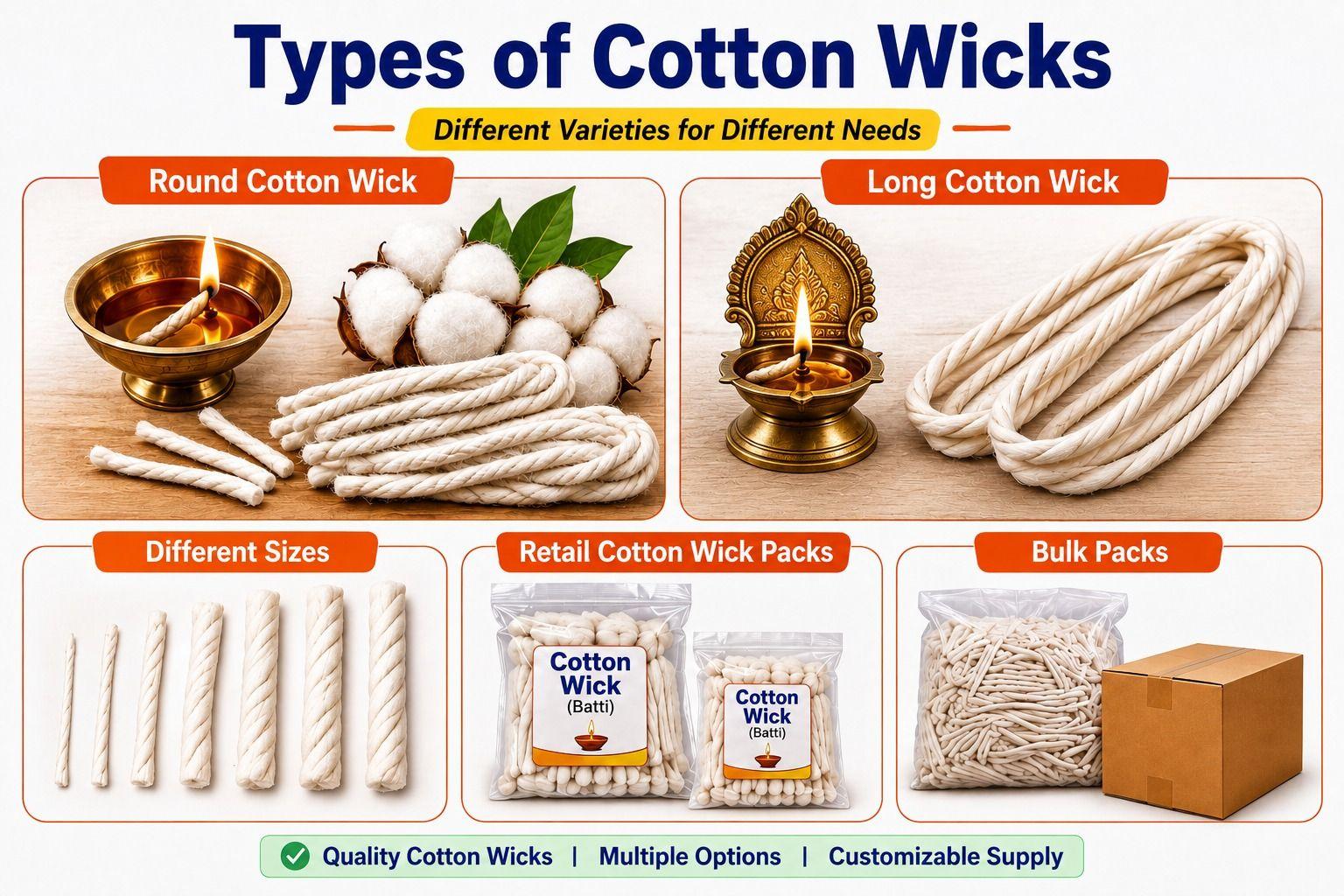
Commonly used for diyas and household puja.
Used for specific lamps and religious applications.
Wicks can be offered in different thicknesses and sizes according to customer requirements.
Small consumer packs can be sold under your own brand and label.
Wholesale customers can be supplied in larger quantities.
Cotton is the primary raw material for a Cotton Wick Business. A packaged product also requires suitable packaging materials.
• Cotton
• Pouches or packets
• Printed packaging
• Labels
• Cartons for bulk transportation
Cotton quality can affect the wick's shape, consistency and burning characteristics. Consistent raw-material quality is important when building repeat customers.
Select cotton according to the required wick size and quality.
Prepare the cotton for the wick-forming process.
Form the cotton into the required wick shape using the chosen production method.
Check finished wicks for uniformity, thickness and shape.
Remove damaged or inconsistent pieces.
Pack finished wicks according to the target market.
Simple flow: Cotton → Preparation → Wick Formation → Quality Check → Sorting → Packaging → Selling
The total Cotton Wick Business Investment depends on the scale of the unit. Instead of focusing on one machine price, calculate the complete setup requirement.
• Basic production equipment
• Raw material
• Packaging material
• Electrical setup
• Work tables and storage
• Weighing equipment
• Transportation
• Initial working capital
A small unit can start with a basic setup and limited inventory; a larger setup needs more production capacity, raw material and working capital.
Total Investment = Equipment + Initial Raw Material + Packaging + Setup + Working Capital
Cotton Wick Business Profit depends mainly on the difference between total sales and total business costs. There is no fixed profit figure that applies to every business.
• Cotton
• Labour
• Electricity
• Packaging
• Transportation
• Equipment maintenance
• Retailer or distributor margin
• Other operating expenses
Profit = Total Sales – Total Business Cost
For packaged cotton wicks, calculate the complete cost per packet before setting the selling price. This gives a more realistic view than relying on generic monthly-income claims.
• Efficient raw-material purchasing
• Reducing production wastage
• Maintaining consistent product quality
• Selling directly to retailers where practical
• Developing wholesale customers
• Using suitable pack sizes
• Building your own brand
Approach puja shops, general stores, religious-product shops and devotional stores.
Bulk orders can help increase production utilisation.
Local temples and religious institutions can be potential bulk buyers.
Distributors can help take the product to multiple retailers.
Branded cotton wick packs can be offered through your website or suitable online marketplaces.
Supplying nearby shops directly can help build relationships and understand customer demand.
Efficient purchasing and inventory planning can directly affect margins.
Uniform size and shape can support repeat orders.
Avoid producing significantly more than your current market can absorb.
Small packs can target retail buyers while larger packs can suit wholesale customers.
Regular retailers and distributors can provide more predictable sales.
Good packaging and consistent quality can differentiate your product.
• Ignoring market demand before deciding production volume
• Overestimating profit without calculating actual costs
• Producing without consistent quality control
• Ignoring packaging and product presentation
• Expanding capacity before establishing repeat demand
• New entrepreneurs
• Small manufacturing businesses
• Home-based entrepreneurs
• Women entrepreneurs
• Self-help groups
• Existing puja-product businesses
• Agarbatti manufacturers
• Diya manufacturers
• Retailers developing their own product

Starting a Cotton Wick Business requires more than selecting production equipment. Entrepreneurs also need to understand their target market, production requirement, costs and sales channels.
• Business requirement assessment
• Production and capacity planning
• Investment planning
• Machinery and equipment guidance
• Supplier guidance
• Manufacturing setup guidance
If you are planning to start a Cotton Wick Business in India, StartupHyper can help you evaluate the business and setup requirements according to your production goals and budget.
For detailed information about Cotton Wick Making Machine options, use the separate StartupHyper guide focused specifically on the machinery.
It can be profitable when production costs are controlled and the business has consistent buyers. Actual profit depends on raw-material cost, production efficiency, selling price, packaging and distribution.
Cotton is the primary raw material. Packaging materials are additionally required for retail packs.
Yes. The appropriate setup depends on your production target, workspace, investment and local demand.
Rui Batti is a commonly used Indian term for cotton wicks, primarily used for diyas and religious purposes.
Potential buyers include puja shops, temples, wholesalers, distributors, general stores, religious-product retailers and individual consumers.
Calculate total sales and subtract cotton, labour, electricity, packaging, transportation, maintenance and other operating costs.
You can target local retailers, wholesalers, distributors, temples, religious-product stores and online customers depending on your business model.
Evaluate local demand, product types, raw-material cost, production requirement, packaging, selling price, distribution and working capital.
The Cotton Wick Business is a small-scale manufacturing opportunity based on a simple product with regular applications in puja, temples, diyas and religious activities.
The business can be started at different scales, but a practical approach is to begin with a realistic production target, calculate actual costs, identify potential buyers and build sales channels before expanding.
For a sustainable Cotton Wick Manufacturing Business, focus on three areas: consistent product quality, controlled production cost and reliable sales channels.
If you are planning to start a Cotton Wick Business in India, StartupHyper can help you evaluate the business and setup requirements according to your production goals and budget.
📞Call / WhatsApp: 9472093913
📧Email: info@startuphyper.com
🌐 Website: www.startuphyper.com | www.machinehai.com
🏢 Branches: Patna | Gaya | Katihar | Saharsa

Aug 18, 2026
Stay updated with the latest tips, trends, and best practices in factory setup and machinery procurement—subscribe to the StartupHyper newsletter!
No spam, we promise. Your inbox is safe with us—only valuable insights.