Read the full article to gain deeper insights and comprehensive information.

Aug 21, 2026
0
Learn about machine requirements, raw materials, production process, investment, packaging, marketing, profit and business opportunities in India.

What Is a Mehendi Making Machine?
Why Start a Mehendi Manufacturing Business?
Market Opportunity for Mehendi Products
How Does a Mehendi Making Machine Work?
Raw Materials Required
Mehendi Manufacturing Process
Investment Required
How to Sell Mehendi Products
How to Choose the Right Mehendi Making Machine
Common Mistakes to Avoid
How StartupHyper Can Help
Frequently Asked Questions
Conclusion
A Mehendi Making Machine is a specialized piece of equipment designed to make the Mehendi production process faster, easier, and more efficient. It is mainly used for preparing and handling Mehendi products such as Mehendi paste and Mehendi cones. Depending on the type of machine, different stages such as mixing, filling, shaping, sealing, and packaging can be carried out with greater accuracy and consistency.
For businesses, a Mehendi making machine can help achieve uniform product quality while reducing manual effort, production time, and wastage. These machines are suitable for small, medium, and large-scale Mehendi manufacturing businesses. With increasing demand for ready-to-use and herbal Mehendi products, using suitable machinery can help manufacturers increase production capacity and business efficiency.
High market demand
Low to moderate investment
Easy availability of raw materials
Growing demand for herbal and natural products
Good profit potential
Simple manufacturing process
Easy packaging and storage
Suitable for small and medium-scale businesses
Opportunities for brand development
Mehendi is an important part of Indian weddings, festivals, and celebrations. Demand increases significantly during occasions such as weddings, Karwa Chauth, Teej, Eid, and Diwali.
Many consumers prefer natural and herbal beauty products. Mehendi made from natural henna can attract customers who want alternatives to products containing harsh chemicals.
Mehendi products have a wide customer base, including individual consumers, Mehendi artists, beauty salons, retailers, wholesalers, and event organizers. This gives manufacturers multiple ways to sell their products.
Manufacturers can produce different types of products such as Mehendi powder, Mehendi cones, herbal Mehendi, bridal Mehendi, and hair Mehendi. Product variety allows businesses to target different customer needs and price segments.
The growth of e-commerce and social media has made it easier for Mehendi manufacturers to reach customers outside their local area. Products can be promoted and sold through online platforms.
Mehendi products have demand in both urban and rural areas. Businesses can sell through local shops, cosmetic stores, salons, distributors, and wholesalers to reach different markets.
Businesses can create a strong brand by focusing on quality, attractive packaging, natural ingredients, and consistent colour results. Premium products can also be sold at higher prices.
A Mehendi manufacturing business can start on a small scale and gradually expand its production, product range, distribution network, and online presence as demand increases
The exact working process depends on the machine model.
However, a typical production workflow involves preparing the mehendi formulation and then filling the prepared paste into cone sheets.
The required ingredients are processed and mixed according to the product formulation.
Cone sheets are prepared according to the desired size and packaging requirements.
The mehendi paste is transferred into the cone using suitable filling equipment.
Consistent filling is important to ensure that customers receive a standardized product.
The filled cone is properly sealed to reduce leakage and protect the product.
Finished cones are checked for:
• Leakage
• Filling consistency
• Weight
• Sealing
• Appearance
• Packaging quality
The finished cones are packed into retail or bulk packaging.
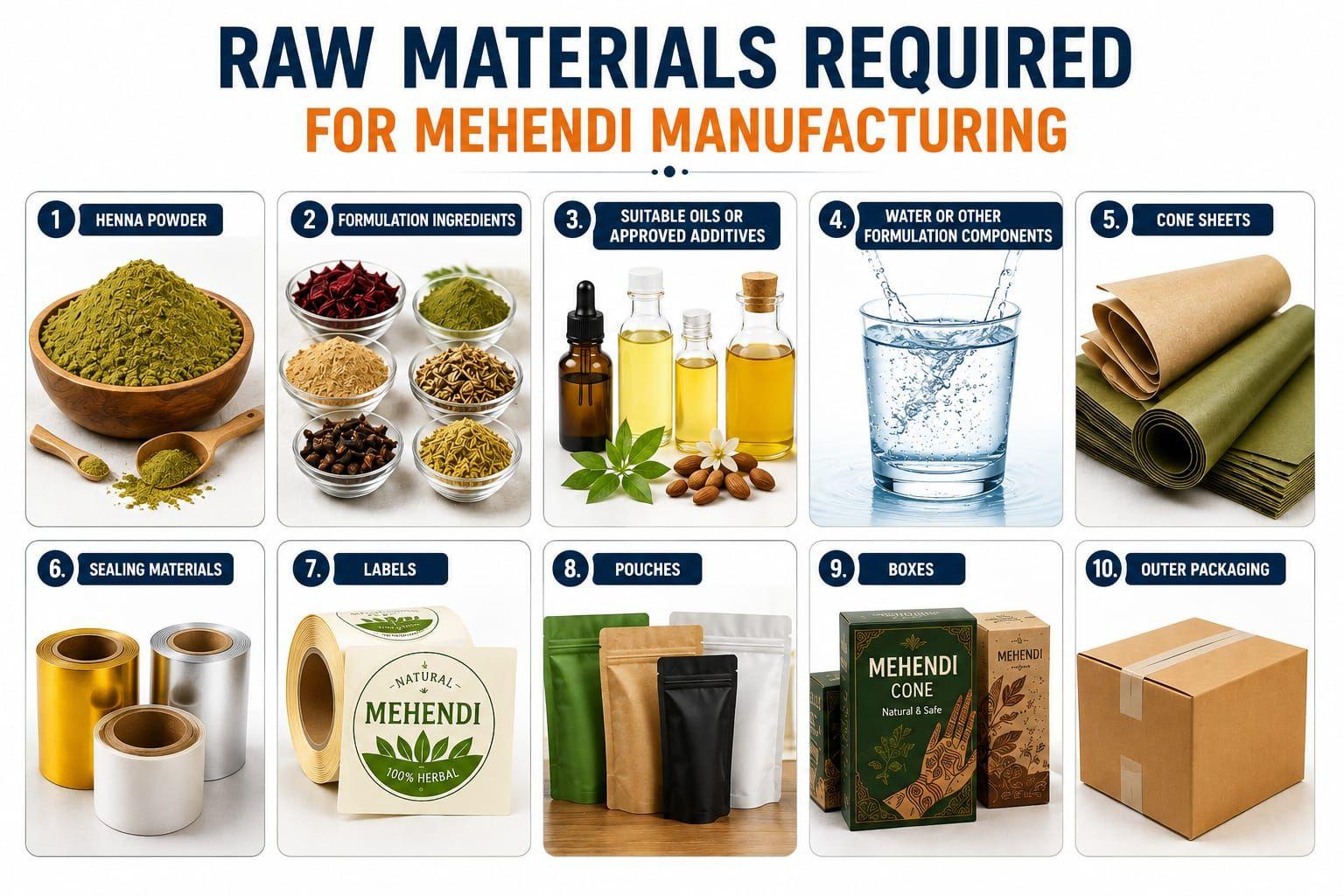
The exact raw materials depend on the formulation and type of mehendi being manufactured.
Common requirements may include:
• Henna powder
• Formulation ingredients
• Suitable oils or approved additives
• Water or other formulation components
• Cone sheets
• Sealing materials
• Labels
• Pouches
• Boxes
• Outer packaging
A basic manufacturing workflow can be divided into several stages.
Purchase suitable-quality raw materials from reliable suppliers.
Henna powder may be sieved to remove unwanted particles and obtain a smoother consistency.
Ingredients are mixed according to the intended product formulation.
Depending on the formulation, the mixture may require a controlled resting or processing period.
Prepare the cone sheets according to the required dimensions.
Fill the prepared mehendi paste into the cones using appropriate equipment.
Seal each cone properly to reduce leakage.
Inspect the cones for:
• Weight
• Filling
• Leakage
• Product consistency
Pack the cones according to the target market.
Store the finished products under appropriate conditions and distribute them through your sales network.
One of the most common questions from new entrepreneurs is:
How much does it cost to start a mehendi manufacturing business?
There is no universal investment figure because the total cost depends on the size and scale of the unit.
The major investment areas include:
• Mehendi making machine - Capacity & automation
• Raw materials - Production volume
• Cone sheets - Product size & quantity
• Packaging - Brand & pack size
• Workspace - Location & scale
• Equipment - Production requirements
• Labour - Automation & output
• Marketing - Sales strategy
• Working capital - Monthly operations
Production is only one part of the business.
Your sales strategy should begin before commercial production.
Approach:
• Cosmetic stores
• General stores
• Gift shops
• Beauty-product retailers
Provide product samples and explain your pricing and retailer margin.
Professional artists can become repeat customers.
You can approach them through:
• Local networking
• Wedding vendors
• Direct visits
Beauty Parlours
Salons and beauty parlours can become regular customers if the product meets their quality and pricing expectations.
Wholesalers can help you move larger quantities.
Once your brand gains traction, distributors can help expand into other locations.
Depending on applicable requirements, consider:
• WhatsApp Business
• Website
• E-commerc
This is one of the biggest mistakes.
Don't purchase a high-capacity machine simply because you expect sales to grow.
Start with market validation.
Customers may try your product once, but quality determines whether they buy again.
Consumer products need professional presentation.
Having a machine without customers is not a business model.
Low price can attract customers initially but may make it difficult to maintain margins.
You need money to purchase raw materials, packaging and manage daily expenses while sales are developing.

StartupHyper can help entrepreneurs set up a Mehendi manufacturing business by providing support in business planning, machinery selection, project report preparation, and factory setup. It can help you understand your investment requirements, production needs, machinery options, and setup process, making it easier to start the business in a planned manner.
StartupHyper can also provide support for government schemes, loan assistance, branding, packaging, marketing, and business growth. With guidance at different stages, entrepreneurs can focus on building a quality Mehendi brand, reaching more customers, and expanding their business with the right strategy.
A mehendi making machine is equipment used to streamline mehendi cone production, particularly the filling process, depending on the machine configuration.
It can be profitable when the business has sufficient demand, good product quality, controlled costs and an effective sales network.
Yes. Entrepreneurs can begin with a smaller production setup and increase capacity as demand grows.
Common requirements include henna powder, formulation ingredients, cone sheets and packaging materials. Exact materials depend on the formulation.
You can sell through local retailers, artists, salons, wholesalers, distributors, social media, your website and suitable online marketplaces.
Consider production capacity, automation, compatibility, machine construction, power requirement, maintenance, warranty, spare parts and after-sales service.
Investment varies according to machine capacity, automation, raw materials, packaging, workspace and working capital. A detailed project calculation should be prepared before investing.
Yes. Packaging protects the product and plays a major role in branding, product presentation and customer perception.
Starting a Mehendi Manufacturing Business can be a promising opportunity due to its high market demand, growing preference for natural products, and wide customer base. With the right machinery, quality raw materials, attractive packaging, and effective marketing, entrepreneurs can build a successful Mehendi brand.
With proper business planning, investment, and market strategy, the business can grow from a small-scale setup to a larger manufacturing operation. Support from StartupHyper can further help entrepreneurs with machinery selection, project reports, government schemes, loan assistance, branding, and business setup, making the journey more organized and efficient.
📞Call / WhatsApp: 9472093913
📧Email: info@startuphyper.com
🌐 Website: www.startuphyper.com | www.machinehai.com
🏢 Branches: Patna | Gaya | Katihar | Saharsa

Aug 18, 2026
Stay updated with the latest tips, trends, and best practices in factory setup and machinery procurement—subscribe to the StartupHyper newsletter!
No spam, we promise. Your inbox is safe with us—only valuable insights.