Read the full article to gain deeper insights and comprehensive information.

Oct 14, 2026
0
10 Diwali products a small unit can make in 2026, with machine prices, licences and loan options. Start small and sell all year.

Looking for Diwali business ideas 2026 that go beyond reselling? Making your own products gives better margins, and many Diwali items sell all year for daily puja. In 2025, Diwali sales hit a record Rs 6.05 lakh crore, with buyers preferring Indian-made goods. Here are 10 products a small unit can make.
• Higher margin than trading
• Sell to shops, wholesalers and online
• Puja products (agarbatti, camphor, wicks) sell all year
• In Bihar, Chhath Puja (13–16 Nov 2026) extends the season
These need little setup and can be made in time for this Diwali.
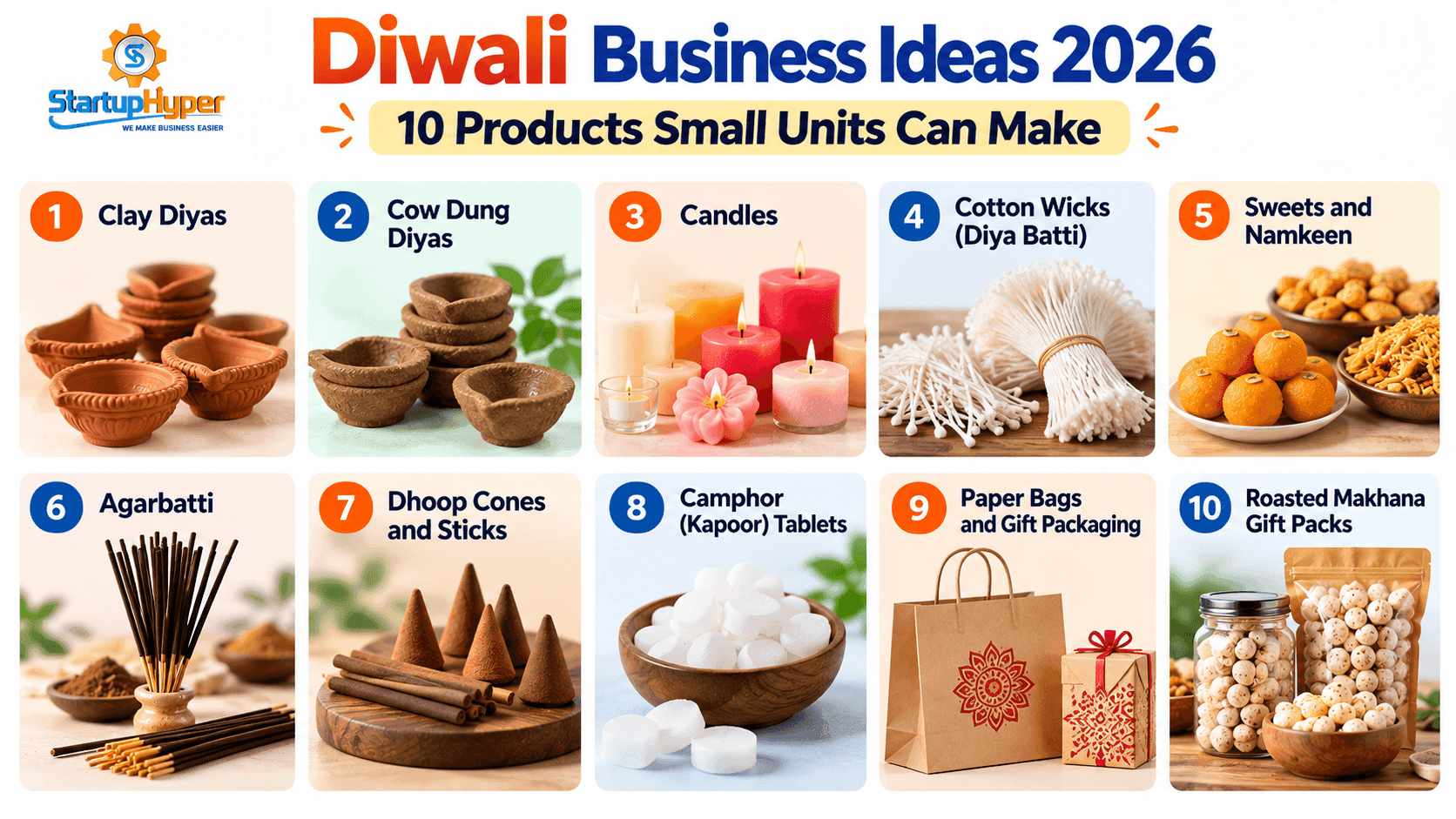
A diya making machine presses clay into uniform diyas. Designer moulds sell at higher prices. Machine: about Rs 30,000; moulds from Rs 13,000.
Eco-friendly and popular in villages with dairy animals. Machine: about Rs 13,000.
Scented, gel and floating candles. Start with moulds and a melting pot; add a machine later.
Every diya needs a wick. Sell small packs to shops or bulk to diya makers.
Laddoo, mathri and namkeen sell fast. FSSAI registration is compulsory.
Machines take time to buy and learn, but these products sell every day.
Daily-use product with a Diwali peak. Agarbatti making machine price: about Rs 58,000–1.1 lakh (automatic).
A simple add-on if you already make agarbatti.
Used in every aarti. Camphor making machine: about Rs 40,000–1.1 lakh. Pack airtight.
High festive demand from shops. Automatic machines cost about Rs 5–6 lakh; printed bags earn more.
A healthy Diwali gift, and Bihar grows most of India's makhana (🔗 Internal link: anchor "makhana" → your Makhana Huller Machine post).
| Product | Approx. machine price |
|---|---|
| Clay diyas | ₹30,000 |
| Cow dung diyas | ₹13,000 |
| Agarbatti | ₹58,000–₹1.1 lakh |
| Camphor | ₹40,000–₹1.1 lakh |
| Paper bags | ₹5–6 lakh |
| Candles, wicks, dhoop | Get quotations |
Licences
• Udyam registration – free
• FSSAI – for sweets, namkeen, makhana
• GST – if turnover crosses the limit
The investment required for a Diwali product manufacturing business depends on the product, machine capacity, production method and scale of operations. Some products can be made on a small scale using basic tools, while others require specialised machinery, workspace and packaging equipment.
Here is an indicative overview of the main costs to consider before starting.
| Business Idea | Approx. Machine Cost | Other Expenses to Consider |
|---|---|---|
| Clay Diya Manufacturing | ₹30,000 | Clay, moulds, drying space, and packaging |
| Cow Dung Diya Manufacturing | ₹13,000 | Raw materials, moulds, and packaging |
| Candle Manufacturing | Get Quotations | Wax, wicks, moulds, fragrance, and packaging |
| Cotton Wick Manufacturing | Get Quotations | Cotton, production tools, and packaging |
| Agarbatti Manufacturing | ₹58,000–₹1.1 lakh | Bamboo sticks, raw materials, fragrance, and packaging |
| Camphor Tablet Manufacturing | ₹40,000–₹1.1 lakh | Suitable raw materials, packaging, and safety arrangements |
| Paper Bag Manufacturing | ₹5–6 lakh | Paper, handles, printing, and workspace |
| Dhoop Cone and Stick Manufacturing | Get Quotations | Raw materials, moulds, and drying arrangements |
| Sweets and Namkeen Production | Get Quotations | Ingredients, food-grade equipment, storage, and packaging |
| Roasted Makhana Gift Packs | Get Quotations | Makhana, roasting equipment, seasoning, and food-grade packaging |
Note: Machine prices are indicative estimates from the available price information, not confirmed current quotations. Actual prices vary by model, capacity, automation, supplier and location. The machine prices do not necessarily include GST, transportation, installation or accessories.
Apart from purchasing machinery, consider these expenses:
Raw materials: Initial stock needed to begin production.
Packaging and labelling: Boxes, packets, labels and branding materials.
Workspace: Rent, electricity, ventilation and storage, if required.
Labour: Wages for helpers or machine operators.
Licences and compliance: Applicable registrations and approvals for your business.
Transportation: Delivery of raw materials and finished products.
Working capital: Money reserved for daily expenses until sales generate sufficient cash flow.
Starting a Diwali product business can be an opportunity to build a manufacturing unit, but poor planning can increase costs and reduce profitability. Avoid these common mistakes before investing.
A machine may produce thousands of items, but that does not mean you will sell them all. Research local retailers, wholesalers and distributors before deciding on production capacity.
The machine is only one part of the investment. Raw materials, packaging, electricity, labour, transportation and working capital can increase the actual startup cost considerably.
Diwali products often have a seasonal demand peak. Buying machinery, arranging materials and testing production take time. Plan your schedule around supplier lead times and the dates when buyers need stock.
Poor finishing, damaged products or unsuitable packaging can lead to complaints and returns. Test product samples and packaging before accepting large orders.
Unsold seasonal inventory can tie up your working capital. Start with a manageable batch, approach potential buyers and increase production according to actual demand.
Do not select a machine based only on its advertised price. Compare production capacity, power consumption, material compatibility, warranty, spare parts availability and service support.
Some products, such as diyas and decorative candles, may experience strong seasonal demand. Others, including agarbatti, camphor and cotton wicks, also have regular demand throughout the year. Consider complementary products to reduce dependence on one season.
Check the applicable registrations before starting production. Food businesses must comply with relevant FSSAI requirements, while manufacturing processes involving heat, dust, chemicals or machinery may require appropriate safety measures.
Government schemes have specific eligibility requirements, application processes and approval conditions. Verify current availability and eligibility through official sources before including any loan or subsidy in your financial plan.

StartupHyper supports small manufacturers from idea to first sale:
• Machine selection – the right machine and capacity for your budget
• Registration – Udyam, FSSAI and GST support
• Project report (DPR) – for bank loans
• Loan and subsidy guidance – Mudra and PMFME
• Branding and marketing – packing and online selling
_ Ready to start your Diwali product unit? Contact Startuphyper_
Clay diyas, cow dung diyas, candles and cotton wicks may be suitable for small-scale production. The required investment depends on whether you use manual tools or machinery, the volume you plan to produce and the cost of raw materials. Check the total setup cost before choosing a business.
The investment varies by product and production capacity. For example, the indicative machine prices in this guide range from around ₹13,000 for cow dung diya production to ₹5–6 lakh for paper bag manufacturing. These figures represent machine costs only, not the complete investment required to start the business.
Some products, such as cotton wicks, candles and certain diya products, may be suitable for small-scale home production if you have sufficient space and appropriate safety arrangements. However, machine size, ventilation, storage, local rules and the nature of the production process must be considered before starting.
Agarbatti, camphor tablets, cotton wicks and some types of candles can serve customers beyond the Diwali season because they are also used for regular worship and household purposes. Actual year-round sales depend on local demand, competition, pricing and distribution.
Approach local retailers, puja-item shops, wholesalers, gift shops and distributors. Prepare product samples, a wholesale price list, minimum-order quantities and delivery timelines. You can also explore suitable online marketplaces and business-to-business channels to reach additional buyers.
Compare the machine's production capacity, operating requirements, power consumption, material compatibility, warranty, installation charges and availability of spare parts. Request a live demonstration or sample production run whenever possible, and obtain written quotations from multiple suppliers.
The requirements depend on the product, business structure, location and scale. Udyam registration can be useful for eligible MSMEs. Food businesses must obtain the applicable FSSAI registration or licence, while GST registration and other local approvals may apply depending on the circumstances. Verify the requirements for your specific activity before starting.
Eligible entrepreneurs may explore financing options such as PM Mudra Yojana, subject to the applicable lending conditions. Food-processing businesses may also investigate relevant government support programmes. Loan approval, subsidy eligibility and application availability must be checked separately; assistance is not guaranteed.
Profitability depends on production cost, selling price, product quality, wastage, competition, order volume and the ability to sell finished stock. Before investing, calculate the cost per unit, identify potential buyers and estimate how many units you need to sell to cover your expenses. Avoid relying on revenue or profit projections without market evidence.
Start planning early enough to compare machinery, test products, arrange raw materials, complete applicable registrations and approach buyers. The exact lead time depends on the product, supplier delivery schedule and order size. For seasonal products, confirming buyer demand before large-scale production can help reduce unsold inventory.
Choosing the right Diwali manufacturing business requires more than finding a machine at an affordable price. You should evaluate total investment, raw material availability, production capacity, customer demand and opportunities to sell beyond the festive season.
Start with a product that matches your budget and available workspace, validate demand with potential buyers and expand production as orders grow.
📞Call / WhatsApp: 9472093913
📧Email: info@startuphyper.com
🌐 Website: www.startuphyper.com | www.machinehai.com
🏢 Branches: Patna | Gaya | Katihar | Saharsa
Stay updated with the latest tips, trends, and best practices in factory setup and machinery procurement—subscribe to the StartupHyper newsletter!
No spam, we promise. Your inbox is safe with us—only valuable insights.