Read the full article to gain deeper insights and comprehensive information.

Jul 15, 2026
0
Learn how to apply for PMEGP Loan in 2026. Check eligibility, subsidy rates, required documents, loan amount, online application process, project report and approval process.
Starting a business requires capital, and arranging funds is often one of the biggest challenges for first-time entrepreneurs. To encourage self-employment and support new micro-enterprises, the Government of India offers the Prime Minister's Employment Generation Programme (PMEGP), a credit-linked subsidy scheme that combines a bank loan with government subsidy.
If you are planning to apply for a PMEGP Loan in 2026, understanding the eligibility criteria, subsidy rates, project cost limits, required documents and online application process is essential. A properly prepared application and project report can significantly improve your chances of loan approval.
In this guide, you'll learn everything about the PMEGP Loan Scheme 2026, including who can apply, how much funding is available, how the subsidy works, the step-by-step application process and the common mistakes applicants should avoid.
The Prime Minister's Employment Generation Programme (PMEGP) is a flagship credit-linked subsidy scheme launched by the Government of India to promote self-employment by helping individuals establish new manufacturing and service businesses.
The scheme is implemented by the Khadi and Village Industries Commission (KVIC) under the Ministry of Micro, Small and Medium Enterprises (MSME). At the state level, it is implemented through State KVIBs, District Industries Centres (DICs) and participating banks.
This reduces the financial burden on eligible entrepreneurs while encouraging employment generation.
The scheme is designed mainly for new businesses and is not meant for expanding existing units.
| Particular | Details |
|---|---|
| Scheme Name | Prime Minister's Employment Generation Programme (PMEGP) |
| Implemented By | Khadi and Village Industries Commission (KVIC) |
| Ministry | Ministry of MSME |
| Loan Type | Credit Linked Subsidy Scheme |
| Maximum Manufacturing Project Cost | ₹50 Lakhs |
| Maximum Service Project Cost | ₹20 Lakhs |
| Government Subsidy | 15%–35% |
| Own Contribution | 5%–10% |
| Beneficiaries | New Entrepreneurs |
| Official Application | PMEGP e-Portal |
Many applicants believe PMEGP is a free government loan.
It is not.
PMEGP is a bank loan supported by a government subsidy.
Here's how it works:
Because of this subsidy, the overall financial burden is lower compared to a regular commercial business loan.
The subsidy available under PMEGP depends on:
| Area | Subsidy |
|---|---|
| Urban | 15% |
| Rural | 25% |
Special Categories include:
| Area | Subsidy |
|---|---|
| Urban | 25% |
| Rural | 35% |
This subsidy is known as Margin Money Subsidy and is released under the PMEGP guidelines after the loan is sanctioned and the required conditions are met.
The maximum project cost depends on whether you are starting a manufacturing or service business.
| Business Type | Maximum Project Cost |
|---|---|
| Manufacturing | ₹50 Lakhs |
| Service | ₹20 Lakhs |
These limits apply to the project cost, not the subsidy amount.
The scheme supports a wide range of manufacturing industries.
Popular examples include:
For StartupHyper readers, many food processing, packaging and manufacturing projects fall under this category.
Service-sector businesses are also covered under the scheme.
Examples include:
The scheme is open to individuals as well as certain institutions that meet the eligibility conditions.
Eligible applicants generally include:
The business must be a new enterprise established under the PMEGP scheme.
To apply for PMEGP Loan, applicants generally should:
For manufacturing projects above the prescribed limit and service projects above the prescribed limit, a minimum educational qualification (currently Class VIII under existing guidelines) may apply.
PMEGP is not available for every business.
Generally, the following are not eligible:
Before applying, always check the latest PMEGP guidelines to confirm whether your proposed business activity is eligible.
| Category | Own Contribution |
|---|---|
| General Category | 10% |
| Special Categories | 5% |
The remaining eligible amount is financed through the bank loan, while the government provides subsidy according to PMEGP norms.
Before starting your online application, keep the following documents ready.
A complete and accurate document set can help speed up the verification process and reduce delays.
Applying for a PMEGP loan is completely online through the official PMEGP e-Portal. Before starting your application, keep your Aadhaar Card, PAN Card, project report (DPR), machinery quotations and other required documents ready.
Go to the official PMEGP website:
Official Website: https://www.kviconline.gov.in/pmegpeportal/
Click on "Online Application Form for Individual" if you are applying as an individual entrepreneur.
If you are applying on behalf of an institution or organization, select the appropriate application option available on the portal.
Create your application by entering basic details such as:
After verification, proceed to the application form.
Enter all the required business details carefully, including:
Make sure all the information matches your supporting documents.
Upload scanned copies of all the required documents, such as:
Ensure the documents are clear and uploaded in the prescribed file format and size.
After reviewing all the details, click "Final Submit."
Once submitted, an Application ID will be generated.
Save or print this Application ID, as it will be required to track the status of your application.
Your application will be verified by the concerned implementing agency, such as:
During verification, your eligibility, business proposal and uploaded documents will be reviewed.
After successful verification, your application is forwarded to the selected bank.
The bank evaluates:
The bank may also call you for an interview or ask for additional information before making a final decision.
If your application is approved, the bank sanctions the loan.
Most beneficiaries are also required to complete an Entrepreneurship Development Programme (EDP) training, as per the PMEGP guidelines, before the subsidy is processed.
The training helps entrepreneurs understand:
Once all formalities are completed, the bank disburses the loan.
You can then:
After the business is established and the required conditions are fulfilled, the PMEGP Margin Money Subsidy is processed as per the scheme guidelines.
Submitting an application does not automatically guarantee approval.
Banks evaluate several factors before sanctioning the loan.
These include:
A realistic project with proper financial planning generally has a better chance of approval.
Many applications are rejected due to avoidable mistakes.
Some of the most common reasons are:
Missing certificates or incorrect information can delay or reject the application.
A weak DPR without realistic financial planning reduces approval chances.
Inflated machinery costs or unrealistic profit projections may create doubts during appraisal.
Projects included in the PMEGP Negative List are generally not eligible.
Selecting the wrong category or submitting incorrect certificates can lead to rejection.
PMEGP is intended for new enterprises. Existing businesses are generally not eligible for subsidy under the same project.
Banks may consider the applicant's repayment history while evaluating the proposal.
If you want to improve your chances of getting the loan approved, keep these points in mind.
A well-prepared application reflects seriousness and improves the confidence of the financing bank.
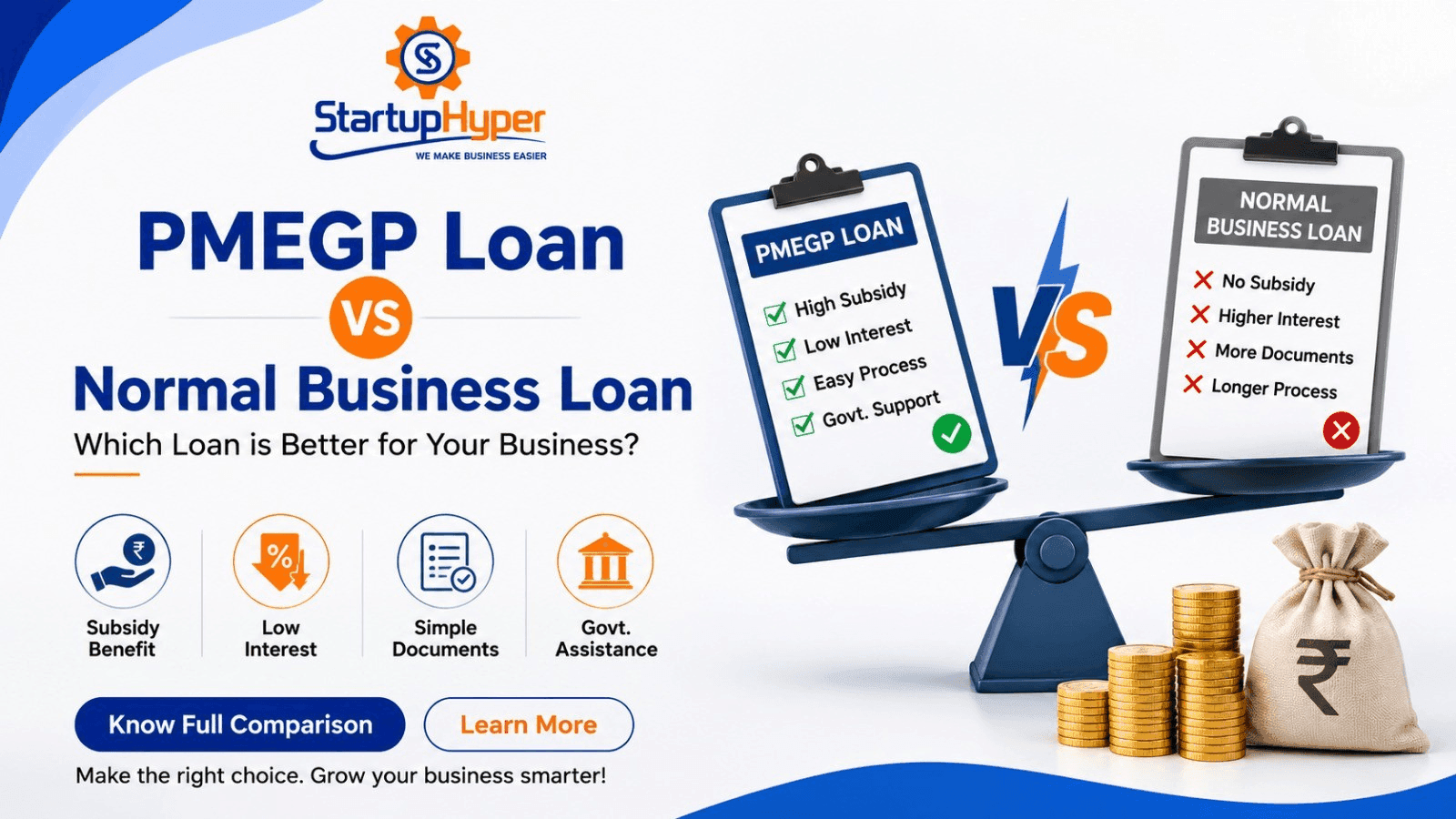
Many entrepreneurs are confused between PMEGP and Mudra Loan.
| PMEGP Loan | Mudra Loan |
|---|---|
| Credit-linked subsidy scheme | Business loan scheme |
| Government subsidy available (subject to eligibility) | No subsidy under Mudra |
| Primarily for new enterprises | Suitable for new as well as existing eligible businesses, depending on the lender and purpose |
| Maximum project cost under PMEGP guidelines | Loan amount depends on Mudra category and lender assessment |
| Own contribution required | Depends on bank policies |
If you are planning to start a new manufacturing business, PMEGP may be a more suitable option because of the subsidy benefit, provided you meet all eligibility conditions.

Applying for a PMEGP loan is not just about filling out an online application. A strong project proposal, accurate machinery quotations and proper business planning can significantly improve your chances of approval.
StartupHyper helps entrepreneurs by providing guidance on:
Whether you are planning to start a spice processing unit, flour mill, cold pressed oil plant, honey processing business, notebook manufacturing unit, paper cup business, plastic recycling plant or any other manufacturing project, StartupHyper can help you understand the machinery and project requirements before applying for PMEGP.
PMEGP is a credit-linked subsidy scheme launched by the Government of India to help entrepreneurs start new manufacturing and service businesses.
PMEGP combines a bank loan with a government subsidy. It is not a free loan.
Manufacturing Sector – Up to ₹50 lakh Service Sector – Up to ₹20 lakh
Individuals above 18 years of age and eligible organizations planning to establish a new enterprise can apply, subject to the scheme guidelines.
No. PMEGP is generally meant for new business ventures.
Collateral requirements depend on RBI guidelines and the lending bank's policies. Applicants should confirm the latest requirements with their bank.
Yes. A Detailed Project Report (DPR) is one of the most important documents for loan appraisal.
Yes. Machinery and equipment can be included in the approved project cost.
The timeline varies depending on document verification, agency scrutiny, bank appraisal and completion of the required formalities.
PMEGP loans are processed through participating public sector banks, private sector banks (where applicable), Regional Rural Banks (RRBs), cooperative banks (where eligible) and other approved financial institutions.
Yes. Applications are submitted through the official PMEGP online portal.
For manufacturing projects, machinery quotations are generally required as part of the project appraisal process.
The Prime Minister's Employment Generation Programme (PMEGP) remains one of the most beneficial government schemes for first-time entrepreneurs looking to start a manufacturing or service business. With project costs of up to ₹50 lakh for manufacturing and ₹20 lakh for service businesses, along with a government subsidy of 15% to 35% for eligible applicants, the scheme helps reduce the financial burden of setting up a new enterprise.
However, getting approval is not just about submitting an application. A clear business idea, a well-prepared DPR, accurate machinery quotations, complete documentation and realistic financial planning are all essential for a successful application. Taking the time to prepare these documents properly can significantly improve your chances of loan approval.
If you are planning to start a manufacturing business under PMEGP—such as a spice processing unit, flour mill, honey processing plant, cold pressed oil unit, notebook manufacturing unit, plastic recycling plant or e-waste recycling business—understanding the scheme and preparing your project carefully can help you make the most of this government initiative.
With the right planning and execution, PMEGP can become the foundation for building a sustainable and profitable business.
📞Call / WhatsApp: 9472093913
📧Email: info@startuphyper.com
🌐 Website: www.startuphyper.com | www.machinehai.com
🏢 Branches: Patna | Gaya | Katihar | Saharsa
Sep 15, 2026
Stay updated with the latest tips, trends, and best practices in factory setup and machinery procurement—subscribe to the StartupHyper newsletter!
No spam, we promise. Your inbox is safe with us—only valuable insights.