Read the full article to gain deeper insights and comprehensive information.

Jul 28, 2026
0
Learn how to start an Ice Cream Making Business in India. Discover investment, ice cream manufacturing machines, production process, profit margin, licenses, government schemes, and complete factory setup guide.
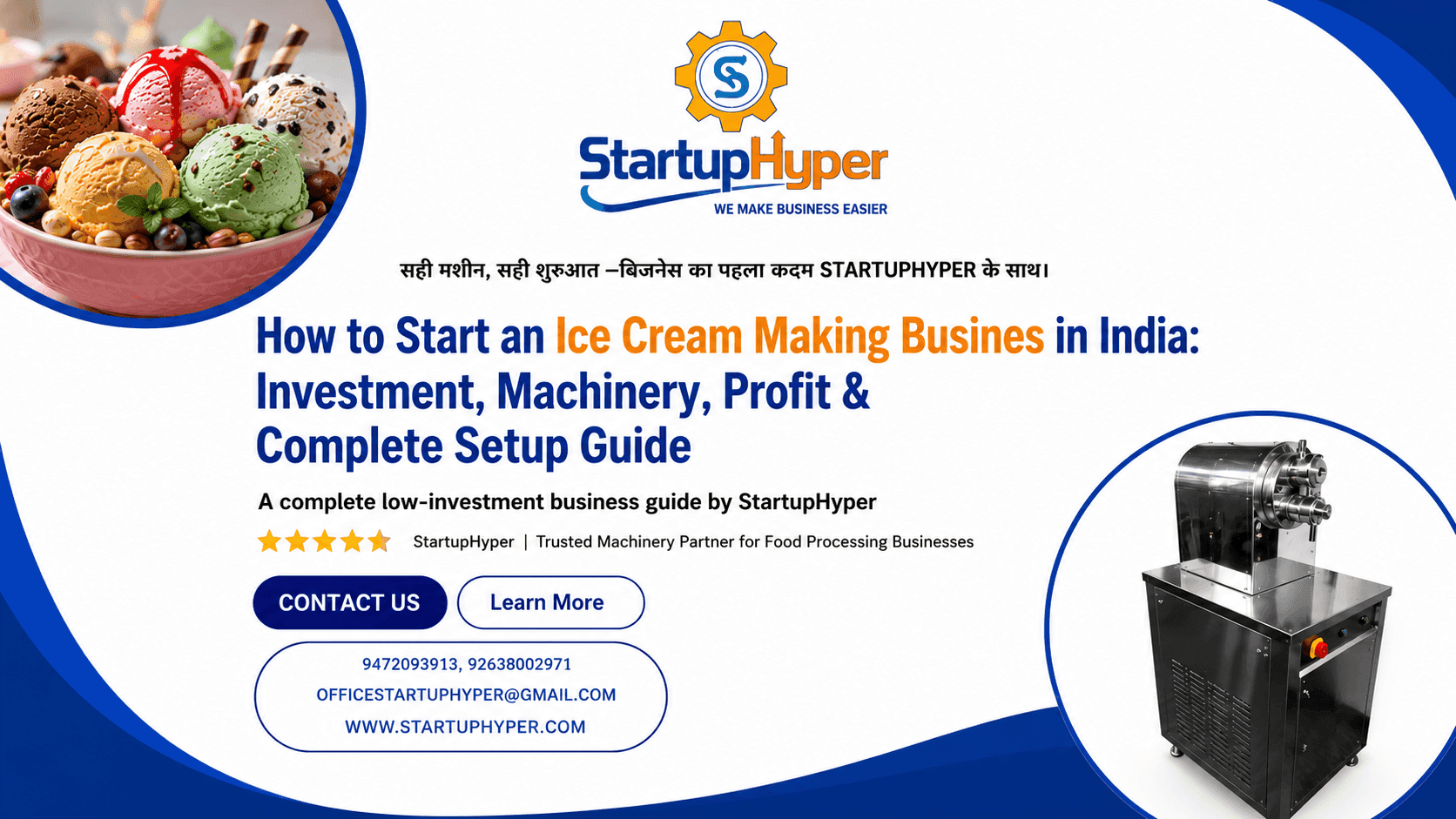
An Ice Cream Making Business is a food manufacturing business that involves producing different varieties of ice cream using ingredients such as milk, cream, sugar, stabilizers, flavors, fruits, nuts, and chocolate. The finished products are packed and supplied to retailers, distributors, supermarkets, restaurants, cafés, and consumers.
Ice cream is one of the fastest-growing segments in India's food processing industry. Increasing disposable income, changing consumer preferences, urbanization, and the growing popularity of premium and healthy ice cream products have created significant opportunities for entrepreneurs.
Depending on your investment and production capacity, you can start a Small-Scale Ice Cream Manufacturing Unit, a Semi-Automatic Plant, or a Fully Automatic Ice Cream Production Plant.
Besides traditional ice cream, manufacturers can also produce frozen desserts, kulfi, soft serve mixes, and premium handcrafted ice creams to serve different market segments.
The Indian ice cream industry continues to grow every year due to rising demand across all age groups. Seasonal demand remains high during summer, while premium ice creams, frozen desserts, and family packs generate year-round sales.
Some of the major advantages of starting an Ice Cream Manufacturing Business include:
With proper quality control and an efficient distribution network, an ice cream business can become a profitable long-term manufacturing venture.
India's ice cream market has witnessed steady growth over the past decade due to changing lifestyles, increasing purchasing power, and the rapid expansion of organized retail.
Major demand comes from:
Family packs, cups, cones, and sticks are popular among household consumers throughout the country.
Hotels, cafés, dessert parlors, and restaurants regularly purchase premium ice cream products.
Modern retail chains stock multiple ice cream brands throughout the year.
Food delivery platforms and quick commerce apps have significantly increased consumer access to ice cream products.
Schools, colleges, hospitals, catering companies, and event organizers often purchase ice cream in bulk.
Summer seasons, weddings, festivals, birthdays, and celebrations create additional sales opportunities for manufacturers.
As consumers continue to seek new flavors, healthier alternatives, and premium products, the Indian ice cream market is expected to witness further growth.
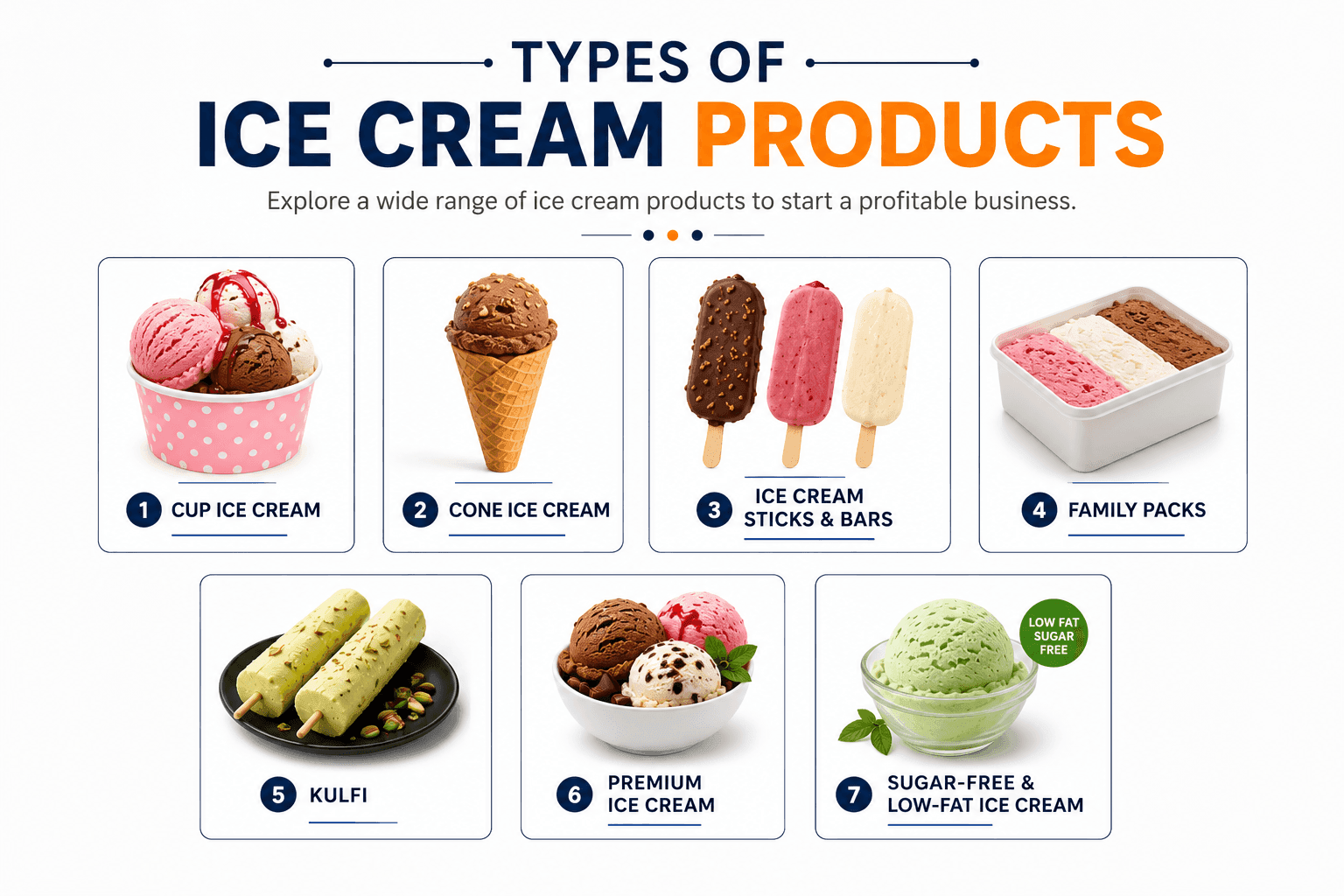
An Ice Cream Manufacturing Plant can produce a wide range of products depending on market demand.
One of the most popular products available in multiple flavors and sizes.
Suitable for:
Ice cream served in edible cones remains highly popular among children and young consumers.
These products include chocolate-coated bars, fruit sticks, and premium frozen treats.
Available in larger quantities for household consumption.
Common pack sizes include:
Traditional Indian frozen dessert available in:
Manufactured using high-quality ingredients such as:
Premium products generally offer higher profit margins.
Health-conscious consumers increasingly prefer low-calorie and sugar-free ice cream products, creating a growing niche market.
The total investment depends on production capacity, machinery, automation level, cold storage requirements, and factory infrastructure.
| Business Type | Estimated Investment |
|---|---|
| Small Manufacturing Unit | ₹10 lakh – ₹25 lakh |
| Semi-Automatic Plant | ₹25 lakh – ₹75 lakh |
| Fully Automatic Plant | ₹75 lakh – ₹5 crore+ |
Note: Actual investment varies depending on machinery specifications, production capacity, cold storage facilities, utilities, land costs, and local market conditions.
Several factors influence the total cost of setting up an Ice Cream Manufacturing Plant.
Higher production requires larger processing equipment, cold storage facilities, and increased working capital.
Fully automatic production lines require higher investment but offer greater efficiency, consistent quality, and lower labor costs.
High-quality machinery improves productivity, hygiene, product consistency, and long-term operational efficiency.
Ice cream manufacturing requires reliable cold storage and refrigerated transportation, making refrigeration one of the largest investments.
Land prices, electricity availability, water supply, and transportation facilities directly affect setup costs.
Manufacturing multiple product categories such as cones, cups, kulfi, and family packs requires additional molds, packaging equipment, and production lines.
Businesses planning to sell under their own brand should also budget for attractive packaging, labeling, marketing, and brand promotion.
Choosing the right machinery is one of the most important steps in setting up an Ice Cream Making Business. The quality of your machines directly affects production capacity, product consistency, hygiene standards, and overall profitability.
Depending on your budget and business goals, you can establish a Semi-Automatic or Fully Automatic Ice Cream Manufacturing Plant.
Below are the essential machines required for an ice cream production unit.
Milk is the primary raw material used in ice cream manufacturing.
A Milk Storage Tank stores fresh milk under hygienic conditions before processing begins.
Its benefits include:
Pasteurization is one of the most important steps in ice cream manufacturing.
A Milk Pasteurizer heats the milk to a specific temperature and then rapidly cools it to destroy harmful microorganisms while preserving its nutritional value.
Benefits include:
A Homogenizer breaks down fat particles into smaller sizes, ensuring they are evenly distributed throughout the ice cream mix.
This process improves:
In this tank, all ingredients are blended together, including:
Proper mixing ensures a uniform ice cream base before freezing.
After mixing, the prepared ice cream mix is transferred to an Aging Tank.
The mixture is stored under controlled temperatures for several hours to improve texture, whipping properties, and overall product quality.
This is the heart of an Ice Cream Manufacturing Plant.
The freezer freezes the prepared mix while simultaneously incorporating air (overrun), giving ice cream its soft, creamy texture.
Depending on production capacity, manufacturers use:
For manufacturing multiple flavors, a Flavor Dosing System adds ingredients such as:
This ensures accurate flavor consistency across every batch.
The Filling Machine automatically fills ice cream into different packaging formats such as:
Automatic filling increases speed while reducing product wastage.
For cup ice cream, a sealing machine applies lids or sealing films to ensure product hygiene and prevent contamination.
Benefits include:
Freshly filled ice cream is transferred to a Hardening Chamber, where it is rapidly frozen to achieve the desired hardness and texture.
Proper hardening helps maintain product quality during storage and transportation.
Since ice cream is a frozen product, a Cold Storage Room is essential.
It stores finished products at low temperatures until they are dispatched to customers.
Proper cold storage prevents melting and maintains product quality.
Large manufacturers often use refrigerated vehicles to transport ice cream while maintaining the required temperature throughout the supply chain.
For branded products, automatic packaging and labeling machines help:
A Water Chilling Plant provides chilled water for various stages of production and helps maintain the required processing temperatures.
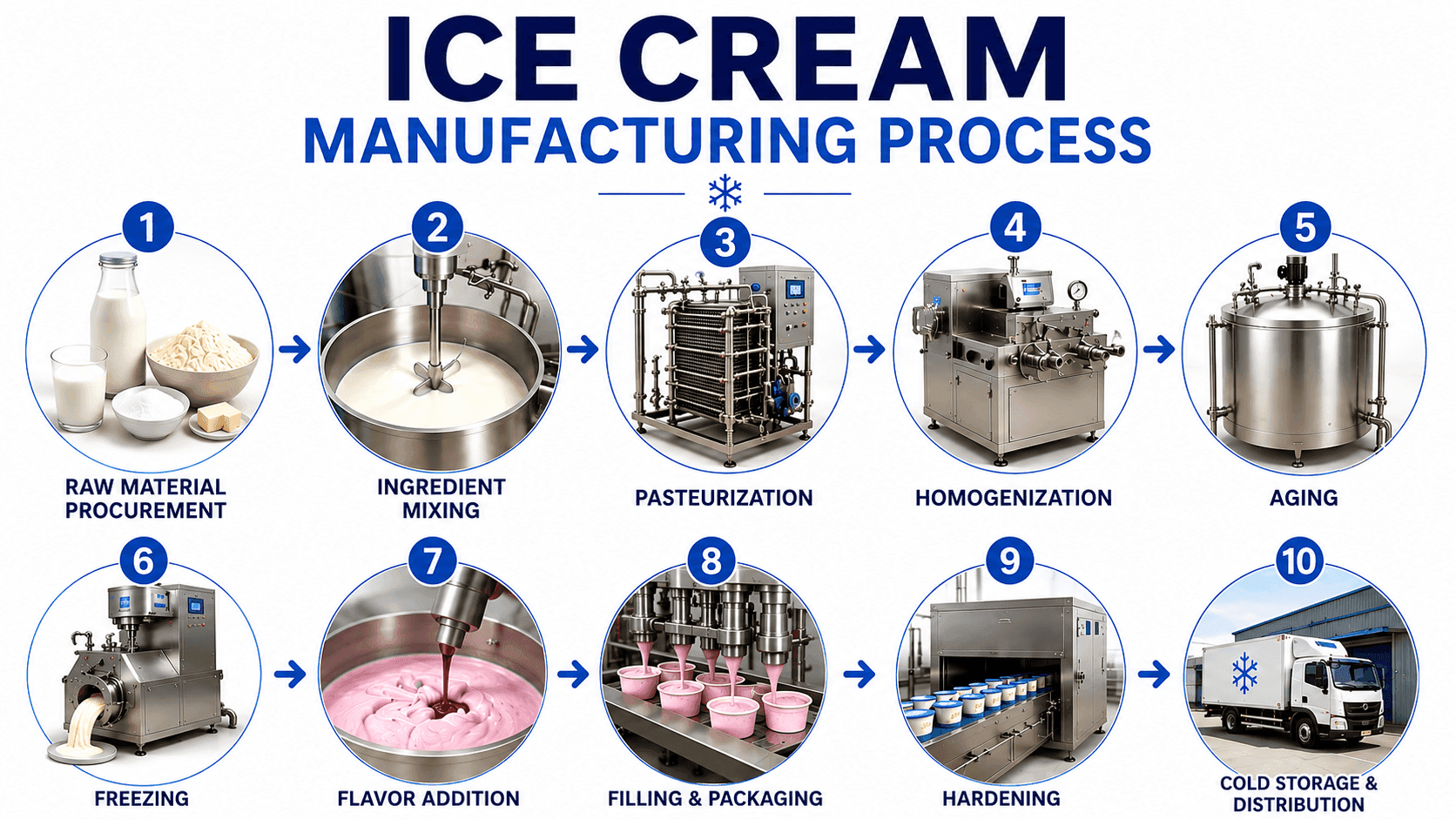
Ice cream production follows a carefully controlled manufacturing process to ensure product quality, hygiene, and consistency.
High-quality raw materials such as milk, cream, sugar, stabilizers, flavors, fruits, nuts, and chocolate are sourced from reliable suppliers.
The ingredients are measured accurately and mixed in the Mix Preparation Tank until a uniform mixture is obtained.
The mixture is pasteurized to eliminate harmful bacteria and improve product safety.
The pasteurized mix passes through a homogenizer to create a smooth and creamy texture.
The homogenized mixture is stored in an Aging Tank under controlled temperatures for several hours.
This improves the body and texture of the final product.
The aged mix enters the Batch or Continuous Freezer, where it is partially frozen and air is incorporated into the product.
Flavors, fruit pieces, chocolate chips, nuts, or other ingredients are added according to the product being manufactured.
The finished ice cream is filled into:
Packaging is then sealed automatically.
Packed products are transferred to the Hardening Chamber, where they are frozen rapidly to achieve the desired firmness.
The finished products are stored in Cold Storage before being transported through a refrigerated supply chain to distributors, retailers, supermarkets, restaurants, and consumers.
The land required depends on production capacity and plant size.
| Business Type | Approximate Land Requirement |
|---|---|
| Small Unit | 2,000–4,000 sq. ft. |
| Semi-Automatic Plant | 5,000–10,000 sq. ft. |
| Fully Automatic Plant | 15,000–30,000+ sq. ft. |
Since ice cream is a food product, obtaining the required licenses is essential before starting production.
Choose a suitable business structure:
An FSSAI License is mandatory for manufacturing and selling ice cream in India.
GST registration is required if your business meets the applicable legal requirements.
MSME registration helps eligible businesses access government schemes, subsidies, and financial assistance.
Manufacturing units covered under applicable factory laws may require a Factory License.
Depending on plant size and state regulations, approval from the State Pollution Control Board may be required.
Large manufacturing units may need Fire Safety Clearance as per local regulations.
Entrepreneurs can explore various government schemes to support manufacturing businesses.
Eligible entrepreneurs may receive financial assistance and subsidy for setting up manufacturing units under PMEGP.
MSME registration provides access to:
Eligible MSMEs can apply for collateral-free business loans under the CGTMSE scheme, subject to the scheme's eligibility criteria.
Conduct detailed market research to understand customer preferences, competitors, and demand in your target region.
Prepare a comprehensive Ice Cream Manufacturing Business Plan, including investment, production capacity, machinery, target customers, and marketing strategy.
Select a factory location with reliable electricity, clean water, road connectivity, and sufficient space for production and cold storage.
Complete all required registrations, licenses, and statutory approvals before starting operations.
Purchase high-quality machinery suitable for your production capacity and future expansion plans.
Install the equipment, conduct trial production, and implement strict quality control procedures.
Build a distribution network by supplying products to distributors, supermarkets, retail stores, restaurants, cafés, hotels, and online delivery partners.
The Ice Cream Making Business is one of the fastest-growing segments in India's food processing industry. Rising disposable incomes, changing consumer preferences, urbanization, and the growing popularity of premium ice cream have created excellent opportunities for entrepreneurs.
Although ice cream sales usually increase during the summer months, products such as family packs, premium ice creams, kulfi, frozen desserts, and institutional supplies help generate business throughout the year.
With proper quality control and an efficient cold chain, an ice cream manufacturing business can generate stable long-term profits.
| Business Type | Estimated Monthly Revenue |
|---|---|
| Small Manufacturing Unit | ₹8 lakh – ₹20 lakh |
| Semi-Automatic Plant | ₹20 lakh – ₹60 lakh |
| Fully Automatic Plant | ₹60 lakh – ₹3 crore+ |
Note: Actual revenue and profit depend on production capacity, product pricing, operating expenses, raw material costs, seasonal demand, and sales volume.
Increasing production alone does not guarantee higher profits. A well-planned business strategy can significantly improve your margins.
The taste and texture of ice cream depend heavily on the quality of ingredients.
Use premium-quality:
Better ingredients improve customer satisfaction and encourage repeat purchases.
Modern ice cream manufacturing machines offer:
This helps increase profitability over the long term.
Instead of manufacturing only one product, consider offering:
A wider product range helps attract different customer segments.
Selling under your own brand can provide significantly better profit margins than manufacturing for third parties.
Invest in:
A strong brand also improves customer loyalty.
Consistent sales depend on reliable distribution.
Target:
A larger distribution network increases sales throughout the year.
Maintaining the proper storage and transportation temperature is essential.
A reliable cold chain:
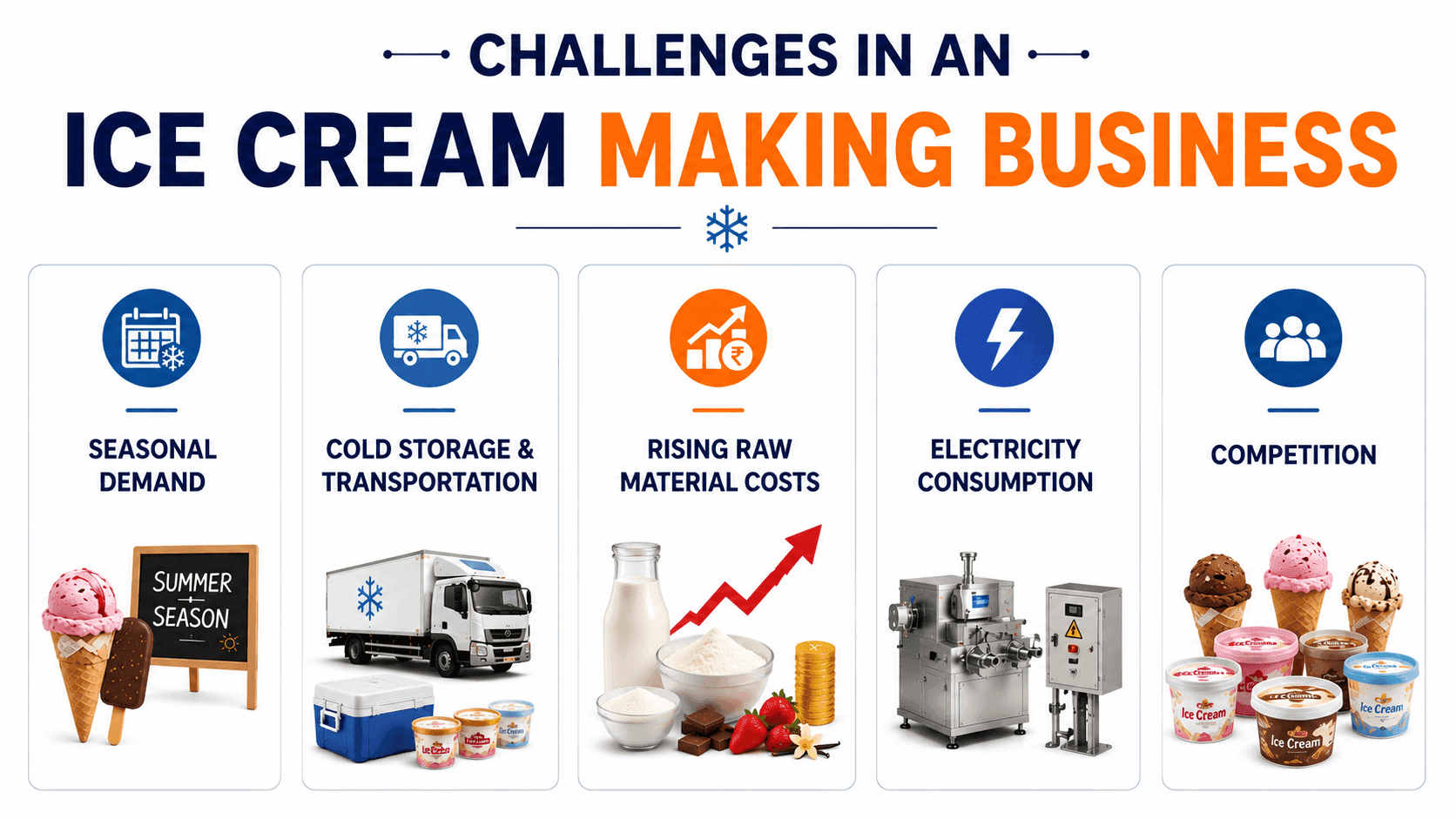
Like every food manufacturing business, ice cream production also presents several operational challenges.
Sales are generally highest during summer and may decline during winter in many regions.
Businesses can reduce seasonal fluctuations by introducing products like kulfi, frozen desserts, and premium ice creams.
Ice cream requires uninterrupted refrigeration throughout production, storage, and transportation.
Any interruption can lead to product loss.
Prices of milk, cream, sugar, dry fruits, cocoa, and packaging materials can fluctuate and affect profitability.
Cold storage units, refrigeration systems, and freezers consume significant electricity.
Using energy-efficient equipment can help reduce operating costs.
The market includes both national brands and regional manufacturers.
Businesses that focus on quality, innovation, attractive packaging, and customer service are better positioned to compete.
Strong marketing is essential for building a successful ice cream brand.
A strong digital presence helps expand your customer reach.
Recommended strategies include:

Starting an Ice Cream Manufacturing Business requires more than purchasing machinery. Proper planning, factory design, regulatory compliance, and technical guidance are equally important.
At StartupHyper, we help entrepreneurs build successful manufacturing businesses through end-to-end business consultation.
Whether you are planning a small manufacturing unit or a fully automatic ice cream plant, StartupHyper can help you make informed business decisions.
The investment typically ranges from ₹10 lakh for a small manufacturing unit to ₹5 crore or more for a fully automatic ice cream manufacturing plant, depending on production capacity and machinery.
Yes. Ice cream has strong consumer demand in India, and manufacturers can improve profitability through efficient production, effective branding, and a robust distribution network.
The primary raw materials include:
Potential customers include:
Depending on your business structure and operations, you may require:
Yes. Many entrepreneurs begin with a small or semi-automatic production unit and gradually expand as demand grows.
Yes. Most modern ice cream manufacturing plants can produce multiple flavors by changing ingredients and following proper cleaning and quality control procedures between batches.
The Ice Cream Making Business is a promising opportunity for entrepreneurs looking to enter India's rapidly growing food processing industry. With increasing demand for premium products, innovative flavors, healthier alternatives, and convenient packaging, the market offers significant growth potential.
Success in this business depends on selecting high-quality machinery, maintaining strict hygiene standards, sourcing premium raw materials, establishing a reliable cold chain, and building a strong distribution network. Investing in branding, product innovation, and digital marketing can further enhance profitability and long-term business growth.
If you are planning to start an Ice Cream Making Business, having the right guidance can simplify the setup process and help you avoid costly mistakes. From machinery selection and project planning to factory setup, government scheme guidance, and business consultation, StartupHyper can support you at every stage of building a successful ice cream manufacturing business.
📞Call / WhatsApp: 9472093913
📧Email: info@startuphyper.com
🌐 Website: www.startuphyper.com | www.machinehai.com
🏢 Branches: Patna | Gaya | Katihar | Saharsa
Stay updated with the latest tips, trends, and best practices in factory setup and machinery procurement—subscribe to the StartupHyper newsletter!
No spam, we promise. Your inbox is safe with us—only valuable insights.