Read the full article to gain deeper insights and comprehensive information.

Jul 27, 2026
0
Learn how to start a Kulhad Making Business in India. Discover investment, kulhad making machines, manufacturing process, profit margin, licenses, government schemes, and complete factory setup guide.

A Kulhad Making Business involves manufacturing traditional clay cups (Kulhads) that are widely used for serving tea, coffee, lassi, buttermilk, desserts, and other beverages. Kulhads are made from natural clay and are biodegradable, making them an environmentally friendly alternative to plastic and paper cups.
With growing awareness about sustainable products and government initiatives to reduce single-use plastic, the demand for clay-based disposable products has increased significantly across India.
Kulhad manufacturing can be started as a small-scale, semi-automatic, or fully automatic manufacturing business, depending on your investment and production capacity.
Apart from tea stalls, kulhads are also used by:
This makes it a business with strong long-term growth potential.
The popularity of eco-friendly products has created excellent opportunities for entrepreneurs in the clay product manufacturing industry.
Some of the major advantages of starting a Kulhad Making Business include:
With proper planning and quality production, a Kulhad Manufacturing Business can become a profitable long-term venture.
The demand for kulhads has grown rapidly in recent years due to changing consumer preferences and environmental awareness.
Several factors are driving this growth:
Many states in India have imposed restrictions on single-use plastic products, encouraging businesses to adopt eco-friendly alternatives like clay kulhads.
Tea cafés, roadside tea stalls, coffee shops, and premium beverage brands increasingly prefer serving drinks in kulhads because they provide a traditional and authentic customer experience.
Government departments and public organizations have promoted the use of clay products in various sectors to support local artisans and reduce plastic waste.
Hotels, resorts, restaurants, and event planners are increasingly using kulhads to offer customers a unique and eco-friendly serving experience.
Handmade and machine-made clay products have growing demand in international markets where consumers prefer sustainable and biodegradable products.
As environmental awareness continues to increase, the market for kulhads is expected to grow further in the coming years.
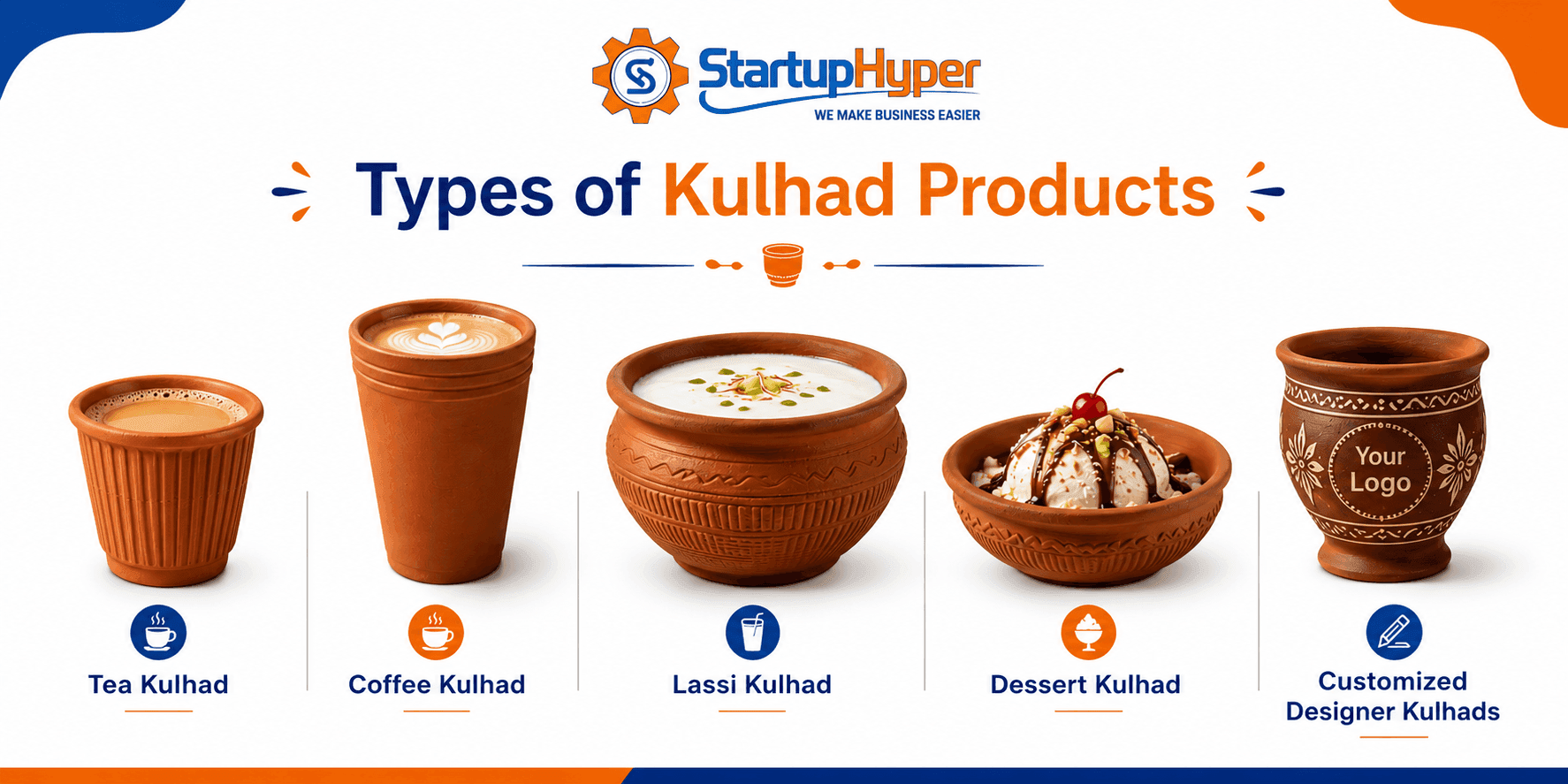
A Kulhad Manufacturing Unit can produce a variety of clay products based on customer demand.
These are the most commonly used clay cups for serving tea at tea stalls, cafés, and railway stations.
Common Sizes:
Designed for serving coffee, these kulhads are generally thicker and available in premium designs.
Suitable for:
These are larger clay cups used for serving:
These products are highly popular in sweet shops and restaurants.
Many businesses order customized kulhads with:
These products generally offer higher profit margins than standard kulhads.
The total investment depends on several factors such as production capacity, automation level, machinery quality, and factory setup.
| Business Type | Estimated Investment |
|---|---|
| Small Manual Unit | $2,500–$6,000 |
| Semi-Automatic Unit | $6,000–$24,000 |
| Fully Automatic Plant | $24,000–$120,000+ |
Note: The actual investment may vary depending on machine specifications, production capacity, land, utilities, and local market conditions.
The overall cost of setting up a Kulhad Manufacturing Plant depends on several important factors.
Higher production capacity requires larger machinery, additional storage space, and more working capital.
Fully automatic machines reduce labor requirements and increase production but require a higher initial investment than manual or semi-automatic units.
Investing in reliable and high-quality machines can improve product consistency, reduce maintenance costs, and increase long-term productivity.
The total setup cost depends on whether you own or lease the land, along with expenses for factory construction, electricity, water supply, and storage facilities.
Easy access to quality clay reduces transportation costs and helps maintain consistent production.
The type of drying system and kiln used for firing kulhads significantly impacts the initial investment and production efficiency.
Businesses that sell branded kulhads may require additional investment in packaging materials, labeling, and printing.
Selecting the right machinery is one of the most important decisions when setting up a Kulhad Making Business. The machines you choose directly impact production capacity, product quality, labor requirements, and overall profitability.
Depending on your budget and business goals, you can start with a Semi-Automatic or Fully Automatic Kulhad Manufacturing Plant.
Below are the essential machines used in a modern kulhad manufacturing unit.
The manufacturing process begins with preparing the raw clay.
A Clay Mixer Machine mixes clay with the required amount of water to create a smooth and uniform mixture suitable for molding.
Its benefits include:
After mixing, the clay passes through a Pug Mill Machine, which removes air pockets and further kneads the clay.
This process improves the strength and plasticity of the clay, making it easier to mold into kulhads.
Advantages include:
Better clay texture Fewer cracks during drying Improved molding efficiency
This is the core machine of the manufacturing plant.
A Kulhad Making Machine compresses prepared clay into the desired shape and size using specially designed molds.
Depending on the machine model, it can produce various types of clay products, including:
Automatic machines provide:
Some manufacturers use a hydraulic press to produce thicker and premium-quality kulhads with better finishing.
This machine is especially useful for designer and customized clay products.
Different molds are required to manufacture kulhads in various sizes and designs.
Common mold types include:
Businesses can easily expand their product range by adding new molds.
Freshly molded kulhads contain moisture and must be dried before firing.
A drying chamber helps:
Small manufacturers may also use natural sunlight for drying.
A Kiln is one of the most important pieces of equipment in the manufacturing process.
It fires the dried kulhads at high temperatures, giving them strength, durability, and the traditional terracotta finish.
Common kiln options include:
The choice depends on production capacity, fuel availability, and operating costs.
After firing, the kulhads are inspected and cleaned before packaging.
This stage may include:
High-quality finishing improves customer satisfaction and brand reputation.
Large-scale manufacturers often use packaging machines for faster and more efficient packing.
These machines help:
Some automatic machines require an air compressor to operate pneumatic systems efficiently.
The required compressor capacity depends on the machine specifications.
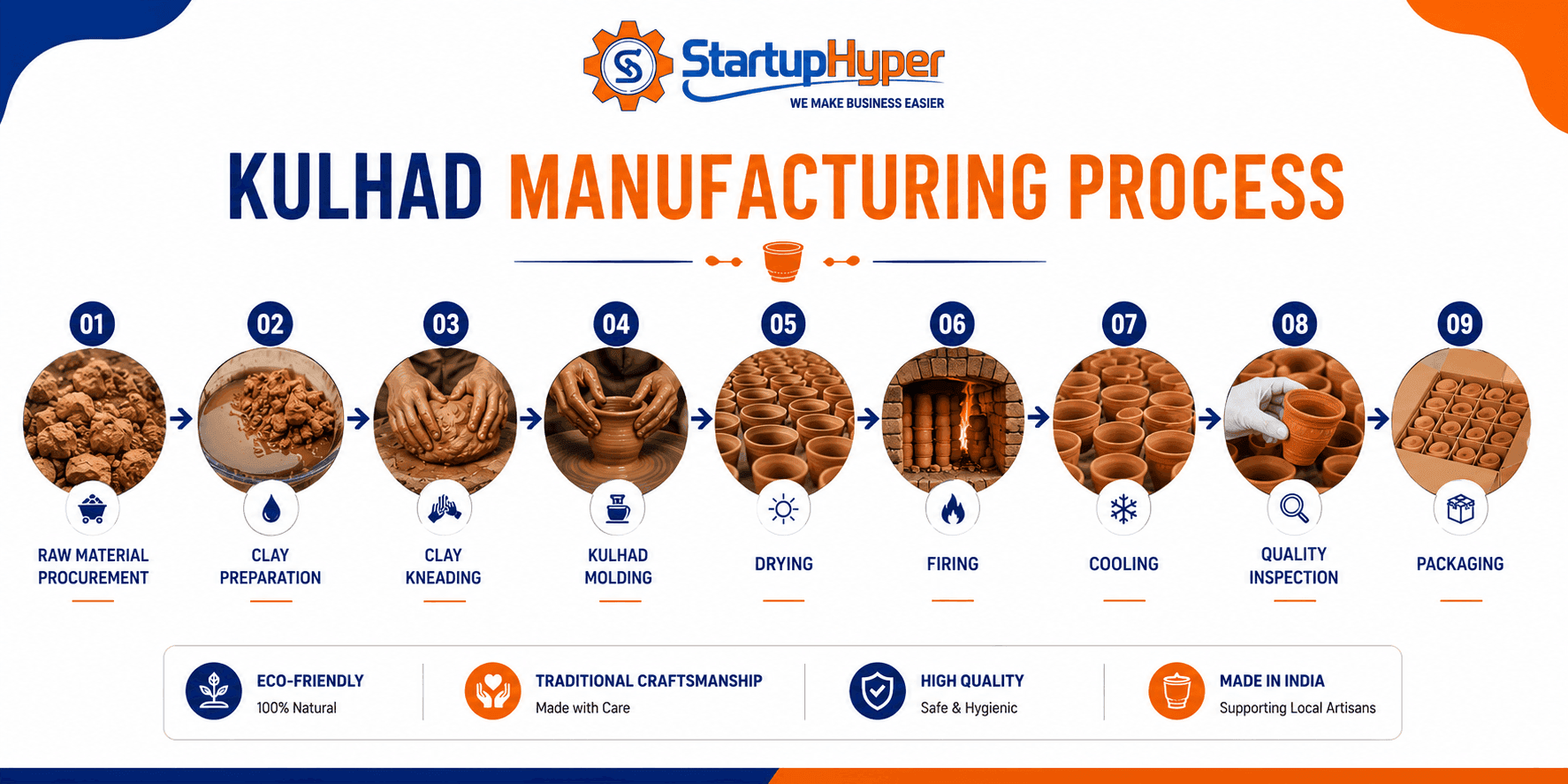
The production of kulhads follows a systematic manufacturing process to ensure consistent quality and durability.
The first step is sourcing high-quality natural clay from reliable suppliers.
The quality of clay directly affects the strength, finish, and appearance of the final product.
The clay is cleaned to remove stones, roots, and other impurities.
Water is then added, and the clay is thoroughly mixed using a Clay Mixer Machine.
The prepared clay passes through a Pug Mill Machine to remove trapped air and achieve a smooth, uniform texture.
The clay is fed into the Kulhad Making Machine, where molds shape it into the required size and design.
The molded kulhads are dried naturally or in a drying chamber until most of the moisture is removed.
Proper drying helps prevent cracks during firing.
The dried kulhads are fired inside a kiln at high temperatures.
This process hardens the clay and gives the products their final strength and durability.
After firing, the kulhads are cooled gradually to prevent thermal shock and cracking.
Each batch is checked for:
Defective products are removed before packaging.
Finished kulhads are packed according to customer requirements and prepared for transportation to wholesalers, retailers, cafés, restaurants, and distributors.
The required land depends on the scale of production and the level of automation.
| Business Type | Approximate Land Requirement |
|---|---|
| Small Unit | 800–1,500 sq. ft. |
| Semi-Automatic Unit | 2,000–4,000 sq. ft. |
| Fully Automatic Plant | 5,000–10,000+ sq. ft. |
Before starting your Kulhad Manufacturing Business, complete the necessary registrations and licenses as applicable in your state.
Choose a suitable business structure such as:
Registering as an MSME allows eligible businesses to access government schemes, financial assistance, and various business benefits.
GST registration may be required depending on your business turnover and applicable tax regulations.
A Trade License may be required from your local municipal authority before commencing operations.
If your manufacturing unit falls under applicable factory regulations, obtaining a Factory License may be mandatory.
Since clay processing and kiln operations may have environmental implications, approvals from the State Pollution Control Board may be required depending on your plant size and local regulations.
Larger manufacturing facilities may need fire safety compliance based on local laws.
Entrepreneurs may be eligible for financial assistance under various government schemes.
Eligible entrepreneurs may receive financial assistance and subsidy for setting up manufacturing units under the PMEGP scheme.
MSME registration can help businesses access:
Eligible MSMEs can apply for collateral-free loans under the Credit Guarantee Fund Trust for Micro and Small Enterprises (CGTMSE), subject to scheme guidelines.
Conduct market research to understand local demand, competitors, and potential customers.
Prepare a detailed Kulhad Manufacturing Business Plan, including investment, production capacity, machinery, and target market.
Choose a suitable factory location with access to electricity, water, transportation, and quality clay.
Complete all required registrations, licenses, and approvals before starting production.
Purchase reliable machinery based on your production requirements and future expansion plans.
Install the machines, conduct trial production, and implement quality control measures.
Develop a sales network by supplying kulhads to wholesalers, tea cafés, restaurants, hotels, event organizers, retailers, and distributors.
The Kulhad Making Business has emerged as a promising manufacturing opportunity due to the increasing demand for eco-friendly disposable products. As more businesses shift away from plastic and paper cups, clay kulhads are becoming a preferred choice in tea shops, cafés, restaurants, hotels, and event catering.
The profitability of this business depends on several factors, including:
Manufacturers who focus on consistent quality and establish a strong customer base often enjoy steady business throughout the year.
| Business Type | Estimated Monthly Revenue |
|---|---|
| Small Unit | $2,000–$6,000 |
| Semi-Automatic Unit | $6,000–$24,000 |
| Fully Automatic Plant | $24,000–$120,000+ |
Note: Actual revenue and profit depend on production capacity, product pricing, operating costs, market demand, and order volume.
A profitable kulhad manufacturing business is not just about producing more—it is also about improving efficiency, reducing costs, and expanding your customer base.
Good-quality clay produces stronger, smoother, and more durable kulhads with fewer defects.
This helps reduce wastage and improves customer satisfaction.
Modern machines offer:
Higher production efficiency leads to better profit margins.
Instead of manufacturing only tea kulhads, consider producing:
A wider product range helps attract more customers and generate additional revenue.
Many businesses prefer customized kulhads with their logo or branding.
Offering customized products can significantly improve your profit margin while helping customers strengthen their own brand identity.
Large and repeat orders help maintain consistent production.
Target customers such as:
Avoid relying on a single source of income.
Sell through:
Diversifying your sales channels reduces business risk and improves revenue stability.
Like any manufacturing business, kulhad production also comes with operational challenges.
Poor-quality clay may result in cracked or weak products.
Maintaining a reliable raw material supply is essential for consistent production.
Kulhads are fragile, making proper handling, packaging, and transportation critical to minimizing losses.
Natural drying becomes slower during the rainy season or in humid climates.
Many manufacturers address this challenge by using drying chambers.
Kilns require fuel or electricity, making energy costs a significant operating expense.
Using energy-efficient equipment can help reduce production costs.
Competition from local manufacturers and alternative disposable products can impact pricing.
Businesses that focus on quality, branding, and customer service are better positioned to stand out.
Effective marketing is essential to building a successful kulhad manufacturing brand.
A strong online presence can help you reach customers across India.
Recommended strategies include:

Starting a manufacturing business requires more than just purchasing machinery. Proper planning, technical guidance, and the right business strategy are equally important.
At StartupHyper, we help entrepreneurs establish successful manufacturing businesses by providing end-to-end consultation.
Whether you are starting a small manufacturing unit or planning a fully automatic plant, StartupHyper can help you make informed business decisions.
Yes. With the growing demand for eco-friendly disposable products, kulhad manufacturing offers good business potential. Profitability depends on production efficiency, product quality, and market reach.
The investment typically ranges from $2,500 for a small unit to $120,000 or more for a fully automatic manufacturing plant, depending on production capacity and machinery.
Natural clay is the primary raw material. Water is also required during the mixing and molding process.
Potential buyers include:
Yes. Many entrepreneurs begin with a semi-automatic setup and expand production as demand increases.
Eligible entrepreneurs may apply for financial assistance under schemes such as PMEGP, Udyam (MSME), and CGTMSE, subject to the applicable eligibility criteria and scheme guidelines.
Most modern kulhad making machines support multiple sizes by changing the molds or dies, allowing manufacturers to produce a wide variety of products with the same machine.
The Kulhad Making Business is an attractive manufacturing opportunity for entrepreneurs looking to enter the growing eco-friendly products market. With rising environmental awareness, restrictions on single-use plastics, and increasing demand from tea cafés, restaurants, hotels, and event businesses, the market for clay kulhads continues to expand.
Success in this business depends on selecting the right machinery, using high-quality raw materials, maintaining consistent product quality, and building a strong distribution network. Focusing on branding, customized products, and multiple sales channels can further improve profitability and support long-term growth.
If you're planning to start a Kulhad Making Business, having the right guidance can make the setup process smoother and help you avoid costly mistakes. From machinery selection and factory planning to government scheme assistance and business consultation, StartupHyper supports entrepreneurs at every stage of building a successful manufacturing business.
📞Call / WhatsApp: 9472093913
📧Email: info@startuphyper.com
🌐 Website: www.startuphyper.com | www.machinehai.com
🏢 Branches: Patna | Gaya | Katihar | Saharsa
Stay updated with the latest tips, trends, and best practices in factory setup and machinery procurement—subscribe to the StartupHyper newsletter!
No spam, we promise. Your inbox is safe with us—only valuable insights.