Read the full article to gain deeper insights and comprehensive information.

Aug 03, 2026
0
Learn how to start a Garlic Powder Making Business in India. Discover investment, garlic powder making machines, plant cost, raw materials, manufacturing process, profit, licenses, and complete factory setup.
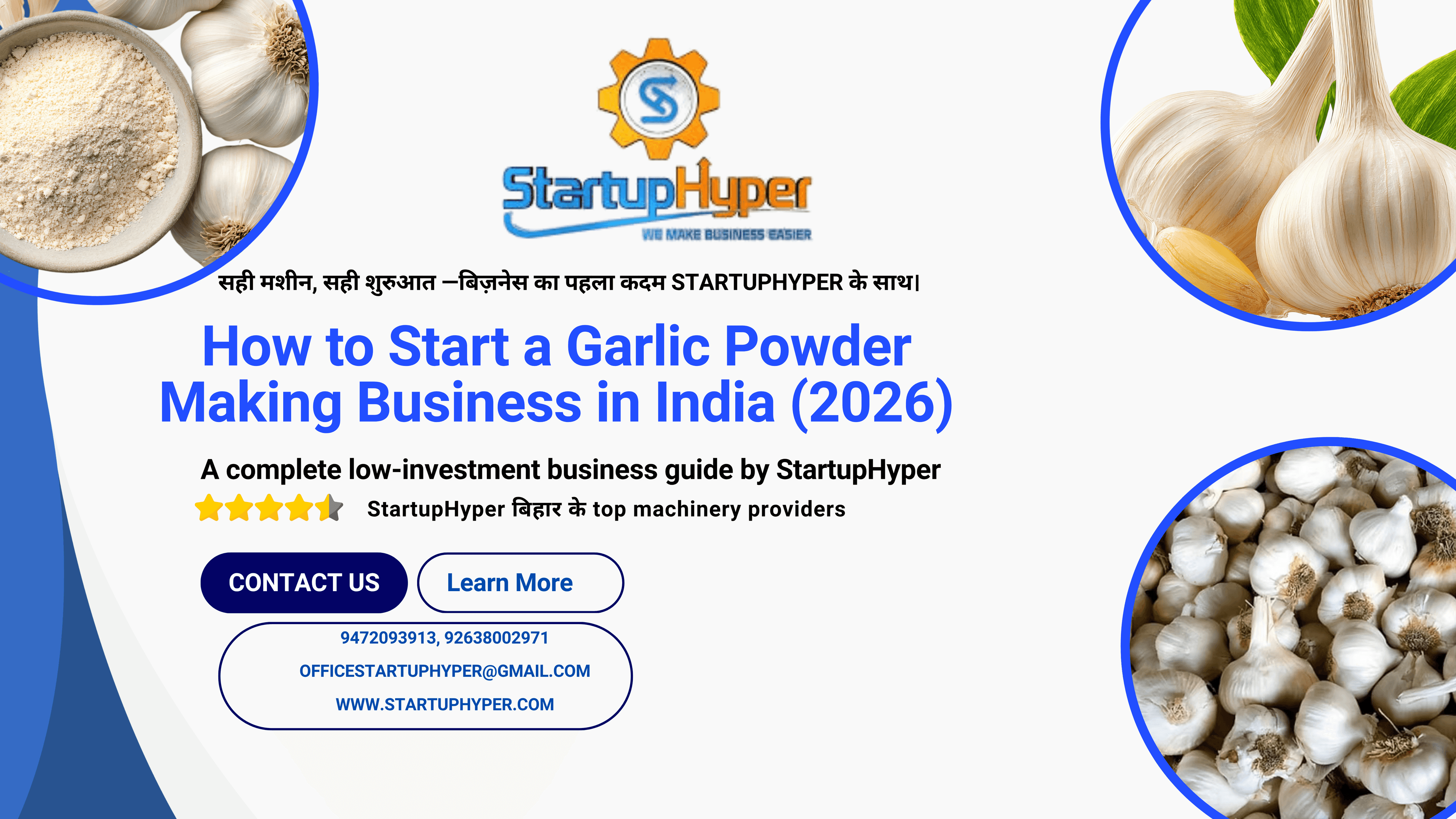
A Garlic Powder Making Businessinvolves processing fresh garlic into dehydrated garlic powder through cleaning, peeling, slicing, drying, grinding, and packaging. Garlic powder is one of the most widely used spice ingredients in the food processing industry because of its long shelf life, strong flavor, and convenience.
Unlike fresh garlic, garlic powder is easier to store, transport, and use in commercial food production. It is widely used by food manufacturers, restaurants, hotels, snack companies, seasoning manufacturers, and spice brands.
With the increasing demand for ready-to-use food ingredients and packaged spices, theGarlic Powder Manufacturing Business has become an attractive opportunity for entrepreneurs looking to enter the food processing industry.
Depending on your investment, you can start with a small-scale garlic powder unit, a semi-automatic plant, or a fully automatic garlic powder manufacturing plant
Garlic is one of the most consumed spices in India, and its processed products are gaining popularity every year. The growing food processing industry, increasing demand for convenience foods, and expansion of packaged spice brands have created excellent opportunities for garlic powder manufacturers.
Some major advantages of starting a Garlic Powder Making Business include:
• Growing demand from food processing industries
• Long shelf life compared to fresh garlic
• Easy transportation and storage
• Increasing demand in domestic and export markets
• Opportunity to supply B2B and retail customers
• Can be started on a small, medium, or large scale
• Good value addition compared to selling raw garlic
With proper quality control and efficient production, garlic powder manufacturing can become a profitable long-term business.
The demand for garlic powder has increased significantly over the last few years. Today, it is no longer used only in restaurants—it has become an essential ingredient across several food industries.
Some of the major demand drivers include:
Garlic powder is widely used in manufacturing:
• Instant foods
• Ready-to-eat meals
• Frozen foods
• Seasoning blends
• Spice mixes
• Instant noodles
• Snacks
Hotels, restaurants, cafés, and cloud kitchens prefer garlic powder because it saves preparation time while providing consistent flavor.
Many spice companies manufacture and sell garlic powder in retail packs through supermarkets, grocery stores, and online platforms.
Pizza outlets, burger chains, sandwich brands, and fried food businesses regularly use garlic powder in their recipes.
Indian garlic powder is exported to several countries where it is used in processed food manufacturing, seasoning industries, and food service businesses.
With increasing demand for processed food products, the garlic powder market is expected to continue growing in the coming years.
One of the biggest advantages of this business is that garlic powder has applications across multiple industries.
It is commonly used in:
• Spice manufacturing companies
• Snack manufacturers
• Instant food manufacturers
• Hotels and restaurants
• Bakery products
• Frozen food industry
• Pickle manufacturers
• Ready-to-cook food companies
• Sauce and seasoning manufacturers
• Export businesses
This wide range of applications ensures consistent market demand throughout the year.
A Garlic Powder Manufacturing Plant can produce multiple products depending on customer requirements.
The most common product used in homes, restaurants, and packaged spice brands.
Made from dehydrated garlic flakes, this product has a longer shelf life and is widely used in food processing industries.
Manufactured using organically grown garlic without synthetic chemicals.
The demand for organic products is increasing in both domestic and international markets.
Garlic granules are coarser than garlic powder and are commonly used in seasoning mixes, spice blends, and processed foods.
Offering multiple garlic products helps businesses serve different customer segments and improve profitability.
The investment required depends on production capacity, machinery, automation level, factory infrastructure, and packaging facilities.
| Business Type | Estimated Investment |
|---|---|
| Small Manufacturing Unit | ₹8 lakh – ₹15 lakh |
| Semi-Automatic Plant | ₹15 lakh – ₹40 lakh |
| Fully Automatic Plant | ₹40 lakh – ₹1.5 crore+ |
Note: The actual investment depends on machine capacity, production volume, land, utilities, packaging requirements, and local operating costs.
Before setting up a Garlic Powder Manufacturing Plant, it is important to estimate all major expenses instead of focusing only on all major expenses instead of focusing only on machinery costs.
Your overall investment generally includes:
| Expense | Approximate Share of Investment |
|---|---|
| Land & Factory Setup | 15–25% |
| Garlic Powder Making Machines | 30–40% |
| Raw Material (Fresh Garlic) | 10–20% |
| Packaging Material | 5–10% |
| Electrical Installation | 5–10% |
| Working Capital | 15–25% |
A detailed cost estimation helps you prepare a realistic budget and avoid unexpected expenses during the setup phase.
The total cost of setting up a Garlic Powder Manufacturing Business depends on several important factors.
Higher production requires larger machines, additional labor, more storage space, and increased working capital.
Fully automatic plants require higher initial investment but offer:
• Higher production
• Lower labor cost
• Better consistency
• Reduced wastage
Choosing reliable and high-quality machinery improves production efficiency, product quality, and long-term operational performance.
If quality garlic is available near your factory location, transportation costs can be reduced significantly.
Retail packaging generally requires higher investment than bulk industrial packaging due to additional packaging materials, labeling, and branding.
Land prices, electricity availability, water supply, and transportation facilities all influence the total setup cost.
Manufacturing multiple products such as garlic powder, garlic flakes, and garlic granules may require additional equipment and packaging systems.
The quality of your raw materials directly impacts the taste, aroma, color, shelf life, and overall quality of the final product. Therefore, selecting fresh and high-quality garlic is one of the most important steps in a Garlic Powder Making Business.
The major raw materials required include:
• Fresh Garlic
• Clean Water (for washing)
• Food-Grade Packaging Material
• Labels & Stickers
• Cartons for Bulk Packing
Among these, fresh garlic is the primary raw material and usually accounts for a significant portion of the production cost.
One of the most common questions asked by new entrepreneurs is,"Where can I buy good-quality garlic for garlic powder manufacturing?"
Choosing the right supplier helps maintain product quality, reduces wastage, and improves profitability.
Some of the best sources include:
Agricultural Produce Market Committees (APMCs) are one of the most reliable places to purchase fresh garlic in bulk.
Advantages:
• Competitive pricing
• Bulk availability
• Multiple suppliers at one location
Buying directly from garlic farmers helps reduce procurement costs and ensures a consistent supply of fresh garlic.
Long-term agreements with farmers can also protect your business from sudden price fluctuations.
Many FPOs supply high-quality garlic directly to food processing businesses.
Benefits include:
• Better quality control
• Bulk quantity availability
• Transparent pricing
Large wholesale fruit and vegetable markets are another reliable source for purchasing garlic throughout the year.
If your production volume is high, contract farming can help ensure a steady supply of garlic at negotiated prices.
Sourcing garlic from major producing states can help reduce costs and improve raw material quality.
Some of the leading garlic-producing states are:
• Madhya Pradesh
• Rajasthan
• Gujarat
• Uttar Pradesh
• Punjab
• Haryana
These states have well-established garlic markets and supply fresh garlic across India.
Before purchasing garlic in bulk, check the following:
• Uniform bulb size
• Fresh appearance
• Strong aroma
• Low moisture content
• No fungal infection
• No sprouting
• No damaged cloves
Good-quality garlic produces better garlic powder with a longer shelf life.
Choosing the right machinery is one of the most important decisions when setting up a Garlic Powder Manufacturing Plant.
The machines you select determine:
• Production capacity
• Product quality
• Labor requirement
• Power consumption
• Overall profitability
Below are the essential machines used in a garlic powder manufacturing unit.
This machine separates garlic bulbs into individual cloves before peeling.
It is useful for medium and large-scale production units.
• Saves labor
• Faster processing
• Uniform separation
This machine removes the outer skin from garlic cloves without damaging them. Advantages:
• High peeling efficiency
• Less product wastage
• Hygienic processing
• Reduced labor cost
After peeling, garlic cloves are thoroughly washed to remove dirt, dust, and impurities.
Proper washing improves hygiene and product quality.
The washed garlic is sliced into uniform pieces.
Uniform slices help achieve:
• Faster drying
• Better dehydration
• Consistent product quality
Drying is one of the most critical stages of garlic powder manufacturing.
The Garlic Dryer removes moisture from sliced garlic while preserving its flavor and color.
Common drying methods include:
• Tray Dryer
• Cabinet Dryer
• Continuous Dryer
Once the garlic is completely dried, it is ground into fine powder using a Pulverizer Machine.
The pulverizer determines:
• Powder fineness
• Production speed
• Output quality
The powdered garlic passes through a Vibro Sifter to achieve uniform particle size.
This ensures:
• Smooth texture
• Consistent quality
• Better customer satisfaction
If spices or anti-caking agents need to be mixed, a Ribbon Blender is used.
It ensures uniform mixing before packaging.
The finished garlic powder is packed using an automatic or semi-automatic packaging machine.
Packaging options include:
• 50 g
• 100 g
• 200 g
• 500 g
• 1 kg
• Bulk industrial packs
Proper packaging increases shelf life and improves product presentation.
While selecting machinery, consider the following factors instead of focusing only on price:
• Production capacity (kg/hour)
• Power consumption
• Machine build quality
• Stainless Steel (SS 304) construction for food safety
• Ease of cleaning
• Availability of spare parts
• After-sales service
• Maintenance requirements
• Future expansion possibilities
A reliable machine may have a higher initial cost but usually offers better productivity and lower maintenance expenses over time.
Garlic powder production follows a systematic process to ensure consistent quality and hygiene.
Fresh garlic is sourced from farmers, wholesale markets, or suppliers.
Damaged, rotten, or sprouted garlic bulbs are removed.
Only good-quality garlic is selected for processing.
Garlic cloves are peeled using a Garlic Peeling Machine.
The peeled cloves are washed thoroughly to remove dirt and impurities.
The garlic is cut into thin, uniform slices.
The sliced garlic is dried until the moisture content reaches the desired level.
Proper drying is essential for producing high-quality garlic powder.
The dried garlic flakes are ground into fine powder using a Pulverizer Machine.
The powder is passed through a Vibro Sifter to obtain a uniform particle size.
The finished garlic powder is packed in food-grade pouches or containers and labeled for retail or bulk sale.
Before starting a Garlic Powder Making Business, complete the necessary registrations and approvals.
Common requirements include:
• Business Registration
• FSSAI License
• GST Registration
• Udyam (MSME) Registration
• Factory License (if applicable)
• Trade License (if applicable)
• Pollution Control Approval (if applicable)
Entrepreneurs may be eligible for financial assistance under various government schemes.
Some popular options include:
• PMEGP(Prime Minister's Employment Generation Programme) for eligible manufacturing businesses.
• Udyam(MSME) Registration, which can provide access to loans, government schemes, and other business support.
• CGTMSE, which offers collateral-free loan support for eligible MSMEs through participating financial institutions.
Conduct market research to understand demand, competition, and target customers.
Prepare a detailed Garlic Powder Business Plan, including investment, machinery, production capacity, and marketing strategy.
Select a suitable factory location with access to quality raw materials, electricity, water, and transportation.
Complete all required registrations, licenses, and approvals.
Purchase reliable garlic powder making machines based on your production goals.
Install the machinery, conduct trial production, and implement quality control measures.
Develop a sales network by supplying garlic powder to spice brands, food manufacturers, wholesalers, distributors, retailers, restaurants, hotels, and export buyers.
The Garlic Powder Making Business is one of the fastest-growing segments in the food processing industry. With the increasing demand for ready-to-cook foods, packaged spices, instant food products, and seasoning blends, garlic powder has become an essential ingredient for both commercial and household use.
One of the biggest advantages of this business is value addition. Instead of selling fresh garlic at fluctuating market prices, manufacturers can process it into garlic powder, which has a longer shelf life, higher market value, and better profit potential.
However, the profitability of a Garlic Powder Manufacturing Business depends on several factors, such as:
• Production capacity
• Quality of raw garlic
• Machinery efficiency
• Labor and electricity costs
• Packaging quality
• Product consistency
• Distribution network
• Market demand
| Business Type | Estimated Monthly Revenue |
|---|---|
| Small Manufacturing Unit | ₹5 lakh – ₹12 lakh |
| Semi-Automatic Plant | ₹12 lakh – ₹35 lakh |
| Fully Automatic Plant | ₹35 lakh – ₹1.5 crore+ |
Note: Actual revenue and profit depend on production capacity, raw material prices, machinery efficiency, selling price, operating costs, and market demand.
Producing more is not the only way to increase profitability. A well-planned business strategy can significantly improve your profit margins.
The quality of garlic powder depends entirely on the quality of fresh garlic used.
Always purchase garlic that has:
• Low moisture content
• Uniform bulb size
• Strong aroma
• No fungal infection
• No sprouted cloves
Better raw material results in higher-quality powder, reduced wastage, and improved customer satisfaction.
Investing in reliable machinery improves production efficiency and reduces operating costs.
A good machine offers:
• Higher production capacity
• Lower power consumption
• Better grinding quality
• Reduced maintenance
• Lower labor requirements
Don't choose machinery based only on price—consider its capacity, durability, and after-sales support.
Instead of selling only garlic powder, expand your product portfolio by manufacturing:
• Garlic Flakes
• Garlic Granules
• Dehydrated Garlic
• Garlic Seasoning Mixes
• Blended Spice Products
A diversified product range helps attract different customer segments and increases revenue opportunities.
Selling under your own brand can generate significantly better profit margins than supplying products without branding.
Invest in:
• Attractive packaging
• Professional label design
• Brand identity
• Digital marketing
• Product quality
A strong brand also builds customer trust and encourages repeat purchases.
Bulk buyers provide consistent orders and better business stability.
Potential B2B customers include:
• Spice Manufacturers
• Food Processing Companies
• Snack Manufacturers
• Sauce Manufacturers
• Pickle Manufacturers
• Hotels
• Restaurants
• Cloud Kitchens
• Catering Companies
Long-term business relationships with industrial buyers can ensure steady cash flow.
Indian garlic powder has strong demand in international markets.
If your product meets food safety and export quality standards, exporting can significantly increase your sales and profitability.
A successful Garlic Powder Making Business requires both quality products and an effective marketing strategy.
• Connect with spice distributors
• Supply grocery wholesalers
• Approach hotels and restaurants
• Partner with food processing companies
• Participate in food exhibitions and trade fairs
• Build a strong distributor network
Having the right customer base is essential for building a profitable garlic powder business.
Major buyers include:
• Spice Brands
• Food Processing Companies
• Ready-to-Eat Food Manufacturers
• Instant Food Companies
• Snack Manufacturers
• Hotels
• Restaurants
• Fast Food Chains
• Catering Companies
• Exporters
• Supermarkets
• Wholesale Distributors
Building long-term relationships with these buyers can help generate consistent business throughout the year.
Many first-time entrepreneurs make mistakes that affect product quality and profitability.
Avoid these common errors:
Cheap raw material often results in poor-quality garlic powder and higher wastage.
Before purchasing a machine, evaluate:
• Production capacity
• Build quality
• Energy efficiency
• After-sales service
• Spare parts availability
Improper drying can reduce shelf life, affect product quality, and increase the risk of moisture-related issues.
Good packaging protects the product, improves shelf life, and enhances your brand image
Expand your reach through B2B marketplaces, distributors, and digital marketing instead of relying only on local buyers.
Starting a Garlic Powder Making Business involves much more than purchasing machinery. Choosing the right equipment, planning the factory layout, preparing a project report, and understanding the manufacturing process are equally important.
At StartupHyper, we provide end-to-end business consultation for entrepreneurs looking to start a manufacturing business.
Our services include:
➡ Guidance in selecting the right Garlic Powder Making Machine
➡ Production capacity planning based on your investment
➡ Assistance in connecting with reliable machinery manufacturers
➡ Project report preparation and business planning
➡ Government loan and subsidy guidance
➡ Factory setup and installation support
➡ Business expansion consultation
Whether you're planning a small-scale unit or a fully automatic Garlic Powder Manufacturing Plant, StartupHyper can help you make informed business decisions.
The investment typically ranges from ₹8 lakh for a small unit to ₹1.5 crore or more for a fully automatic manufacturing plant, depending on production capacity and machinery.
Yes. Due to increasing demand from the food processing industry and the value addition involved, garlic powder manufacturing can be a profitable business when managed efficiently.
Fresh garlic is the primary raw material. Other requirements include food-grade packaging materials, labels, and cartons.
Major buyers include:
• Spice Manufacturers
• Hotels
• Restaurants
• Food Processing Companies
• Snack Manufacturers
• Exporters
• Wholesale Distributors
Depending on your business structure and operations, you may require:
• FSSAI License
• GST Registration
• Udyam (MSME) Registration
• Factory License (if applicable)
• Trade License (if applicable)
Yes. Many entrepreneurs begin with a small manufacturing unit and gradually expand production as demand increases.
When stored properly in food-grade packaging under dry conditions, garlic powder generally has a shelf life of 9 to 18 months, depending on packaging quality and storage conditions.
The Garlic Powder Making Businessis a promising opportunity in India's growing food processing industry. With increasing demand from packaged spice brands, restaurants, food manufacturers, and export markets, the business offers excellent potential for long-term growth.
Success depends on sourcing high-quality garlic, investing in reliable machinery, maintaining strict quality standards, and building a strong marketing and distribution network. Expanding your product range, developing your own brand, and targeting B2B buyers can further improve profitability.
If you're planning to start a Garlic Powder Making Business having the right guidance can help you avoid costly mistakes and establish your manufacturing unit with confidence. From machinery selection and factory planning to government scheme guidance and business consultation, StartupHyper supports entrepreneurs at every stage of building a successful garlic powder manufacturing business.
Stay updated with the latest tips, trends, and best practices in factory setup and machinery procurement—subscribe to the StartupHyper newsletter!
No spam, we promise. Your inbox is safe with us—only valuable insights.