Read the full article to gain deeper insights and comprehensive information.

Sep 02, 2026
0
Description Learn how to start a corn flakes manufacturing business, covering machines, raw materials, production process, investment, packaging, marketing, and profit potential.

What Is a Corn Flakes Manufacturing Business?
Why Start a Corn Flakes Manufacturing Business?
Types of Corn Flakes Products
Raw Materials Required for Corn Flakes Manufacturing
Corn Flakes Manufacturing Process
Machine and Equipment Required
Corn Flakes Manufacturing Business Setup
Packaging of Corn Flakes
Investment Required for Corn Flakes Manufacturing Business
How to Sell Corn Flakes
Challenges in Corn Flakes Manufacturing Business
How StartupHyper Can Help
Frequently Asked Questions
Conclusion
A corn flakes manufacturing business involves producing ready-to-eat breakfast cereal from maize or corn. The process generally includes cleaning, cooking, drying, flaking, roasting, cooling, and packaging the processed corn to produce crispy and ready-to-consume flakes.
Manufacturers can produce different varieties such as plain corn flakes, sugar-coated corn flakes, honey corn flakes, and flavoured corn flakes based on market demand. The finished products can be packed in different sizes and sold through retail stores, supermarkets, distributors, wholesalers, and online platforms.
Starting a corn flakes manufacturing business requires proper planning for machinery, raw materials, production capacity, food-grade packaging, quality control, manpower, and working capital. Entrepreneurs can choose a suitable production scale based on their investment capacity and target market.
Starting a corn flakes manufacturing business can be a promising opportunity in the packaged food industry. Corn flakes are widely consumed as a convenient breakfast option, and their easy preparation makes them suitable for households, students, working professionals, and families.
Some key reasons to consider this business include:
The demand for ready-to-eat breakfast products is increasing as consumers prefer convenient and quick food options. Corn flakes are easy to prepare and can be consumed with milk, fruits, or dry fruits, making them a popular breakfast choice.
Corn flakes have a broad customer base, including children, adults, students, working professionals, and families. This gives manufacturers the opportunity to target different customer groups through suitable product varieties and pack sizes.
Manufacturers can offer different corn flakes varieties, such as plain, sugar-coated, honey, chocolate, and other flavoured options. Offering multiple products can help businesses cater to different consumer preferences.
Corn flakes can be sold through various sales channels, including retail stores, supermarkets, wholesalers, distributors, and online platforms. Using multiple channels can help businesses reach customers in both local and wider markets.
Entrepreneurs can create their own food brand by focusing on attractive packaging, product quality, competitive pricing, and effective marketing. A strong brand can help a business establish recognition in the packaged food market.
A corn flakes manufacturing business can be scaled up as demand increases. Entrepreneurs can gradually increase production capacity, introduce new flavours, add more packaging sizes, and expand their distribution network.
Corn flakes are a value-added food product made by processing maize into a ready-to-eat cereal. This allows entrepreneurs to move beyond selling raw maize and develop a packaged product with its own brand and market identity.
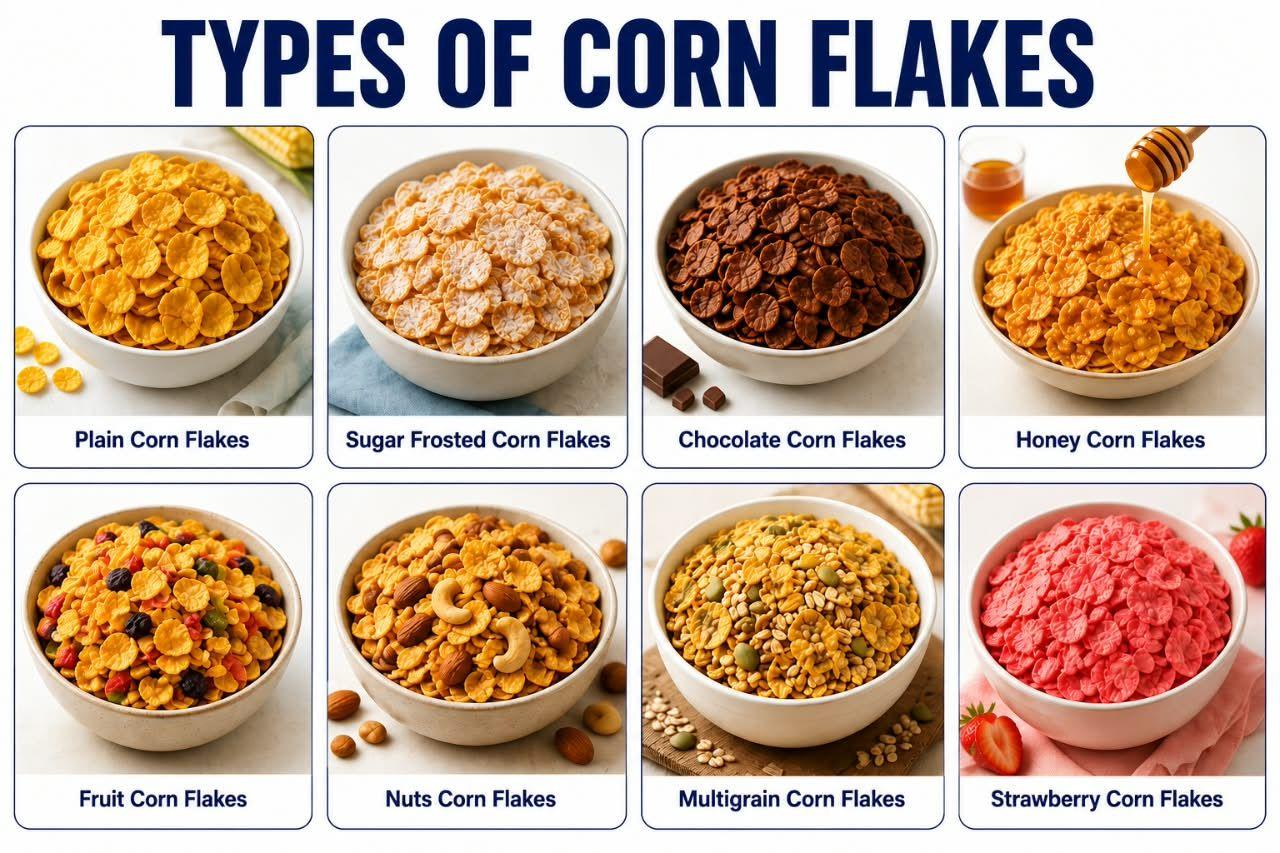
Corn flakes can be produced in different varieties to meet the preferences of different customers. Manufacturers can select suitable product types based on market demand, target customers, ingredients, and production capabilities.
The quality of raw materials plays an important role in maintaining the taste, texture, appearance, and overall quality of corn flakes. The main raw material is maize, while other ingredients are selected according to the product variety.
• Maize/Corn
• Sugar
• Salt
• Honey
• Cocoa Powder
• Fruit Flavouring
• Nuts
• Other Grains
• Edible Oil
• Food-Grade Additives
The corn flakes manufacturing process involves several stages that convert maize into crispy and ready-to-eat breakfast cereal. Each stage, from cleaning and cooking to flaking, roasting, cooling, and packaging, is important for maintaining the desired taste, texture, and quality of the final product.
The process starts with cleaning maize or corn to remove dust, stones, dirt, husk, and other unwanted impurities. Proper cleaning ensures that good-quality maize is used for further processing.
The cleaned maize is conditioned by adjusting its moisture content to the required level. This helps prepare the maize for proper cooking and improves the consistency of the final product.
The conditioned maize is cooked with the required ingredients according to the product formulation. This softens the maize and helps develop the desired taste and texture.
The cooked maize is dried to reduce its moisture content to the required level. Proper drying prepares the maize for flaking and helps achieve the desired crispness.
The prepared maize is passed through flaking rollers, where it is pressed and flattened into thin, uniform flakes. The thickness of the flakes can be adjusted according to the product requirements.
The flakes are roasted at a controlled temperature to develop their crispy texture, colour, and flavour. Proper roasting gives the corn flakes their characteristic crunch.
The roasted flakes are cooled to bring them to a suitable temperature before packaging. Proper cooling helps maintain the texture and quality of the product.
The finished flakes are checked for taste, texture, colour, size, moisture, and overall quality. Any damaged or defective flakes are removed before packaging.
The approved corn flakes are weighed according to the required pack size and packed in suitable food-grade packaging. Proper packaging helps protect the product from moisture and contamination.
The packaged corn flakes are stored in a clean and dry environment before dispatch. They are then distributed through retailers, wholesalers, supermarkets, distributors, and online channels.
A corn flakes manufacturing unit requires different machines for cleaning, cooking, drying, flaking, roasting, cooling, flavouring, and packaging. The machinery selection mainly depends on the production capacity, level of automation, product variety, and available investment. Choosing suitable equipment can help maintain consistent product quality and improve production efficiency.
| Machine/Equipment | Purpose |
|---|---|
| Corn Cleaning Machine | Removes dust, dirt, husk, and other impurities from maize. |
| Destoner | Separates stones and other heavy particles from maize. |
| Corn Cooker | Cooks the prepared maize with the required ingredients. |
| Dryer | Reduces excess moisture from the cooked maize. |
| Flaking Machine | Converts processed maize into thin and uniform flakes. |
| Roasting Machine | Roasts the flakes to develop crispness, colour, and flavour. |
| Cooling Conveyor | Cools the roasted flakes before further processing. |
| Flavouring/Coating Machine | Applies sugar, honey, chocolate, or other suitable flavours and coatings. |
| Weighing Machine | Measures the required quantity of corn flakes for packaging. |
| Packaging Machine | Packs the finished product into suitable food-grade packaging. |
| Sealing Machine | Seals the packages to protect the product from moisture and contamination. |
| Coding Machine | Prints batch number, manufacturing date, expiry date, or other required information. |
The machinery should be maintained properly to ensure smooth production, consistent quality, and efficient operations. Regular cleaning and servicing can also help reduce breakdowns and maintain the performance of the equipment.
Setting up a corn flakes manufacturing business requires proper planning of the production facility, machinery, storage, utilities, manpower, and hygiene arrangements. A well-organised setup helps maintain a smooth production process, product quality, and efficient use of resources.
The manufacturing unit should be located in an area with good road connectivity, electricity, water supply, and transportation facilities. Easy access to suppliers and markets can also help reduce logistics costs.
Adequate space should be provided for machinery installation, raw material handling, processing, packaging, and finished-product storage. The layout should allow smooth movement of materials throughout the production process.
Separate storage arrangements should be made for raw materials, packaging materials, and finished corn flakes. The storage area should be clean, dry, and properly organised to protect materials from moisture and contamination.
The unit requires a reliable electricity supply to operate processing and packaging machinery. Adequate water facilities may also be required for processing, cleaning, and maintaining proper hygiene.
Since corn flakes are a food product, the manufacturing area should be maintained in a clean and hygienic condition. Regular cleaning of equipment, floors, storage areas, and production surfaces helps maintain suitable food-processing conditions.
The business may require workers for machine operation, production, quality checking, packaging, cleaning, and material handling. The number of employees will depend on the production capacity and level of automation.
A dedicated area should be available for weighing, packaging, sealing, coding, and finished-product inspection. Proper organisation of this area helps ensure that packaged products are ready for storage and distribution.
Packaging plays an important role in maintaining the crispness, freshness, taste, and shelf life of corn flakes. Since corn flakes can lose their texture when exposed to moisture, the packaging should provide proper protection during storage, transportation, and sale.
Corn flakes are commonly packed using food-grade packaging materials that provide protection against moisture, air, light, and contamination. The choice of material depends on the product type, pack size, and required shelf life.
The primary package comes directly in contact with the product and is designed to protect the corn flakes from moisture and contamination. Suitable food-grade plastic films, laminated pouches, or inner liners may be used.
Secondary packaging is used to group and protect individual packs during storage and transportation. Corrugated boxes or suitable cartons can be used to hold multiple consumer packs.
Manufacturers can offer corn flakes in different pack sizes, such as small, medium, and family packs. Different sizes allow businesses to target customers with different consumption requirements and budgets.
The packaging should carry relevant product and regulatory information, such as product name, ingredients, net quantity, nutritional information, batch details, manufacturing or packing date, best-before information, and applicable licence details.
An attractive packaging design can help the product stand out on retail shelves. Clear product information, appealing graphics, brand identity, and easy-to-read labels can support effective product presentation.
After quality checking, the corn flakes are weighed, filled, sealed, and coded using suitable packaging equipment. Proper sealing is important to prevent moisture from entering the package and affecting the product's crispness.
The investment required for a corn flakes manufacturing business depends on the production capacity, machinery, infrastructure, packaging system, and level of automation. Entrepreneurs can start on a small, medium, or large scale based on their budget and business plan.
| Investment Component | Estimated Cost |
|---|---|
| Land & Building | ₹5–20 Lakh |
| Corn Flakes Manufacturing Machinery | ₹10–30 Lakh |
| Packaging Machinery | ₹3–8 Lakh |
| Electrical & Utility Setup | ₹2–5 Lakh |
| Raw Materials | ₹2–5 Lakh |
| Packaging Materials | ₹1–3 Lakh |
| Licences & Registrations | ₹50,000–₹1 Lakh |
| Labour & Staff | ₹1–3 Lakh |
| Marketing & Branding | ₹1–3 Lakh |
| Working Capital | ₹3–8 Lakh |
| Miscellaneous Expenses | ₹1–2 Lakh |
| Total Estimated Investment | ₹29.5–88 Lakh |
The actual investment may vary depending on the scale of production, machinery capacity, location, and infrastructure requirements. A detailed project report can help estimate the investment more accurately before starting the business.
Corn flakes can be sold through both offline and online sales channels to reach a wider customer base. Manufacturers can choose suitable channels based on their production capacity, target customers, pricing strategy, and distribution network.
Manufacturers can supply corn flakes to local grocery stores, supermarkets, and general stores. Offering attractive margins to retailers can encourage them to stock the product regularly.
Working with wholesalers and distributors can help manufacturers reach multiple retail outlets across different locations. This can be useful for expanding the business beyond the local market.
Corn flakes can be supplied to supermarket chains and modern retail stores. Proper packaging, competitive pricing, and consistent product quality can improve the chances of getting shelf space.
Manufacturers can sell corn flakes through online marketplaces and e-commerce platforms. Online selling allows businesses to reach customers in different cities and regions without depending only on physical stores.
A business can create its own website or online store to sell corn flakes directly to customers. Direct selling can help the manufacturer build a customer base and strengthen brand visibility.
A corn flakes manufacturing business can offer good growth opportunities, but entrepreneurs may face several challenges related to production, raw materials, quality, competition, and sales. Understanding these challenges in advance can help in better business planning and risk management.
The prices of maize, sugar, flavouring ingredients, and packaging materials may fluctuate due to market conditions and supply changes. Rising raw material costs can increase the overall production cost and affect profit margins.
Maintaining consistent taste, texture, crispness, colour, and moisture levels can be challenging. Proper quality control and regular monitoring are required to ensure that every batch meets the desired standards.
The corn flakes market has competition from established cereal brands and other breakfast products. New manufacturers may need to offer competitive pricing, attractive packaging, and good product quality to build a customer base.
Corn flakes manufacturing requires suitable processing and packaging machinery. Equipment breakdowns, maintenance costs, and improper machine operation can interrupt production and increase operating expenses.
Corn flakes can lose their crispness when exposed to moisture. Proper processing, packaging, sealing, and storage are therefore important to maintain product quality throughout its shelf life.
The business requires suitable food-grade packaging and proper storage conditions. Poor packaging or improper storage can result in product damage, moisture absorption, and wastage.
Reaching a wider market requires an effective distribution and logistics network. Transportation costs, retailer margins, inventory management, and timely delivery can become challenging as the business expands.
Creating awareness for a new corn flakes brand can require significant marketing and promotional efforts. Businesses may need to invest in advertising, product sampling, digital marketing, and attractive packaging to compete with established brands.

Starting a corn flakes manufacturing business requires proper planning for machinery, investment, production setup, raw materials, and business requirements. StartupHyper can support entrepreneurs in understanding these requirements and planning the manufacturing unit according to their budget and production capacity.
The support can cover various stages of the business setup, from machinery selection and project planning to investment estimation, loan assistance, branding, and marketing.
Suitable machinery selection based on production capacity and budget.
Business plan preparation covering key project requirements.
Production unit planning for machinery and infrastructure.
Investment estimation for machinery, raw materials, and working capital.
Loan and subsidy guidance for eligible business owners.
Branding and packaging support for developing the product identity.
Marketing guidance to reach target customers and expand sales.
Corn flakes manufacturing can be a profitable business when production costs, product quality, pricing, distribution, and marketing are properly managed.
The main raw material is maize or corn, while ingredients such as sugar, salt, honey, cocoa powder, fruit flavouring, nuts, and other grains may be used depending on the product variety.
Common machines include a corn cleaning machine, destoner, cooker, dryer, flaking machine, roasting machine, cooling conveyor, flavouring machine, weighing machine, and packaging machine.
The investment depends on production capacity, machinery, infrastructure, packaging requirements, and working capital, with larger automated units requiring higher investment.
Corn flakes are packed using suitable food-grade packaging that protects the product from moisture and contamination, followed by weighing, filling, sealing, and coding.
Corn flakes can be sold through grocery stores, supermarkets, wholesalers, distributors, online marketplaces, and institutional buyers such as hotels and cafeterias.
A new brand can attract customers through good product quality, attractive packaging, competitive pricing, product sampling, retailer promotions, and effective marketing.
Starting a corn flakes manufacturing business can provide an opportunity to enter the packaged food and breakfast cereal market. With suitable machinery, quality raw materials, proper production practices, attractive packaging, and effective distribution, entrepreneurs can develop a competitive corn flakes brand.
Before starting the business, it is important to carefully plan the investment, production capacity, operating costs, quality control, licences, packaging, and marketing strategy. Proper planning and consistent product quality can help build customer trust and create opportunities for long-term business growth.
📞Call / WhatsApp: 9472093913
📧Email: info@startuphyper.com
🌐 Website: www.startuphyper.com | www.machinehai.com
🏢 Branches: Patna | Gaya | Katihar | Saharsa
Stay updated with the latest tips, trends, and best practices in factory setup and machinery procurement—subscribe to the StartupHyper newsletter!
No spam, we promise. Your inbox is safe with us—only valuable insights.