Read the full article to gain deeper insights and comprehensive information.

Sep 12, 2026
0
Waste Paper Recycling Business in India 2026 – Cost, Machinery, Process & Profit Guide
##** Table of Contents**
A waste paper recycling business involves collecting used paper and paper-based waste, sorting it, processing it and converting it into recycled pulp or new paper products. Depending on the scale, an entrepreneur can operate a collection and sorting business, a pulp-processing unit or a complete recycled paper manufacturing plant.
The basic business cycle is:
Waste Paper Collection fi Sorting fi Processing fi Pulping fi Cleaning fi Paper Manufacturing fi Finishing fi Packaging fi Selling
The exact process depends on the type and quality of waste paper and the final product being manufactured.
a. Waste Paper Collection
Paper waste can be collected from offices, schools, printing presses, factories, warehouses, retailers, households and scrap dealers.
b. Waste Paper Processing
Collected paper is sorted and processed to remove unwanted materials before it enters the recycling system.
The processed fibre can be used to manufacture products such as recycled kraft paper, paperboard, packaging paper and other paper products.
The waste paper recycling business combines waste management with manufacturing. It allows entrepreneurs to convert discarded paper into useful industrial raw material and finished products. The opportunity is particularly attractive for entrepreneurs who can build a reliable supply chain for waste paper and develop consistent buyers for recycled products.
Businesses are increasingly looking for ways to reduce waste and use recyclable materials.
Waste paper is generated continuously by households, offices, schools, printing businesses, packaging companies and industries.
An entrepreneur can start with collection and sorting, move into baling and processing, or eventually establish a complete recycled paper manufacturing unit.
Recycled paper products are used across packaging, shipping, printing and several other commercial applications.
Once the supply and customer network becomes stable, the business can be expanded by increasing processing capacity or adding new recycled-paper products.
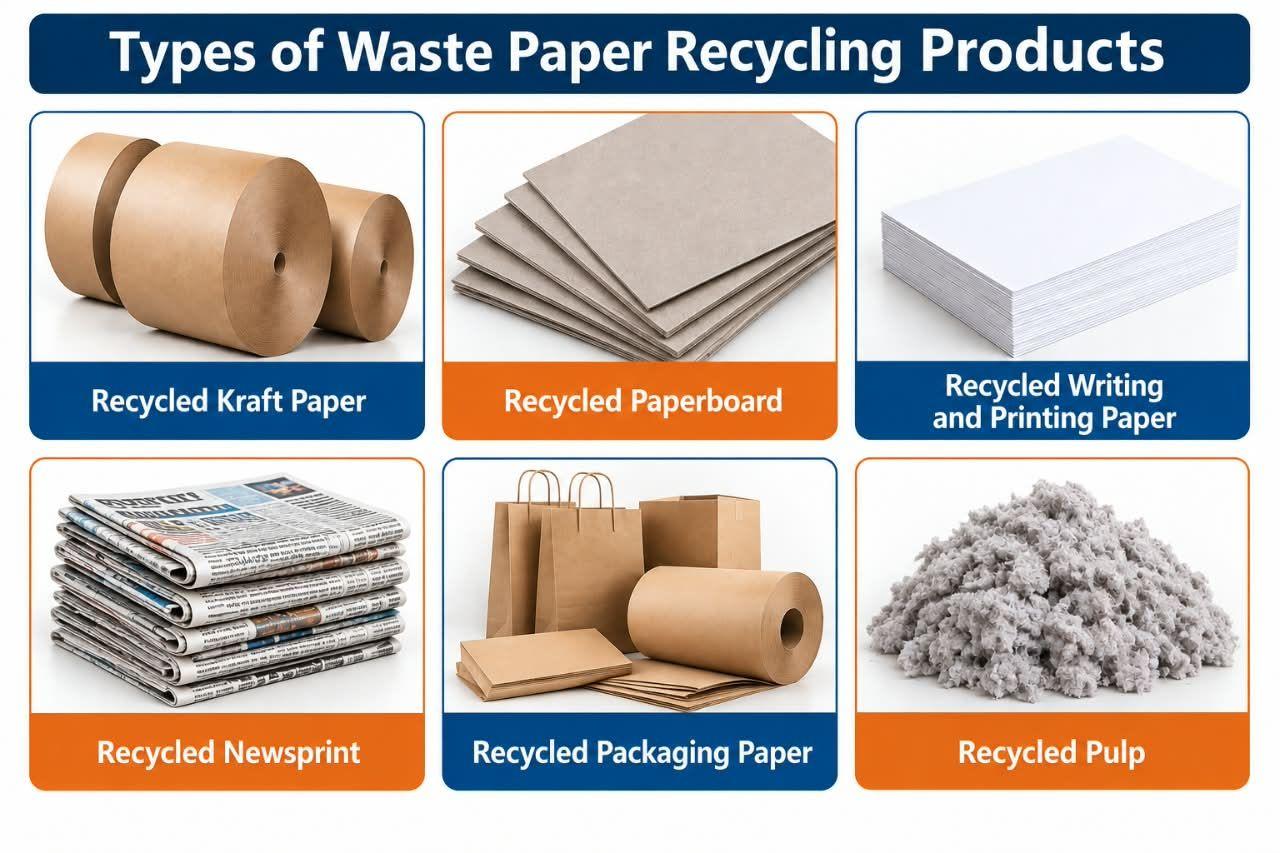
Waste paper can be converted into different products depending on the raw material quality, machinery, technology and target market. Choosing the right product is one of the most important decisions before setting up a recycling unit.
• Used extensively in packaging and corrugated boxes.
• Suitable for industrial and commercial packaging applications.
• Demand is closely connected with the packaging sector.
• Used for cartons, boxes and other packaging applications.
• Can be manufactured using recovered paper fibres.
• Product specifications can vary according to customer requirements.
c. Recycled Writing and Printing Paper
• Used for notebooks, office paper and stationery products.
• Requires better-quality recycled fibre.
• Deinking and additional processing may be required depending on product specification.
• Manufactured using recovered paper fibres.
• Requires suitable pulp preparation and quality control.
• Used for newspaper and similar printing applications.
• Used for bags, wrapping and various packaging applications.
• Can provide opportunities for small and medium-scale converters.
• Product quality depends heavily on fibre characteristics.
• Processed recycled fibre can be sold to other paper manufacturers.
• Allows an entrepreneur to focus on pulp production rather than finished-paper manufacturing.
• Requires consistent fibre quality and contamination control.
The market for recycled paper is supported by demand from packaging, e-commerce, logistics, retail, printing and manufacturing industries. Corrugated boxes, kraft paper and paperboard are particularly important applications because businesses require large quantities of packaging materials.
Packaging companies use kraft paper, paperboard and corrugated materials for boxes and other packaging solutions.
The expansion of online shopping has increased the importance of paper-based packaging and shipping materials.
Consumer-product companies require packaging materials for transportation, storage and product presentation.
Schools, offices, publishers and stationery manufacturers create demand for various paper grades.
Manufacturers use paper-based packaging for protecting and transporting industrial products
Stay updated with the latest tips, trends, and best practices in factory setup and machinery procurement—subscribe to the StartupHyper newsletter!
No spam, we promise. Your inbox is safe with us—only valuable insights.