Blog Details

Read the full article to gain deeper insights and comprehensive information.

How to Start Kulhar Making Business in India? ₹50K Investment, Earn ₹2 Lakhs Monthly - Complete Guide 2026

Startuphyper
By Startuphyper

Jan 29, 2026

0

Learn how to start a kulhar making business with just ₹50K investment and earn ₹2 lakhs monthly. Complete guide covering machinery, raw materials, licenses, marketing & sales strategies. Get MSME loan info, railway supply contracts & business setup tips for Bihar & India. Step-by-step kulhar pottery business guide 2026.

Kulhar and Clay Utensils Business: Complete Guide 2026

Introduction

The kulhar and clay utensils business in India is not only traditional but also a rapidly growing opportunity in today's eco-friendly era. As a biodegradable alternative to plastic, the demand for kulhars is continuously increasing at railway stations, tea stalls, events, and hotels. This guide will provide you with all the essential information to start this business.

Business Opportunities

Market Demand:

  • Daily consumption of millions of kulhars at railway stations
  • Tea stalls and roadside eateries
  • Weddings, ceremonies, and religious events
  • Growing demand for eco-friendly packaging
  • Market for decorative clay items

Business Advantages:

  • Low initial investment possible
  • Locally available raw materials
  • Government subsidies and loan facilities
  • Environment-friendly products
  • Export potential

Types of Business Models

1. Cottage/Micro Industry Level

  • Handmade production
  • Investment: ₹50,000 - ₹2,00,000
  • Production: 1,000-5,000 kulhars/month
  • Monthly Profit: ₹20,000 - ₹60,000

2. Semi-Automatic Unit

  • With some machinery
  • Investment: ₹2,50,000 - ₹8,00,000
  • Production: 10,000-50,000 kulhars/month
  • Monthly Profit: ₹60,000 - ₹2,00,000

3. Commercial/Factory Level

  • Full automation
  • Investment: ₹10,00,000 - ₹50,00,000+
  • Production: 1 lakh+ kulhars/month
  • Monthly Profit: ₹2,00,000 - ₹8,00,000

Raw Materials

Main Materials:

  • Clay (Red Clay, Ball Clay, Kaolin)
  • Water
  • Sand and flux (to improve clay quality)
  • Fuel (coal/wood/gas/electricity)
  • Glaze materials (if glossy finish required)
  • Packaging materials

Raw Material Costs:

  • Regular clay: ₹500-₹1,500 per ton
  • Ball clay: ₹2,000-₹5,000 per ton
  • Fuel costs: As per production

Manufacturing Process

Step 1: Clay Preparation

  • Clay selection and collection
  • Removing stones and impurities
  • Crushing and sieving clay

Step 2: Mixing

  • Mixing clay and water in pug mill
  • Removing air bubbles
  • Creating right consistency

Step 3: Molding

  • By hand or press machine
  • Using hydraulic press (for uniform shape)
  • Shaping in molds

Step 4: Drying

  • Natural sun drying (24-48 hours)
  • Or controlled drying in chamber
  • Care to prevent cracks

Step 5: Firing

  • Firing in kiln at 900-1200°C
  • 6-12 hour firing process
  • Keeping in kiln until cool

Step 6: Finishing

  • Quality check
  • Smoothing and polishing
  • Branding/logo (if required)

Step 7: Packaging

  • Careful packing
  • Placing in carton boxes
  • Labeling and dispatch
Media

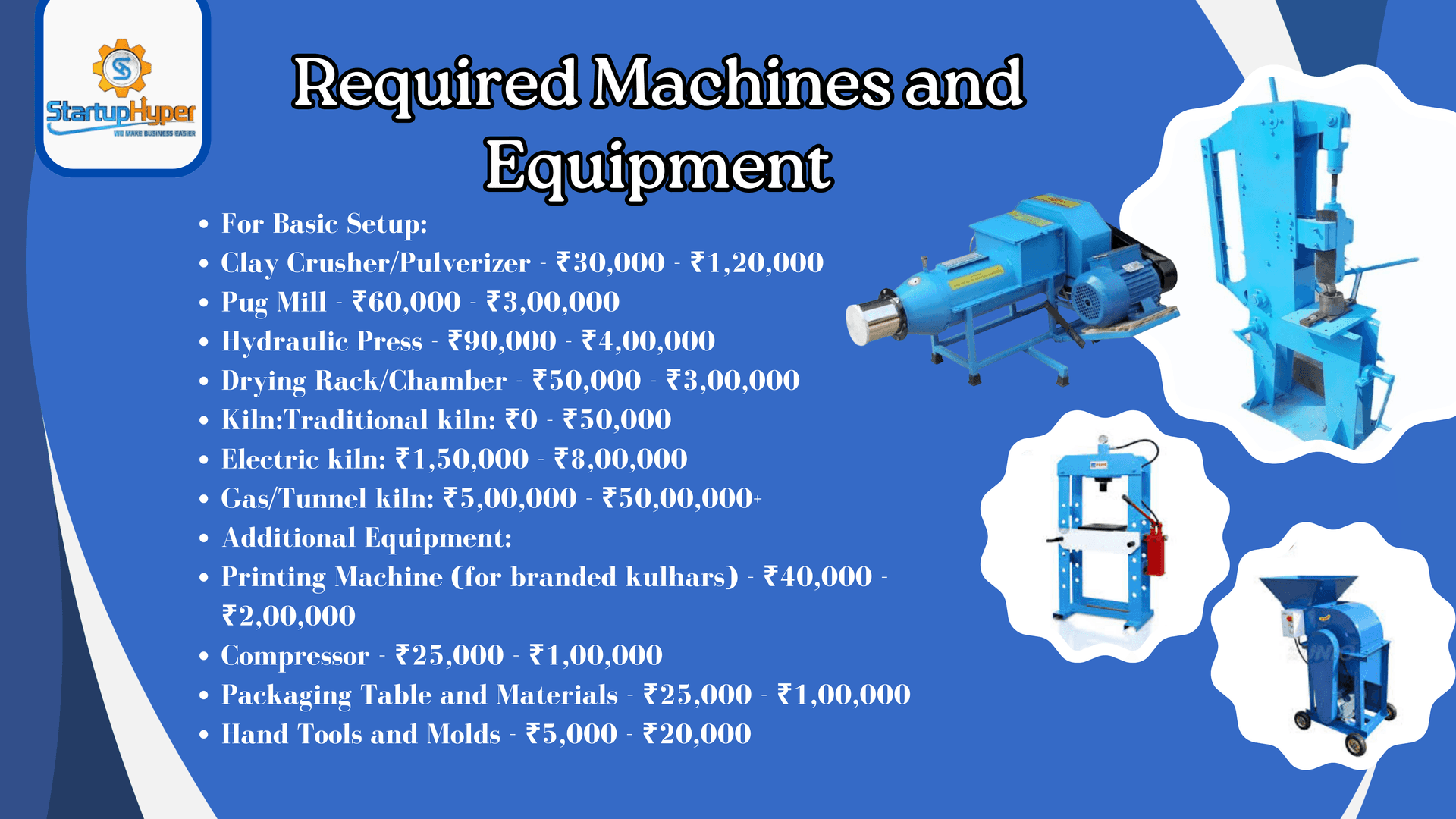
Required Machines and Equipment

For Basic Setup:

  • Clay Crusher/Pulverizer - ₹30,000 - ₹1,20,000
  • Pug Mill - ₹60,000 - ₹3,00,000
  • Hydraulic Press - ₹90,000 - ₹4,00,000
  • Drying Rack/Chamber - ₹50,000 - ₹3,00,000

Kiln:

  • Traditional kiln: ₹0 - ₹50,000
  • Electric kiln: ₹1,50,000 - ₹8,00,000
  • Gas/Tunnel kiln: ₹5,00,000 - ₹50,00,000+

Additional Equipment:

  • Printing Machine (for branded kulhars) - ₹40,000 - ₹2,00,000
  • Compressor - ₹25,000 - ₹1,00,000
  • Packaging Table and Materials - ₹25,000 - ₹1,00,000
  • Hand Tools and Molds - ₹5,000 - ₹20,000

Detailed Investment Breakdown

Small Scale (Cottage Level):

  • Machines and equipment: ₹50,000 - ₹1,00,000
  • Raw material (1 month): ₹20,000 - ₹30,000
  • Rent and electricity: ₹10,000 - ₹20,000
  • License and registration: ₹5,000 - ₹10,000
  • Total Initial Investment: ₹85,000 - ₹2,00,000

Medium Scale (Semi-Automatic):

  • Machines and equipment: ₹2,00,000 - ₹5,00,000
  • Raw material (1 month): ₹50,000 - ₹1,00,000
  • Rent, electricity, staff: ₹40,000 - ₹80,000
  • License and registration: ₹10,000 - ₹20,000
  • Total Initial Investment: ₹3,00,000 - ₹8,00,000

Large Scale (Commercial Factory):

  • Machines and equipment: ₹8,00,000 - ₹30,00,000
  • Raw material (1 month): ₹1,50,000 - ₹3,00,000
  • Rent, electricity, staff: ₹1,00,000 - ₹2,00,000
  • License and registration: ₹20,000 - ₹50,000
  • Total Initial Investment: ₹10,00,000 - ₹50,00,000+

Profit and ROI Calculation

  • Example: Semi-Automatic Unit
  • Monthly Production: 20,000 kulhars
  • Selling Price (wholesale): ₹3 per kulhar
  • Monthly Revenue: 20,000 × ₹3 = ₹60,000

Monthly Expenses:

  • Raw materials: ₹18,000
  • Fuel/electricity: ₹8,000
  • Labor: ₹12,000
  • Packaging: ₹3,000
  • Rent/others: ₹5,000
  • Total Expenses: ₹46,000

Monthly Net Profit: ₹14,000 - ₹25,000 Annual Profit: ₹1,68,000 - ₹3,00,000 ROI (Return on Investment): 6-12 months

Note: Branded or printed kulhars can be sold at ₹6-₹15, doubling the profit margin.

Marketing and Sales Strategy

Local Market:

  • Tea stalls and roadside eateries
  • Sweet shops
  • Street food vendors
  • Hotels and restaurants
  • Catering services

Bulk Buyers:

  • Railway canteens
  • Event management companies
  • Wedding decorators
  • Religious institutions and temples
  • Corporate events

Online Sales:

  • Listing on Amazon, Flipkart
  • Own website
  • Promotion on Instagram and Facebook
  • Local SEO ("kulhar supplier Patna")

Branding Methods:

  • Logo printing service (custom kulhars)
  • Eco-friendly packaging
  • Food-safe certification
  • Social media marketing
  • Sample distribution
Media

Required Licenses and Registration

  • Udyam/MSME Registration - For subsidies and loans
  • GST Registration - If turnover exceeds ₹40 lakhs
  • FSSAI License - For food contact products (kulhars)
  • Trade License - From local municipal corporation
  • Pollution Control Certificate - For large kilns
  • Labor License - If 10+ employees
  • Fire NOC - For safety

Challenges and Solutions

Challenge 1: Cracks During Drying

Solution: Use controlled drying chamber, slow drying process Challenge 2: Rising Fuel Costs

Solution: Invest in electric or gas kiln, use solar energy Challenge 3: Seasonal Demand

Solution: Build stock for festivals, diversify product range

Challenge 4: Competition and Price Pressure

Solution: Branding, quality, customization services

Challenge 5: Shortage of Skilled Workers

Solution: Train local potters, contact ITI institutes

Growth and Scaling Tips

  • Start Small: First pilot batch of 500-1000 kulhars
  • Find Stable Buyers: Secure 2-3 large bulk buyers
  • Value Addition: Printed kulhars, glazed mugs, gift sets
  • Focus on Quality: Implement quality control system
  • Technology Upgrade: Gradually increase automation
  • Government Schemes: Utilize PMEGP, Mudra Loan
  • Networking: Participate in trade fairs

Government Schemes and Subsidies

PMEGP (Prime Minister's Employment Generation Programme)

  • 15-35% subsidy
  • Urban area: Up to ₹25 lakhs

Mudra Loan

  • Shishu: Up to ₹50,000
  • Kishore: ₹50,000 - ₹5,00,000
  • Tarun: ₹5,00,000 - ₹10,00,000

MSME Subsidy

  • 15-20% subsidy on machinery

Stand-Up India

  • ₹10 lakhs - ₹1 crore loan for SC/ST/Women entrepreneurs

First 30 Days Action Plan

Week 1:

  • Market survey and competitor analysis
  • Local clay sample testing
  • Contact potential buyers

Week 2:

  • Prepare business plan
  • Location selection (rent or purchase)
  • Apply for licenses

Week 3:

  • Purchase machines and equipment
  • Arrange raw materials
  • Hire and train workers

Week 4:

  • Pilot production (500-1000 kulhars)
  • Quality check
  • First order delivery
  • Feedback and improvements

Success Mantras

  • Never compromise on quality
  • Ensure timely delivery
  • Keep customer relationships strong
  • Experiment with new products
  • Maintain proper financial records
  • Focus on cash flow management
  • Continuously invest in marketing
Media

Conclusion

The kulhar and clay utensils business is a profitable and eco-friendly venture. Starting with a small investment, it can be gradually scaled to a large level. With proper planning, focus on quality, and good marketing, this business can provide you with stable income and growth opportunities. With increasing awareness about environmental protection, the future of kulhars and clay products is bright. If you take this business seriously and keep improving continuously, success is assured. Best Wishes!


Buy Kulhar Making Machines in Patna | StartupHyper

Bihar's Most Trusted & Best Machinery Supplier Company

Ready to start your kulhar business? StartupHyper provides complete machinery solutions for entrepreneurs in Patna and across Bihar. We supply quality kulhar making machines, clay processing equipment, and offer end-to-end business setup support.

What We Offer:

Premium Machinery Range:

✅ Kulhar Making Machines (Manual & Automatic)

✅ Clay Pug Mill & Processing Equipment

✅ Hydraulic Press with Molds

✅ Electric Kilns & Gas Furnaces

✅ Drying Chambers

✅ Printing & Branding Machines

✅ Complete Production Line

Complete Business Support:

✅ Free Installation & Setup Guidance

✅ Worker Training Programs

✅ Raw Material Supplier Network

✅ Market Linkage (Railway, Hotels, Events)

✅ MSME Loan & Subsidy Assistance

✅ Business Consultation & Planning

✅ After-Sales Technical Support

Why Choose StartupHyper?

🏆 500+ Successful Business Setups

🏆 ISI Certified Quality Machines

🏆 Best Price Guarantee

🏆 Delivery Across All Bihar Districts

📞 Contact Us Today:

☎️ 9472093913, 9263800297

📧 officestartuphyper@gmail.com

🌐 www.startuphyper.com

Start Your Kulhar Business with Bihar's #1 Machinery Supplier!

MSME Registered | Trusted by 500+ Entrepreneurs


💬 Book Your FREE Business Consultation Now!