Read the full article to gain deeper insights and comprehensive information.

Jul 24, 2026
0
Learn how to start an RO Water Plant Business in India. Discover the investment required, machinery, setup process, licenses, profit margin, and complete business plan for a successful commercial RO water plant.
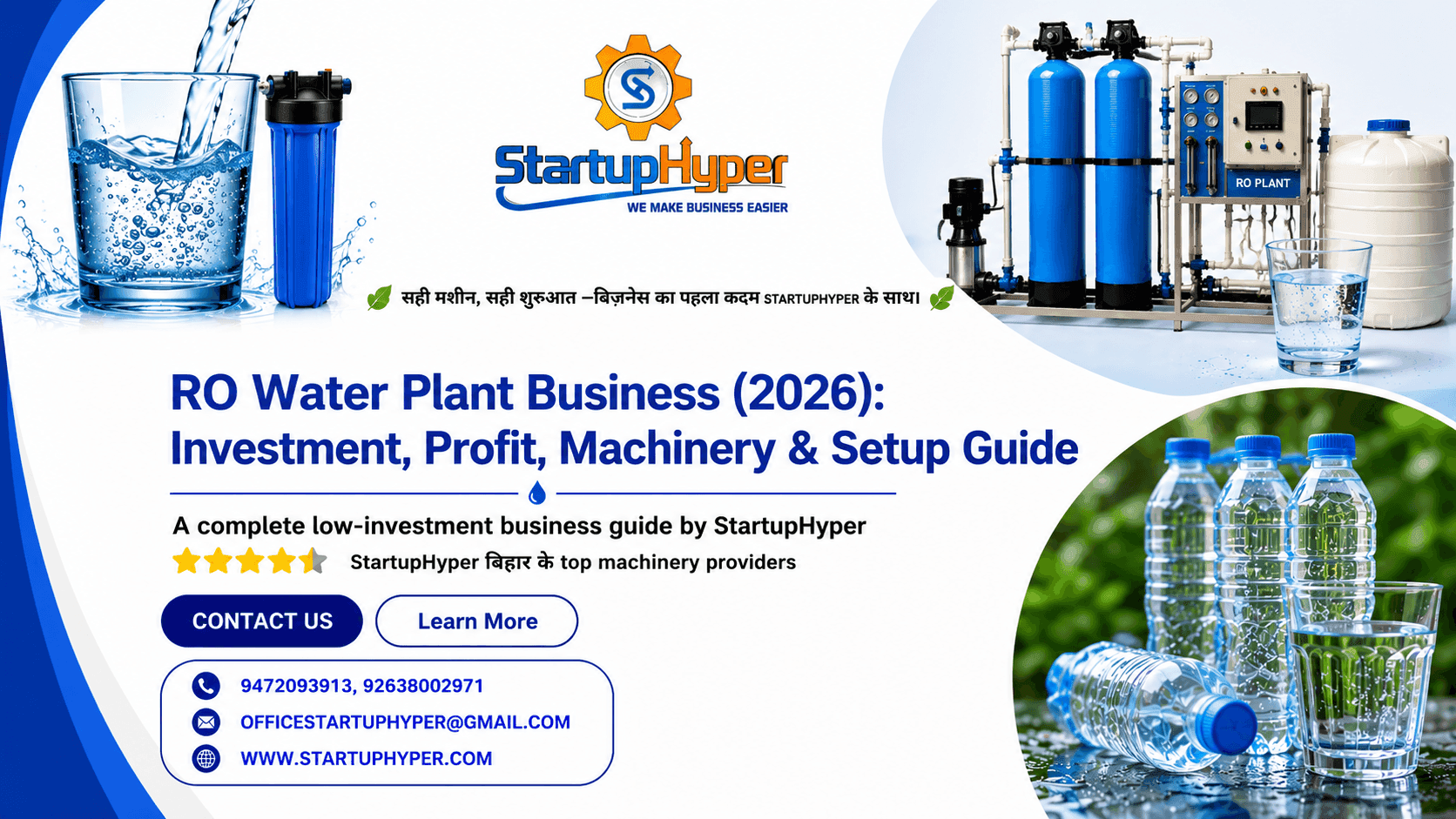
An RO Water Plant Business is a water purification business that uses Reverse Osmosis (RO) Technology to remove dissolved salts, bacteria, viruses, chemicals, heavy metals, and other impurities from raw water, making it safe for drinking.
After purification, the treated water can be supplied in different forms depending on your business model, such as:
With the increasing awareness of safe drinking water, the demand for purified water has grown rapidly across India. Today, households, offices, schools, hospitals, restaurants, hotels, industries, and commercial establishments rely on RO water for daily consumption.
As a result, starting an RO Water Plant Business has become one of the most promising manufacturing and service-based business opportunities.
The demand for clean drinking water continues to rise due to urbanization, pollution, industrialization, and increasing health awareness.
Some major reasons to start this business include:
With the right planning, quality equipment, and effective marketing, an RO Water Plant can become a stable and profitable business.
India's packaged drinking water industry has witnessed significant growth over the past few years. Increasing concerns about water contamination have encouraged consumers to choose purified drinking water over untreated water.
Major customers include:
With proper branding and distribution, businesses can expand from serving local areas to multiple cities.
Before investing, you should decide which business model suits your budget and target market.
This is one of the most common RO water businesses in India.
Purified water is filled into reusable 20-litre jars and supplied to:
It offers recurring monthly income because customers usually reorder water regularly.
In this model, purified water is packed into PET bottles of different sizes such as:
These bottles are sold through distributors, supermarkets, restaurants, hotels, and retail stores.
This business requires additional packaging machinery and regulatory approvals.
Commercial RO Plants are installed for institutions and businesses that require purified water in large quantities.
Typical customers include:
Revenue is generated through plant installation, maintenance, or bulk water supply contracts.
Large-capacity RO plants can produce purified water that is transported to commercial customers using tankers or bulk storage systems.
This model is generally suitable for industrial areas and regions with high water demand.
The investment depends on your plant capacity, business model, automation level, machinery, and packaging requirements.
Below is a general estimate.
| Business Type | Estimated Investment |
|---|---|
| Small RO Water Plant (20L Jar Supply) | ₹5–12 Lakhs |
| Commercial RO Water Plant | ₹12–30 Lakhs |
| Packaged Drinking Water Plant | ₹30 Lakhs–₹1 Crore+ |
If you already own the land and building, your initial investment can be significantly lower.
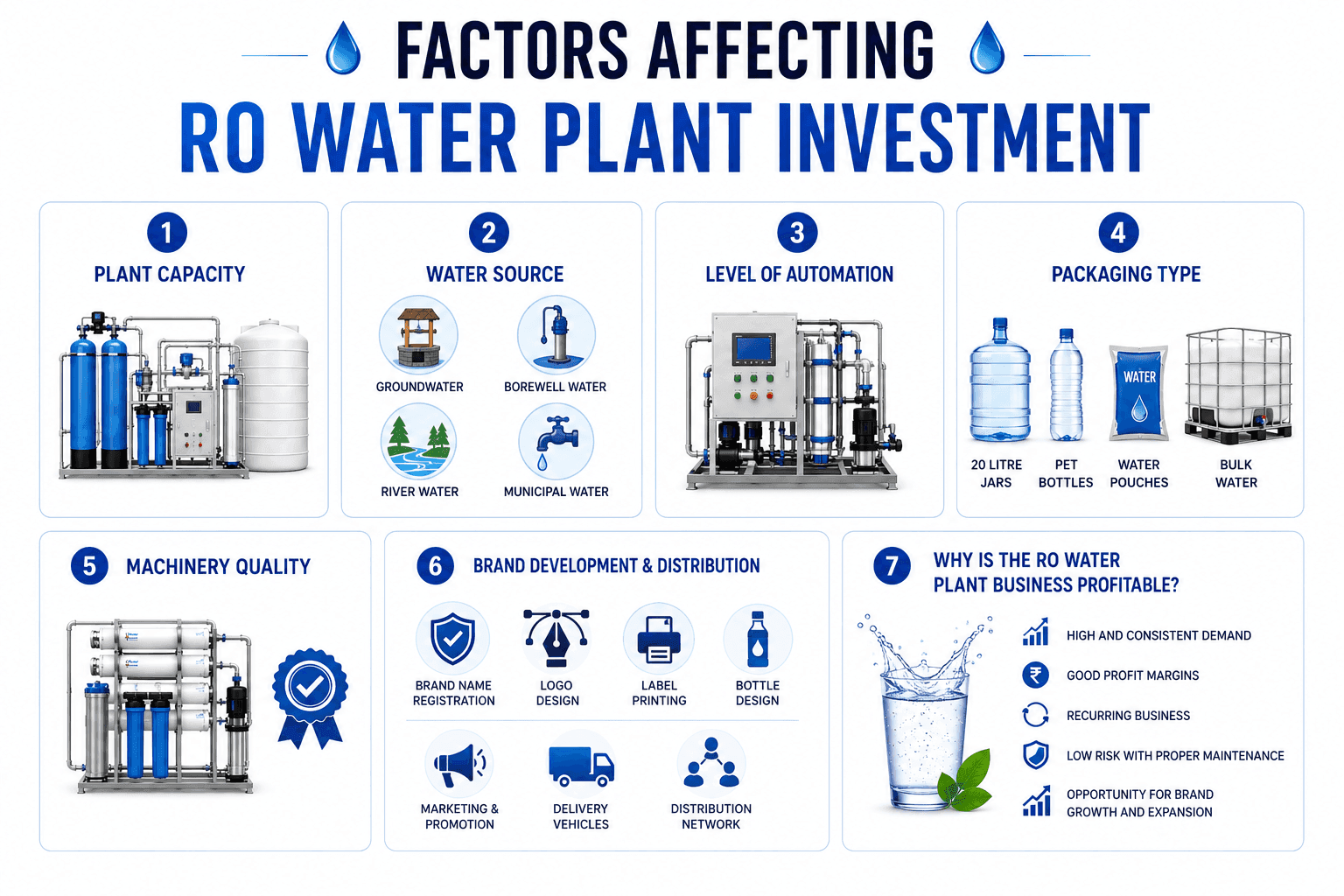
The total cost of setting up an RO Water Plant Business depends on several factors.
Higher production capacity requires larger RO systems, bigger storage tanks, and higher investment.
The quality of raw water determines the type of filtration system required.
Groundwater, borewell water, river water, and municipal water may require different treatment processes.
A fully automatic plant costs more initially but reduces manpower requirements and improves production efficiency.
Your investment will also depend on whether you plan to sell:
Each format requires different filling and packaging equipment.
Choosing reliable and high-quality RO Water Plant Machinery improves efficiency, reduces maintenance costs, and ensures consistent water quality.
If you plan to launch your own drinking water brand, you should also budget for:
These costs should be included in your RO Water Plant Business Plan.
The need for clean and safe drinking water is increasing every year, making the RO Water Plant Business a sustainable business opportunity. Unlike seasonal businesses, purified drinking water is required throughout the year by households, businesses, and institutions.
A well-managed RO Water Plant with quality machinery, efficient operations, and a strong customer network can generate steady long-term revenue.
The success of an RO Water Plant Business largely depends on the quality of the machinery used. Investing in reliable equipment ensures efficient water purification, consistent water quality, lower maintenance costs, and compliance with drinking water standards.
Depending on your production capacity and business model, you can set up a Semi-Automatic or Fully Automatic Commercial RO Water Plant.
Below are the essential machines and equipment required to establish an RO Water Plant.
The purification process begins with storing raw water collected from sources such as:
A Raw Water Storage Tank ensures a continuous supply of water to the purification system.
A Raw Water Pump transfers water from the storage tank to the filtration system while maintaining the required pressure for smooth plant operation.
The Multi Grade Sand Filter removes suspended solids, sand, dirt, rust particles, and other large impurities from raw water.
This is the first stage of water filtration and helps protect downstream equipment from damage.
After sand filtration, water passes through the Activated Carbon Filter.
This filter removes:
It also improves the overall quality of water before it enters the RO Membrane.
If the source water contains high hardness, a Water Softener is installed before the RO system.
It reduces calcium and magnesium content, preventing scale formation on the RO Membranes and increasing their lifespan.
Before entering the RO Membrane, water passes through a Micron Cartridge Filter, which removes very fine suspended particles.
This protects the RO Membrane from clogging and improves purification efficiency.
The High Pressure Pump generates the pressure required for the Reverse Osmosis process.
Without sufficient pressure, the RO Membrane cannot effectively separate dissolved salts and impurities.
The RO Membrane is the heart of the entire purification system.
It removes:
This process produces clean and safe drinking water.
Many commercial plants also include a UV Sterilizer.
Ultraviolet light destroys bacteria, viruses, and microorganisms without using chemicals, providing an additional level of safety.
An Ozone Generator disinfects purified water and helps increase its shelf life, especially in bottled drinking water production.
Ozonation also helps maintain water quality during storage.
After purification, the treated water is stored in Food Grade Stainless Steel Storage Tanks before filling.
These tanks help maintain hygiene and prevent contamination.
Before filling, bottles and 20-litre jars must be cleaned properly.
A Bottle or Jar Washing Machine removes dust, dirt, and microbial contamination, ensuring hygienic packaging.
The purified water is filled into:
Automatic Filling Machines improve accuracy, reduce wastage, and increase production speed.
After filling, bottles are sealed using a Bottle Capping Machine.
Proper sealing prevents leakage and contamination while increasing product shelf life.
A Labeling Machine applies labels containing important information such as:
Professional labeling enhances brand identity and consumer trust.
For wholesale distribution, a Shrink Wrapping Machine bundles multiple bottles together for safer transportation and professional packaging.
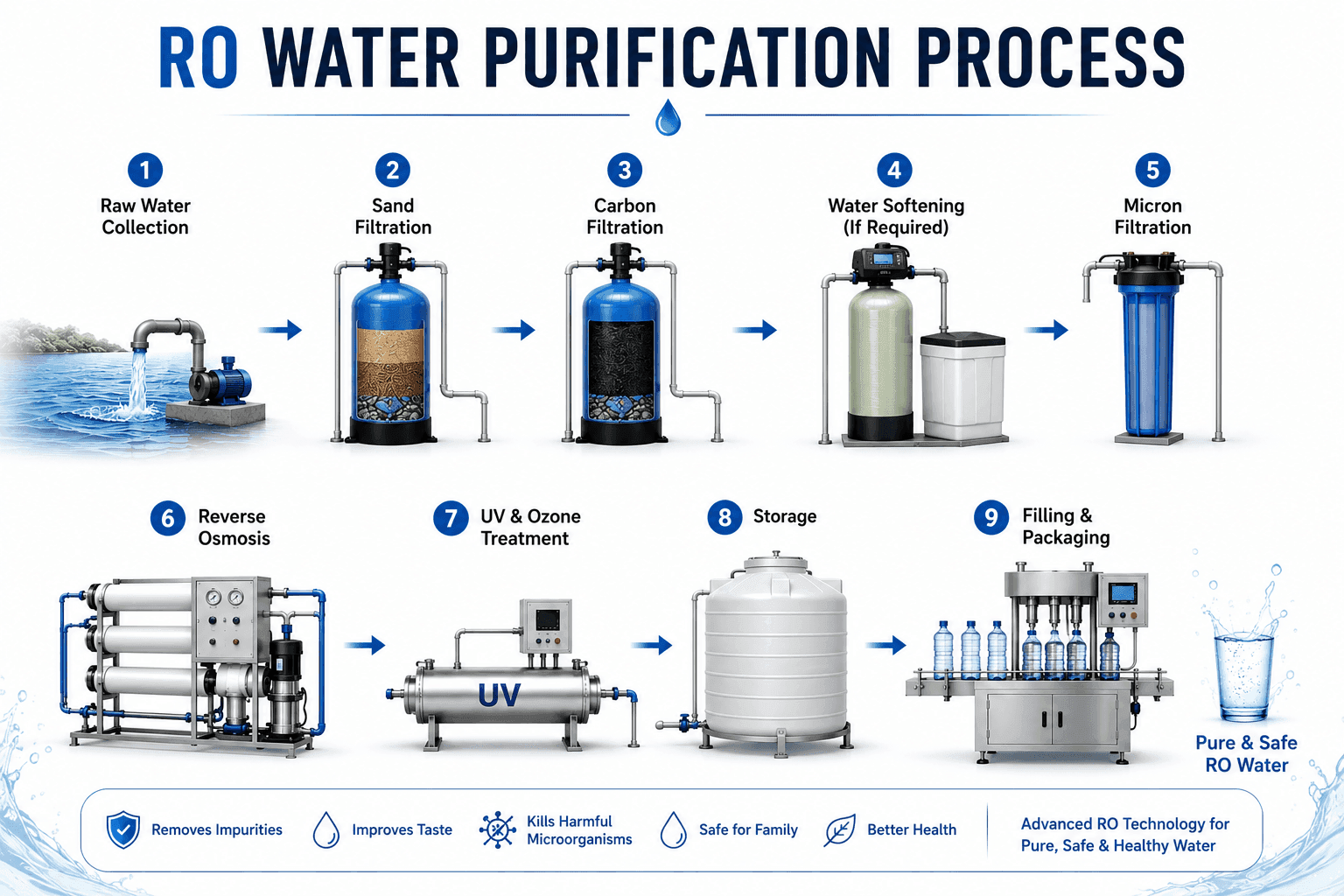
The purification process in an RO Water Plant follows multiple stages to ensure safe drinking water.
Water is collected from a suitable source such as a borewell, municipal supply, or other approved source.
Water passes through the Multi Grade Sand Filter, where suspended solids, sand, and larger particles are removed.
The Activated Carbon Filter removes chlorine, odor, color, and organic impurities.
If hardness is high, water is softened before entering the RO system.
Fine suspended particles are removed using a Micron Cartridge Filter.
Water passes through the RO Membrane, which removes dissolved salts, bacteria, viruses, heavy metals, and other contaminants.
Purified water is further disinfected using UV Sterilization and Ozonation to ensure microbiological safety.
Purified water is stored in hygienic Stainless Steel Tanks before packaging.
Finally, the treated water is filled into jars, bottles, or pouches, sealed, labeled, and packed for distribution.
The land requirement depends on the plant capacity and production volume.
| Business Type | Approximate Area Required |
|---|---|
| Small RO Water Plant | 800–1,500 sq. ft. |
| Commercial RO Water Plant | 1,500–3,000 sq. ft. |
| Packaged Drinking Water Plant | 3,000–6,000+ sq. ft. |
Proper plant layout improves workflow, hygiene, and operational efficiency.
Before starting an RO Water Plant Business, obtain the necessary licenses and registrations applicable to your business model.
Register your business as:
If you are manufacturing Packaged Drinking Water, obtaining BIS (Bureau of Indian Standards) Certification under the relevant IS standard is mandatory before selling the product.
Since packaged drinking water is treated as a food product, an FSSAI License is generally required for manufacturing and sale.
GST Registration may be required depending on your turnover and business operations.
A Trade License from the local municipal authority may be required to operate the manufacturing unit.
Depending on your state's regulations and plant size, approval from the State Pollution Control Board may be necessary.
If groundwater is used as the primary water source, permission from the relevant authority may be required depending on local regulations.
Entrepreneurs may explore various government schemes that support manufacturing and MSME businesses.
Eligible entrepreneurs can apply for financial assistance under PMEGP to establish a new manufacturing or service-based business.
Registering as an MSME provides benefits such as:
Businesses may also explore the Credit Guarantee Fund Trust for Micro and Small Enterprises (CGTMSE) scheme, which helps eligible MSMEs obtain collateral-free loans through participating financial institutions.
Conduct market research and identify your target customers.
Prepare a detailed RO Water Plant Business Plan, including investment, plant capacity, machinery, and marketing strategy.
Select a suitable location with access to a reliable water source, electricity, and transportation.
Complete all required registrations and obtain the necessary licenses.
Purchase high-quality RO Water Plant Machinery based on your production requirements.
Install the machinery, test water quality, and conduct trial production.
Launch your brand and begin supplying purified water through distributors, retailers, offices, institutions, and direct customers.
One of the biggest advantages of starting an RO Water Plant Business is the consistent demand for safe and purified drinking water. As concerns about water contamination continue to grow, the need for clean drinking water in homes, offices, hospitals, schools, restaurants, hotels, and industries is increasing every year.
Your profit depends on several factors, including:
A well-managed Commercial RO Water Plant with an efficient distribution system can generally achieve a net profit margin of around 20% to 35%.
Your monthly income depends on your production capacity, customer base, and business model.
Below is a general estimate.
| Business Type | Estimated Monthly Revenue |
|---|---|
| Small RO Water Plant (20L Jar Supply) | ₹3–10 Lakhs |
| Commercial RO Water Plant | ₹10–25 Lakhs |
| Packaged Drinking Water Plant | ₹25 Lakhs+ |
Note: These figures are indicative estimates. Actual revenue and profit depend on plant capacity, local demand, pricing, operating costs, packaging format, and distribution network.
Running an RO Water Plant successfully requires more than just installing machinery. Efficient operations, consistent water quality, and a strong customer network are equally important.
Investing in reliable RO Water Plant Machinery ensures consistent water quality, lower maintenance costs, and reduced downtime.
Regular testing of purified water helps ensure compliance with regulatory standards and builds customer trust.
Conduct periodic testing for:
Control expenses by:
Lower operating costs directly improve profit margins.
Develop a reliable delivery system for:
Timely deliveries help retain customers and generate recurring income.
Instead of supplying water without branding, create your own packaged drinking water brand.
Focus on:
A recognized brand often commands better pricing and improves customer loyalty.
As your business grows, you can expand into:
Offering multiple packaging options helps you serve different customer segments and increase overall sales.
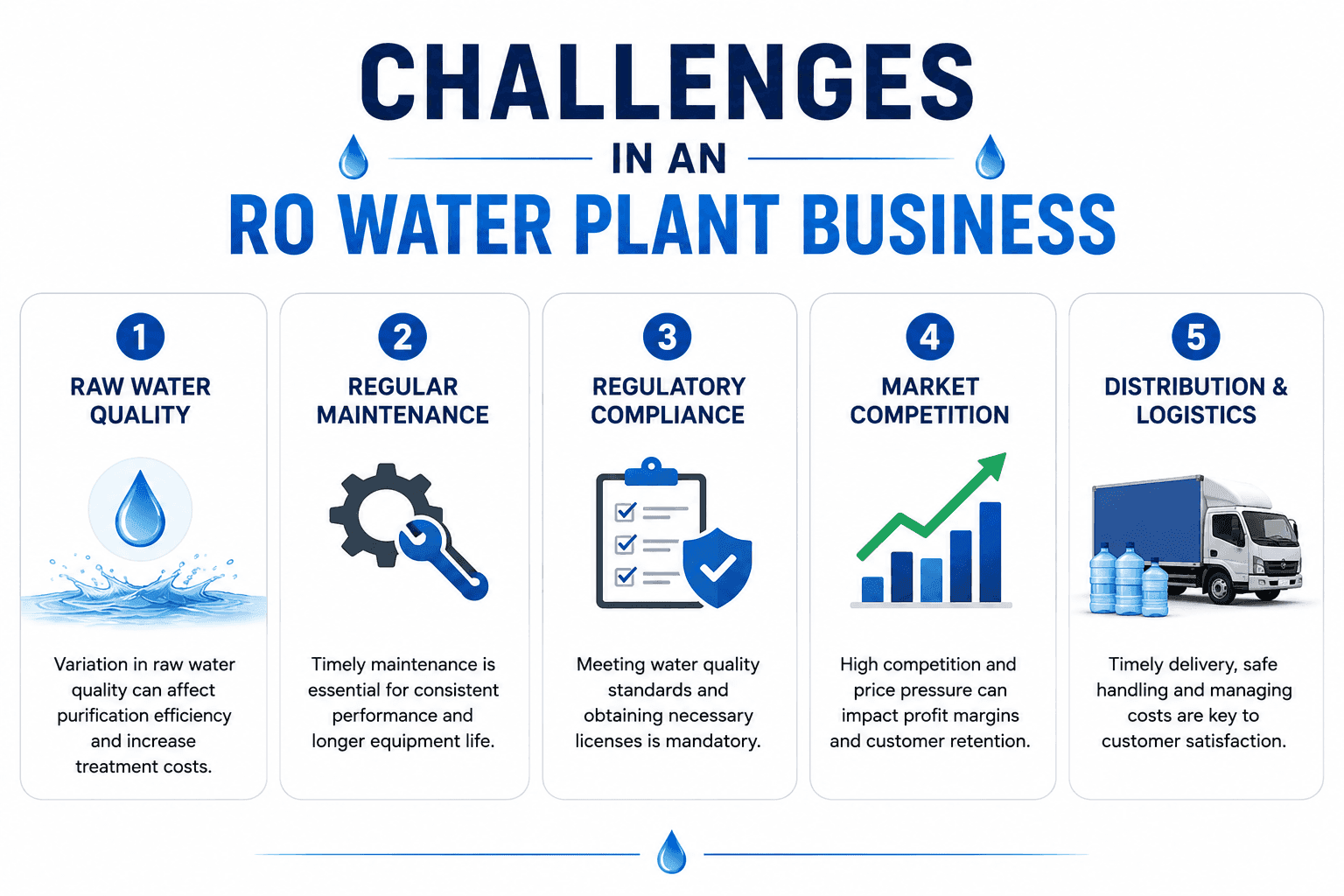
Like any manufacturing or processing business, an RO Water Plant also comes with operational challenges.
The quality of the source water affects treatment costs and plant efficiency. Water with high TDS or contamination may require additional filtration stages.
RO membranes, filters, UV systems, and pumps require timely maintenance and replacement to ensure uninterrupted operation.
Businesses must comply with applicable standards, including BIS certification (for packaged drinking water), FSSAI requirements, and local regulations.
Many local and national brands operate in the drinking water industry. Consistent quality, reliable service, and competitive pricing are essential to remain competitive.
Supplying water on time, especially for jar delivery services, requires efficient route planning, delivery vehicles, and customer management.
A strong marketing strategy can help you build a loyal customer base and grow your business faster.
Some effective strategies include:

Starting an RO Water Plant Business requires careful planning, the right machinery, and expert guidance. At StartupHyper, we help entrepreneurs choose suitable equipment and provide end-to-end support for setting up a successful water purification business.
▶ Expert consultation for setting up RO Water Plants.
▶ Guidance in selecting the right RO Water Plant Machinery based on your production capacity.
▶ Comparison of machinery from trusted manufacturers.
▶ Assistance with project planning and plant layout.
▶ Competitive quotations with transparent pricing.
▶ Support for machinery installation and business setup.
Whether you're planning a 20 Litre Jar Water Plant, a Commercial RO Water Plant, or a Packaged Drinking Water Plant, StartupHyper helps you make informed decisions for long-term business success.
Yes. Due to the growing demand for safe drinking water, an RO Water Plant Business can be profitable when supported by quality machinery, efficient operations, and a strong distribution network.
The investment depends on the business model. A small RO Water Plant may require around ₹5–12 lakhs, while a packaged drinking water plant may require ₹30 lakhs to ₹1 crore or more.
The major machines include:
Depending on your business model, you may require:
Yes. Many entrepreneurs begin with a 20-litre jar water supply business and later expand into bottled drinking water or commercial water supply as demand increases.
Major customers include:
An RO Water Plant focuses on purifying water using Reverse Osmosis technology and may supply water in jars or bulk. A Packaged Drinking Water Plant includes additional bottling, packaging, labeling, and regulatory compliance for selling packaged drinking water under a brand.
The payback period depends on plant capacity, customer acquisition, operating costs, and sales volume. A well-managed business with steady demand can recover its investment over time, but the exact timeline varies for each project.
The RO Water Plant Business is one of the fastest-growing opportunities in India's water purification industry. With increasing demand for clean drinking water from households, businesses, institutions, and commercial establishments, entrepreneurs have the potential to build a sustainable and scalable business.
Success in this industry depends on choosing the right RO Water Plant Machinery, maintaining consistent water quality, complying with regulatory requirements, and building a strong distribution network. By starting with a well-prepared RO Water Plant Business Plan and investing in reliable equipment, you can establish a profitable business with long-term growth potential.
If you're planning to start an RO Water Plant Business in India, StartupHyper can assist you with machinery selection, project planning, manufacturer comparison, quotations, and expert guidance to help you set up your business with confidence.
📞Call / WhatsApp: 9472093913
📧Email: info@startuphyper.com
🌐 Website: www.startuphyper.com | www.machinehai.com
🏢 Branches: Patna | Gaya | Katihar | Saharsa
Stay updated with the latest tips, trends, and best practices in factory setup and machinery procurement—subscribe to the StartupHyper newsletter!
No spam, we promise. Your inbox is safe with us—only valuable insights.