Read the full article to gain deeper insights and comprehensive information.

May 28, 2026
0
Want to start a dal mill business in Bihar? Read this complete 2026 guide covering pulse mill machine cost, mini dal mill setup, MMUY 2026 scheme, FSSAI license, profit margin, and how StartupHyper helps you launch end-to-end.
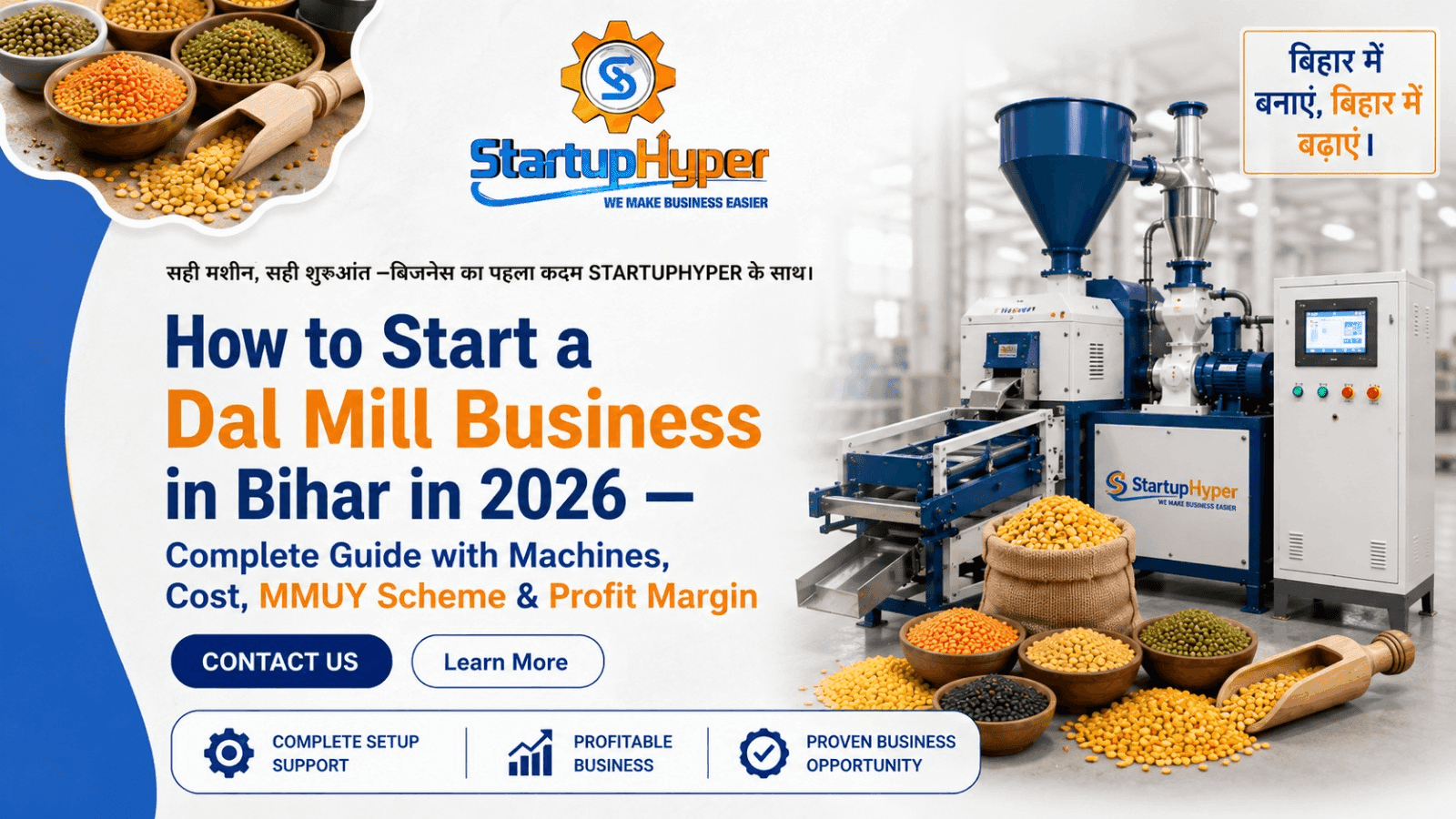
Every Indian home cooks dal every single day. Arhar. Moong. Masoor. Urad. Chana. Dal is not a food item — it is a daily necessity. A habit. A cultural staple that never goes out of demand. And yet — most of the dal processed and packaged in India comes from large mills located far away from where the raw pulses are actually grown. Bihar is one of India's major pulse-producing states. Raw material is here. Farmers are here. Demand is everywhere. But processing? That is happening somewhere else. This guide is for those who want to change that — and build a real, stable, profitable dal mill business in Bihar in 2026.
Dal milling is the third-largest food processing industry in India after rice and wheat. Bihar is among the major pulse-producing states alongside Madhya Pradesh, Rajasthan, Maharashtra, and Gujarat. MUVSI The global dal mill machine market is valued at US$3.5 billion in 2026 and is expected to reach US$4.5 billion by 2033, growing at a CAGR of 3.7%, driven by rising demand for efficient pulse processing infrastructure across both developing and developed economies. Persistence Market Research
What does this mean on the ground?
— Dal demand never stops
— Raw material is locally available in Bihar
— Processing infrastructure is still underdeveloped in rural areas
— Premium branded packaged dal sells at 2 to 3 times the price of loose dal
This is the gap. And this is your opportunity.
Dal Mill Business — What Exactly Is It?
A dal mill takes raw pulses — whole chana, arhar, moong, urad, masoor — and processes them into clean, split, polished dal ready for packaging and selling.
The process includes:
— Cleaning raw pulses
— Drying and pre-treatment
— De-husking and splitting
— Polishing for better appearance
— Grading by size
— Weighing and packaging
Each step adds value. Each step increases the selling price. And each step is done by a specific machine.
Based on the official MMUY 2024-25 project list, here are the exact machines needed:
Core Machines:
| S.No | Machine / Equipment | Cost (₹) |
|---|---|---|
| 1 | Mini Dal Mill — 3 HP | ₹1,60,000 |
| 2 | Dal Polisher | ₹1,00,000 |
| 3 | Dal Dryer | ₹35,000 |
| 4 | Sorting Machine | ₹1,05,000 |
| 5 | Band Sealing Machine | ₹20,000 |
| 6 | Weighing Machine | ₹5,000 |
| 7 | Other Tools & Equipment | ₹25,000 |
| Total Machinery Cost | ₹4,50,000 |
The core machine. Splits whole pulses into two halves. Removes the outer husk. Converts raw grain into processable dal. This is where raw material becomes a product.
Polishes split dal to give it a clean, bright appearance. Consumers always prefer polished dal — it looks fresher, cleaner, and sells at a premium price.
Removes excess moisture from dal before and after processing. Proper drying prevents spoilage, increases shelf life, and maintains quality.
Grades dal by size. Separates broken pieces from whole splits. Uniform size dal commands higher price in the market.
Seals packets and pouches airtight. Increases shelf life. Gives a professional, branded look to your product.
Ensures accurate weight in every packet. Builds customer trust. Mandatory for FSSAI compliance.
As per MMUY 2024-25 Official Project List:
| S.No | Item | Cost (₹) |
|---|---|---|
| 1 | Shed Preparation | ₹2,00,000 |
| 2 | Machinery | ₹4,50,000 |
| 3 | Working Capital | ₹2,00,000 |
| Total Project Cost | ₹8,50,000 |
After MMUY 2026 Subsidy:
The MMUY scheme offers a comprehensive financial package of up to ₹10 lakh, which includes a 50% subsidy up to ₹5 lakh and a loan up to ₹5 lakh on extremely favorable terms.
| S.No | Item | Amount (₹) |
|---|---|---|
| 1 | Total Project Cost | ₹8,50,000 |
| 2 | MMUY Subsidy | ₹5,00,000 |
| 3 | Your Effective Investment | ₹3,50,000 |
₹3.5 lakh effective investment for a complete dal mill unit. That is the reality in 2026.
After all expenses, you can earn a profit of ₹2 to ₹4 per kg of dal. Monthly profit can go up to ₹50,000 to ₹1 lakh depending on scale and sales. Finline
Here is a realistic monthly breakdown for a basic dal mill unit:
Production:
— Processing capacity — 50 kg/hour
— Daily production — 400 kg (8 hours)
— Monthly production — 10,000 kg
Input Cost:
— Raw pulses — ₹60–80/kg average
— Raw material cost — ₹6,00,000–₹8,00,000
Output:
— Processed dal yield — approximately 70–75%
— Sellable dal — 7,000–7,500 kg
— Selling price — ₹90–₹120/kg (local wholesale)
— Premium branded — ₹130–₹160/kg
Revenue:
— Monthly Revenue — ₹6,30,000–₹9,00,000
Expenses:
— Raw Material — ₹6,00,000–₹8,00,000
— Labour — ₹20,000
— Electricity — ₹12,000
— Packaging — ₹15,000
— Miscellaneous — ₹8,000
— Total Expenses — ₹6,55,000–₹8,55,000
Net Profit:
— Monthly Profit — ₹50,000–₹1,00,000
ROI:
— Investment recovery — 6 to 10 months
And as you scale — add more varieties, add branded packaging, add online selling — margins grow significantly.
The Bihar government has officially opened the application window for the Mukhyamantri Udyami Yojana 2026. This flagship scheme aims to empower the state's youth by providing substantial financial assistance to start their own businesses.
Eligibility:
— Bihar resident
— Age 18–50 years
— Minimum 10th pass
— No existing government loan default
— SC/ST/OBC/Women get additional benefits
Documents Required:
— Aadhaar Card
— Bank Passbook
— Educational Certificate
— Caste Certificate (if applicable)
— Project Report (DPR)
— Land/Shed documents or rent agreement
How to Apply:
— Visit udyami.bihar.gov.in
— Register with Aadhaar number
— Select your project — Pulse Mill (Dal Manufacturing)
— Upload all required documents
— Submit your DPR
— Wait for district-level verification
— Approval and disbursement
Important: Your DPR (Detailed Project Report) must be accurate and complete. A wrong or incomplete DPR leads to rejection. StartupHyper prepares MMUY-ready DPRs for dal mill businesses and guides entrepreneurs through the full application process.
Licenses Required
Before your first sale, these licenses are mandatory:
1. FSSAI License
Mandatory for all food processing businesses. Apply at fssai.gov.in. Basic registration starts at ₹100/year.
2. MSME/Udyam Registration
Gives access to government schemes, subsidies, and priority lending. Apply at udyamregistration.gov.in. It is free.
3. GST Registration
Required once annual turnover crosses ₹20 lakh. Apply at gst.gov.in.
4. Trade License
From your local gram panchayat or municipality. Required before starting operations.
5. Pollution NOC
From Bihar State Pollution Control Board. Required for manufacturing units. StartupHyper assists with all license documentation as part of the complete setup package.
Dal has the widest customer base of any food product in India.
Local Retail:
Every household buys dal weekly. Local kirana stores, weekly mandis, and bazaars are your immediate market. No marketing needed — just good quality and fair price.
Wholesale & B2B:
Restaurants, hotels, dhabas, caterers, school mid-day meal programs, and government canteens buy in bulk. One B2B client can give you 500 kg to 2,000 kg per month.
Branded Retail:
Increasing demand for clean-label and organic dals requires gentler processing that maintains nutritional integrity. A branded packaged dal with proper FSSAI labelling can command 30 to 50 percent higher price than loose dal.
Online:
Amazon, Flipkart, and JioMart actively promote regional food brands. Your Bihar-origin dal — marketed as fresh, locally processed, chemical-free — has a strong urban audience waiting.
Export:
Indian diaspora across UAE, USA, UK, and Canada actively seek authentic Indian pulses. With proper export registration through APEDA, Bihar dal can reach global markets.
Mistake 1 — Wrong Machine Selection
Not all dal mill machines process all types of pulses equally. Arhar needs different settings than moong or masoor. Always get machine consultation before buying. StartupHyper provides product-specific machine guidance.
Mistake 2 — Ignoring Polishing
Unpolished dal looks dull and sells at a lower price. A dal polisher costs only ₹1 lakh — but it can increase your selling price by ₹10 to ₹20 per kg. Never skip this machine.
Mistake 3 — No Packaging Strategy
Loose dal limits your price and reach. Even basic branded pouches with FSSAI label can double your margin. Invest in packaging from day one.
Mistake 4 — Poor Working Capital Planning
Dal milling is a high-volume, thin-margin business. You need consistent raw material supply. Always keep enough working capital to buy at least 15 days of raw material stock.
Mistake 5 — Buying from Wrong Supplier
Machine quality varies significantly. A low-quality dal mill breaks down frequently, increases downtime, and reduces profitability. Always buy from verified, experienced machinery suppliers.
StartupHyper is Bihar's trusted machinery and business setup partner for food processing entrepreneurs. Here is exactly what we do for your dal mill business:
✅ Machine Consultation — Right machine for your budget, production capacity, and pulse variety
✅ Site Visit & Layout Planning — Proper shed setup and machine placement guidance
✅ MMUY DPR Preparation — Complete, accurate, scheme-ready project reports
✅ License Support — FSSAI, Udyam, GST documentation assistance
✅ Machine Supply & Installation — Verified machines with installation and trial run
✅ Operator Training — Your team learns to run machines properly from day one
✅ Market Entry Strategy — Local wholesale, retail, and online selling guidance
✅ Post-Setup Support — Ongoing support even after your unit is running
From first conversation to first sale — StartupHyper stays with you.
Ask yourself these four questions —
— Are you in or near a pulse-growing area in Bihar? ✅
— Can you invest ₹3.5–5 lakh after MMUY subsidy? ✅
— Are you ready to build consistently for 6 to 12 months? ✅
— Do you want a business with permanent, repeat demand? ✅
If your answer is yes — dal mill business is made for you.
Final Word
Every day. Every home. Every meal.
Dal is not optional in India.
Bihar grows the pulses. But processing happens elsewhere. Profit goes elsewhere. MMUY 2026 gives you ₹10 lakh to fix that.
StartupHyper gives you the machines, the plan, and the support to fix that. The only thing left is your decision.
Comment 'DAL MILL' below — and our team will reach out personally.
Q. How much does it cost to start a dal mill business in Bihar?
Machinery costs approximately ₹4.5 lakh. With shed preparation and working capital, total project cost is ₹8.5 lakh. After MMUY 2026 subsidy of ₹5 lakh, your effective investment is around ₹3.5 lakh.
Q. Which machines are required for a dal mill?
Mini dal mill (3HP), dal polisher, dal dryer, sorting machine, band sealing machine, and weighing machine are the core machines required.
Q. Is dal mill business profitable in Bihar?
Yes. A basic unit processing 10,000 kg per month can generate ₹50,000 to ₹1 lakh net profit monthly depending on scale and selling channel.
Q. Do I need FSSAI license for dal mill business?
Yes. FSSAI license is mandatory for all food processing businesses including dal mills.
Q. Can I get government subsidy for dal mill business in Bihar?
Yes. MMUY 2026 provides up to ₹5 lakh subsidy and ₹5 lakh loan specifically for pulse mill businesses in Bihar.
Q. Which pulses can I process in a mini dal mill?
Arhar, moong, masoor, urad, chana, and most common Indian pulses can be processed in a mini dal mill with appropriate machine settings.
Q. How does StartupHyper help in setting up a dal mill?
StartupHyper provides end-to-end support — machine selection, DPR preparation, MMUY application guidance, installation, training, and market entry strategy.
Published by StartupHyper — Bihar's Most Trusted Machinery & Business Setup Partner
Category: Food Manufacturing | Dal Mill | Pulse Processing | MMUY 2026 | Bihar Business

Stay updated with the latest tips, trends, and best practices in factory setup and machinery procurement—subscribe to the StartupHyper newsletter!
No spam, we promise. Your inbox is safe with us—only valuable insights.